
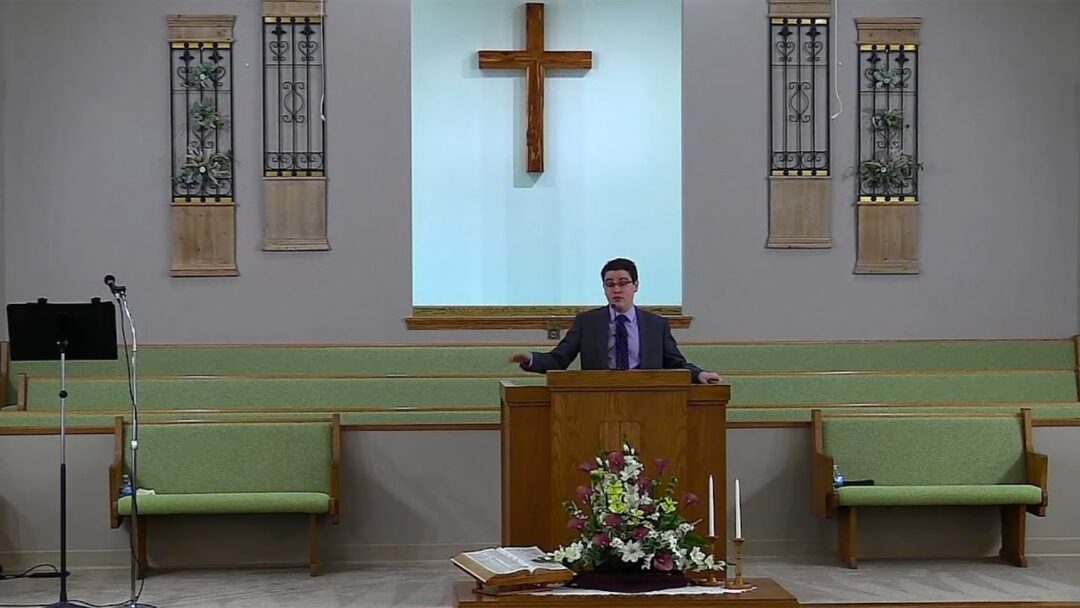
From our Sunday service on February 13, 2022, 1 Corinthians 13:1–13. Watch the full message: What’s Up with Love? on YouTube.
Tomorrow is Valentine’s Day, so I’m obligated to have a lesson on love today. What I want to show you from God’s Word is that God wants you to live your life by true love.
Two weeks ago, when I taught, I talked about two words in the Bible for love. I told you about the story of Peter and Jesus, where Jesus asks, “Peter, do you love Me?” and uses the word agape. I went to Bible college, so I like to sprinkle a little Greek in as a bit of salt and seasoning. There is agape in the New Testament, and there is phileo. We all know about New Philadelphia, right down the road. That “Philly” comes from phileo, the word for brotherly love, and that is what Jesus asks Peter at the end: “Peter, do you even have brotherly love for Me?” We aren’t talking about phileo today, the familial, best-friend kind of love. We are talking about agape, which, as I said two weeks ago, means love in action. It is love that has no choice but to do something.
You may have experienced this in a relationship. Someone says, “Babe, I just don’t feel like you love me the way you used to.” What is that person saying? There is something you did in the past because you loved her that you don’t do anymore. Your agape love has turned into phileo. You don’t love in action anymore, and you aren’t driven to do things for her because you love her. You are just fond of her and like being around her, but the agape love is gone. Today we are talking about that strong love and what it means. We can learn a few things about it.
Love Is Ordered
Little children, yet a little while I am with you. Ye shall seek me: and as I said unto the Jews, Whither I go, ye cannot come; so now I say to you. A new commandment I give unto you, That ye love one another; as I have loved you, that ye also love one another. By this shall all men know that ye are my disciples, if ye have love one to another.
John 13:33–35
Jesus says to His disciples, “I have a new rule for you.” The Old Testament is gone, and there is a New Testament, and Jesus can sum up all the laws of the New Testament in one thing: love God and love others. If you don’t get anything else, this is what you need: to love one another with agape. And He says one more thing. The way other people will know that we are His disciples is not that we go to church on Sunday morning, or go to a Bible study, or pray, or do this or that. It is the love we have.
I’ll mention marriage a little, but I want to talk about love in a way that everyone can apply, outside of marriage as well. It does apply to marriage, though, because if you want to love the way God wants you to love, you have to start with your wife or your husband. Your spouse is the person you are around the most, so your spouse is your daily practice. If you learn to love your spouse right, you will have a lot of practice at loving others right as well.
So when Jesus says, “A new commandment I give unto you, That ye love one another,” what does that mean? It means love is ordered. It is not an option. If we want to be like Christ, we have to perfect it.
Love Is Owed
Render therefore to all their dues: tribute to whom tribute is due; custom to whom custom; fear to whom fear; honour to whom honour. Owe no man any thing, but to love one another: for he that loveth another hath fulfilled the law.
Romans 13:7–8
Not only is love ordered, love is owed. If you meet a stranger on the street, you ought to love that person. Why should I? The stranger has done nothing for me, and I don’t know him. But when the Bible talks about taxes, it says don’t owe people money, and what you do owe them is love. That is the default, because that person is made in the image of God. We have talked about the image of God, and it gives every person value and significance. If someone is made in the image of God, he deserves to be loved.
I love the fact that the Pharisees and the Jews come to Jesus asking silly questions about legalistic things, and here Paul is talking about taxes, and people are worried about paying money. Paul says, in effect, “You know what’s more important than money? Love. You’re missing the point. Christianity is more than that. Don’t worry about whether you should pay the taxes. Just pay them, and above that, love other people.”
Love Speaks the Truth and Builds Up
Love is ordered, and God wants us to love. Love is owed, because other people deserve to be loved by default. Now let’s see a little of what love is. In Ephesians 4, we see that love speaks the truth and edifies.
I therefore, the prisoner of the Lord, beseech you that ye walk worthy of the vocation wherewith ye are called, With all lowliness and meekness, with longsuffering, forbearing one another in love; Endeavouring to keep the unity of the Spirit in the bond of peace.
Ephesians 4:1–3
Notice the word “forbearing” that I talked about in my last message, the idea of tolerating. That is not a romantic word. It means that even if people bother you, you tolerate them in love. We are all called to be conformed to the image of Christ, and if we are going to walk worthy of that calling, we must love each other.
That we henceforth be no more children, tossed to and fro, and carried about with every wind of doctrine, by the sleight of men, and cunning craftiness, whereby they lie in wait to deceive; But speaking the truth in love, may grow up into him in all things, which is the head, even Christ: From whom the whole body fitly joined together and compacted by that which every joint supplieth, according to the effectual working in the measure of every part, maketh increase of the body unto the edifying of itself in love.
Ephesians 4:14–16
Two things stand out. First, “speaking the truth in love.” This is about love in this church. If we want a church that honors and glorifies God, we have to speak the truth in love, which means dealing with and encouraging other people. Second, the last verse speaks of the body edifying itself in love. “Edifying” literally means to build up, to construct one another in love.
If you love somebody, you are going to tell that person the truth. If you see a shortcoming in someone’s life, it might be hard to talk about, and the person might not want to talk about it, but if you see something that needs to change, you take the time and find a way to do it the right way. You speak to that person in love: “Hey, I noticed this. I’m worried about this. I’m praying for you about this, and I hope you’ll pray about it too.” You speak the truth and lift the person up. You build each other up, not tear down. If you see something in the church and say, “Buddy, I saw that guy over there do this in church on Sunday,” that doesn’t build up. That tears down. That doesn’t construct and doesn’t edify. When you construct, you go to the person in truth and build him up. He might not be where he needs to be, but let me tell you a secret: you are not where you need to be either. None of us are. When you see somebody who needs help, helping him in love and building him up is what the church is all about.
Love Endures
Love is ordered, love is owed, and love speaks the truth and edifies. Now let’s look at our main passage, which shows how love endures and what the love God wants us to have looks like.
Though I speak with the tongues of men and of angels, and have not charity, I am become as sounding brass, or a tinkling cymbal. And though I have the gift of prophecy, and understand all mysteries, and all knowledge; and though I have all faith, so that I could remove mountains, and have not charity, I am nothing. And though I bestow all my goods to feed the poor, and though I give my body to be burned, and have not charity, it profiteth me nothing.
1 Corinthians 13:1–3
The word “charity” here is the Greek word agape. I’ve hit on this before: why does the Bible use the word “charity”? It is an older English word, and today when we think of a charity, we think of a non-profit. But it is called a charity because of what the word originally meant, which is doing something in love. When we are talking about agape, love in action, “charity” is a good fit. I’ll be calling it love from now on, but as I read the passage, don’t separate love and charity. They are the same thing; “charity” is just the more specific word in this passage.
Words Without Love Are Just Noise
Paul’s illustration in verse 1 still holds up thousands of years later. When I hear “sounding brass,” I think of a little kid in music class who gets his first chance to play a trumpet. He doesn’t care whether he is good or bad. He is just excited to have the trumpet, and he goes crazy. I had a recorder when I was a kid, and I had it for about 20 minutes before my mom stole it and hid it for a decade. That sounding instrument is irritating. It gets under your skin and drives you mad. And then there is the “tinkling cymbal.” I think of those little monkeys with cymbals. How long would it take before that really started to bother you? If your kids came home with one, you would find a way for it to go missing.
Paul is speaking of “the tongues of men and of angels,” the idea of a great orator, someone who gets up and demands respect, with all the right words to say. That sounds beautiful and powerful. But this speaker lacks agape love, and Paul says he is nothing. His words become a frustrating noise. It doesn’t matter if you go to church on Sunday and say wonderful things, or wake up in the morning and tell your spouse, “You’re so beautiful.” If you don’t have agape love, it is just noise. Words don’t mean anything unless something else backs them up. Otherwise they are just air breathed out of your lungs. People can tell when you aren’t sincere. You might hide it for a little while and trick people into thinking things are the same, but over time they will know, and the testimony you have of being a loving person will go away, and people will just be irritated.
I’ve had that happen to me. When I started my Nerd in the Word website, I would write articles online, and I could see when somebody read one. When I first started, there was only about one person reading a day. People at church would come to me and say, “Zach, I loved your website. I read it about 20 minutes ago, and it was the best article I ever read.” Then I would go online and check my stats, and no one had been on my website. They wanted to be encouraging, but they didn’t have the action to back it up. That wasn’t agape love. That was sounding brass and tinkling cymbal. I didn’t feel better or encouraged. They had good intentions, but their agape love was gone, and that happened more than once. Our lives ought not to be that way. We ought not to speak words that have no action to back them up. Those words are just lies.
Knowledge and Faith Without Love Are Nothing
In verse 2, Paul lists different roles in the church: prophecy, mysteries, wisdom. You might be a person in the church who understands the Bible and has doctorate-level knowledge. You might have gone to college and be smart. But if you don’t have love, it is nothing. It doesn’t matter how much you know about the Bible if you can’t apply it to your life and live with love. And it doesn’t matter how much faith you have in Jesus if you don’t have love. It won’t do anything, and you will never reach anybody. One of my Bible teachers always said, “Nobody cares how much you know until they know how much you care.” You have to let people know you care about them, or they won’t care what you know. Otherwise it is pointless, vain, and all that work is for nothing, because no one will ever feel anything different.
Good Deeds Done Without Love Profit Nothing
In verse 3, someone is doing a good action that is changing lives. He is giving away large amounts of money to the poor and actually making a difference, because you give a poor person money and food, and you have done something. Yet Paul says it profits him nothing. It isn’t that it gives the poor man nothing. It does. But it profits the giver nothing. God is not pleased when we do the right things for the wrong reason. If we do things only so that other people will say, “That person is a really good Christian,” and we are doing it just to hear those flattering words, we are not getting any benefit from it, and we won’t get any blessings from God, because we have already received our blessings here on earth. True love does not act for its own benefit. True love acts because of love. In a relationship, you can’t just buy a gift and make everything better. You have to show that you care and that you love. You have to act out the love, and you have to be consistent in love.
Charity suffereth long, and is kind; charity envieth not; charity vaunteth not itself, is not puffed up, Doth not behave itself unseemly, seeketh not her own, is not easily provoked, thinketh no evil; Rejoiceth not in iniquity, but rejoiceth in the truth; Beareth all things, believeth all things, hopeth all things, endureth all things. Charity never faileth: but whether there be prophecies, they shall fail; whether there be tongues, they shall cease; whether there be knowledge, it shall vanish away.
1 Corinthians 13:4–8
Here we see less action and more the character attributes of love, which separate it from phileo, where you are just fond of each other. We use this passage in weddings because we want people to know what true love is when they get married. Let’s see what each attribute teaches us.
Love “suffereth long.” That word literally means to have patience in trials and struggles. It is not just being patient but being patient in the hard times. It may not be enjoyable, but love waits out the hard times. Paul doesn’t stop there. He connects it with another idea: love “is kind.” The Greek word for “kind” is the same word Jesus uses in Matthew 11:30, “my yoke is easy, and my burden is light.” It has that idea of easiness and gentleness even when times are hard. Paul doesn’t say to get through the hard times and then be kind later. You have to carry kindness into the hard times and the times of suffering. Work patiently with others and love them. Be understanding, gracious, and mild. It is a lot easier to be harder on other people than on ourselves. Sometimes agape love in church is taking a step back and thinking, “I’m not perfect either. These people are going through hard times, and they have struggles and hardship. I need to be gentle and understanding. I need to look and say, ‘That could be me. I’m one bad day away from that.'” Say that one day someone comes to church in a bad mood and says some harsh words to you. Is that right? No. But we need to take a step back and suffer long. “I understand that person is hurting. I don’t need to bite back or fight or hold a grudge. I need to be kind and gentle and mild and understand that we all have those days.”
Love “vaunteth not itself, is not puffed up.” “Vaunteth” means boasts, saying or doing things to make yourself look good. “Puffed up” is literally inflated, like someone walking around saying, “Look at me, I’m wearing a suit today.” That is showing off. Love doesn’t show off or make the topic about itself. Love cares about the other person.
Love “doth not behave itself unseemly,” meaning inappropriately. Love does not do inappropriate things. It behaves in a way that is right. It “seeketh not her own,” and in a relationship you can slip up on that: “Sorry, that was me thinking about myself and not about you.” It is an easy one to fall into, because we all live inside our own heads 24/7. From our perspective, the world revolves around us. Everywhere I go, I see through my own eyes and hear my own thoughts. But if we want to love people, we have to realize that is not how the world works. I’m not the center of attention. All these other people are valued and made in the image of God, just like me, and they are just as important as I am.
Love “is not easily provoked.” I like the Greek word here, which has the word “pointy” in it, like a nail, meaning prodded or poked. If somebody pokes you, you don’t instantly get mad and say, “What was that about? Stop it.” It is about being calm and controlled. If somebody does something to you, your first response isn’t anger. True love doesn’t respond immediately with anger.
Love “thinketh no evil.” This one is pretty deep. The word “thinketh” refers to keeping a mental list in your head of things that have happened. How many times in relationships with other people do we keep a mental list of all the mistakes and wrongdoings they have done to us? That is what this verse is literally talking about. When I get in a fight with my partner, I’m not going to say, “Last week, what about this? You’re always like this.” (Also, never say “always.” That’s always a lie.) Don’t keep that list in your head. You have to forgive and forget and let it go. Love doesn’t hold on to past mistakes. Love forgives.
Love “rejoiceth not in iniquity, but rejoiceth in the truth.” Love celebrates righteousness and rejects wrongdoing. Love will correct a mistake, will go out of its way to help people do what is right, and will celebrate with other people when they do what is right.
Verse 7 is one of my favorite parts: love “beareth all things, believeth all things, hopeth all things, endureth all things.” I think this is the most marital of them all. Love carries everything together. When you go through a hard time, love says, “I’m going to come by you, pick up that burden, and walk with you.” Love believes all things, and that is the same word we use to believe on the Lord Jesus Christ. There is no doubt in my mind that love has that confident belief or trust in the other person. Love hopes all things. Love does not assume the worst. Love always assumes the best, looks forward to the best, and longs for it. And love endures all things. No matter how bad things get, the difference between true love and false love is that in the end, love is still there.
Paul continues that thought in verse 8: “charity never faileth,” while prophecies, tongues, and knowledge will fail, cease, and vanish away. He is going back to the first three verses, where he said that if we speak with the tongues of angels but don’t have love, we are just noise. Those languages and skills are going to vanish away, but if you have true love, that love will still be there. All that wisdom, no matter how much you know or how spiritual you are, will vanish. When you get old, you won’t remember it all, and you will forget a lot of it. Let me tell you how much I forgot between one semester and the next. That knowledge is not always going to be there, but if you have true love, then even when those things fall away, the love remains. The languages these people learned in the Old Testament are long dead and gone. No one speaks Latin or ancient Greek anymore. They have passed away, but the love of God still remains, and hopefully it still lives in us today.
For we know in part, and we prophesy in part. But when that which is perfect is come, then that which is in part shall be done away. When I was a child, I spake as a child, I understood as a child, I thought as a child: but when I became a man, I put away childish things. For now we see through a glass, darkly; but then face to face: now I know in part; but then shall I know even as also I am known. And now abideth faith, hope, charity, these three; but the greatest of these is charity.
1 Corinthians 13:9–13
Paul concludes with a spiritual thought: right now we are not perfect. We know in part and prophesy in part, and we will never perfect our knowledge or understand everything about our lives. But that is not always going to be the case. When “that which is perfect” has come, who is Jesus Christ, “that which is in part shall be done away.” There is a day when our love will be changed and transformed to be like the love of Christ. When we get into heaven and the new earth, we will be able to love each other the way we should.
Paul compares this to being a child. When I was a kid, I worried about all sorts of silly things, but when I became a man, they didn’t matter anymore. Paul compares that to our future days. When we get to heaven, it will be as if we were little children here, trying to figure things out, and we realize there are a lot of things more important.
In verse 12, “we see through a glass, darkly” means a distorted mirror. In the old days, mirrors were hammered out of bronze and polished, and because they were hammered, they had little distortions in them. When you looked in a brass mirror, you saw your reflection, but it didn’t look exactly like you. Paul is saying that the love we have on the earth is like looking into that distorted reflection. We know what it is, but we aren’t quite clear on it. That sounds bad, that we don’t have this perfect image. But one day we will see face to face, as if looking in a perfect reflection and seeing love as it truly is: “then shall I know even as also I am known.”
Paul also gives one word of encouragement. Even though we won’t be perfect in love right now, and it is going to be a little distorted, three things remain that we can hold on to. First, we can hold on to our faith in Jesus Christ. Even though we can’t be perfect, we still have Christ, and we can believe and trust in Him. Second, we can hold on to hope, because we can always look forward to the day when we will be perfect and transformed. And lastly, there is our word of the day, our Valentine’s Day word: charity, love. We can have faith in Christ, hope for the future, and right now we can work on getting this love right. Paul concludes, “the greatest of these is charity.” Love is the greatest thing we can figure out on this earth. If we are going to figure out anything in this church, I pray that it is love.
Will You Choose to Live in Love?
What did we learn today? We learned that love is the most important aspect of the Christian walk and of our relationships with others. We learned that love is ordered by God, who gave us a new command that we have to love each other. We learned that love is owed to other people, because anyone deserves love by being made in the image of God. We learned that love speaks the truth and builds us up in the church, so we need to go out of our way to speak the truth and build up each other in Christ. And most of all, we learned that love endures through everything.
God wants you to live your life by true love. My question today is: will you choose to live in love today? The Lord says that love is how other people know we believe in Him, trust in Him, and have been transformed to look more like Him. I pray that each of us will have a love that others can see today.

Recent Comments