
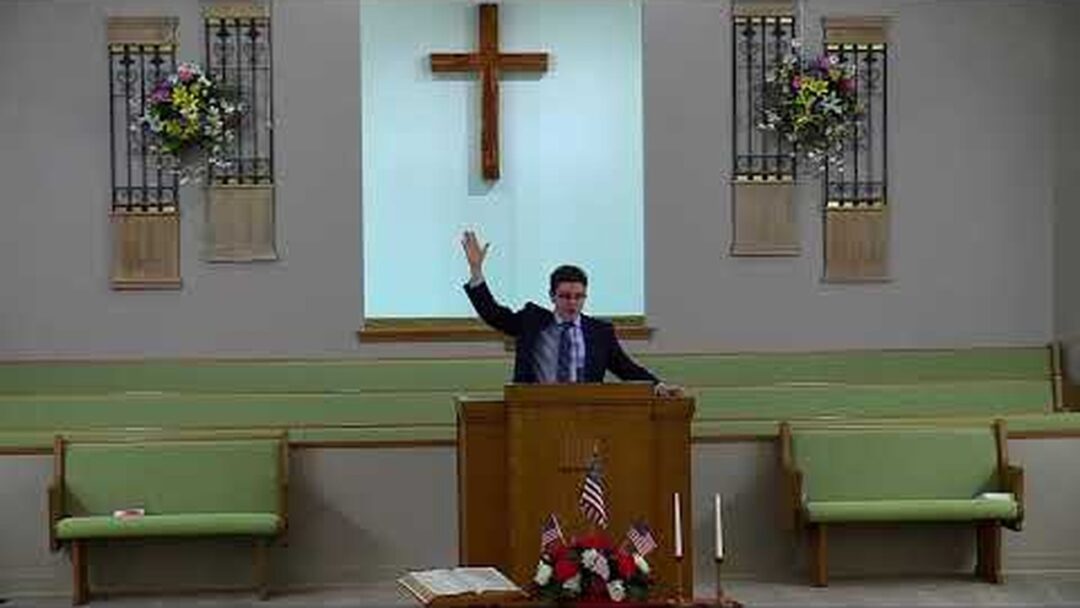
From our Sunday service on May 15, 2022, Ezekiel 22:23–31 (with Ezekiel 13). Watch the full message: Who Will Stand? on YouTube.
When did you last hear a message out of the book of Ezekiel? When did you last read it? I like to teach out of passages that people don’t hear all the time. Today we will be in Ezekiel 22, but first we need Ezekiel 13 for a little context.
For those who don’t know much about Ezekiel, the book takes place around the Babylonian exile. Israel sins and turns away from God, and God says, “If you’re not going to follow My will and My instructions, I’m going to take away My defense and protection over Israel, and Israel will fall.” The Babylonians conquer Israel and take captives from Jerusalem, and one of those captives is poor Ezekiel. He was meant to be a priest serving God in the temple, and what a discouragement it must have been to have that honored position and lose it when his country went into captivity. The book of Ezekiel starts about five years after the exile begins, on Ezekiel’s 30th birthday, the year he would have started as a priest. The Lord comes to him and says, “I have some words for you to tell the people of Israel.”
We can’t go through the whole book, but we are going to look at one lesson God had for Ezekiel. If I were giving a bad pitch for this message, I would say it is a message about botany, because we are going to talk about hedges. But what God wants is for you to stand in the gap.
The Foolish Prophets and the Missing Hedge
Thus saith the Lord GOD; Woe unto the foolish prophets, that follow their own spirit, and have seen nothing! O Israel, thy prophets are like the foxes in the deserts. Ye have not gone up into the gaps, neither made up the hedge for the house of Israel to stand in the battle in the day of the LORD. They have seen vanity and lying divination, saying, The LORD saith: and the LORD hath not sent them: and they have made others to hope that they would confirm the word. Have ye not seen a vain vision, and have ye not spoken a lying divination, whereas ye say, The LORD saith it; albeit I have not spoken? Therefore thus saith the Lord GOD; Because ye have spoken vanity, and seen lies, therefore, behold, I am against you, saith the Lord GOD.
Ezekiel 13:3–8
God has challenging words here. He starts with the foolish prophets and says what they did: they follow “their own spirit,” meaning their own desires and wants, and the result is that they have “seen nothing.” They haven’t seen God work in their lives, because they have been distracted by their own desires. That is what we want to avoid today.
Verse 5 gives us our theme: “Ye have not gone up into the gaps, neither made up the hedge.” A hedge in that day was used for protection. We use the phrase “hedge of protection.” When people wanted to keep their animals safe, they planted hedges close together and interwove them. The hedges had thorns and thistles, so if you planted them close enough and wove them together tightly enough, the thorns kept out predators and kept them from getting to the livestock. It was a natural defense. God is saying, “Israel, you have planted the hedges of protection, but there are giant holes in your wall.” You can plant as many hedges as you want, but if there is a big empty space where nothing is being done, the protection is worthless.
The prophets also “have seen vanity and lying divination.” People were going around saying, “This is God’s will for our lives. This is what God wants for me,” and God says, “I didn’t say it. I didn’t send them. This is not My will.” A “vain vision” is pointless and empty. If you read Ecclesiastes, it is like smoke that is there for a little while and then disappears, with no substance to it. If the vision you have for your life, or for your church, is empty, do we want that? No. They said it was the Lord’s will, but He had not spoken it, and the consequences were dire: “I am against you, saith the Lord GOD.” Israel followed its own hearts’ desires. They told themselves, “I know what God wants for me. The things I want are what God wants,” and they told others, and others confirmed it for them. God wanted someone to stand up, take that place, and fill the hole in the house of Israel.
The Hedge Around Job
A hedge is for protection, and God wants a hedge of protection around you and your church. We see an example in the book of Job.
There was a man in the land of Uz, whose name was Job; and that man was perfect and upright, and one that feared God, and eschewed evil.
Job 1:1
Job is a righteous man, the kind Ezekiel would say stands in the gap. He does what God wants, follows the will of the Lord, and everything he does is for the Lord’s glory.
Now there was a day when the sons of God came to present themselves before the LORD, and Satan came also among them. And the LORD said unto Satan, Whence comest thou? Then Satan answered the LORD, and said, From going to and fro in the earth, and from walking up and down in it. And the LORD said unto Satan, Hast thou considered my servant Job, that there is none like him in the earth, a perfect and an upright man, one that feareth God, and escheweth evil? Then Satan answered the LORD, and said, Doth Job fear God for nought? Hast not thou made an hedge about him, and about his house, and about all that he hath on every side? thou hast blessed the work of his hands, and his substance is increased in the land. But put forth thine hand now, and touch all that he hath, and he will curse thee to thy face.
Job 1:6–11
Job served the Lord and was righteous, and God gave him something: a hedge. That hedge gave him protection, because he was a righteous man. It was “about his house” as well, because Job stood in the gap, so there was a hedge of protection around his household. His righteousness did not just affect him; it affected his home. It was also “about all that he hath on every side,” which means all the employees who worked with him were blessed by God because Job had the hedge of God’s blessing. Satan says, “Take away the hedge, and Job will curse You to his face. The only reason Job worships You is because he has this hedge.” That is a message for another day. What we learn is that a hedge in the Bible is a symbol of divine protection, provided by God’s favor on a believer and, because of that believer, on behalf of others.
The hedge protected Job and his family, and it also protected his community. Job is reminiscing about his old life:
When I went out to the gate through the city, when I prepared my seat in the street! … When the ear heard me, then it blessed me; and when the eye saw me, it gave witness to me: Because I delivered the poor that cried, and the fatherless, and him that had none to help him. The blessing of him that was ready to perish came upon me: and I caused the widow’s heart to sing for joy. I put on righteousness, and it clothed me: my judgment was as a robe and a diadem. I was eyes to the blind, and feet was I to the lame. I was a father to the poor: and the cause which I knew not I searched out.
Job 29:7, 11–16
Job’s righteousness and his hedge of protection did not extend only to him and his family. They blessed his community. Everyone listened to him and blessed him and testified of how good he was, because he delivered the poor, the fatherless, and the one who had none to help him. You see a righteous man going and helping those in need. He was a blessing to those who were dying, he encouraged the widows, he was eyes to the blind and feet to the lame, and he was a father to the poor. The hedge of protection was a blessing to everyone around him, and his whole community was blessed.
What Happens When the Hedge Drops
Before we get to our main passage in Ezekiel 22, we need to see what happens when we drop the hedge. I am reading these verses so that you know this hedge of protection isn’t just an Ezekiel thing. This idea goes throughout all of Scripture, and it has an effect on our lives today. We are familiar with the story of Lot, who lived in Sodom and Gomorrah. Abraham is going to plead for Sodom and Gomorrah on behalf of Lot.
And the men rose up from thence, and looked toward Sodom: and Abraham went with them to bring them on the way. And the LORD said, Shall I hide from Abraham that thing which I do … For I know him, that he will command his children and his household after him, and they shall keep the way of the LORD, to do justice and judgment; that the LORD may bring upon Abraham that which he hath spoken of him. And the LORD said, Because the cry of Sodom and Gomorrah is great, and because their sin is very grievous; I will go down now, and see whether they have done altogether according to the cry of it, which is come unto me; and if not, I will know. And the men turned their faces from thence, and went toward Sodom: but Abraham stood yet before the LORD. And Abraham drew near, and said, Wilt thou also destroy the righteous with the wicked? Peradventure there be fifty righteous within the city: wilt thou also destroy and not spare the place for the fifty righteous that are therein? That be far from thee to do after this manner, to slay the righteous with the wicked: and that the righteous should be as the wicked, that be far from thee: Shall not the Judge of all the earth do right? And the LORD said, If I find in Sodom fifty righteous within the city, then I will spare all the place for their sakes.
Genesis 18:16–26
God was going to destroy Sodom and Gomorrah for their sin, and Abraham learns about the coming destruction. What are we seeing here? We are seeing the hedge of protection. God says He will go destroy the wicked, and Abraham says, “I know Your character, Lord. I know You will spare that city for the righteous who live inside it. If there are fifty people in that city, Lord, will You spare it?” And God says yes. It goes on, and we don’t have time to read it all today. From fifty, Abraham goes to forty, then thirty, all the way down to ten. If there are ten righteous, will You spare the city? The Lord says, “I won’t destroy it for ten’s sake.”
A hedge of protection would have been great, but we know the story. How many righteous were there? It wasn’t ten. There was only one righteous man, Lot, whose soul was vexed day by day. One man was not enough to build the hedge, and Sodom and Gomorrah was destroyed. That didn’t have to be the destiny of Sodom and Gomorrah. Had there been Lot’s family, there would probably have been ten people to spare that city. But Lot failed in his walk with God to teach his family the way of the Lord. His children and his sons-in-law laughed and didn’t believe in God. He didn’t train up his family and put a hedge about them to protect them, and because of that, many people died.
Four Groups in the Conspiracy
Now we know about this hedge and what it does. Let’s go to Ezekiel 22.
And the word of the LORD came unto me, saying, Son of man, say unto her, Thou art the land that is not cleansed, nor rained upon in the day of indignation. There is a conspiracy of her prophets in the midst thereof, like a roaring lion ravening the prey; they have devoured souls; they have taken the treasure and precious things; they have made her many widows in the midst thereof. Her priests have violated my law, and have profaned mine holy things: they have put no difference between the holy and profane, neither have they shewed difference between the unclean and the clean, and have hid their eyes from my sabbaths, and I am profaned among them. Her princes in the midst thereof are like wolves ravening the prey, to shed blood, and to destroy souls, to get dishonest gain. And her prophets have daubed them with untempered morter, seeing vanity, and divining lies unto them, saying, Thus saith the Lord GOD, when the LORD hath not spoken. The people of the land have used oppression, and exercised robbery, and have vexed the poor and needy: yea, they have oppressed the stranger wrongfully.
Ezekiel 22:23–29
There is a conspiracy going on, something happening secretly that hasn’t been dealt with, and four groups are involved: the priests, the princes, the prophets, and the people. You might think, “Pastor Zach, I can’t be in a lot of these groups. I’m not a priest. I’m not a prophet.” Well, read Revelation 1.
John to the seven churches which are in Asia: Grace be unto you, and peace … And from Jesus Christ, who is the faithful witness, and the first begotten of the dead, and the prince of the kings of the earth. Unto him that loved us, and washed us from our sins in his own blood, And hath made us kings and priests unto God and his Father; to him be glory and dominion for ever and ever. Amen.
Revelation 1:4–6
In the Old Testament there were priests and prophets, and in the New Testament that position has transferred to every believer. We are the modern priests, because the Spirit of God dwells in us, and we are the temple of God. Is someone else going to care for the temple of ourselves? No. It is our responsibility. We are priests to God ourselves. So when we read about these priests, princes, prophets, and people, they are us.
Why is it important to stand in the gap? We learn from Job. Our choices to follow God don’t just affect us. They affect everyone around us. If we don’t stand in the gap, we drop the protection around ourselves, around our families, the ones we love most, around this church, and around our community, our cities, our states, and our country. So we need a very sincere focus on standing the way God wants us to.
The Priests: No Difference Between Right and Wrong
The priests violated the law and put no difference between the holy and the profane. They failed to speak the truth. These believers failed to tell the world the truth of God’s righteousness. They didn’t make a separation between righteousness and unrighteousness. They didn’t care. They did whatever they wanted and said, “Whatever I want is good.” If we are going to be righteous before God, we can’t do that. Our first shortcoming can be not making a difference between right and wrong. We need to teach our families and those around us that right is right and wrong is wrong. Most people in this world will say that is not the case, that everybody has his own truth and that’s fine, but it isn’t. We need to stand for the truth.
The Princes: Wealth Kept to the Hurt of Others
The princes had money, and the Bible says princes are wealthy, as kings are. They kept their money to the hurt of others. God told Israel early on in the law that if there are poor among you, widows, or the afflicted, you help them and care for them. But the wealthy in the nation of Israel kept all their money and said, “I’m not going to help the poor. That’s their problem. I can’t solve everybody’s problems, so I won’t do anything to help at all. That’s not my responsibility.” God says they are like wolves ravening the prey, shedding blood and destroying souls to get dishonest gain. They exploited the poor to make more money and didn’t care what it did to other people. All they cared about was whether they and their family had money. If we are going to be Christians today, we need to make sure our greed doesn’t control us, and that what we do in our lives is not powered by the pursuit of money but by the pursuit of God’s glory.
The Prophets: Untempered Mortar
Of the prophets, the passage says they have “daubed them with untempered morter.” That sounds confusing. Why are we talking about mortar? It is a very weird illustration, but think back to that time. Israel is in ruin. Babylon came into Jerusalem and knocked down the walls, and the defenses are shattered. Mortar is for rebuilding the walls. You have been rebuilding the walls of your defense, your doctrine, and your teaching with untempered mortar, so what you are using to build is not sound doctrine. If you use bad mortar on a wall, the mortar is going to crack and the wall is going to fall down. It is only a matter of time. God is telling Israel, “You have changed My teaching. What you are laying as your foundation has broken structural integrity, and it’s only a matter of time until everything topples on you and this hedge of protection falls down.” They led other people astray by teaching them what they wanted to hear. God forbid we do that as Christians, that we let people hear what they want to and think what they want to, and never correct them and say, “Yes, this is God’s will for your life.” How many times in this passage have we already seen God say, “You said this is the Lord’s will, when it was not”?
The People: Oppression and No Love for the Neighbor
The last group is the people. They were dishonest and oppressed the poor, the needy, and the foreigners in their land. They didn’t love their neighbor or those less fortunate than themselves. They loved only the people who benefited them. It is easy to love people who are like you, though maybe not too much like you, because then it starts to get a little annoying. When people live the same style you do, it is easy to love them. But these people saw others who were different from them or less fortunate than them, and they shunned and oppressed them. God forbid we do that. I think it is easy as Christians to shun atheists, to not have them in our lives at all, to set them aside and see them as a lost cause, when God loves them. It is easy for us to look down on the poor and destitute, but God loves them like us. God forbid we find that in our lives.
Where Do We Stand?
These are the sins that destroy the hedge. This hedge of protection is not about us. It is about your family, your neighborhood, your city, your state, and your country, all of which are affected by your choice to live for God. Let’s look at them one by one.
Your family. Are you putting a hedge of protection around your family by living your life for God? Parents, have you shown your family that God is a priority? Have you shown the priority of church? I know I might be stepping on some toes. Are you showing your family that God is a priority, and putting a hedge of protection around them to encourage them to walk in the Lord, so that when they go their own way, they are blessed and have a hedge around them? Have you demonstrated in your family the importance of prayer? Prayer changes lives, and prayer does some unexplainable things. Have you experienced prayer in your life and passed that experience on to other people? Prayer is often a hard habit to get into, and a lot of times we feel silly praying. In my life I’ve learned, through a lot of silly moments, that it’s not so silly after all. When you become a pastor, you have to step up to the plate and do uncomfortable things. When I graduated from seminary, prayer was still a little scary, especially the first week, when I had to make visits and pray with people who were having a hard time. That kind of high-stakes prayer moment is intense and serious, and it is hard to say, “I have to be strong right now. This person needs this prayer and this confidence in God, and I have to have all that faith in this moment.” It is not always easy to step out in faith and say, “I’m going to pray, and I’m going to see God do things in my life. I’m going to stand before my children, my family, and my community, and I’m going to have a prayer life that shows God is real and doing something in my life.” We need to demonstrate the importance of prayer.
Another thing about family: do you encourage your children to be in the Scriptures? Are we in the Bible as much as we should be? I’m not going to raise hands, but how many of you haven’t even opened your Bible this week? Knowing the statistics online, a good chunk of people probably haven’t. For some, church on Sunday or watching online is all they get in the week, all the spiritual food they get, and they think that’s enough. But if we want to build the hedge of protection and change the world around us, we have to step up and set an example.
Your community and neighborhood. We need to put the hedge around our neighborhoods too. I’ve recently become a homeowner, so I now have neighbors, and I’ll be honest, I haven’t met them all yet. I hope that when I meet them and introduce myself, I show them the love of Christ, and they don’t think, “That Pastor Zach, what a weirdo, what a jerk.” I would hope they see the love of Christ in my life. I don’t want to let them down. We need to let people in our community see the love of Christ in our lives. If we have the hedge around our families, I believe it will be much more obvious to our communities, but we also need to go out of our way to show them the love of Christ. Do we set a good example? Do we do things that make us different? The first failure was that the priests didn’t make a difference between righteousness and unrighteousness. If we are living our lives for God, there should be an obvious difference, because most people are apathetic, and God forbid a Christian be apathetic. We should be doing something, and if we are doing something for Christ, people in our neighborhood will see it.
Your city. The wickedness of Sodom and Gomorrah was horrible, and God said that if only ten righteous people were in it, He would have spared it. Who knows what would have happened if God had spared Sodom and Gomorrah? Would more have come to Christ? Would Lot have turned his family around? We don’t know. But we do know that if we don’t stand in the gap and do what God wants us to do, it could lead to harm to our cities.
Your country. Proverbs says:
Righteousness exalteth a nation: but sin is a reproach to any people.
Proverbs 14:34
If you want America to be a great country, there is one thing to focus on, and that is righteousness, because righteousness is what exalts a nation. It is not the GDP, the current price of gas, or whoever is in power, but the righteousness of its people. If we want our nation to change, we need to put righteousness in our own lives. If we start doing what God wants us to do, we will start changing our nation, not by one politician at a time but by one heart at a time. It may not seem fast or efficient, but the true way to change this country is to reach one person, one soul, and if you keep doing that, eventually many people will come to Christ, and we will see a change.
Blessed is the nation whose God is the LORD: and the people whom he hath chosen for his own inheritance.
Psalm 33:12
Don’t we want that for our nation? Don’t we want to be able to say that our country is one that is for God? That doesn’t come from a symbol on a coin that says “In God We Trust.” It is the righteous people who live inside the nation who put a hedge of protection around it. The righteousness of a people is the defense of our nation, and if we want America to be great, we need to act for our great God.
Your church, your school, and your work. Is there a place where you need to step up and serve God? God is talking to Ezekiel about a hedge with holes in it, as we saw with Sodom and Gomorrah. It is not just one person or two people who make the hedge. It is not Pastor Shank or me who builds it. It is the church as a whole. Is there a gap in our church where someone needs to step up and serve the Lord? There are plenty of things we could be doing if more people stood in the gap. I want God to bless this church, and I want to see it grow. We have seen growth in the year or so I’ve been here, but I believe we can see more and do more if people are willing to serve the Lord. Some of you have things God has put on your heart that have been on the back burner, because you think you can’t do them or they are too difficult, but God can enable you to do something.
Kids, the schools today are vicious, harsh, and cruel, and Christianity is not accepted or loved there. But as Christians, we can stand up in our schools and present the love of Christ through how we act and treat others and by sharing the gospel. And what about your work? You spend a lot of time there, which is exhausting, but it also gives you a large opportunity. You will see the same people all the time, people who may not be on their way to heaven, who may be hurting and need encouragement and the love of God. Are you going to look for the gap in your work? Are you going to be the Christian whose righteousness shines and puts a hedge of protection around your workplace, showing God there? Are you serving, and are you being an example that reaches out to others?
When No One Stands
And I sought for a man among them, that should make up the hedge, and stand in the gap before me for the land, that I should not destroy it: but I found none. Therefore have I poured out mine indignation upon them; I have consumed them with the fire of my wrath: their own way have I recompensed upon their heads, saith the Lord GOD.
Ezekiel 22:30–31
God’s wrath had been stored up over Israel. He looked for a man, and in this case it was just one man, who would stand up so that He would not destroy Israel. He found no one, and because of it He gave them their own way: they received the reward of their own works. This is a New Testament idea too.
For the invisible things of him from the creation of the world are clearly seen, being understood by the things that are made, even his eternal power and Godhead; so that they are without excuse: Because that, when they knew God, they glorified him not as God, neither were thankful; but became vain in their imaginations, and their foolish heart was darkened. Professing themselves to be wise, they became fools, And changed the glory of the uncorruptible God into an image made like to corruptible man, and to birds, and fourfooted beasts, and creeping things. Wherefore God also gave them up to uncleanness through the lusts of their own hearts, to dishonour their own bodies between themselves: Who changed the truth of God into a lie, and worshipped and served the creature more than the Creator, who is blessed for ever. Amen. For this cause God gave them up unto vile affections: for even their women did change the natural use into that which is against nature:
Romans 1:20–26
God gave them up. God will give people what they want if they go for it long enough. If people search out wickedness, God will let them have it. The way of the wicked leads to destruction, and God holds it back in His mercy for a limited amount of time. In Ezekiel He says, “Their own way have I recompensed.” This is what they worked toward, and because there are no righteous people to turn them from their path, He will lead them to their own destruction. Christians, are we going to stand up and protect the unsaved? God says that if there is no hope for them, and if His people won’t stand up, He will leave them to their own destruction, because there is nothing to turn them away.
Sin destroys your hedge. If you seek wickedness long enough or are distracted long enough, God will leave you to your own devices. It is like a seared conscience: God won’t convict you anymore. He says, “Child, I’ve corrected you time and time again. I’ve tried to teach you and put you back on the path, but each time I tell you, you say no, so I’m going to step back and let you go.” God won’t put that on your heart anymore. It may have bothered you a year or two ago, but now that you’ve lived that way, God just doesn’t convict you anymore.
The Idolatry of Today
Romans speaks of changing the truth of God into a lie and worshiping and serving the creature more than the Creator. That is idolatry. We often think, “In society today we don’t have idolatry. We don’t worship idols. That’s not relevant.” That is not true. We talked about this with the teens, about the Hebrew word Elohim. When we think of the word “God,” we think from a Western idea that God is the ultimate creator, but that is not how it works in Hebrew. Elohim is not just used to refer to a deity or spiritual being. In Greek culture, for instance, there was a fertility god. If you wanted a baby, you went to the fertility god, because the thing you wanted lined up with that god. A farmer went to the farming god and made an offering, because his mind was set on farming. If you wanted money, you went to the god of wealth and riches and made an offering there, because your heart was set on wealth.
The Bible uses Elohim as “God” with a capital or lowercase letter, and sometimes, as in Exodus, it refers to rulers, leaders, or kings. What these have in common is that they are authorities. So Elohim means an authority, and the plural form says that God, Jehovah, Yahweh, is the authority of authorities. So what is the god of your life? It is your authority, the thing that controls you and directs your choices. For the people seeking a child, wanting a child was their authority, and they did what they did every day because of it. For those who sought wealth, riches were their authority, and every choice they made was based on the money they wanted to earn. The farmer’s every choice was for the benefit of his farm. His god was his farm.
Many things can have authority over us. The biggest is usually money. How many times has a choice you’ve made been, “I don’t want to do that, because I want to make more money”? Or maybe it is a hobby: “I’m not going to this activity, because I’m choosing my hobby over it.” Or entertainment, and that can be sports too: “I won’t do this, because there’s a game on tonight.” That becomes your authority, and it determines your choices. Maybe it is education, and everything you do is based on it, and you have shunned everything else. Maybe it is beauty, or comfort: “The thing I seek most in life is comfort. I only do the things I am comfortable with.” That authority in your life will destroy your usability for God, and it is one of the hardest to overcome. Maybe it is even religion, so that everything you do is for religion and not for the love of God, about rules and regulations and what makes you look good on the outside. Maybe you will only serve in ways that make you look better instead of in the background, where God is pleased and no one else knows. Or maybe your authority is self-indulgence and pleasure, and you only do things because they please you: “I will only do this because I want to, and if I don’t want to, I won’t put it in my life.”
Church, this is the idolatry of today. We don’t put these things into statue form and set them on a pedestal, but we let them control our lives and make all our life choices toward these single goals. That is taking Christ off His throne and worshiping the creature more than the Creator, worshiping what is made more than the Maker.
Who Will Stand?
Today we have to choose whether we will be the ones who stand in the gap and protect our families, communities, country, churches, schools, and workplaces. In Ezekiel’s day, Israel failed, and God gave up on them and said, “I will leave you to your obsessions, to your idols, to the authorities that control your life.” Church, today let’s choose to stand. The title of this message is “Who Will Stand?” If it’s not the church, it’s no one.
God forbid He comes to Dundee, looks at our church, and says, “Today I’m looking for someone to stand,” and finds none. God wants you to stand in the gap. He wants you to see the needs of the people around you and help them. He wants you to step up and serve Him, and there are places to serve God today. God forbid we be allowed to fall away and have our consciences numbed like those people in Romans, and let down the duty God has called us to do. So I ask you one last time: who will stand? God wants you and me to stand in the gap, but will you stand in the gap for Him today?

Recent Comments