
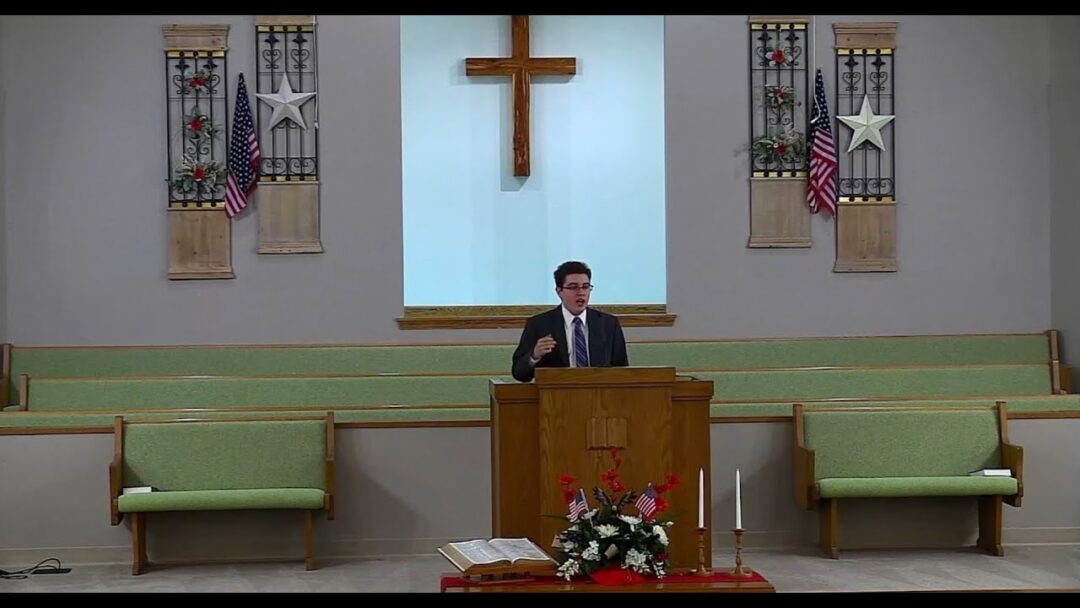
From our Sunday service on June 26, 2022, John 17. Watch the full message: When Jesus Prayed for You on YouTube.
A Word Before We Begin
You have probably all heard the news today about a very major event in our nation: Roe v. Wade has been overturned, and we praise God for that. The lives of the unborn are being protected. God loves children, God values children, and God ordains children in the womb for His ministry. But as I thought about whether to say something today, I was drawn back to a time at Pensacola Christian College, in seminary, when a retired pastor who taught there gave us some advice. I realized it isn’t just for pastors and leaders. It is good advice for everyone.
He sat down with our class of nine and said, “I want you to learn a lesson that I learned in ministry the hard way. I don’t want you to learn it the hard way too.” He pointed out that they say one in four women have had an abortion by the age of 45, which means that in any church room there are probably one or two people who have. He told us that one week, at a preaching conference, he was hitting the pulpit, preaching fire and brimstone on abortion. He said nothing wrong about what the Bible says, but the way he said it was wrong. A visiting lady was in the congregation that day, and she was a Christian. He was proud of himself, shaking his suit coat as he walked out the door and thinking, “I sure preached the truth to that congregation.”
The next day she knocked on his office door, came in bawling, and said, “Pastor, I was a guest at your church yesterday. Before I got saved, I had an abortion. It took me years to overcome that, but through the grace and mercy of God I found peace and forgiveness in Jesus Christ. Yesterday I wanted to kill myself, because the words you said took away the grace I felt. I don’t want to be mad at you or guilt you, but God gave me grace, and you tried to take it away.” He told us he thought, “Oh dear Lord, if an unsaved person had walked into that church on Sunday, and not someone so understanding, what would I have done?” He had the right words to say about abortion, but he said them the wrong way.
If we look at the characters in the Bible, we find that most of the people God used weren’t perfect. David had someone killed. Paul had many Christians killed. But God gave them grace, forgave them, restored them, and used them. One in four is a high number. We celebrate that there will be fewer babies aborted, but we need to be careful in our celebration that we don’t sound bitter, harsh, or condescending. God wants to heal those people too. A lot of them regret it, and that wound isn’t healed. God forbid that in our excitement for something good we hurt other people. So I encourage you to be loving.
It would be easy to say, “Roe v. Wade is overturned, we’ve checked the box,” and not look at the sheet that’s still there. James 1:27 defines what pure religion is:
Pure religion and undefiled before God and the Father is this, To visit the fatherless and widows in their affliction, and to keep himself unspotted from the world.
James 1:27
The second half we remember all the time: keep yourself unspotted and do your walk with God. But there is another part, to visit. That word carries the idea of taking care of needs. Who do we visit? The fatherless. There are going to be a lot of babies born now into one-parent homes, and they will be fatherless. We can’t check off the box and say, “We’ve overturned Roe v. Wade.” James 1:27 gives the church another responsibility: to care for the women who have made the right choice. God doesn’t say it’s the government’s job or her job. He says, “Church, you see a need, so take care of it.” Our checklist isn’t done, Lakeview. We have the first step and a journey ahead of us, because there will be people who need our help, and we need to be willing to help. Let’s make sure we don’t push people away from Christ but show them the love of Christ, visit them where they are, and lead them to Him.
How Jesus Prayed for You
We are in John 17. If you look at your bulletin, you will see I’ve entitled this message “How Jesus Prayed for You.” Let me see a raising of hands: how many of you knew that Jesus prayed for you specifically? One, two, three, four, five, six, seven, eight, nine, ten. That’s pretty good.
In this passage we see a very special moment. Jesus is in the garden with His disciples, about to be betrayed by Judas and handed over to the Roman guard to be crucified and die for our sins. This is the last time Jesus talks with His disciples before the crucifixion. In our first hour we talked about how He told them not to worry about affliction, that He had their back and was sending the Holy Spirit. Now He talks about what He wants them to do with the Spirit He is giving them. He has a mission for them. This is the most important thing He is going to tell them, He’s saving it for last, and He will send them out into the world to do the work He has for them.
These words spake Jesus, and lifted up his eyes to heaven, and said, Father, the hour is come; glorify thy Son, that thy Son also may glorify thee: As thou hast given him power over all flesh, that he should give eternal life to as many as thou hast given him. And this is life eternal, that they might know thee the only true God, and Jesus Christ, whom thou hast sent. I have glorified thee on the earth: I have finished the work which thou gavest me to do. And now, O Father, glorify thou me with thine own self with the glory which I had with thee before the world was. I have manifested thy name unto the men which thou gavest me out of the world: thine they were, and thou gavest them me; and they have kept thy word. Now they have known that all things whatsoever thou hast given me are of thee. For I have given unto them the words which thou gavest me; and they have received them, and have known surely that I came out from thee, and they have believed that thou didst send me.
John 17:1–8
Jesus bows His head to pray and says, “Father, the hour is come.” If you’ve been in teen class, you know Jesus talked about this hour a whole lot. He had been talking about it for a year and a half, and only in the last week did He say, “The hour is coming, it’s coming.” The disciples really didn’t understand what it was. In the first hour we saw them say, “Yes, we understand what’s happening now,” and Jesus said, “No, no, no. Do you believe? Do you understand? In a couple of hours you’re all going to be scattered. The Roman guards are going to come, you’re not going to stand by My side, you’re not going to understand the plan, you’re going to think it’s over and that we lost, and you’re going to hide.” But here He is praying for these disciples, that they will have strength.
Eternal Life Is Knowing Him
Look at what He says about eternal life. Jesus defines it here, not just temporary life but life that never ends: “that they might know thee the only true God, and Jesus Christ, whom thou hast sent.” We always talk about living forever as the main aspect: you’ll go to heaven, there will be a new heaven and a new earth, and you’ll live forever. But Jesus says the most important thing in eternal life is to know God and Jesus Christ. Isn’t that comforting? The definition of eternal life is knowing Jesus Christ. That means that if someone tells you there is another way to eternal life, it’s not true. The Bible says it is through Jesus Christ.
Jesus is reviewing works He has done for us, and then He is going to give us some works to do ourselves. The first work was that He gave us eternal life. The second work is that He glorified the Father. Jesus, existing before His birth with God at creation, says, “I have glorified thee on the earth. I have finished the work.” In teen class we looked at an illustration from the Old Testament, in Ezekiel and Isaiah, where Israel is the vine. When you got saved, you joined with Israel. But two chapters earlier Jesus said, “I am the vine, and ye are the branches.” Before, the way you had a working relationship serving God was through Israel. Now He is the vine, and if you want to serve God, you don’t do it through Israel anymore. You do it through Jesus Christ and the Holy Spirit. When He says “I’ve finished the work,” He is passing the job to us. He isn’t going to stay on the earth much longer. He is preparing His disciples to teach, preach, and spread the good news. In the past He said, “I am the light of the world,” but later He says, “Ye are the light of the world.” He is passing the torch.
What Does “Glorify” Mean?
Jesus says, “Glorify thou me with thine own self.” How many of us have a real idea of what the word glorify means? We have a general idea, but let’s make sure we all know. The word in Greek is doxazo, as in the song “Doxology.” The root idea is to evoke a good opinion, or to raise an opinion, to change the perception of another, and it is a positive change. So when we glorify God, in the Greek sense, we are raising the opinion of God. We are showing people an attribute of God so that their opinion of Him can be more like it should be.
The Hebrew word is kabod, and it means to assign the proper weight. Think of the weights and balances they used to use. You would put a weight on one side of the scale and the grain on the other, and to kabod is to balance them so that what you are getting weighs the right amount. In the Hebrew sense, to glorify is to give God the value and honor He deserves. We need to honor God, give Him the value, and raise His reputation on the earth. It is possible to give God a bad reputation by the way you act. The lady in our earlier story is an example: the pastor’s words did not give God the opinion He deserved. He deserved a better opinion, but the actions of His people brought Him down.
This leads to a sidetrack, because I just remembered something I saw online a couple of weeks ago. A lot of people leave the church because they say, “Those people who believe in God don’t do the things the Bible says.” That’s a shame. But if you go to church and have a problem with the people because they don’t do what the Bible says, then you don’t have a problem with God. You have a problem with people. If your faith is shaken by Christians not doing what they should, your faith is not in Jesus Christ. It’s in the actions of believers or the atmosphere of a church. Our faith should not be shaken by Christians who don’t live up to God’s standards, because none of us do. We need to have our faith in Jesus Christ, recognize that no one is going to be perfect, and help them when we can.
There is another picture of glory. In Greek they would speak of the glory of the sun, meaning the brightness that comes from it. The sun ascribes light to the earth, like the song “This Little Light of Mine.” It is the evidence that the sun is there. Can you look into the sky and see a perfect circle of the sun? No, you are blinded by the glory of the sun. You don’t see the sun. You see the light that shines from it. Jesus said for a reason that He was the light of the world and that we are the light of the world. We shine. We are the evidence of the glory of God. So when we glorify the Father on the earth as we should, we make His character and attributes visible like the light and make opinions of Him more positive.
In Rome they would ascribe glory to their soldiers on the battlefield. We do that on Veterans Day and Memorial Day. These soldiers died in war, risking their lives for our country, and how easy it would be to forget them. They’re dead and in the dirt, but they made a sacrifice, so we ascribe glory to them. We reveal the attributes of that soldier and say, “They were brave, courageous, self-sacrificing.” When we glorify God, we say, “He is merciful, gracious, righteous, just, almighty, all-powerful.” We ascribe to the Lord His attributes. In the simplest terms, glory means to raise the opinion of oneself or another, or as a noun, your reputation or your honor.
He that speaketh of himself seeketh his own glory: but he that seeketh his glory that sent him, the same is true, and no unrighteousness is in him.
John 7:18
If we put our definition in there, it says, “He that speaketh of himself seeketh to raise the opinion of himself, but he that seeketh to raise the opinion of the One who sent him is true, and no unrighteousness is in him.” Jesus is saying, “I glorified the Father. I did not raise My own opinion.” Jesus was humble. He lived humbly on the earth and didn’t have a place to lay His head. People called Him a drunkard and a lunatic, but all He did was serve the Lord and bring glory to God. That was His role. He says, “I have manifested thy name unto the men which thou gavest me.” The word manifested simply means to make known. He made known what the Father had taught Him and gave them the words, and they believed. They have guarded His work, and now He wants to pray for them.
He Prayed for Us
I pray for them: I pray not for the world, but for them which thou hast given me; for they are thine. And all mine are thine, and thine are mine; and I am glorified in them. And now I am no more in the world, but these are in the world, and I come to thee. Holy Father, keep through thine own name those whom thou hast given me, that they may be one, as we are. While I was with them in the world, I kept them in thy name: those that thou gavest me I have kept, and none of them is lost, but the son of perdition; that the scripture might be fulfilled.
John 17:9–12
In verse 9 Jesus says, “I pray for them: I pray not for the world.” Notice the word glorified there: “I am glorified in them” means the reputation of another is being raised. Jesus is praying for us, not for the world. Ecclesiastes 9:11 says:
I returned, and saw under the sun, that the race is not to the swift, nor the battle to the strong, neither yet bread to the wise, nor yet riches to men of understanding, nor yet favour to men of skill; but time and chance happeneth to them all.
Ecclesiastes 9:11
What is the connection? Ecclesiastes is a downer of a read. It talks about how the world is unfair to you, how the rich persecute the poor, and how you save all this money and in the end you die. Time and chance happen to everyone. But Jesus says, “Not for My followers, not for those who put their trust in Me. You gave them to Me.” Romans 8:28 says:
And we know that all things work together for good to them that love God, to them who are the called according to his purpose.
Romans 8:28
Jesus is setting us apart from the world. You can choose between two options: be part of the world or be a follower of Christ. If you choose the world, your life will be driven by time and chance and circumstance. Romans 8:28 doesn’t say that all things work together for good for just anyone, but for those who are called according to His purpose, those who are serving God. We have a choice today: do we want to serve the Lord and be guaranteed that all things will work together for good, or do we want to serve ourselves and leave our lives to time and chance?
In verses 5 and 10 Jesus asks that the glory of the Father be passed on to us: “all mine are thine, and thine are mine; and I am glorified in them.” The glory of the Father is passed to Jesus, and now His disciples are going to glorify Him, and by glorifying Christ we glorify the Father. Jesus is giving us the role He had in His ministry, pointing people to God and showing people who God was.
Our salvation is also safe in Christ. In verse 12, “none of them is lost, but the son of perdition.” That is Judas, who betrayed Christ. We are all safe in Christ’s arms. The Bible says no man can pluck us out of His hands. Jesus is praying that we are His own and that we choose to glorify Him.
Why He Prayed
And now come I to thee; and these things I speak in the world, that they might have my joy fulfilled in themselves. I have given them thy word; and the world hath hated them, because they are not of the world, even as I am not of the world. I pray not that thou shouldest take them out of the world, but that thou shouldest keep them from the evil.
John 17:13–15
Why is Jesus praying for this? He prayed for unity and for us to glorify Him, and He says, “These things I speak in the world, that they might have my joy fulfilled in themselves.” There is a reward for serving Christ and living for Christ: joy. Christ doesn’t just save us so we can have a little better life. He came so that we can have abundant life, joy overflowing, more than we could ever imagine, and He prays for us to receive that joy and live in Him. He wants us to be glad and motivated by this prayer to serve our Lord. And He leaves us encouragement: “I have given them thy word.” Jesus had teachings that He gave us so that we can follow them, and we can believe in Jesus Christ through the words He said.
The world hates them because they are not of the world, even as He is not. I talked about this in the last hour. At the Last Supper Jesus, the Master and Teacher, put Himself below them and washed their feet. In that culture, if you didn’t have a servant to wash someone’s feet, you just didn’t wash them, because it was considered an insult to yourself. Jesus called back to that example: if I lower myself and I’m the Master, how much more should you lower yourselves? If the world hates Me, the Master, what does that mean for you? If they don’t respect the teacher, they’re not going to respect the student. Jesus says that the world hated them because they’re not of the world, just as He is not.
Then He makes a deliberate choice: “I pray not that thou shouldest take them out of the world, but that thou shouldest keep them from the evil.” That word evil carries the idea of Satan’s actions. He is not praying for these people to be removed from the struggles they face. In the last service we talked about how God has given us the Spirit to help us through trials. It would be easy to go to heaven instantly when we’re saved, but God doesn’t want that. He wants to use us. That’s why we’re here. Jesus doesn’t pray that the Father take them out, but that He protect them from the works of evil.
They are not of the world, even as I am not of the world. Sanctify them through thy truth: thy word is truth. As thou hast sent me into the world, even so have I also sent them into the world. And for their sakes I sanctify myself, that they also might be sanctified through the truth.
John 17:16–19
Now Jesus is asking for sanctification. That word means to be set apart, put aside for a specific use. There should be a difference between us and the world. Jesus says, “Sanctify them through thy truth: thy word is truth.” What is truth? That’s what Pilate is going to ask Jesus in a couple of days. Jesus says, “Thy word is truth. Set them apart through Your teachings.” If we’re not in the Bible, we’re not going to know what those teachings are or how to be set apart from the world. We need to spend our time learning what Jesus has taught us and the Spirit.
Once again Jesus is emphasizing that His ministry continues through those who are converted after the resurrection. He says, “You’ve put Me here to be a light to the world. Now I’m taking these disciples, and those who will be led to worship Me through their ministry, and I’m going to have them be the light to the world.”
There is a difference between how we are sanctified and how Jesus was sanctified. Jesus’ role for God is different from our role. God doesn’t ask us to die on a cross. We can’t. We’re sinful and fallen, and we can’t save ourselves. When He says, “For their sakes I sanctify myself,” He means, “I have set Myself aside for the cross, for their sake, for their benefit, for their joy, so that they continue the ministry that I started, that they might be sanctified through the truth of the word and be set apart to continue the work.” Now Jesus is describing His work for us to continue today, and He is going to pray specifically for you and me.
He Prayed for You
Neither pray I for these alone, but for them also which shall believe on me through their word; That they all may be one; as thou, Father, art in me, and I in thee, that they also may be one in us: that the world may believe that thou hast sent me. And the glory which thou gavest me I have given them; that they may be one, even as we are one: I in them, and thou in me, that they may be made perfect in one; and that the world may know that thou hast sent me, and hast loved them, as thou hast loved me. Father, I will that they also, whom thou hast given me, be with me where I am; that they may behold my glory, which thou hast given me: for thou lovedst me before the foundation of the world.
John 17:20–24
“Neither pray I for these alone.” This prayer is not just for the disciples who are there right now. It is for every believer who will come to faith throughout all of time. Jesus isn’t praying for just the next twenty or thirty years. He is praying for all eternity, that this work would be continued. That’s what Jesus prayed for me and you. That’s pretty strong. That we may be one.
This is a really strong one. What does He compare it to? “As thou, Father, art in me, and I in thee.” As Christ is one with the Father, that unity within the Godhead, the Trinity, Christ prays that we have a unity as strong as God the Father, God the Son, and God the Holy Spirit. I often point out that Jesus teaches things that, if He hadn’t taught them, I wouldn’t believe were possible. If someone told me, “You can have a unity with the church, a unity in the Spirit, like Jesus and God the Father,” I’d say, “Me? Zach? I can have that kind of unity?” But here it has to be true. It is Jesus Christ Himself who says, “My desire for My church is a unity like I have with You.” That means unity between members of the church and between the Spirit and us. I’m not going to ask you to raise hands, but if we ask ourselves, “Do I have a oneness with God like that?” I don’t think I would raise my hand. “Do I have a oneness with every single Christian I know?” I don’t think I could raise my hand there either. There is still some work to be done. This is Jesus’ most crucial moment, the last things He has to teach before He goes to the cross to die for our sins and start the work, and what does He say? “I want everyone to be one like Me and God the Father.” This prayer is important.
When Jesus walked the earth, He did miracles, and a lot of people emphasized the signs and wonders. But He told the Pharisees multiple times, “No, no, no, it’s not about signs and wonders. You’re missing the point.” When the Pharisees asked Him to do a sign, He said no. Why, when He had done signs before? Because He saw a poor lame man by a pool and said, “I love that man, I can fix that.” Friends carried a crippled man down through a roof, and Jesus said, “I love that man, I can fix that.” He saw a man possessed with demons and said, “I love that man, I can fix that.” He didn’t do it for signs and wonders. All Jesus did in His ministry was for the love and unity He wanted to have with these people. A lot of the people who received miracles didn’t come crying out to Him. He went to them. He saw their need and helped. Now He is talking about us continuing this work to a level where we’re at this oneness.
He asks for three things. He wants us to have unity (verse 21). He wants us to have His glory (verse 22), and glory is reputation: Jesus wants the reputation He has to be our reputation, a reputation that mirrors Jesus Christ, one of love and mercy above all others. And the last thing, the key to the other two, is that He prays for us to be in Him: “I in them, and thou in me, that they may be made perfect in one.” Are we going to have unity on our own? A Christ-like reputation on our own? No. It’s not about us. We talked about this last hour: it is about the Spirit of Jesus Christ. It is unity with God through the Spirit. We have to surrender ourselves and allow Jesus to take our heart and work on it.
He says “that they may behold my glory.” If you don’t see Christ for who He is, it is going to be hard to imitate who He is. We need to have community together, and with the Spirit, where we can see who Christ is and what Christ means. A lot of times a church messes up when it forgets who Christ was, what Christ did, and what Christ taught. If we come to church every Sunday but don’t know who Christ is, what He did for us, and what He wants us to do for others, we’re the blind leading the blind, as Jesus says.
The Closing of His Prayer
O righteous Father, the world hath not known thee: but I have known thee, and these have known that thou hast sent me. And I have declared unto them thy name, and will declare it: that the love wherewith thou hast loved me may be in them, and I in them.
John 17:25–26
In John 3 Nicodemus came to Jesus wanting to know what he needed to do to be saved. A lot of the Jews had the same issue, as we talk about in teens all the time, so they’re probably rolling their eyes right now. They thought their lineage as Jews would save them. They thought Abraham, Isaac, Jacob, David, and Solomon had all made it to heaven. Jesus tells the Jews five or six times in the Gospel of John, “They’re still in Abraham’s bosom. I haven’t died on the cross yet. No man has seen God at any time.” All those patriarchs, all those men of faith, hadn’t made it yet. All the great things they did weren’t enough. He says, “I’ve got to go die on that cross in a few days, and then they will see the Father.” “The world hath not known thee, but I have known thee, and these have known that thou hast sent me.” Why? Because they had fellowship with God. A few chapters earlier Philip talked about how no one had seen God, and Jesus was personally offended by that. You can see the hurt: “Philip, have I been so long with thee?”
The Jews thought they had it all figured out, but they didn’t have that relationship with God. Jesus is saying, “I’m going to that cross, and I’m going to change everything. No longer are you going to be missing that relationship with God. You’re going to see God, and God is going to be in you. He’s going to fellowship with you.” In the previous chapter, last Sunday, Jesus sat down with them and said, “I’ve called you servants, but I’m not going to call you servants any longer.” Those people in the Old Testament, the prophets and priests, were servants. One man would tell them what to do and they did what God told them to do, but they didn’t have a continuous relationship with Him. He didn’t power people up in the Spirit every day for years. He enabled them for a moment, they served Him, and then He left. But Jesus tells the disciples, “I’m no longer going to call you servants. I’m going to call you friends. Our relationship is changing. You’re going to know what the Spirit wants. The Spirit of God is going to be in you. You don’t have to wonder anymore. You’re not a servant, you’re a friend. You have a relationship with God through My sacrifice.” So when He closes, He says, “that the love wherewith thou hast loved me may be in them, and I in them”: Jesus Christ in us.
Will You Respond?
Church, something amazing has happened in our lives. If we’re saved, we have friendship with God, or at least the opportunity to, and whether or not we respond to that opportunity is something else. We have to set our hearts on Christ, listen to the Spirit of Christ inside us, and let Him lead us in every step we take. It sounds difficult, and it is hard to grasp that I can have this relationship with God, where I’m one like Christ and God the Father are, and one with my church. But Jesus has prayed for you, and if anyone’s prayer is going to enable you, it’s the prayer of Jesus Christ. So today, are you going to respond?
The end result of all of this is to love God, be loved by God, and love others through God’s love. This is what God wants from us. This is what Jesus prayed for: to set us apart to be representatives, the light of God on the earth, and to be unified together as a church in service to Him. If Jesus prayed for us, it is possible to achieve. So the question today is, will you choose to follow Christ’s desire for us to make Him visible in the world, to glorify Him, to have that unity, and to shine the light of Christ to everyone we meet?

Recent Comments