
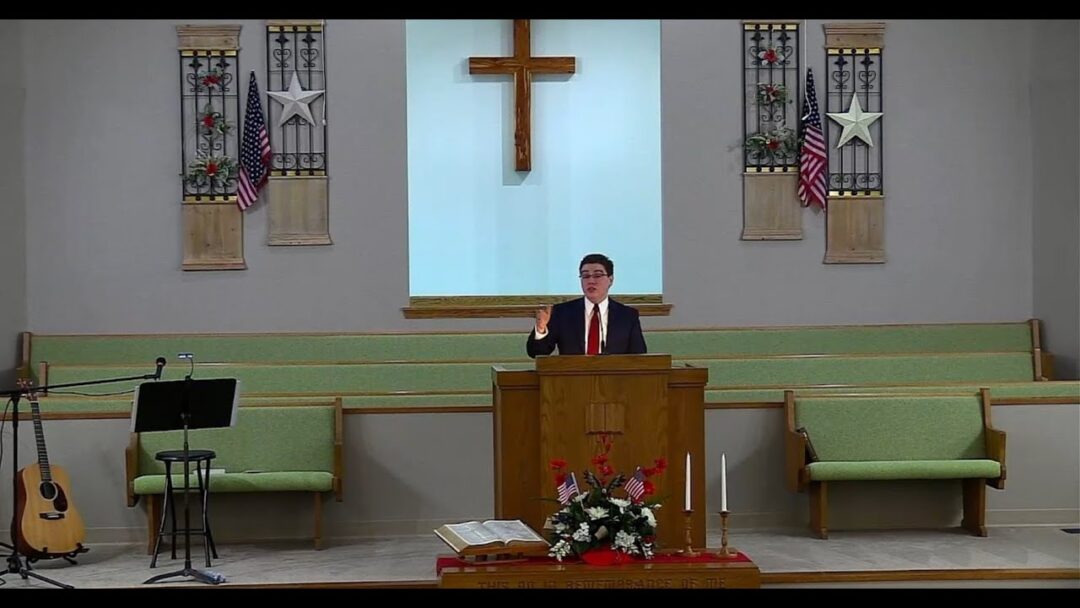
From our Sunday service on July 3, 2022, Luke 3:1–17 (with Isaiah 40). Watch the full message: Suitable Works on YouTube.
Thankful for Our Freedoms
Tomorrow is the Fourth of July, our time to celebrate the independence of our nation and the freedoms we have. As Christians we have a lot to celebrate in this country, and I wanted to say a little about that before we get started.
We have the freedom to choose our role in life, which connects to our lesson today. In some nations you get thrown into a caste and you’re stuck there your whole life, and what you’re born into is what you die in. In America we can forge our own destinies, follow God’s will, and do what He wants us to do. We also have the freedom to protect what belongs to us and our families. I don’t know if you read online today, but in China there was an incident where thousands upon thousands of bank accounts were missing their last deposit. The working theory is that the government decided it needed more money and just took the last deposit out of everybody’s account. I thank God that we have the freedom to protect what is ours, so that no one is going to come and take it away.
We have the freedom to make our own success. I wouldn’t be here preaching if I were in another nation that wouldn’t let me. In China it’s illegal to be a preacher unless you’re born a Chinese citizen and go to their schools of theology, and other nations like Haiti don’t allow people like me to teach the Word of God. We have the freedom of movement across our country, the American road trip, with so many states to move between freely and so many wonderful things God has created in each one. We have the freedom to improve our nation. We’re not stuck with the people in charge like in North Korea, a dictatorship where whatever you get is what you get and you can’t overthrow them. Here we can vote for elected officials who represent our values and have ourselves heard through them. And we have the freedom to worship God without true persecution. A lot of us sometimes feel persecuted when we give someone the Word of God and they turn it away, but we don’t know what true persecution is. Here we are graciously allowed to preach the Word of God, even in our schools. As hard as that is, it is a lot better than in many other places. Students can still host Bible studies and spread the Word of God with their friends, and no one is going to threaten them or throw them out without some giant legal recourse. I thank God for that.
America didn’t start out perfect. We had things we needed to improve, and there are still things to improve today. Frederick Douglass, a black man in the North who had escaped slavery, gave a speech on the Fourth of July in the 1800s. He said that the Fourth of July is for you, but what about the slaves? Yet he had a hope for America. He said America is a young nation, since nations are measured in thousands of years, and so there is still time to improve things. He hoped that slavery would be gone, and as a Christian he wanted to see America become more like Christ. America is only 246 years old. We’re still a young nation, and what he said then still applies today. If there is something you don’t like in America, praise the Lord, we can use our vote to change it. There is still hope for America, and we as Christians are part of that. So tomorrow, when we celebrate, let’s remember all the things we can be grateful for and make sure that next year we make America even better, a nation that pleases God.
Suitable Works
We’re in Luke 3. If you look at your bulletin, you’ll see this message is entitled “Suitable Works.” Today we’re talking about what God requires of us as Christians. Luke 3 is really the beginning of the gospel ministry of Jesus Christ. It is John the Baptist, right before he baptizes Jesus to begin the miracles and wonders of His ministry.
Now in the fifteenth year of the reign of Tiberius Caesar, Pontius Pilate being governor of Judaea, and Herod being tetrarch of Galilee, and his brother Philip tetrarch of Ituraea and of the region of Trachonitis, and Lysanias the tetrarch of Abilene, Annas and Caiaphas being the high priests, the word of God came unto John the son of Zacharias in the wilderness. And he came into all the country about Jordan, preaching the baptism of repentance for the remission of sins;
Luke 3:1–3
Luke starts with history. He lists all the historical credentials of this event, and we talked in the last hour about why. The gospel writers were making sure that you know these things are true. They record all the details: this is who was in charge, this is when it happened, you can prove these facts and know that the other things they’re telling you are true. We also talked about how Annas and Caiaphas was kind of a coup. Annas wasn’t really the high priest, Caiaphas was, and Annas was controlling him. Luke says here that they were both the high priests, and then that the word of God came to John the son of Zacharias in the wilderness.
This is before the Holy Spirit is poured out on believers, so we are still in the age of prophets, where in the Old Testament the Spirit came upon someone for a short time, enabled them for work, and then left. Here John the Baptist receives the Spirit, the word of the Lord comes on him, and he begins to teach in preparation for Jesus Christ. That was his ministry. John was the prophet like Elijah who came in the spirit of Elijah to prepare the way for Jesus Christ, so that when Christ came, people’s hearts were ready to respond to His message. If John was preaching to prepare people for Jesus Christ, then what he has to say is still relevant today, because we still need to be prepared to serve Jesus Christ. This was a time of preparation for the church, and today we are going to learn what we need to do to be used by Jesus Christ as His followers.
John came into all the country about Jordan, “preaching the baptism of repentance for the remission of sins.” Before the New Testament era, baptism was used as a ritual cleansing. If you touched a dead carcass, a dead body, or something filthy, like an animal that could be diseased, you had to go outside the camp, wash yourself, and purify yourself. They also had a baptism of repentance. If you sinned, there would be a baptism of repentance. Before going to the temple, the priests would wash, and in Jerusalem today, if you go under the houses, a lot of the wealthy ones had their own little baptismal chamber, because to go before God you had to baptize yourself to ritually wash away your sins. That wasn’t pointless. It was a picture of what Jesus would do in the future. John’s baptism of repentance is saying, “I am a sinner, I need washing,” and it is “for the remission of sins,” or the forgiveness of sins. You confess your sins so that you can be washed of them. But he is also going to tell us that a change of lifestyle is needed, not just ritual washing, and that is what we will see today.
As it is written in the book of the words of Esaias the prophet, saying, The voice of one crying in the wilderness, Prepare ye the way of the Lord, make his paths straight. Every valley shall be filled, and every mountain and hill shall be brought low; and the crooked shall be made straight, and the rough ways shall be made smooth; And all flesh shall see the salvation of God.
Luke 3:4–6
What John is going to preach comes out of Isaiah 40, and he is preparing the way of the Lord, the Lord Jesus Christ. As I said in the first hour, when you read the Bible, the Bible assumes you’ve read the other parts of the Bible. In the old days you had to write everything by hand, and you didn’t put down a whole section of Isaiah if you didn’t have to. You would say, “Go read the Isaiah scroll.” So let’s go to the Isaiah scroll and see what it has to say.
A Prophecy of Comfort
Comfort ye, comfort ye my people, saith your God. Speak ye comfortably to Jerusalem, and cry unto her, that her warfare is accomplished, that her iniquity is pardoned: for she hath received of the LORD’S hand double for all her sins.
Isaiah 40:1–2
Whatever this prophecy is about will determine how we understand the message being preached from it. John the Baptist is a preacher taking an Old Testament passage and preaching a message on it, so the prophecy sets the message topic. First off, it is a prophecy of comfort. Their struggle and fight with God was finally going to come to an end, because Jesus Christ was coming on the scene to save humanity. Their iniquity would be pardoned, because Jesus would come, forgive them, and give them an opportunity to be cleansed. That is why John the Baptist is doing baptism.
A Prophecy of Unity
And the glory of the LORD shall be revealed, and all flesh shall see it together: for the mouth of the LORD hath spoken it. The voice said, Cry. And he said, What shall I cry? All flesh is grass, and all the goodliness thereof is as the flower of the field: The grass withereth, the flower fadeth: because the spirit of the LORD bloweth upon it: surely the people is grass. The grass withereth, the flower fadeth: but the word of our God shall stand for ever.
Isaiah 40:5–8
The glory of the Lord is about to be revealed, and that is what John the Baptist is talking about. We talked about glory as reputation, the exact image of God. The reputation of God is going to be revealed in Jesus Christ, and “all flesh shall see it.” When Christ was lifted to the cross, all men were drawn to Him. Isaiah then takes time to humble us, saying that all flesh is grass. We are here for a short while on this earth, and soon we will fade away. But despite this, when the flower fades and the grass dies away, “the word of our God shall stand for ever.” That is kind of a double meaning. It is the Scriptures, the sayings recorded in the Bible, but who else is the Word of God? Look at John 1:
In the beginning was the Word, and the Word was with God, and the Word was God. The same was in the beginning with God.
John 1:1–2
That’s Jesus Christ. The Word of our God shall stand forever.
Behold, the Lord GOD will come with strong hand, and his arm shall rule for him: behold, his reward is with him, and his work before him. He shall feed his flock like a shepherd: he shall gather the lambs with his arm, and carry them in his bosom, and shall gently lead those that are with young.
Isaiah 40:10–11
The glory of the Lord is going to be revealed, and it will dwell with man, and all of you are going to understand it. That is unity with God coming on the scene. And “he shall feed his flock like a shepherd” is a relationship, a special unity with God. So Isaiah 40 is not only a prophecy of comfort but also a prophecy of unity and relationship with God.
A Prophecy of Enabling
Hast thou not known? hast thou not heard, that the everlasting God, the LORD, the Creator of the ends of the earth, fainteth not, neither is weary? there is no searching of his understanding. He giveth power to the faint; and to them that have no might he increaseth strength. Even the youths shall faint and be weary, and the young men shall utterly fall: But they that wait upon the LORD shall renew their strength; they shall mount up with wings as eagles; they shall run, and not be weary; and they shall walk, and not faint.
Isaiah 40:28–31
This is a prophecy of enabling. Those who wait upon the Lord, who have patience and endure with the Lord, will be uplifted, encouraged, and have their strength renewed. They shall run and not be weary, and they shall walk and not faint. God will enable you to do what He wants you to do.
So the prophecy that John is going to preach on is a prophecy of comfort, a prophecy of unity and relationship, and a prophecy of enablement to do God’s will. It sets the context for John’s message. Conveniently, it is a three-point message, and everybody loves a good three-point message. John the Baptist did too. We will see the call of the people, the responsibility of the people, and the enablement of the people.
The Call of the People
Then said he to the multitude that came forth to be baptized of him, O generation of vipers, who hath warned you to flee from the wrath to come? Bring forth therefore fruits worthy of repentance, and begin not to say within yourselves, We have Abraham to our father: for I say unto you, That God is able of these stones to raise up children unto Abraham. And now also the axe is laid unto the root of the trees: every tree therefore which bringeth not forth good fruit is hewn down, and cast into the fire.
Luke 3:7–9
John is speaking to the multitude that came forth to be baptized by him. These were followers of John who wanted the baptism of repentance for the remission of sins. They came and said, “I’m sorry about my sins. I realize all these sins I’ve committed, and I want to be pure. Could you baptize me and ritually purify my heart as a symbol of my humility?” But we learn very quickly that the attitude these people had was completely different from the words they were saying. John responds to them very harshly: “O generation of vipers.” You bunch of snakes, a whole generation of hypocrites. Who told you that judgment is coming and that this is your escape from it? This is not how you flee judgment.
“Bring forth therefore fruits worthy of repentance.” In the Bible, fruits are good works or actions. If you are just talking with your mouth, do something that shows you actually are repenting. The Greek word for repent literally means to change your mind. John is saying, “Change your mind, people. You come here saying words, but your mind is in the same place, and when everything is said and done you’re still going to do the same thing. When you change your mind, you’re going to change your actions.” Another way to say it is rethink, reconsider what you’re doing. Being baptized without repentance is pointless. They said they wanted a baptism of repentance, but their hearts were in the wrong place, and there are works they need to do to show they have actually repented.
Then John says, “Begin not to say within yourselves, We have Abraham to our father.” The Israelites loved to take comfort in the fact that they were related to Abraham. In my family, we came to America for religious freedom. We were persecuted in Germany and Holland for preaching against Catholicism and preaching faith alone by grace, and they threw us into prison, so we came to America because we wanted religious freedom and were going to start churches here. One of my forefathers started four or five churches in the Beach City area. But I can’t say, “I have him as my father, therefore I have works worthy of repentance, and I can be baptized and saved because of my forefathers.” It sounds ridiculous: hundreds of years ago somebody did something, so I’m good to go. No. What about you? What about your heart and your works? These people were doing it as part of a club. They saw John the Baptist’s popularity: “Everybody’s getting baptized, let’s go do it too. Let’s be part of this little community. People think we’re kind of cool.” John says, “You say you’re Jews, children of Abraham, but being born from the line of Abraham doesn’t give you the character of Abraham or the relationship with God that Abraham had.” Abraham was called the friend of God because of his relationship with God. “God doesn’t even know you guys. Who do you think you are?”
Then comes a word of warning: “The axe is laid unto the root of the trees.” There is that analogy again of fruit and trees. Israel was often called the vine, because the works of God were worked through Israel. God did act outside of Israel. He went to Nineveh and preached the gospel to them even though they weren’t Israelites, and they had the option to be saved. But when God sent a prophet, He didn’t send them through the Ninevites or the Canaanites or the Philistines. He sent Israel, because Israel was the tree from which the good works of God were going to grow. Now John is saying the axe is at the root of the tree: “You have not done your works. Jesus is coming, and He is going to do a work.” We talk about this in youth group, how the vine is now going to be Christ and all works are going to be done through the Spirit of Christ. When the tree is cut down and Christ is the root, make sure you’re rooted in Him, because soon the tree will be cast into the fire.
The Responsibility of the People
And the people asked him, saying, What shall we do then? He answereth and saith unto them, He that hath two coats, let him impart to him that hath none; and he that hath meat, let him do likewise.
Luke 3:10–11
That is a fair question. If judgment is coming and our hypocrisy won’t stand, what does God want from us? This is a wonderful message, and you’re going to leave today really happy, because what God has for you is not complicated. Micah says:
He hath shewed thee, O man, what is good; and what doth the LORD require of thee, but to do justly, and to love mercy, and to walk humbly with thy God?
Micah 6:8
Or, love thy neighbor as thyself. All of these are very simple concepts. Sadly, these people didn’t have them, but we will see three groups of people come to John and ask what they need to do.
The Commoners
The first answer isn’t addressed to any specific group. It is people in general, and most of us are just people in general. If you can afford to give to those who have needs, is that complicated or hard? John the Baptist had a crazy following, and these people were wondering if he was the Messiah. They asked what they needed to do to show that they had works worthy of repentance and that God was in their lives, and he built it up and said, “If you have two coats, give somebody a coat who doesn’t have one. They’re cold.” Is that difficult? But these people didn’t do it. He doesn’t say that if you only have one coat, give it to somebody else, or that you need to sacrifice to your own weakness.
When Jesus was preaching, one person said, “I’ve done all the work since my youth. What must I do?” and Jesus said, “Sell all that you have and follow Me.” He wasn’t saying that because that’s what you have to do to be a disciple of Christ. He said it because that man’s idol was his things. He worshiped his things and not God, and Jesus said that if he wanted to follow Him, he had to get rid of it. But Jesus doesn’t call each and every one of us to sell everything and follow Him. I told the story about the man who was a drug addict, who came and gave me words of encouragement and gave literally all he had and became a homeless man. That is not the calling for everyone. The calling for everyone is this: if you have excess, give to those who don’t. Help them and encourage them, not only with coats but also with food, with meat. John didn’t say, “You need to change your entire lifestyle and identity and start all over.” You don’t need to sell all you have or live in the wilderness like me. John the Baptist wandered through the wilderness eating wild honey, and he didn’t say, “Be my follower and eat wild honey with me in the desert.” It was something simple, because that was John’s calling and not theirs. My calling here is to preach, and that is not going to be everyone’s calling. You don’t have to be a pastor to have works worthy of repentance. So the first thing, to the commoners, is this: if you can afford to give to those who have needs, do it.
The Tax Collectors
Then came also publicans to be baptized, and said unto him, Master, what shall we do? And he said unto them, Exact no more than that which is appointed you.
Luke 3:12–13
If you remember the Gospels, the Pharisees didn’t think of publicans as worthy of being baptized. They thought they were hypocrites and terrible people who didn’t deserve salvation. But here John the Baptist is baptizing them, and they call him “Master,” the word for rabbi or teacher. During this day tax collectors worked for Rome or Herod and went around knocking on doors, saying, “The tax this year is this amount, give it to me.” There was no internet and no central database to figure out the actual tax for that person, so if it was a hundred, they would say, “You owe a hundred and twenty-five.” They pocketed the twenty-five and gave the hundred to Rome or Herod. These are people the commoners hate, and John says, “Do your job honestly. Don’t defraud for your own gain.” What did he not say? He did not say, “Quit your job and be my disciple.” These people had a job they were supposed to do. Was it a spiritual job? No. Was it even a job people liked? No. How many of you like the IRS? I’ve got good news, though: if you work for the IRS, God is not telling you that you need to quit your job at the IRS. What He says is to do your job honestly, as you should, and not exact more than is appointed to you. Don’t defraud your neighbor.
So far there are two responsibilities. The commoner, if you have excess, gives to those who don’t have the same things. The tax collector does his job like he should and doesn’t rip people off. He didn’t say to quit, because that job was their appointment in life, what they were meant to do.
The Soldiers
And the soldiers likewise demanded of him, saying, And what shall we do? And he said unto them, Do violence to no man, neither accuse any falsely; and be content with your wages.
Luke 3:14
I don’t know if you realize how big this one is. These were soldiers of Rome itself or of Herod, and both were absolutely despised by any Jew. If you worked for Rome or for Herod, you worked for an occupying force over Israel. Israel was enslaved to this nation, and these men were employed by them, not just as tax collectors but as the military force used to oppress. That was God’s will for the nation at the time. They had turned from God, so God allowed the occupiers to come in and correct them. You would expect any Jew, if asked what works worthy of repentance should look like, to say, “Quit working for Rome. Quit oppressing your brother. You shouldn’t even be associated with those people, they’re terrible.” Is that what John says? No. He lists a few things.
Do violence to no man. These are military men with training. They are strong, and Rome took its military seriously. They were armed to the teeth. The Bible talks about how if someone compelled you to go a mile, go with them two. That’s a Roman soldier, who by the authority of Rome could tell you to carry their stuff one mile, and you would have to do it. They had authority and power, and John just says, “Do no violence.” You have the military training to force people to do what you want by threatening them. Don’t abuse the power your job gives you to get what you want.
Accuse any falsely. They have a political role, and they are the police. Don’t falsely accuse someone just because you’ve got a powerful voice. Your job enables you to get rid of someone in a second, because if a soldier says something, who are they going to trust, the commoner or the soldier? Don’t misuse the power your job has given you to control others.
Be content with your wages. Don’t be greedy or selfish. Be glad with what God has given you. Don’t sulk, don’t cry, but be content.
What did John not say? He did not say to leave your job for a life of peace, free from political issues. It would have been easy not to be a soldier of Rome and not to be hated by all your neighbors. He did not say to leave the politics behind and have a life of peace and tranquility without any controversy. They had a job to do, and both groups were hated by the Jews, but John says, “This is your calling. This is the job God has put you in.” We see it through all these groups. Not everybody is meant to have a specific spiritual role like in a church, but all of us are called to live well for Jesus Christ.
To review, John told the people to bless others by giving what they can afford to give, which is not hard. Second, do the job you are called to with honesty. Third, do no violence against others by abusing the power granted to you. He also said to keep your testimony honest before others and, lastly, to be content with the wages God has provided for you.
The Enablement of the People
And as the people were in expectation, and all men mused in their hearts of John, whether he were the Christ, or not; John answered, saying unto them all, I indeed baptize you with water; but one mightier than I cometh, the latchet of whose shoes I am not worthy to unloose: he shall baptize you with the Holy Ghost and with fire: Whose fan is in his hand, and he will throughly purge his floor, and will gather the wheat into his garner; but the chaff he will burn with fire unquenchable.
Luke 3:15–17
The people are wondering whether John is the Christ. It was such a simple message, to do what God has called you to the best of your ability, that they asked, “Is this the Messiah? Is this the one who’s going to save us?” But John answers, “No, no, no. I am here to prepare the way. What I’ve taught you is to prepare you to be used by God.” One mightier than he is coming, who will baptize you with the Holy Ghost and fire. Ritual cleansing is one thing, but the Holy Spirit, being immersed in God Himself, is going to be something you can’t even comprehend. The fire there is purification. The fire of God will purify your hearts and enable you to be used by Him. So John says he is not the Messiah. He is preparing people for the Messiah, and God will enable us to serve Him if we are prepared to be served.
Lastly, there is a warning for those who aren’t listening: “Whose fan is in his hand, and he will throughly purge his floor, and will gather the wheat into his garner; but the chaff he will burn with fire unquenchable.” If you can’t accept the grace of God when it is coming and understand what God wants from you, there is punishment for the unsaved. There are consequences for living your life saying, “I don’t need God. I don’t need to be purified. My life is good. I’m a good person. I’ve got everything figured out.” If you do that, the fire is going to be unquenchable. There is no way to put it out, and it will consume you. But there is another way. The Holy Ghost fire can purify you. There is fire one way or the other, but one is destructive and one creates.
There is a judgment day coming, and these people needed to be prepared to respond to salvation. Jesus was coming. He was going to preach salvation to them and die to provide salvation for them, and He wanted them to decide whether or not to follow Him. John says, “Your current hypocrisy is not going to protect you. Words without actions are not going to protect you when Jesus comes. I want you to have this figured out so you can respond. Don’t have your heart hardened by these selfish actions.” Jesus came, and they made their choices, and today we have to make the same choice.
Simple Things
Christ died for our sins, and we also should produce works worthy of repentance. If Christ saved our soul, we have a responsibility to live our lives for Him. If someone died for you and saved your life, would you not feel obligated to live your best life? How much more should we do it for Jesus Christ? Once again, these are simple things. Let’s go through them one more time:
Bless others by giving what you can afford to give. Work the job God has called you to honestly. Don’t abuse the power granted to you. Keep your testimony honest. Be content with the wages God has provided you.
Is that not simple? Can you not leave today and say, “I got something from the Bible that I can do”? If you do these things, you are prepared to be used by Jesus Christ. That’s what John the Baptist’s message was about: a prophecy about comfort, a prophecy about unity, and a prophecy about enabling. If we follow these five little things, we can have the comfort of God, the unity with God, and be enabled by God. That’s all it takes to be used by God. So I pray today that we figure that out, and that as we go through the week and our Fourth of July celebrations, as we interact with others, they will see these attributes in us and see that we aren’t hypocrites, but that we truly have repented and truly want to live our lives for Him.

Recent Comments