
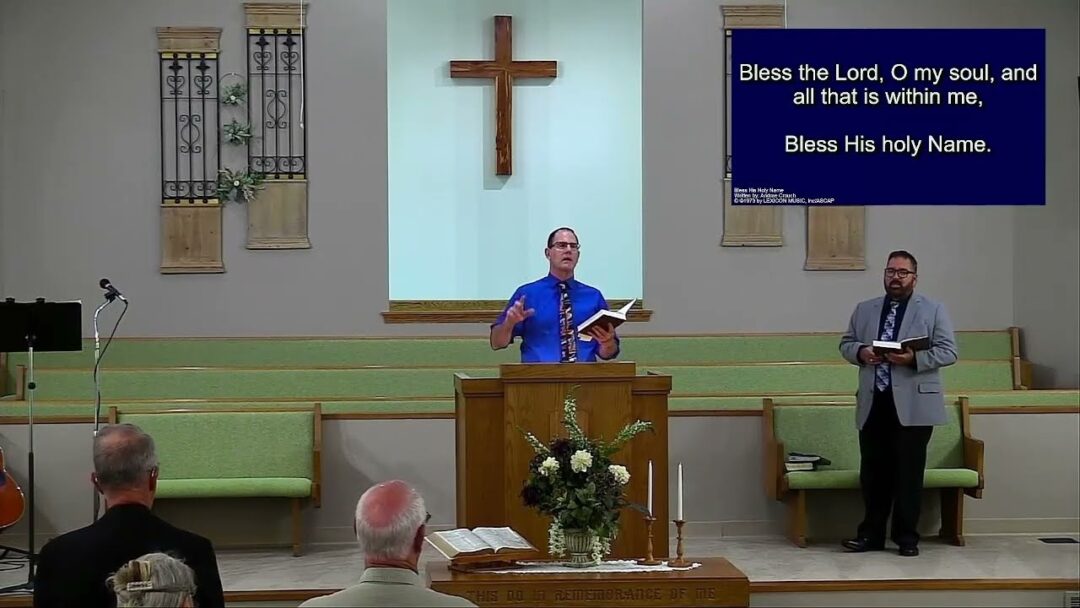
From our Journey Through James series, our Sunday service on May 21, 2023, James 3. Watch the full message: A Journey Through James 3 on YouTube.
A while back we started our journey through the book of James, and we had a little delay because of Mother’s Day and a youth activity, but we are finally picking up on our third lesson. James was written by the half-brother of Christ, the pastor of the church at Jerusalem. It was written to believers who were scattered through the Roman Empire because of persecution, who were struggling in their walk, and James as their pastor wrote them a letter to encourage them to keep the faith and improve their walk with God.
In the first message we looked at the introductory passage in chapter 1, which introduced the key idea of the book: pure religion. What does it look like? Today we would call it a relationship with Jesus Christ, since we don’t like the word religion anymore because it carries the idea of a strict set of rules. If you have a relationship with Jesus Christ, what attributes should you have in your life? Then we looked at the first two of the twelve lessons James has for his church. The first was that God wants you to show love, not favoritism. People in the church then, and today, showed favoritism to people of high status, the rich and the powerful, and James told the church that church should be about God and ministry, not about ignoring the poor and favoring the rich. The second was that God wants you to show genuine faith through your works, since faith without works is dead. He encourages believers not just to go to church and hear the words but to go outside the church and do the words.
Today in chapter 3 we have two more lessons: God wants you to control your tongue, and God wants you to have a wise lifestyle. The main lesson James is trying to get across in this chapter is that God wants us to have a successful and peaceful life.
Lesson Three: Control Your Tongue
My brethren, be not many masters, knowing that we shall receive the greater condemnation. For in many things we offend all. If any man offend not in word, the same is a perfect man, and able also to bridle the whole body.
James 3:1–2
The first thing James says is “be not many masters.” Is that a master-slave or boss-employer situation? No, in this case it means being a teacher, with the idea of a rabbi or spiritual leader. In our lives we meet a lot of people who want to be teachers. You are just hanging out and talking with somebody casually, and they say, “Well, did you know it’s actually this way? I believe this and you should believe this too.” They are trying to be a teacher for everyone. James is warning Christians who have a genuine faith and a genuine walk with God, but who think they need to be everybody’s pastor, everybody’s teacher, everybody’s rabbi, that this puts more on them than they realize.
Why? Because we will receive greater condemnation, and we have to give an account to God for the words we speak. If you put yourself in the position of a spiritual teacher, you have to be extra careful. If you teach somebody something, it had better be true, and if you are wrong, you will receive greater condemnation. It is better not to be someone’s teacher than to teach them wrong. The church needs to be careful about getting into other people’s business, telling them how it is, and being so confident that they teach people wrong. That includes me as a pastor. I am teaching right now, and if I teach you wrong I have something to fear, because God will hold me accountable. I need to do my study and prayer to make sure that what I am teaching is true and accurate.
Why is this such a big deal? Verse 2 tells us. You cannot teach somebody without using your tongue, and James is about to tell us about the dangers of the tongue. It is so easy to lose control of your tongue, and if you use it all the time as a teacher, it is easy to offend somebody. As pastors we all learn in our education that you will offend people. It is impossible not to, even if you walk on your tiptoes and try your best. James is saying the same thing: no matter how hard you try, at some point in your life you are going to offend somebody. If someone never offends anybody in his whole life, he is a perfect man who has never done anything wrong. But the Bible says there is none righteous, no, not one, so there is no perfect man, and no person has controlled his tongue all the time.
In Greek, the word for offend carries the idea of stumbling or tripping up. The point is not that someone takes offense in his heart but that you make him stumble in his Christian walk. Imagine you were a younger believer and someone saw something in your life they did not like and wanted to correct you lovingly, but the way they did it hurt your feelings instead of encouraging you to do right, and it caused you to stumble. If we are not careful, we sometimes cause other people to trip up in their spiritual walk even when we are trying to help. If nobody caused anybody to stumble, he would be a perfect man, but nobody is perfect, so be careful when you choose to be the teacher.
A Bit and a Rudder
Behold, we put bits in the horses’ mouths, that they may obey us; and we turn about their whole body. Behold also the ships, which though they be so great, and are driven of fierce winds, yet are they turned about with a very small helm, whithersoever the governor listeth. Even so the tongue is a little member, and boasteth great things. Behold, how great a matter a little fire kindleth!
James 3:3–5
James does what all preachers do and uses illustrations, and he picks two: bits and ships. We live near Amish country, so we know about the horse and buggy and the bits in the horses’ mouths. Without the horse, the Amish would be hopeless. They can’t go to Walmart or travel that distance with all their stuff and make it back, but through a bit in the horse’s mouth they can steer it with the reins. A horse is a big, powerful beast. If it does not want you on its back, it can throw you on the ground or trample you. But put a little bit in its mouth and suddenly you are able to turn it around.
Your words are like that. Your tongue is a small part of your body, but what it does has a huge effect on your effectiveness as a Christian. If your tongue speaks bad things, like gossiping, criticizing, and slandering, your effectiveness as a Christian is done. It is a little thing with great effects.
The second illustration is the ship. James is talking about giant cargo ships driven by the wind. The wind is a powerful force. How many of us have seen a hurricane destroy a city? But with a sail and a little rudder on the back, you can take advantage of that power and direct it somewhere. Compared with the rest of the ship, the helm is the tiniest part, but it does not take much to turn that ship, and a little rudder gives complete control. It goes wherever the governor, the captain, desires. If your tongue says things that are not Christlike, it will not take you toward a Christian testimony. It will take you in the opposite direction.
A Little Fire
The tongue is a little member that boasts great things. Isn’t the tongue powerful? Don’t we love to use our words? Doesn’t it feel powerful to speak your mind? But look at the end of verse 5: “Behold, how great a matter a little fire kindleth.” The word translated “matter” carries the idea of a forest. Smokey the Bear warned us that only we can prevent forest fires, and he would agree with James. Consider how great a forest can burn with just a little ember, like a cigarette falling on the ground. That is how your tongue is. On its own the ember is nothing, there for a second and gone, but in the right situation, where the fire is ready to burn, it will ignite and go out of control.
And the tongue is a fire, a world of iniquity: so is the tongue among our members, that it defileth the whole body, and setteth on fire the course of nature; and it is set on fire of hell.
James 3:6
Those are pretty strong words, so let’s break them down. The tongue is a small part of the body, but it makes a big difference. It is the ember, the tiny thing that can burn down your whole life. When I was in college I had to translate passages from the Greek, and this is how I chose to translate this one:
Consider how much of a forest a little fire can kindle. The tongue is a fire, a world of iniquity. In the same way the tongue is set in the parts of our body, defiling the whole body, igniting the duration of our lives, and igniting with hell’s fire.
James 3:5–6 (my translation)
The phrase translated “the course of nature” is literally “the wheel of existence” in the Greek, a Roman idiom for your whole lifetime. So the tongue does not just defile our words. It defiles our whole body, our whole essence, because the words we say define who we are. And it affects the duration of our lives. We live around the prime of cancel culture. How many people’s words have ruined the duration of their lives? They said one thing a little off-color, somebody heard it and somebody else found out, and suddenly everybody knows about this belief or this thing they said, and their lives are over. That is what James is warning those who want to be many masters, people speaking all the time and giving their opinions on things: all it takes is one slip-up for the rest of your life to be ruined.
And James does not say only that it affects your whole body and your whole life. He says it is “set on fire of hell.” It is wicked and corrupting. Don’t think you can control it, because what you are playing with is literally fire, in this case hell’s fire. It takes one time to skew your perspective of who you are, to ruin your position of authority or respect, or to change someone’s entire opinion about you.
The Untamable Tongue
For every kind of beasts, and of birds, and of serpents, and of things in the sea, is tamed, and hath been tamed of mankind: But the tongue can no man tame; it is an unruly evil, full of deadly poison.
James 3:7–8
We are all familiar with the Coliseum in Rome, which was up and operating at this time in history. Every day they had fights with all kinds of animals, lions and tigers and bears, which were trained not to attack the people caring for them but to attack the combatants in the arena. Bears and tigers were controlled by man and used for the purpose he wanted. James says you might be able to tame the bear, the lion, and the snake, but there is a part of your life you will never be able to tame, and if you think you can, you’re a fool. “The tongue can no man tame” means nobody, not me and not you. The word unruly carries the idea of unrestrainable, the same idea as restraining the animals, and it is “full of deadly poison,” which refers back to the snake.
If somebody said, “I’ve trained this snake. I’ve had it for years and it’s never bitten anybody,” you might consider holding it for a little while as an experience. But if somebody tells you they have a venomous snake they have never been able to control and asks whether you would like to hold it, what is your answer? “No, are you crazy? I do not want to hold your unrestrainable poisonous snake.” James is saying that is what the tongue is like. It is full of poison, it can corrupt your whole life, and it is unrestrainable, so do you want to use it? Put that way, maybe I don’t want to say those words, maybe I don’t want to jump in and give my two cents. If the tongue can’t be restrained, maybe we can restrain ourselves.
A Spring That Is Not Both
Therewith bless we God, even the Father; and therewith curse we men, which are made after the similitude of God. Out of the same mouth proceedeth blessing and cursing. My brethren, these things ought not so to be.
James 3:9–10
Here James talks about a problem in the church. You go into the congregation and sing songs, praise God, and worship Him, using your tongue to bless the Father, but at the same time you use that same tongue to curse or harm your brother. James says these things ought not to be, and he gives some illustrations of why.
Doth a fountain send forth at the same place sweet water and bitter? Can the fig tree, my brethren, bear olive berries? either a vine, figs? so can no fountain both yield salt water and fresh.
James 3:11–12
How many of you have gone backpacking? My dad and I used to go when I was younger, and getting nice, fresh spring water gushing from a rock after a long hike is so refreshing. But James is talking about a hypothetical spring that is inconsistent: one day it is fresh, refreshing water, and the next day it is bitter sulfur water that is disgusting. A spring does not produce both. If you found a spring that did, and some days it was sweet and other days it made you want to be sick, you would not choose it as your water source when there are perfectly good springs that are always sweet.
That is the illustration for our lives. If we are blessing and cursing, who is going to go to us as believers? Would you want to go to the believer who is sometimes in a good mood and happy to talk to you, and other times hates your guts and is ready to curse you or talk bad about you behind your back? No.
The fig tree makes the same point. If I plant a fig tree, it does not grow olive berries. What grows is the fruit you plant. If you plant good speech, you will grow good speech, and if you plant bad speech, you will grow bad speech. If you don’t control your tongue, you will grow bad things in your life, and you cannot expect an uncontrolled tongue to produce good Christian fruit. In the same way, no fountain can yield both salt water and fresh. If we are not controlling our tongues, there is no way we can be effective as Christians or represent Christ well, because if one area of our lives is poisoned, it is all poisoned.
Sins of the Tongue
Proverbs, our book of wisdom, lists some of the sins of speech that might be tainting the fountain of our tongue.
Lying. This is trying to defend yourself by not being truthful, which the Old Testament calls bearing false witness. Somebody confronts you about something you did, like a job you were given last week, and you change your story a little: “You didn’t give me that, you must have forgotten.” That taints your reputation as a Christian.
Gossiping. We all know what it is: “Did you hear what so-and-so did? Well, so-and-so said this.” It poisons the water supply.
Criticizing. Instead of being constructive, lifting people up and trying to help them, you just criticize the way they do things. The Bible does not want us to get on people if we don’t have some solution to the problem and are just going to beat them down. People who are always beating others down will not have a good reputation for Christ.
Careless speech. How easy it is to say something reactively that offends somebody. Maybe we did not mean it that way, but the way it came out was not good. The Bible says to be careful how we speak so as not to offend, to take thought before we speak.
Overspeaking. This one I did not realize was in there. Maybe we had a right to speak up in the beginning, and the thing we are talking about is important, but then we went too far. We need to know where the boundaries are and when we have said enough, so we don’t destroy our brother. I think a very common situation is correcting someone, especially a young person, and being overly cruel by beating it in over and over. Yes, you have corrected the problem, so now release it. What did Jesus say to the woman caught in adultery? He did not beat on her. He said, “Neither do I condemn thee: go, and sin no more.” A lot of times as Christians we say “go and sin no more,” and then we keep driving it in: “Don’t forget I told you not to sin. Don’t forget you sinned before.” That hurts the believer’s walk. It does not help, it only harms. So be careful with your speech, and don’t overspeak.
Lesson Four: Live a Wise Lifestyle
That concludes our first lesson, and we have a short second one. Not only should we control our tongue, but we should control our lifestyle. God wants us to have a wise lifestyle.
Who is a wise man and endued with knowledge among you? let him shew out of a good conversation his works with meekness of wisdom.
James 3:13
If you want to be intelligent and have wisdom, which is skill for living, this is how you do it: show it by a good conversation. That word carries the idea of a lifestyle or behavior, so show your wisdom through your actions, “with meekness of wisdom.” It is one thing to be wise and another to tell everyone you are smart and wise. James is saying not to go around announcing, “I’m so smart, I’ve got skill for living,” but to show it through your actions, in humility. Those who are truly wise are humble about it, and your lifestyle will show whether you are wise or not.
But if ye have bitter envying and strife in your hearts, glory not, and lie not against the truth. This wisdom descendeth not from above, but is earthly, sensual, devilish. For where envying and strife is, there is confusion and every evil work.
James 3:14–16
Wise living is humility with wisdom, and wicked living is envy and conflict. Those who are unwise will find conflict in their lives, and those who are wise will avoid it. If you claim to be wise but you are jealous of everybody else and in conflict with everybody else, stop lying against the truth. Don’t lie to yourself and say you have everything together. If you walk around getting mad at everyone around you, or you have said, “I just don’t like most people,” maybe you have the problem, because most people have not done anything wrong to you.
You may think, “I don’t trust anybody. I’ve learned in my life that the only person I can trust is me, and maybe my wife sometimes.” If that is your wisdom, the Bible says it is not wisdom but foolishness, and you are lying against the truth. That wisdom “descendeth not from above” but is from Satan, a deceit to keep you from the joy God wants you to have. It is earthly, “sensual,” which means self-pleasing, and “devilish,” or demonic. The demons want you to think you should not have a relationship with other people or trust other people, because it is easier to make you trip up when you are all by yourself. The Bible says a threefold cord is not easily broken. When a Christian is in fellowship with another Christian, supporting each other, it is a lot easier to live right by God. If Satan can divide and conquer, tripping someone up is as easy as blowing a little bit on them and they fall right over, because there is no support system there to help.
James says you have been singling yourselves out from the rest of Christianity, so proud of yourself that you think you are the only person you can trust. Stop it. Where envy and strife are, there is confusion and every evil work. This leads to discord among the church and to people not knowing how to interact with you, and it leads to sin. All kinds of sins can come from this mentality: not only pride but all the sins of the tongue, such as lying, gossip, criticizing, careless speech, and overspeaking, come from this hateful, jealous attitude.
The Wisdom from Above
But the wisdom that is from above is first pure, then peaceable, gentle, and easy to be intreated, full of mercy and good fruits, without partiality, and without hypocrisy. And the fruit of righteousness is sown in peace of them that make peace.
James 3:17–18
James does not just tell us what not to do. He also tells us what to do, and he describes the wisdom that is from above.
Pure. This is like that spring, not tainted. The first step is to get rid of everything else. If we are going to have a well-controlled tongue and a well-controlled lifestyle, we have to remove everything and start over with God, rededicate ourselves, get rid of the sin, confess it, give it over to God, and then work on new attributes.
Peaceable. It seeks out peace with other people. While one person says, “I can’t trust anybody,” the other says, “I want to try my best to love everybody and be a friend to everybody, and when there’s conflict, I will seek to resolve it.”
Gentle. The Greek idea of gentle is having the ability to harm somebody else but choosing not to, like a bodybuilder deciding not to beat somebody up. He has more than enough ability to cause harm, but he knows it and chooses not to use it. When people make mistakes and we correct them, we have the ability to correct, but knowing in wisdom how far to go is a different story. When we have power, we should not use too much or too little, but take time with God, pray about it, and consider what we should do and how.
Easy to be entreated. This means compliant. Say somebody comes to you with a wise heart and says, “I looked at your report and I know you’re working hard, but something’s not working and we need to redo it.” The fool says, “I’m doing my best, and you don’t appreciate me.” The wise person says, “Let me take time to consider that, and I’ll get back to you next week with some new ideas about how we can make this work.” Instead of immediately rejecting everything people bring to us, we consider it, try our best to comply, and work with them.
Full of mercy. It forgives and does not hold a grudge forever. As Christians we will be wronged just as much as the unsaved, and the only difference is how we respond. Are we merciful to those who do wrong to us, or are we revengeful, bitter, or jealous?
Full of good fruits. We should not just be Christians who forgive but Christians who act. Going back to the idea of agape love that works, there should be good actions in our lives that show the love of God to others.
Without partiality. Here the idea is uncertainty, and you are not uncertain about what you are doing. You are not a Christian who just does what he wants day to day. You have purposefully decided to do this, and you are not on the edge but all the way in.
Without hypocrisy. This is what James is really talking about in the church. He is talking about people who say they are Christians but do not live the life of Christ, who take the title of Christ and ignore all His teachings. You cannot just say you are in. You actually have to do it.
Verse 18 gives the concluding thought: “the fruit of righteousness is sown in peace of them that make peace.” If you are going to be a Christian who grows fruit, you have to plant your fruit in peace, not in conflict with other people. Those conflicts deprive the fruit of the tree of our Christian life of the sustenance it needs to survive, or, in the other illustration, the fire will burn down our tree. If we don’t have these things in our lives, we will not be able to produce fruit. Our tongue will burn through our entire lives, destroying our testimony and our effectiveness for the walk of God. And if our wisdom is shown only through words instead of behavior, we are hypocrites.
Do You Want to Live a Peaceful Life for God?
The question before we leave is this: do you want to live a peaceful life for God? We can choose to live a life without peace, but then we have to pay the consequence. God is offering us a life of peace. He has taught us how to live with less confrontation, more joy, and more purpose. If your answer is yes, what do you need to do? Four things.
First, we must control our tongue. The first step is to control when we use it.
Second, we must avoid being everyone’s teacher. We can’t think we have all the answers or speak our mind all the time. We have to choose what is appropriate.
Third, we must not be hypocritical. We can’t be people who say things and don’t live a life to back them up. We have to have the behavior of a Christian, not just the title.
Fourth, we must be pure, peaceful, and kind. We must seek to be at peace with others. That does not just fall into place. It takes work. The Bible says, as much as lieth in you, live peaceably with all men. It is not always possible, but we have to try and work at peace.
If we control our tongues, avoid trying to be everyone’s teacher, avoid hypocrisy, and seek peace, we can live a life that is peaceful and blessed by God.

Recent Comments