
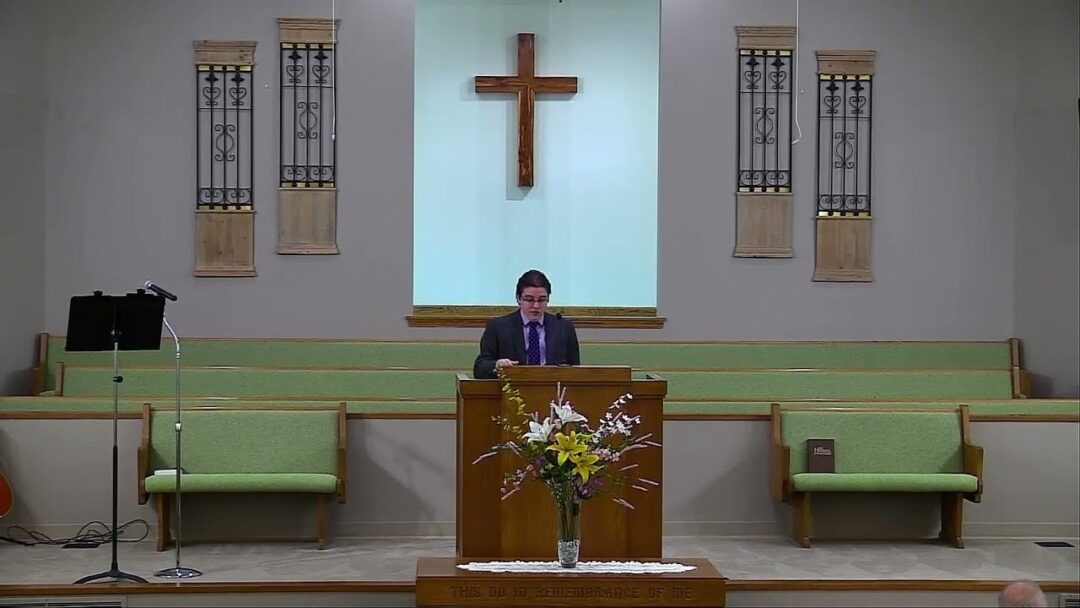
From our Sunday service on August 18, 2024, Psalm 56. Watch the full message: This I Know: Psalm 56 on YouTube.
The special today fits well with the message. Two lines in it actually quote our passage: “Lord, you hear me when I’m calling” and “Lord, you catch me when I’m falling.” I believe both refer to the book and chapter we’re going to be in today, Psalm 56. I’ve entitled this message “This I Know.”
The inspiration for this message was a little different than normal. I got it from a TikTok. I’ll admit I try to stay off TikTok, because if you spend too much time on that platform it starts to rot your brain. But I had exams this week, and I just wanted to not think about it for a little while, so I hopped on and started scrolling. Because I’m such a Bible nerd, I get all these TikToks about the Bible. Sometimes it’s so much that I think, “Please just give me something else. I’ve worked on my message for the last three hours, and the last thing I want to do is scroll through two hours of Bible facts.” But sometimes you get something good.
A man named Chad Bird had made a TikTok about a Hebrew phrase that he says can get you through the darkest times. Chad Bird is a pastor, and he has been going through hard times for the last four years. His wife has had cancer twice. Just after she got over it, his son, who was special needs, passed away. After all that, his father passed away. He was experiencing difficulty after difficulty after difficulty, and he started making TikToks about how God has been faithful through it. In this series, he says there is a phrase from the Bible, as a Hebrew scholar, that got him through the darkest times in life. The phrase is zeh yadati ki Elohim li, which is translated “This I know, that God is for me.”
We’re in a transitional time, not just us as a church but personally in our lives. Kids and teachers are starting a new year at school, and some kids are entering high school for the first time. These are times when we face challenges, difficulty, and adjustment. Young adults who have graduated are moving on to the next phase of their lives, starting college or focusing on a career full time. But even if we’re not in those phases, we’re always facing difficulties in our lives. Maybe it’s a job we just started, and I know a few people in this church have started new jobs. That can be challenging, and there can be a lot of uncertainty. Maybe we’re facing medical worries. As somebody who does visits, I know there’s always a need in the church and always health concerns. I’m a diabetic, so I know what that’s like. Maybe that’s bringing anxiety, difficulty, and hardship into your life. Maybe it’s your finances. Maybe after COVID things just never got better, the income hasn’t been enough, and things have been tight. There are many challenges in life regardless of who we are or what we do, so this phrase, “This I know that God is for me,” is something for everyone.
The Context of Psalm 56
Psalm 56 is referenced in a few other places in the Bible. Its refrain is quoted in Psalm 118:6, and it’s quoted in Hebrews 13 and Romans 8. Hebrews 13:5–6 says:
Let your conversation be without covetousness; and be content with such things as ye have: for he hath said, I will never leave thee, nor forsake thee. So that we may boldly say, The Lord is my helper, and I will not fear what man shall do unto me.
Hebrews 13:5–6
If that passage ever brought you comfort, that comfort was inspired by this psalm. Romans 8 also quotes it. I didn’t even realize there was some overlap with what we were talking about in teens, but as I studied, I learned that it says:
What shall we then say to these things? If God be for us, who can be against us? … For I am persuaded, that neither death, nor life, nor angels, nor principalities, nor powers, nor things present, nor things to come, Nor height, nor depth, nor any other creature, shall be able to separate us from the love of God, which is in Christ Jesus our Lord.
Romans 8:31, 38–39
As you can see by how this psalm is referenced in Scripture, it is a psalm of hope despite the difficulties life may bring.
The psalm wasn’t written out of no context. It has an origin. David wrote it in the context of 1 Samuel 21. David was anointed by the prophet Samuel to be the next king of Israel. The current king was Saul, and he wasn’t serving the Lord as he should. He abused his power, and he was prideful and arrogant. God rejected him because he made prideful choices, not to follow God but to make his own decisions. In his rejection, God called the prophet Samuel to anoint David. That meant that as soon as Saul was out of the way, David was the next king of Israel. But David didn’t let this go to his head, and he didn’t abuse the power. He said, “I will not touch the anointing of the Lord. God anointed King Saul, and when God wants Saul out of the way, God will be the one to take him out of the way.” So David faithfully served Saul. He ended up marrying Saul’s daughter, and he became best friends with Saul’s son.
The difficulty arose when they went to war and people started to celebrate David more than Saul, because David had been more brave in battle. Saul became concerned about his legacy, his title, and his honor. He began to fixate on David: “This David is ruining my reputation. This David is stealing all my limelight. This David is driving me crazy. I want to do something about it.” It got so intense that he threw a javelin at David, and David barely escaped with his life. David talked to his best friend, Saul’s son, and said, “I need you to figure out if it’s safe to stay here.” I’m not going to go into the details of how he delivered the message, but Saul’s son delivered it: “Run. Get out of here. It’s not safe. My father wants you dead.”
That’s the context in which this psalm is written. David is on the run because the throne wants him dead, despite his doing nothing wrong. Saul is sending his men after David to put him to death. David wrote this song about a time in his life when he was running from King Saul. He can no longer spend time with his best friend. He has to spend time away from his wife. He is without food and starving. He went to the Tabernacle, which acted as the temple at that time, and you had to go to the priest to get food from the table of showbread. This was something you couldn’t do without priestly authority. In desperation David said, “I need food. I’m starving. My men are starving. I have nothing. Please give it to me.” The priests gave it to him anyway, because he was starving. Jesus talks in the New Testament about how that was okay only because David was so starving that he would have died had he not done it.
So when David writes his psalm, he is scared, running, and starving, with absolutely no weapons to defend himself. He runs to Nob, to the priest. He says, “I have no weapon. Do you have any weapons?” and the answer is, “The only weapon we really have here is Goliath’s sword, the giant you killed.” The sword’s way too big for him, but he says, “That’ll do. I’ll take Goliath’s sword and use it to defend myself. I’ve got nothing else.” Saul finds out that the priests of Nob helped, and he says, “Anybody who helped David, I’m going to slaughter them all and put him to death.” David finds out that everybody who just helped him was dead. He has all this guilt on his shoulders: “These people helped me, they did nothing wrong, and now Saul has killed them.” On top of that, David flees and hides among Israel’s enemies, the Philistines, and pretends to be insane so they wouldn’t recognize him and see him as a threat.
This isn’t a moment of pride or honor in David’s life. This is David at one of his lowest points. I’m not going to say it’s his lowest, since we don’t know for sure, but David felt pretty low, and it’s in this mindset that he writes Psalm 56. The one lesson we can get from Psalm 56 is that God wants us to rely on Him.
Reading a Psalm: The Title
Let’s start in verse 1 and read the title.
To the chief Musician upon Jonathelemrechokim, Michtam of David, when the Philistines took him in Gath.
Psalm 56 (title)
Some of the psalms have little titles at the front, and these function as a director’s note. We’re going to learn how to read the psalms effectively. The psalms are songs. They were written to be sung, so at the beginning they have these title banners that tell the song director how to sing them. We learn a little about this song, including its authorship, the tune it uses, its genre, and its topic. The authorship is David. The tune is “Jonath-elem-rechokim,” which roughly translates to “The Silent Dove in Distant Places.” We don’t know what that tune was. The genre is a Michtam. We don’t really know exactly what this term means, but it’s associated with gold, with honor and value. So this song is supposed to be golden, with a royal value to it. And the topic, or context, is “when the Philistines took him in Gath.” We know from the psalm that this is situated in 1 Samuel, while David is on the run from King Saul. With all this information, we can diagnose what’s going on in this song and how to apply it to our lives.
Daily Pressure, and the Choice to Trust
Let’s begin in verse 1.
Be merciful unto me, O God: for man would swallow me up; he fighting daily oppresseth me. Mine enemies would daily swallow me up: for they be many that fight against me, O thou most High.
Psalm 56:1–2
If you want to get the emotion in this, you have to make your voice quiver a little bit. The Hebrew there for “daily” is “each day,” which is more dramatic. The word “swallow” is a little weird. The best way I picture it is a snapping turtle. If you put a stick there, it snaps on it. It may not grab you, but it snatches really quickly. The verb carries that idea. It can also be used in the context of a chase, where someone is running after you and is right behind you, just barely missing. They’re trying these quick attacks, and you just miss, like a snapping turtle snapping at your finger. David is saying, “Each day these people are pursuing me. They’re trying to catch me. They’re trying to snatch me away. And each day they try to oppress me.” The word “oppress” has the idea of pressure, of stress. They’re trying to stress me out, make me anxious, and make me uneasy each and every day as they chase me and pursue me around each corner.
David was running from Saul’s army, and they weren’t far behind him. At one point, they were both camping in the same cave, and Saul’s army didn’t know. You can picture them being just one step behind. I don’t know about you, but knowing there’s an army pursuing me and they’re only a few hours away at any given moment would give me anxiety. How would you ever find rest in that? I would hope we never face a situation like that. I don’t know if you read it, but last week in Nigeria there was a situation where Muslims came into a Christian community and slaughtered 50 Christians. That kind of situation is a reality for some Christians, but in our country we’ve been blessed not to face it. Still, can you imagine yourself in that position, where people dedicate themselves every single day to nothing more than ending you, taking your life, and taking away what little freedom you still have?
David says there are many against him. He’s just one man who ran away. His best friend said “run,” and he ran. He didn’t have a sword, an extra pair of clothes, or any food. He’s one man versus an army. But he says, “O thou most High.” He has one person on his side.
Verse 3 says:
What time I am afraid, I will trust in thee.
Psalm 56:3
How many times have we heard this verse? We’ve heard it time and time again, but I don’t think we often put it in its context, of just how severe a time this was for David. Notice what David is doing here. He’s not saying it as a matter of fact, “Yeah, whenever I’m afraid I always trust you.” He’s doing this as an action: “Whenever I am afraid, I’m going to trust in you.” It’s not passive. It’s not that when I’m afraid, I naturally go trust God to take care of my situation. David is saying, “I am so stressed right now, I don’t know what to do, and I can barely sleep. But whenever I’m afraid, I know what I need to do. I’m not naturally going to do it, but I’m going to put my trust in you despite my circumstances.” David responds to his fear by reminding himself of the God in whom he trusts.
The Refrain
That brings us to verse 4, the refrain of the song, or as you would say in modern terms, the chorus.
In God I will praise his word, in God I have put my trust; I will not fear what flesh can do unto me.
Psalm 56:4
That almost feels like a modern-day chorus, with the rhythm and the repetition in there. It’s not just Hebrew poetry. It’s the way David is reminding himself. It’s a picture of him repeating it to himself as a truth: “In God I will praise his word. In God I have put my trust. I will not fear what flesh can do unto me.” He is repeating this to himself in his time of desperation and difficulty.
David explains in this little chorus how he finds hope in God, whose word he praises. David had access to the earlier books of the Bible. He knew the promises God had made to Israel and to individuals. So David says, “I can not fear, because I have the words you’ve given me to tell me about you. I know your character, God, and I know that you will help me.” “In God I have put my trust.” Who else would he rely on? As Christians, how true is this for us? If we are saved here today, we have made a choice to place our trust for our eternal security in God, in Jesus Christ. If we can trust God with our eternal security, which is the most important thing we can trust Him with, then how can we not trust Him in everything else? David is using that same philosophy here: “I’ve put my trust in God for everything. He’s anointed me king. I’m going to have faith that He’s going to get me there.”
Then he adds, “I will not fear what flesh can do unto me.” He reminds himself how big God is. It’s not just that he has a reason to pray or that he has trusted, but that God is bigger than any mortal. That’s what the word “flesh” means: somebody mortal. God is immortal. You can’t kill God. Why would I be afraid when an unkillable God is coming against these enemies who are just mere people? If God wants to save me, then sure, He will do it.
So what’s our first application? Placing trust in God is an act of choice. David had to actively pursue this trust in God. Even though he trusted God for his salvation, even though God anointed him and promised he was going to use him, David still had to choose each day, “I will trust God today to take me through whatever these difficulties are.” So place your trust in God every single day. When you begin to doubt, remind yourself of these truths: “In God I will praise his word. In God I have put my trust. I will not fear what man can do to me.”
The Plan of the Wicked
Let’s look at the next section, the wicked’s plan, in verses 5–7.
Every day they wrest my words: all their thoughts are against me for evil. They gather themselves together, they hide themselves, they mark my steps, when they wait for my soul. Shall they escape by iniquity? in thine anger cast down the people, O God.
Psalm 56:5–7
So far, all we know is that they’re chasing him. He has only talked about the literal army, but that’s not the only difficulty David faces. This section is probably going to feel more familiar to us than being pursued by an army. Let’s look at it verse by verse.
Verse 5: “Every day they wrest my words: all their thoughts are against me for evil.” The word “wrest” literally means to reform. It’s used for taking wood and carving a picture out of it. They’re taking his words, the things he has spoken, and reshaping them to mean something he didn’t say. I’m sure there have been times in our lives when we’ve met people who twist our words. The second half says, “all their thoughts are against me for evil.” All their mental plans are to cause bad things to happen to him. That’s something pretty realistic, whether at school as a kid, in high school, in college, or in the workplace. There may have been somebody in your life who for some reason didn’t like you. They may not have liked the way you talked or the way you dressed. They decided, “I don’t like this person, and I’m really out to get them.” You say something without meaning anything bad, and they think, “I can twist that and make it about something else. I can make that discriminatory. I can make that insensitive. I can get them in trouble with their boss or the teacher.” So they take your words and carve them into something you didn’t say. I think David is talking about Saul here: “David said he’s going to be king. He wants to overthrow me.” And David says, “I didn’t say I wanted to overthrow you. I didn’t say I’m replacing you. God anointed me. It’s not something I’m doing, it’s what God is doing. I’ve let you have your position. Why are you shaping this and making me an enemy of the state?”
Verse 6: “They gather themselves together, they hide themselves, they mark my steps.” There are four things here. First, they gather. It’s not just one person. There’s a little crew of people who don’t like David: “You don’t like David, you don’t like David, all right, let’s team up.” The wicked team up against David. Second, they hide themselves. These people aren’t going to confront David face to face. I think that’s very relatable in our lives. The people who cause problems for us often aren’t bold enough to do it to our face. They hide behind anonymity: “I will hide my face, but I will spread these lies.” Third, they mark his steps. They’re watching: “I’m waiting for one opportunity for you to trip up. You say you’re a Christian, and I want to ruin you. I’m going to watch until you make one slip. When you lie, you’d better bet I’m going to catch it and write it down, and I’m going to tell everybody how much of a liar you are. When you caused that accident at work and didn’t tell anybody, I’m going to tell everybody it was you, and then your testimony is going to be ruined.” And the last phrase is that they lie in wait. They’re waiting for the opportunity to catch him tripping up and jump. It’s like a lion watching its prey, waiting for the deer to trip for a second so it can grab it and pull it away.
Doesn’t this section seem more relevant to us? There are people in our lives who will do this. They’ll watch us and wait for us to make a mistake, and they’ll throw us under the bus and make our lives more difficult. This is why it’s so important to be consistent as Christians. That’s our second application. In our Christian walk, we have to be sure we’re not filled with hypocrisy, that we’re doing the things we say we do, because there are people waiting for us to trip up. We need to be consistent Christians so that the people lying in wait don’t have an opportunity to slander God because of us. That’s a condemnation Israel gets a couple of times, that nations slander God because of the things they are doing. It may not be said about us that we cause others to slander God, that we’re the reason people can say, “I don’t believe in God. So-and-so did this, and they say they’re a Christian. Why should I believe?” I think that is one of the greatest shames we can have in our lives.
Here David really struggles with this, and he’s praying, “God, this is really hard to deal with. These people do not let up. They do not relent. Every single day they’re waiting for me to make one mistake, to say one thing that can be twisted the wrong way.” So we have to be extra careful. But we’re not left in the psalm with just the wicked’s plan. We’re also told what God is going to do.
Verse 7 says, “Shall they escape by iniquity? in thine anger cast down the people, O God.” David says, “God, I know these people are frustrating and hard, but I know that you’re righteous. Will they escape by iniquity? In the end of all this, is their sin going to get them out of trouble? Is this really going to benefit them?” No, because one day they’re going to have to stand before God and give an account. God is going to say, “What did you do to my child? Why did you harass them each day?” Are they going to escape that judgment by saying, “Well, the Christian tripped up, and I caught him that day”? They’re not going to escape judgment. David says God is angry with the people who oppress His children. He does not find joy in His children’s suffering. David says, “One day you’re going to make this right, and I’m going to recognize that.”
What God Does in Response
Here is what God does in response, in verses 8–9.
Thou tellest my wanderings: put thou my tears into thy bottle: are they not in thy book? When I cry unto thee, then shall mine enemies turn back: this I know; for God is for me.
Psalm 56:8–9
Let’s look at verse 8: “Thou tellest my wanderings: put thou my tears into thy bottle: are they not in thy book?” The phrase “tellest my wanderings” is a little hard to understand. It sounds like the wilderness wanderings, but that’s not what it’s talking about here. David is talking specifically about his exile from Israel, how he has been cast out from his people and is now wandering among other nations because he isn’t safe in his own country. The word “tell” isn’t like telling. It’s the same word used for a tally mark. It’s an accounting term. David is saying, “Lord, you are keeping track of my exile. The fact that I am in exile has not escaped you, God. You are more than aware of my situation.” So God is not oblivious to the facts of our suffering. He is not oblivious or surprised when we go to Him and say, “God, I’ve really been having a hard time.”
That’s the first half: God knows the facts of our life and the facts of our difficulty. But it doesn’t end there. In the second half, it says, “put thou my tears into thy bottle.” Here David is talking about his emotional pain. He’s not just talking about the facts that he’s suffering anymore, or the mean things people are saying, or the army pursuing him. Now he’s talking about his tears and his weeping. David’s emotional pain is not forgotten by God either. God recognizes the emotional reality of our suffering alongside the physical. God doesn’t deal with our suffering from a distance. He is intimately connected to how it makes us feel. We talked about how the Holy Spirit prays for us when we can’t even speak because we’re so broken. Here David recognizes that God is putting his tears into a bottle. He’s not forgetting them. It’s not that He just sees them. He’s storing them, remembering them, and keeping them. God is intimately involved in this mourning process with us.
When I Cry Unto Thee
Verse 9 says, “When I cry unto thee, then shall mine enemies turn back: this I know; for God is for me.” This word “cry” isn’t talking about tears. It means when I call out to you. David is saying, “When I call out to you, things are going to change.” David notices something here: he hasn’t called for God’s help yet. He’s just been running scared, and can you blame him? Your first reaction is, “I need to survive. I need to get out of here. I need to do what I can right now.” Our first reaction isn’t, “I need to go to God for help.” Here David is having a little moment to himself with the Philistines, and he realizes, “God, I haven’t actually asked for your help. I’ve been running from this, and I’ve been scared.” David realizes that his victory depends on his humility to call on God. Until David calls on God, his enemies will not stop. He says, “When I cry unto thee, then shall mine enemies turn back.” If I don’t call on you, why would I expect you to help? God, you’re always waiting for an opportunity to help me, but you want it to be in a way that I know you did it. We’re not going to know God did it unless we ask Him to. God says, “I need you to come to me in humility and ask me to help you with this situation, and I’ll be more than happy to do it.” And David knows why this is the case: “This I know; for God is for me.” He knows that when he calls, God will help him because God is for him.
How Do We Know God Is for Us?
That leaves us with a question: how do we know God is for us? If you remember back to the book of Joshua, there’s an interaction that I think is a good example. Joshua is going to fight the Battle of Jericho, and before that happens, he’s sitting out in the wilderness and meets the angel of the Lord, standing there with a sword. He asks the angel of the Lord, as I’m paraphrasing here, “Are you for us or for our enemies?” The angel of the Lord basically says, “Neither.” Joshua is asking the angel of the Lord the wrong question. He’s asking, “Is God on my side?” What the angel of the Lord really wanted from Joshua was for him to say, “I am on God’s side.” When you’re on God’s side, God is on your side.
The easy way to ask, “If I call on God, is He going to answer me?” is to ask yourself, “Am I on God’s side?” When I am truly on the side of God, then He will be for me, because I am aligned with His will. The application is that when we put ourselves on God’s side and humble ourselves enough to ask Him for help, God will help us.
The Refrain Again
That brings us back to the refrain, in verses 10–11.
In God will I praise his word: in the LORD will I praise his word. In God have I put my trust: I will not be afraid what man can do unto me.
Psalm 56:10–11
We get this repetition, but this time, if you notice, it’s more personal. He uses “LORD,” with capital letters, the divine name of God. David isn’t just going to God. He’s going to his personal God. He says, “In God will I praise his word. In Yahweh will I praise his word.” You’re not just God, you are my God, and he uses His name because he knows Him by name. Then he can say, “In God have I put my trust: I will not be afraid what man can do unto me.” It’s slightly different from last time, when it said “flesh” and now it says “man,” but it carries the same idea.
David’s Hope Restored
Then we see the final result of David realizing his mistake and readjusting himself with God’s will. David’s hope is restored in verses 12–13.
Thy vows are upon me, O God: I will render praises unto thee. For thou hast delivered my soul from death: wilt not thou deliver my feet from falling, that I may walk before God in the light of the living?
Psalm 56:12–13
David says, “Thy vows are upon me.” He’s talking about all the promises God made in the Scriptures. He promised Israel that they would be protected as long as they were in His will, and He made a promise to David that he would be the next king of Israel. David says, “God, how can I forget your promises? They hang over me. As long as you have those promises there, what do I have to fear? Those promises are destined to come true. You’ve called me to this.”
Maybe some of us have a calling that we know for a fact God has called us to. That can look different from person to person. For me, that was being called to the ministry. Other people may be called to business, to raise money to help another ministry or help those in need. If you know in your heart God has called you to something, then you can have confidence: “God, you’ve called me to that, and I know you’re going to complete it. Things may be hard right now, and things may not be clear right now, but God, you’ve made this promise, and I know you’re going to keep it.”
“I will render praises unto thee.” The word “praises” is the Hebrew word used for the thankfulness offerings. Later, when the temple was set up, people were encouraged to go in and offer from their blessing an offering of thankfulness whenever something good happened. David says, “You’ve promised these things to me, and because of that I’m going to give you a gift of thankfulness. I’m going to give from my life.” A gift of thankfulness can be many things. A lot of times we think of money, but it doesn’t have to be. They offered many things, food or whatever, to support the temple ministry. But a gift of thankfulness can be outside the church too. You say, “God, you blessed me. Let me do something nice for somebody else.” Give a cup of water in Jesus’ name, and it has its reward.
Why does David want to be thankful? Verse 13 gives three things. “Thou hast delivered my soul from death: wilt not thou deliver my feet from falling, that I may walk before God in the light of the living?” As the song says, “Lord, you catch me when I’m falling.” That’s one of our three things. God delivered David’s life from death. He kept him from stumbling into sin. And He allowed him to walk in God’s presence, in the light of life. Because God had a promise for him, David knew those enemies weren’t going to overcome him. He knew he was God’s anointed and he was in the will of the Lord. He said, “No matter how much these people pursue me, they’re not going to kill me. God is going to preserve me.”
Second, God kept him from stumbling into sin: “You’ve delivered my feet from falling.” These people who wanted to accuse him were waiting day and night for him to trip up. David says, “God, I noticed that because they were doing that, you helped me walk more in line with your word, so that they didn’t have a reason to accuse me or a reason to slander your name.” Third, ultimately, this was for allowing him to walk before God “in the light of the living.” That light of life carries the idea of the joy of living. Would I struggle to say I have joy in living when I was in David’s circumstances, hiding out in my enemy’s city while pursued by my own people? But David says, “You’ve done these things for me, and I realize I can walk before God in the light of life with joy and happiness and hope.”
What Is Our Conclusion?
There are three conclusions. Number one, no matter what we face, we do not need to be afraid. As I said, most of us won’t face anything close to what David did, but some of us may find people in our lives who are antagonistic to us, whether it’s due to our beliefs, our standards, or our personalities. One way or another, we’re going to find ourselves in adversity with other people, and no matter what kind of adversity that looks like, we don’t have to be afraid, because we have God on our side. This I know, that God is for me.
Secondly, no matter what, we can always praise the Lord. David was at the bottom of the bottom, and yet he recognized, “I can have joy and praise the Lord. I will give an offering of thankfulness, not because of my situation right now but because I know you will bring me out of it and give me what you have promised.” This I know, that God is for me.
Lastly, no matter what, we can overcome. No matter our circumstances, the promises of God still remain. David concludes by talking about how we walk each day in God’s presence. We are not alone. We are not far from God. God is keeping a tally mark of our suffering. God is keeping our tears in His bottle. He is not far removed. He is closely associated with whatever difficulty we face. So as we go through times of change and times of hardship, remember: God is for us, so who can be against us? This I know, that God is for me.
The Question I Leave You With
What is your trust in? Is your trust in God or in your circumstances? Have you called on the Lord for help? Is there a difficulty you’re facing where you just assumed God is going to help, but you’ve never humbled yourself and said, “God, I need to ask for your help”? If you haven’t humbled yourself, it may be that God is just waiting for that call to move into action. And lastly, have you placed yourself on God’s side? Have you chosen that no matter where you are in life and no matter what you do, your ultimate goal is going to be to follow Christ?

Recent Comments