
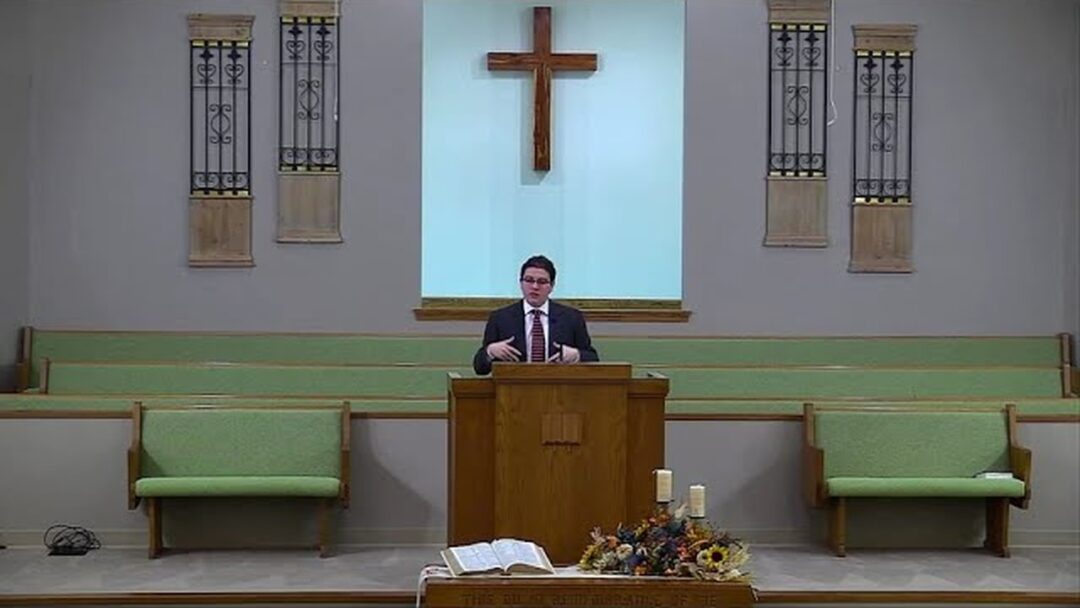
From our Sunday service on September 8, 2024, 2 Peter 1. Watch the full message: Growing in Godliness on YouTube.
We’re going to be in 2 Peter 1 once again. I thought we’d do a series, taking one book of the Bible and going through it over the next few weeks to see what we can learn. This series for the month of September is called Nurturing Faith in a Changing World.
I think you can all agree that our society here in the United States has been drifting further and further away from God over the past few decades. Things that used to be sacred, like Sundays, are not held in such high regard. It used to be easier to get off work. It used to be that going to church wasn’t something to make fun of or think was a waste of time. It was just normal and expected. Society has moved further away from that, so we’re going to look at nurturing our faith in a world that’s changing and walking away from it.
Second Peter was written by Simon Peter, the disciple and apostle, shortly before his death, around AD 64 to 68. Emperor Nero was in charge of Rome and was persecuting the church. But there was a bigger threat to the church that Peter writes about. False teachers were going around claiming to have secret teachings of Jesus, and they were taking the teachings of Jesus and reframing them based on their own new interpretations.
You can see the same trend in some denominations in America today, and in individual churches, whether or not they’re associated with a denomination. They say, “That’s not really what the Bible was saying,” or “The Bible was written for the people of that time and cultural context, so who are we to push their moral expectations on our society?” Then they say, “I have this new teaching. I have this secret understanding,” and they start reframing the teachings of Christ based on their own interpretations and the culture they live in.
In Peter’s day it was early Gnosticism. People taught that Jesus was more like a magician with crafty sayings, and that he had secret truths about salvation that were only for the select few. They also taught that some of the sins of the world, such as sexual sins, were not a big issue anymore, that it was just a kind of metaphor. That’s similar to the situation we’re in today.
So Peter writes to prepare all believers to withstand false teachers. The main argument he uses across the whole book is that biblical knowledge is the best offense against false teaching. My proposition for you today is that God wants you to be knowledgeable in the word.
A Servant First, an Eyewitness Second
Simon Peter, a servant and an apostle of Jesus Christ, to them that have obtained like precious faith with us through the righteousness of God and our Saviour Jesus Christ: Grace and peace be multiplied unto you through the knowledge of God, and of Jesus our Lord,
2 Peter 1:1–2
Peter starts everything perfectly, by setting an example for the reader. He isn’t just going to teach what it means to be a Christian. He’s going to show what it looks like.
Notice how he introduces himself: “a servant and an apostle of Jesus Christ.” Like Paul in his letters, Peter humbles himself by calling himself a bondslave of Christ first. Second, he is an apostle, someone who was an eyewitness of Jesus while he walked on the earth and who heard Christ’s teaching straight from his mouth. Peter could have boasted about that. He could have said, “I am an eyewitness of Jesus. That is my title.” Instead he says, “I have put myself under submission to Jesus, and the first and foremost quality I want you to know about me is that I am submitted and dedicated to Christ.” Then he adds that he is also an eyewitness. Who better to correct false teaching than someone who sat with Christ as he taught every day?
It’s more important to be surrendered to Christ than it is to have seen Christ with your own eyes. We may never see Christ with our eyes until we see him in glory, but there is something greater than that, and it’s to be surrendered to Christ and know his word.
Peter is writing to those who have “like precious faith,” the same faith Peter had, in contrast to the false faith going around that is based on secrecy. He’s writing to people who haven’t given in to the new ideology that the things Christ said weren’t exactly as he said them.
Everything We Need
According as his divine power hath given unto us all things that pertain unto life and godliness, through the knowledge of him that hath called us to glory and virtue: Whereby are given unto us exceeding great and precious promises: that by these ye might be partakers of the divine nature, having escaped the corruption that is in the world through lust.
2 Peter 1:3–4
Peter says that according to God’s divine power, we’ve been given “all things that pertain unto life and godliness.” We’ve talked about this divine power: Christ sent his Spirit to dwell in us. Peter is saying that if you’re looking for these false teachings outside of the word and the Spirit, you’re looking in the wrong place. God has given us the Spirit to discern, and the Spirit and the word give us everything we need for our life on this earth and for godliness. Godliness is the idea of a proper reverence for God and a proper submission to God.
The “knowledge of him that hath called us” is a saving knowledge in Jesus Christ, and through this salvation we are given “exceeding great and precious promises.” There are many promises in the Bible for those who put their faith in Christ. We’re promised forgiveness, that our sins will be removed as far as the east is from the west and won’t be brought up anymore. We’re promised transformation through the Holy Spirit if we follow him. We’re promised a resurrection at the end, when our bodies will be raised from the dead. And we have the down payment of those promises in the Holy Spirit.
“Partakers” is a legal term. It’s what you’d call a shareholder who holds stock, or, in the context of the Romans, a joint partner who owns half of a business. We share the Holy Spirit together as one in Christ, and it’s through this that we can escape “the corruption that is in the world through lust.” Lust is a wrongful desire, a longing, a desperate need for something that is bad for you. The false teachings were making that corruption acceptable. Peter says there is something better than giving in to the corruption around you. There is a Spirit inside you with the power to overcome it.
Add to Your Faith
And beside this, giving all diligence, add to your faith virtue; and to virtue knowledge; And to knowledge temperance; and to temperance patience; and to patience godliness; And to godliness brotherly kindness; and to brotherly kindness charity.
2 Peter 1:5–7
Beyond having the Holy Spirit as our teacher, we need to do some more work to protect ourselves. “Diligence” is the idea of being eager and ready to act, putting your full energy into it. You have faith, and faith is what saves you and gives you the Holy Spirit, but there are other steps we need to take.
Virtue
In my Greek study I found it interesting that the word for virtue here is the Greek word for manliness. Men, here’s a little lesson for you: in the Bible there is no such thing as manliness without virtue. They’re inseparable. There is no manly man who is not also virtuous. The attribute is being an honest man, a man with integrity. So not only do you need faith in God, you need integrity.
Knowledge
Knowledge here means the teachings of Christ and understanding them. It doesn’t do you much good to be saved and have virtue but not know anything about the word of God. How are you supposed to keep making wise, biblical, God-honoring choices if you don’t know what the Bible says those choices are?
Temperance
Temperance is self-control, the ability to restrain yourself from action. Instead of instantly jumping out and making choices without thinking them through, you ask, “Is this a good idea? Is this something I should do or shouldn’t do?” Instead of quickly giving an answer, you take time to think it over.
Patience
It’s good to have self-control, but it’s even better to wait on God’s answer. Sometimes God’s answer takes a lot of patience. Patience is a virtue we need to have if we’re going to be proper followers of God and not be driven away by every wind of doctrine.
Godliness
Godliness is reverence, the proper respect for God that we talked about in the first service. We need to accept that God is sovereign and can do anything he wants, and no matter what he does, some people will think it’s good and some will think it’s bad. Whether God’s mercy is a good thing to you usually depends on whether you’re the one sinning or the one sinned against. To be in a proper state of mind, we need to realize that God is so much bigger than we are and knows so much more than we do, and say, “God, I have reverence for you. I want to be like you. I want to follow you in every step I take.”
Brotherly Kindness and Charity
What good is reverence and self-control if all we’re doing is responding, instead of going out and doing something ourselves? Brotherly kindness is the idea of friendliness, the kind of love you have for a friend in your life. But the Bible also tells us that if we only love those who are our friends, what praise do we have? The wicked do that too.
So Peter says to add to your friendly love agape love, which is translated here as “charity.” That is a sacrificial love, a love that acts. It’s used in the context of a spouse, and it’s not a sensual love. That would be eros, a different Greek word. They had two words to describe marital love: eros, which was sensual, and agape, which was sacrificial. The last thing Peter says you need to develop, after all these character traits, is to love people who are your friends and love people who are your enemies, to go out and do good to them expecting nothing in return. This is always the end game of the Christian: to be a giver in the name of Jesus Christ.
Why It Matters
For if these things be in you, and abound, they make you that ye shall neither be barren nor unfruitful in the knowledge of our Lord Jesus Christ. But he that lacketh these things is blind, and cannot see afar off, and hath forgotten that he was purged from his old sins.
2 Peter 1:8–9
If you put these attributes in your life every day, if each day you look at this checklist and ask, “Do I have this? Do I have this? What am I lacking today? What can I improve?” Peter says it is impossible for you to be barren or unfruitful. In other words, it’s impossible for you not to produce good works or not to show the love of God in your life. If you’re following these attributes, the rest comes naturally.
One way I’ve seen this put is to go around every day imagining that every person you interact with is Jesus. Jesus sets that example in the Bible.
And the King shall answer and say unto them, Verily I say unto you, Inasmuch as ye have done it unto one of the least of these my brethren, ye have done it unto me.
Matthew 25:40
If you ask, “If the person at this table were Jesus, how would I react to him right now?” and then react to that person as if he were Christ, it’s impossible for you to sin against him or be judgmental of him. A lot of times we get so stressed as Christians about arriving at the destination that we prevent ourselves from getting there. Peter says it’s easy: just try to get these few things down every day, and the rest comes naturally.
But those who lack these things are blind. If you don’t have these attributes and you’re trying to achieve godliness and be like Christ, there’s no hope. You’re nearsighted, and you’ve forgotten that you were purged from your old sins. You’ve forgotten the man you were. You think you’re a Christian and that on your own you can make yourself what you’re supposed to be. You’re not surrendering to Christ. You’re trying to get there your own way and forgetting that Christ is the one who transformed you.
Wherefore the rather, brethren, give diligence to make your calling and election sure: for if ye do these things, ye shall never fall: For so an entrance shall be ministered unto you abundantly into the everlasting kingdom of our Lord and Saviour Jesus Christ.
2 Peter 1:10–11
Peter is saying that new secret teachers keep popping up and saying God wants you to really do this or really do that. There’s a good way to sort all of that out: follow these attributes in your life, and anything God wants you to do you’ll already be doing. Those who practice these attributes are unable to be useless for Christ. You’ll naturally serve him if you seek to do these things. Without them, you’ll be blind, unable to tell the truth from a lie, and prideful about your salvation. If you focus on finding these attributes in your life, you’ll not fall into sin, because when these things are a priority, sin and lust cannot overpower you. They’re no longer important.
Peter Will Remind Us Until He Dies
Wherefore I will not be negligent to put you always in remembrance of these things, though ye know them, and be established in the present truth. Yea, I think it meet, as long as I am in this tabernacle, to stir you up by putting you in remembrance; Knowing that shortly I must put off this my tabernacle, even as our Lord Jesus Christ hath shewed me. Moreover I will endeavour that ye may be able after my decease to have these things always in remembrance.
2 Peter 1:12–15
Is this stuff new to us, that we’re supposed to be patient and have self-control? No. Peter says, “though ye know them.” We too need to be reminded from time to time. That’s why the Spirit spoke through Peter to write it down. The world wants to distract us, and false teachers want to give us a new way to look at things. But following Jesus isn’t supposed to be complicated. It’s not a book you have to buy to figure out how to be a good Christian. Everything we need is right here in the Bible and right here in our hearts. Peter says, “I’m going to remind you until the day I die that you have what you need, and there’s nothing new that’s going to make it any easier.”
He says, “I will endeavour that ye may be able after my decease to have these things always in remembrance.” That prayer was answered. It was recorded in the word of God and kept there always for our remembrance.
A More Sure Word
For we have not followed cunningly devised fables, when we made known unto you the power and coming of our Lord Jesus Christ, but were eyewitnesses of his majesty. For he received from God the Father honour and glory, when there came such a voice to him from the excellent glory, This is my beloved Son, in whom I am well pleased. And this voice which came from heaven we heard, when we were with him in the holy mount.
2 Peter 1:16–18
Peter knows there are people out there creating lies and writing fake gospels with fake accounts of what Jesus did and taught. So he says what he comes to teach is not a cleverly made myth or fan fiction about who Jesus could have been. He was an eyewitness of Jesus Christ and his majesty. He walked with him on this earth and heard what he taught, and he can say that these false teachings have nothing to do with him.
How does Peter know? He was on the Mount of Transfiguration, when they saw Christ’s glory transfigured before them and heard the voice of God confirm that Jesus was the Messiah. Because of that, he knows for a fact that Jesus is who he said he was. He saw it with his own eyes. It isn’t a myth or a legend. It is reality.
We have also a more sure word of prophecy; whereunto ye do well that ye take heed, as unto a light that shineth in a dark place, until the day dawn, and the day star arise in your hearts: Knowing this first, that no prophecy of the scripture is of any private interpretation. For the prophecy came not in old time by the will of man: but holy men of God spake as they were moved by the Holy Ghost.
2 Peter 1:19–21
But Peter doesn’t end with his own testimony, because it only goes so far. He says, “I’m just Peter. I’m the guy who told Jesus, ‘Be it far from thee, Lord: this shall not be unto thee.’ I’m the Peter who said, ‘Lord, not my feet only, but also my hands and my head.’ I’m the Peter who walked on the water and then lost faith and sank. I’m the Peter who denied Jesus three times. I’m an eyewitness, and I make mistakes.” So he points to something greater: a more sure word of prophecy, the word of God.
Peter says you do well to take heed to it as to “a light that shineth in a dark place.” Think of this book as a light in a dark place.
Thy word is a lamp unto my feet, and a light unto my path.
Psalm 119:105
Take that verse seriously. Take it as if you live in a dark world that is trying to trick you into falling into lust and is constantly trying to reframe the words of Christ. Take this lamp and use it “until the day dawn, and the day star arise in your hearts.” That’s talking about salvation with Jesus.
“No prophecy of the scripture is of any private interpretation.” The prophecies about Jesus Christ confirm who he said he was. There are thousands upon thousands of prophecies about Jesus that all came true, and when you look at them there is no doubt that Jesus was the Messiah. These things were outside of his control unless he was God. Those prophecies didn’t come because man wanted them. Salvation didn’t come the way it did because man came up with a clever idea to save himself. They came as holy men of God, devoted to him, felt the Spirit of God on their hearts and were told to write this down for future generations.
So there is a testimony greater than Peter’s, and it’s the word of God. The Bible foretold Christ. Peter was going to pass away soon, but God’s word will not pass away.
Go Back to the Word
The world is constantly in flux, moving toward God and away from God. As the waters get rocky, as the world gets difficult, and as truth and lies become obscured in your day-to-day life, go back to the word and familiarize yourself with it. One of the virtues you need to never fail in is knowledge of God’s word. If we as Christians want to overcome the darkness of the world and walk without stumbling, we need to know what God’s word says and follow it.
Scripture does not have a private interpretation. There is no secret knowledge. There are no secret golden plates that were buried in Manchester, New York. There are no secret meetings in caves on Mount Hira near Mecca. There are no hidden books of scripture lost to time. There have been no secret meetings with Jesus where he opens someone’s mind to new revelation. What God has revealed has been revealed in his word. This is our revelation: the word of God and the Spirit inside us.
We live in a world where the truth can be whatever you want it to be. Our society teaches us that right and wrong are more gray than they’ve ever been. So how will you prepare yourself to live in this world? God teaches us that truth comes from his word and from knowledge of his word. The question is, are you reading his word? Are you studying it and meditating on it? Are you praying for God to make his will for your life clear and to make the steps you should take visible to you?

Recent Comments