
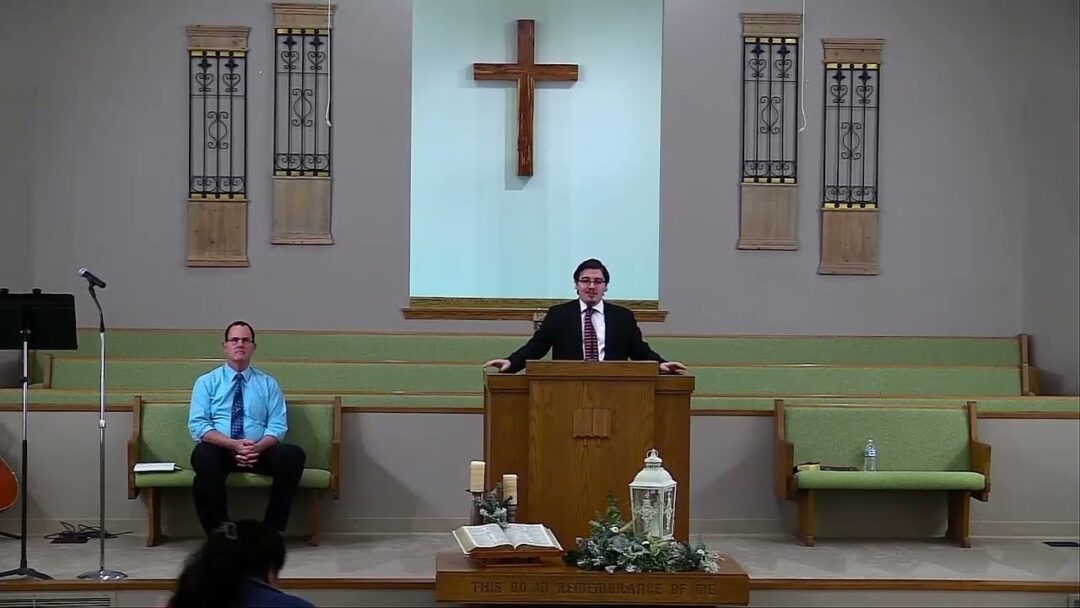
From our Sunday service on January 26, 2025, 2 Corinthians 5, Matthew 5, Galatians 2, Titus 2, Colossians 4, John 13, 2 Timothy 2, Zechariah 7, Leviticus 19, Deuteronomy 10, Matthew 25, and Hebrews 13. Watch the full message: Ambassadors for Christ on YouTube.
Halfway through this week I shifted the last part of my message. It was already something we were going to talk about, but as the week went on I felt a greater need to address the topic in more detail. With the inauguration having just occurred, I thought a message with a bit of a political theme was fitting. As the bulletin says, the message is “Ambassadors for Christ.” Most Christians know we’re supposed to be ambassadors for Christ, so today I want to look at what that means and what qualities an ambassador for Christ should have.
Now then we are ambassadors for Christ, as though God did beseech you by us: we pray you in Christ’s stead, be ye reconciled to God. For he hath made him to be sin for us, who knew no sin; that we might be made the righteousness of God in him.
2 Corinthians 5:20–21
What is an ambassador, and what is his responsibility? Webster’s 1828, the dictionary to use if you want a definition in line with the KJV, says an ambassador is “a minister of the highest rank employed by one prince or state at the court of another, to manage the public concerns of his own prince or state, and represent the power and dignity of his sovereign.” In that definition we see three roles, and from a biblical perspective the ambassador of Christ is employed by Christ, manages the concerns of Christ, and represents Christ to others. The first step is that you have to be saved. Then how do we manage Christ’s concerns and represent him to others? Today I hope to show you some ways, and at the end I want you to realize that God wants you to be his ambassadors.
Our Responsibility: Salt and Light
Before we look at the qualities of an ambassador, let’s look at the responsibility. This is from the Sermon on the Mount, where Jesus teaches that believers are to be the salt and the light of the world.
Ye are the salt of the earth: but if the salt have lost his savour, wherewith shall it be salted? it is thenceforth good for nothing, but to be cast out, and to be trodden under foot of men. Ye are the light of the world. A city that is set on an hill cannot be hid. Neither do men light a candle, and put it under a bushel, but on a candlestick; and it giveth light unto all that are in the house. Let your light so shine before men, that they may see your good works, and glorify your Father which is in heaven.
Matthew 5:13–16
You Are the Salt of the Earth
I don’t think “salt” is an analogy we use much in the modern world, so let’s step back and ask what salt was used for in ancient Israel. The first thing that would have come to mind is that salt is a preservative. You surround your meat with salt to pull away the moisture and stop it from spoiling. So if we are the salt of the earth, we are meant to preserve righteousness in the world by carrying the teachings of Christ to those who have never heard them. Salt stops corruption from spreading.
If Christ just wanted to save people, he could say, “Do you choose me, yes or no? Circle your answer,” and if you circled yes, take you to heaven right now. Some days some of us might prefer that. But that’s not how God chose to do it. He said, “I’m going to save you, lead you, and use you as a light to the world, and I want you to stay on this earth and continue the work I did.” Jesus calls himself the light of the world before he calls us the light of the world, because he wants to signify that we have the same mission. He taught the truth. He called out corruption. He overturned the money changers’ tables in the temple and called out the Pharisees for their hypocrisy. Now he says, “I’m leaving. I need you to carry on the mission I started. I need you to be the salt that preserves this world.” Yes, he could pull us out, but that would give this world over to evil. The only thing evil needs to prosper is for good men to do nothing, if I do believe that’s a quote.
The gospel message itself would not be preserved without Christians to continue Christ’s work. If everyone who heard the gospel just disappeared, there wouldn’t be churches for people to walk into on a bad day and hear the gospel. They’d have to find an ancient scroll from thousands of years ago and happen to know the language to read it. It takes good Christian men and women to preserve the gospel and spread it to their neighbors.
Salt also enhances flavor. It doesn’t make a different flavor but enhances the flavors that already exist. John Chrysostom, a theologian from around AD 400, said that by saying “You are the salt of the earth,” Jesus signifies that all human nature has lost its flavor, having become rotten through sin. This fallen world has good things, because God created the world and said everything was good, but in a fallen world we lose track of them. The Christian is to enhance the flavor of this world: to bring back a little bit of heaven to earth and show people what it’s like to follow Jesus, with the good works, good morals, and teachings of Jesus Christ.
Then there is the warning: salt is good for nothing if it loses its savor. We can be people who believe in Jesus Christ and have the gospel, yet lose our savor, which here means having an off-putting taste. I’ve never had a bag of salt that was bitter, but if you got a pack from Walmart and it had a bitter flavor, you’d throw it out immediately. That’s the picture. If the salt is bitter and ruining the flavor of everything it touches, it’s good for nothing, so you dump it outside. The Christian with that bitter flavor, who hasn’t followed Christ’s instructions or upheld his duty as an ambassador, loses his preserving and flavor-enhancing qualities when he lets bitterness overtake him.
In the ancient world, when conquering armies took a city, they sometimes spread salt over the farmland to kill the soil. With the Roman Empire at its height, I’m sure some conquered nations had their fields salted. That would also have come to mind. Bad salt doesn’t just get thrown out. It can be a destructive force, actively negative rather than apathetic. I saw three or four of the church fathers draw out this analogy in their letters: just as soil is destroyed by salt thrown on it, the gospel is diminished by a Christian whose salt has lost its savor. When we give off a bitter flavor, we become a force of destruction rather than preservation. So being salt is important enough that it can preserve, transform, and enhance, but also destroy.
You Are the Light of the World
This one is easier to understand. Darkness is common today, and light is a force that removes darkness from the world around it. We are to shine light on the darkness of this world and be a hope and a direction. Like a mosquito flies to light, we’re supposed to be the light that directs others straight to Christ. And the light is not of ourselves. It is of God, and we are a reflection of his light. It’s not about us; it’s about him.
But there’s a warning here too. A city set on a hill cannot be hid, and nobody lights a candle and puts it under a bushel. There’s a real risk that we receive the light of Christ and are too scared to shine. We put a basket over ourselves and darken our light so others can’t see it. When the Christian hides the truth of Christ in him, it defeats the whole purpose of us living on this earth. If we want to live with purpose, our light needs to shine and our salt needs to preserve, protect, and enhance.
So what are we supposed to do? Verse 16 says, “Let your light so shine before men, that they may see your good works, and glorify your Father which is in heaven.” If we want the light of Christ to shine, we have to do good works. When we do, we reveal Christ’s light in us and point people to him, and everybody around us can see it, like a city on a hill whose light shines for miles. That’s our responsibility, and it’s what we’re fighting for as Christians: to preserve this world from darkness and direct people to the light.
The Qualities of an Ambassador
A Clear Identity with Jesus Christ
I am crucified with Christ: nevertheless I live; yet not I, but Christ liveth in me: and the life which I now live in the flesh I live by the faith of the Son of God, who loved me, and gave himself for me.
Galatians 2:20
The Christian has the opportunity, when he’s saved, to stay on this earth as Christ’s representative. He’s been changed and has a new identity in Christ. He doesn’t live for the flesh or his own pleasure but by faith in the Son of God, who sacrificed himself for us. So a good ambassador must die to self and place his identity in Christ. He can’t think, “What benefits me, me, me, I, I, I?” He thinks, “What benefits the mission I’m here for, my purpose as salt and light, to preserve and shine the light of Jesus?”
Then said Jesus unto his disciples, If any man will come after me, let him deny himself, and take up his cross, and follow me.
Matthew 16:24
Choosing to be a Christian who shines his light is not easy. Jesus compares it to Roman crucifixion: grabbing your cross and walking yourself to Golgotha, where they’re going to nail you to it. If you’re going to follow him, you have to say, “I cannot live for me, or I will not succeed in this goal set before me.” I have to carry my cross and die daily. A good ambassador denies himself every day and makes a purposeful choice to do what is hard.
Integrity and Credibility
In all things shewing thyself a pattern of good works: in doctrine shewing uncorruptness, gravity, sincerity, Sound speech, that cannot be condemned; that he that is of the contrary part may be ashamed, having no evil thing to say of you.
Titus 2:7–8
An ambassador can’t be corrupt. “Gravity and sincerity” means being serious and grounded. Life’s not a joyride or a party, and you’re not living all willy-nilly, not caring about anything. Christ has called you for something, and you’re responsible to represent Jesus Christ, your Savior and God, on this earth. You need to be sincere and take that seriously.
“Sound speech that cannot be condemned” means being careful about the words you say. There are words that can destroy your testimony, and in a moment I’ll give some examples from my own life. Why does it matter? “That he that is of the contrary part may be ashamed, having no evil thing to say of you.” There are people who are against Christ, waiting for an opportunity to slander the name of God, to post on Twitter or Facebook what you did and why it shows God’s not real. We need to be careful that what we say doesn’t give them something to fire back and blaspheme our God to everyone around them.
So how’s your testimony at work? What do people there think of you? Are you someone who gossips about other employees behind their back? It may not be anything severe, but it could be a cause of shame. Do you shift a few numbers in the work logs to get a little extra cash, one or two people added because you’re a few steps from a bonus? “It’s not a big deal, no one will notice.” Do you tell little white lies to look better in front of your boss? Sometimes something doesn’t go completely right and you think, “I could shift the blame to somebody else, or blame the customer, instead of getting in trouble.” If you’re doing that, your sound speech is at risk, your testimony is in danger, and your salt is at risk of becoming bitter and your ministry ending. We can’t make little white lies we think won’t be caught. You can’t do it forever. One day it will catch up with you.
What’s the first thing people think when they hear your name? Do they think, “I could trust them with anything, I know what they say is true”? Or do they think, “Some things have been kind of weird lately about them. I’m just not sure”? If you’re new, that’s okay. But if you’ve been at a company for years and your coworkers aren’t sure about you as a Christian, then what have we been saying?
Gracious Communication
Walk in wisdom toward them that are without, redeeming the time. Let your speech be alway with grace, seasoned with salt, that ye may know how ye ought to answer every man.
Colossians 4:5–6
The church may think you’re great. They see you every Sunday and think you’re a perfect Christian living a perfect life. But what about the lost you interact with? You’ve got to think before you speak and pray before you respond to conflict, and season your words with kindness and wisdom. Some days it’s going to be hard. There will be real conflict and real temptation to respond in anger or confrontationally, but as Christians we are to have our communication gracious and well seasoned.
“Redeeming the time” also means knowing when to speak and when to keep your mouth shut. There are some people you just don’t talk to. If a conversation is just going to end in a fight, don’t let the conflict start to begin with. Don’t waste your time on arguments that go nowhere. Spend your time talking with those who actually want a conversation. Some people don’t like the fact that you’re a Christian and will never give you the time of day. If they just want to fight, don’t fight, and don’t give them the ability to say later, “I fought with a Christian today, they were so mean.” If they don’t want a conversation, don’t have one. That’s between them and God and the Holy Spirit. Redeem the time: know when to speak and when to remain silent.
Love and Compassion
A new commandment I give unto you, That ye love one another; as I have loved you, that ye also love one another. By this shall all men know that ye are my disciples, if ye have love one to another.
John 13:34–35
The only way people are going to know that Christianity is real and Christ has really changed us is if we show love to one another. Jesus says this shortly before his arrest and death. He’s giving his disciples instructions and says, “Now that I’m leaving, I’m going to give you one instruction to live by. It’s a lot less complicated than what I’ve been saying before. Love each other. If you love one another, everything else will naturally fall into place.” The only way people will know we are Christ’s ambassadors is by our love. It’s not going to be our church attendance, our tithes, or the words we say about being a Christian. It will be the actions we do through our love for them. If we fulfill this command, all the other requirements will naturally follow.
Faithful in Conflict
Thou therefore endure hardness, as a good soldier of Jesus Christ. No man that warreth entangleth himself with the affairs of this life; that he may please him who hath chosen him to be a soldier.
2 Timothy 2:3–4
This is Paul writing to a pastor. This is where things really get hard, when you’re tested in your Christian walk. The “hardness” is a general difficulty, and in this case it’s conflict. God knew what was coming down the road. These Christians already lived under a repressive regime in the Roman Empire. Jesus knew when he went to the cross that his church was going to suffer and deal with some hard topics and hard choices. So Paul says to Timothy, in effect, “Preacher man, if you’re going to represent Christ well, you have to endure difficulty as a good soldier.”
And he gives a warning: no soldier who goes to war entangles himself with the affairs of this life. If you want to be a good soldier for Christ, you’re going to have to let go of some battles. A soldier can’t fight on the battlefield and be at home at the same time. He does it to please the one who chose him, Jesus Christ, and we can’t please Jesus if we’re going to fight battles outside of his war. Life comes with difficulty and conflict, period, end of story. As Christians we need to be ready to face it.
John Chrysostom said, “You are a spiritual soldier. This kind of soldier does not sleep on an ivory bed but on the ground. He is not anointed with perfumed oils. You must not smell of perfumes but of virtue.” A soldier’s life isn’t easy. He doesn’t live in the Roman cities enjoying the fresh water from the aqueducts, the bathhouses, or the fancy perfumes of the market. He doesn’t have the liberty to make himself comfortable or look nice. He sleeps on the dirt of the wilderness in tents. So don’t get trapped in the battles and comforts of this world, because God hasn’t called us to sit in comfort but to do the work. We cannot serve God if we’re wrapped up in the controversy of this world. A Roman soldier didn’t focus on what was happening back home in his city.
Basil of Caesarea also said, “Where is Christ the King? In heaven, to be sure. In this direction it benefits you, soldier of Christ, to direct your course. Forget all earthly delights. A soldier does not build a home, does not aspire to possess lands, does not concern himself with crafty, coin-providing trades. The soldier enjoys sustenance provided by the king. He need not furnish himself or worry in this regard.” If you’re going to be an ambassador or a soldier for Christ, you’ll have to let go of some things. The soldier doesn’t worry about buying property or starting a new business, because he’s paid for by the king. God will provide, and he’s not going to worry about living in luxury in this world. There’s a real risk that we get so distracted providing for ourselves that we sacrifice our ministry to do it.
No man can serve two masters: for either he will hate the one, and love the other; or else he will hold to the one, and despise the other. Ye cannot serve God and mammon.
Matthew 6:24
We cannot become so wrapped up in what’s going on in the world that we lose focus on what Christ has called us to do as his ambassadors.
A Warning: Loving the Foreigner
This last section is not targeted at any individual. I haven’t seen this in our church, but it’s something I’m a bit concerned about. What I’m about to say is not an issue of left versus right but of right versus wrong. It’s not Democrat or Republican but biblical truth. It’s not a matter of personal opinion but a fundamental teaching of Scripture. I’ve seen a trend in America and in our churches. A few of my friends in the ministry have brought it up, and I’ve seen it poking its head into my life and the lives of those around me. I have a similar feeling to what I had in 2018, and I’ll use two examples of how I felt it before.
In 2018 the scientist Stephen Hawking passed away after a long battle with ALS. He was the one in the chair with the robot voice. I was at Pensacola Christian College, spending almost all my time around Bible majors, pastors, and teachers, and I saw a trend that broke my heart. They had confused Stephen Hawking with Richard Dawkins, the author of The God Delusion, and when they heard Hawking had died, they said something along the lines of, “Good, he can rot in hell and know that he was wrong about his atheism and that God is real.” I heard that come from someone training to be a pastor: “Good, he can rot in hell.” Christian, that’s not a word that can come out of your mouth, let alone the mouth of a pastor. I saw this trend as I walked through the campus, one after another saying, “Good, this guy who is against Christianity is dead and his punishment is eternal.” God forbid those words come out of our mouths. How destructive an attitude. The salt has lost its savor, the light has gone out. That broke my heart.
I had a similar experience in 2019, when the mask mandate came out. I have some immunocompromising qualities, and I’m about three times more likely to get sick when something is going around. I was in a class of Bible majors, and the guy to my right was ranting about the mask mandate: “I hate it, why should they make me do that?” The whole class started discussing it. “Why should I have to wear a mask to protect those immunocompromised people? Can’t they just stay home and have their groceries delivered? Why should I make myself uncomfortable? That’s their problem. If they die, it’s because they were weak.” I’m sitting right next to this man as he talks to my face about me. “I’m an immunocompromised brother. I’m sitting right next to you. Do you know what conversation you’re having? You just told me to my face it’s okay if I die because I’m weak.” The salt lost its savor and the light went out. I would never invite that man to work at my church or speak at one of my conferences. Christian, be careful what your words say. You never know who is around you. When the mask mandate for PCC did come out, he bought himself a mesh mask with holes in it to make a statement that he wasn’t going to follow it, and he sat right next to me sick. God forbid this be the attitude of the Christian. Care for those around you and show love. Love is the only way people know we are Christians.
Today I’ve seen another trend, and I’d like to talk about the biblical teaching about love for the foreigner. I’ve seen some hate going around, in my life and in the lives of others, and I don’t want this church to be tempted to fall into it. The news wants you to get along with their narrative that all these people are our enemies, and as Christians we cannot get entangled with the war and lose our testimony.
When I was doing my research on Thursday, I found that there are supposedly 400 verses in the Bible calling us to love immigrants, foreigners, and refugees. I thought that number was way too high, so I did some research, and after about five minutes of counting I found over 70 verses specifically about not oppressing the foreigner. The number may in fact be true, though I don’t have time to commit to 400 verses for a week’s study, so I’d like to highlight a few. A note first: the Old English word for “foreigner” in the KJV is “stranger.”
Zechariah 7
Here God gives a very stern warning that we should pay careful attention to.
And the word of the LORD came unto Zechariah, saying, Thus speaketh the LORD of hosts, saying, Execute true judgment, and shew mercy and compassions every man to his brother: And oppress not the widow, nor the fatherless, the stranger, nor the poor; and let none of you imagine evil against his brother in your heart. But they refused to hearken, and pulled away the shoulder, and stopped their ears, that they should not hear. Yea, they made their hearts as an adamant stone, lest they should hear the law, and the words which the LORD of hosts hath sent in his spirit by the former prophets: therefore came a great wrath from the LORD of hosts. Therefore it is come to pass, that as he cried, and they would not hear; so they cried, and I would not hear, saith the LORD of hosts: But I scattered them with a whirlwind among all the nations whom they knew not. Thus the land was desolate after them, that no man passed through nor returned: for they laid the pleasant land desolate.
Zechariah 7:8–14
It’s clear from this passage that God will not bless a nation that oppresses its foreigners. Part of the reason Israel went into captivity was that they oppressed the foreigners who resided in their nation and treated them unfairly.
Leviticus 19
And if a stranger sojourn with thee in your land, ye shall not vex him. But the stranger that dwelleth with you shall be unto you as one born among you, and thou shalt love him as thyself; for ye were strangers in the land of Egypt: I am the LORD your God.
Leviticus 19:33–34
The word “vex” means to oppress or mistreat, so we are supposed to treat foreigners as one of us. Why? Is it because of a political affiliation? No. Social justice? No. An agenda? No. Because, as God says, “I am the LORD your God.” We are supposed to treat others with dignity because they are made in God’s image and God loves them.
Deuteronomy 10
He doth execute the judgment of the fatherless and widow, and loveth the stranger, in giving him food and raiment. Love ye therefore the stranger: for ye were strangers in the land of Egypt.
Deuteronomy 10:18–19
This is talking about God. God has no bias. He loves everyone, and it specifically says he loves the foreigner and executes judgment to protect and provide for them. So we must love them like God does, and to oppress the foreigner is to oppose God’s teaching.
What Jesus Says
When the Son of man shall come in his glory, and all the holy angels with him, then shall he sit upon the throne of his glory: And before him shall be gathered all nations: and he shall separate them one from another, as a shepherd divideth his sheep from the goats: And he shall set the sheep on his right hand, but the goats on the left. Then shall the King say unto them on his right hand, Come, ye blessed of my Father, inherit the kingdom prepared for you from the foundation of the world: For I was an hungred, and ye gave me meat: I was thirsty, and ye gave me drink: I was a stranger, and ye took me in: … Then shall the righteous answer him, saying, Lord, when saw we thee an hungred, and fed thee? or thirsty, and gave thee drink? When saw we thee a stranger, and took thee in? or naked, and clothed thee? Or when saw we thee sick, or in prison, and came unto thee? And the King shall answer and say unto them, Verily I say unto you, Inasmuch as ye have done it unto one of the least of these my brethren, ye have done it unto me. … Then shall he say also unto them on the left hand, Depart from me, ye cursed, into everlasting fire, prepared for the devil and his angels:
Matthew 25:31–41
Jesus explicitly says that when we meet him, one of the things he’s going to ask is why we didn’t care for the foreigner when they needed us. God cares for the foreigner, and he does not want us to oppress them. Yes, we have laws in this nation, and yes, they should be followed. But just because somebody breaks the laws doesn’t mean we should break our testimonies. The situation is complex and multifaceted, with generations of issues to resolve, but in our daily speech we must be sure that we speak with love and do not consider these people enemies, because the Bible says we do not wrestle against flesh and blood but against principalities and powers, against the wickedness in high places. We must not fight against others but love others. I’ll read Hebrews 13:1-2 to summarize.
Let brotherly love continue. Be not forgetful to entertain strangers: for thereby some have entertained angels unawares.
Hebrews 13:1–2
Be careful not to forget to be kind to foreigners, because sometimes those foreigners were God’s messengers in disguise.
Remember Your Calling
The Bible teaches us that we are ambassadors of Christ. That means we’re employed by Christ, we manage the concerns of Christ, and we represent Christ to others. We’re called to be salt and light: we preserve the gospel, enhance this world, and light the way to Jesus through the things we do. We are to identify with Christ, with integrity, grace, love, and compassion, and to be faithful to these qualities even in the midst of conflict and adversity. And remember, don’t fall into the traps and battles of this world. We have a battle that’s not here, and we are soldiers for it. Remember your calling. God wants you to be his ambassador. Will you choose to be a faithful ambassador today?

Recent Comments