
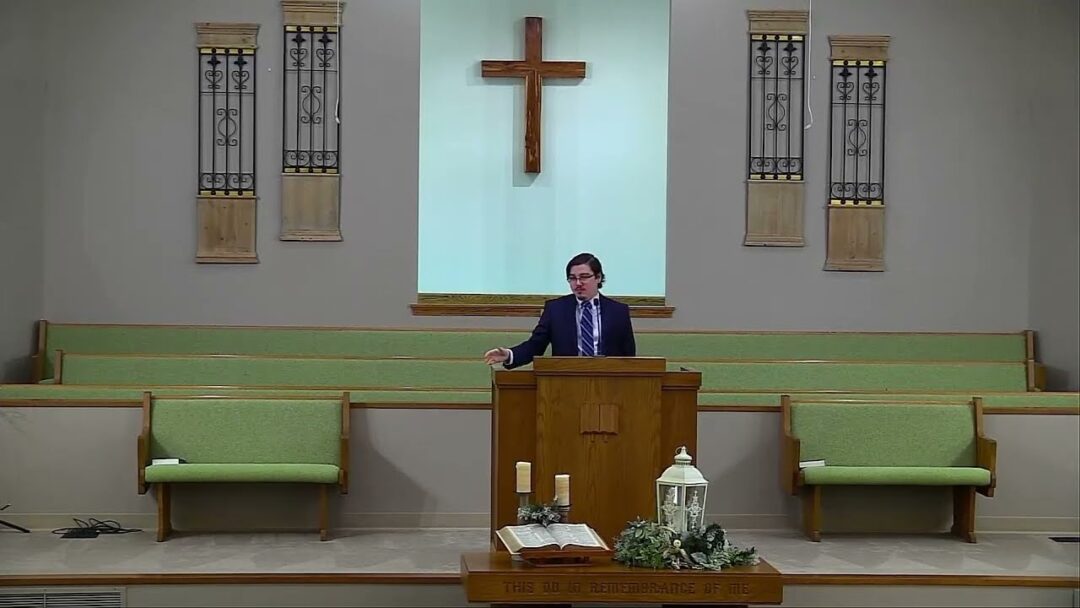
From our Sunday service on March 2, 2025, Ephesians 1. This is part 1 of our Ephesians series. Watch the full message: The Blessings of Salvation – Ephesians Series #1 on YouTube.
I hope you all enjoyed our last series on the book of Ruth. I really enjoyed doing the study, and today I’d like to begin a new series. This one also comes from your recommendations, so thank you for that. We’re going to be looking at the book of Ephesians.
Ephesians was written by the apostle Paul in Rome, where he was imprisoned around AD 60 to 62. What’s unique about this letter is that when Paul writes to a church, it’s often to correct them of something they’re doing wrong. Ephesians isn’t like that. Paul is writing to a church he calls faithful, a church that is doing what God called them to do. Rather than call them out for their mistakes, he writes to encourage them to continue to be faithful and to double down on their devotion to Christ. Usually when we’re reading Paul, he’s slapping us around. For the rest of this series, he isn’t. We get a break from being corrected and a series that’s about encouraging us to fully embrace the salvation that has been given to us and our duty as believers.
Who Was This Written To?
Paul is writing to the people of Ephesus, as you may have guessed from the name. Ephesus was an ancient city in modern-day Turkey, the capital of the Roman province of Asia, sitting on the coastline. The city was called neokoros, which means “the warden of Diana.” You may know Diana by the name Artemis, one of the Greek and Roman gods. The Temple of Diana was in Ephesus and is considered one of the Seven Wonders of the Ancient World. The city had been a religious center for Diana worship for hundreds and hundreds of years. The temple was built completely out of marble at very great cost to the people there, and people would travel all the way there just to look at the beauty of the building. Inside sat a museum of great historical works, including a piece by Apelles, a native of Ephesus and one of the greatest artists in the world at that time: his painting of Alexander the Great.
So this was not a city in the middle of nowhere. It was a city of cultural importance, with great influence politically, religiously and culturally, where people from all over the world traveled. It was also a city with a nice perk if you were a criminal. You could flee to Ephesus and not be extradited to other parts of the Roman world. They would protect you as long as you were inside their walls. So in Ephesus you’d occasionally meet a colorful character with a not-so-great backstory. It was a unique place not just for the Christians but also for the pagans, the criminals and the warlords. It also had the world’s largest amphitheater, which held 24,000 people and was about one and a third football fields in diameter. It was a place where people came to have a good time, and also a place where Paul went to preach the gospel.
The church there is of great importance in Christian history. Ephesus is the only place that mentions disciples of John the Baptist. John was the forerunner of Christ, coming in the spirit of Elijah to declare Christ the Messiah and to prepare hearts to receive him. Here in this pagan city, we find that John had a congregation that predates Christ’s death on the cross. In the book of Acts, as people go around spreading the good news, they come to these followers of John and say, “Are you still waiting for the Messiah? He came years ago. Didn’t you find out yet?” Even before Christ died on the cross, there were people in Ephesus awaiting the Messiah. They were unaware that Jesus had come, but when Paul arrived they converted and began to follow Christ in the church that already existed there.
We don’t know who started the church of Ephesus. The Bible doesn’t tell us. It probably wasn’t Paul, because it started so early. It may have been Aquila and Priscilla, since the church was held in their house, so it’s possible they started it, and if not, they were there very early on. The apostle Paul pastored in Ephesus for two years. First and Second Timothy were written to Timothy when he was the pastor there, and after Timothy passed away, Onesimus, the runaway slave in the book of Philemon, took over the church of Ephesus. So there’s a rich history even before Paul arrived. Whether Ephesus appears in Acts, one of Paul’s letters or the book of Revelation, they are always praised for their hard work in the faith. Yet despite being faithful, the church of Ephesus struggled with distraction from all the things going on around them in their big city, and sometimes they forgot their first love. So Paul is encouraging them: “You have been faithful and you have this rich history of faith, but as all these things go on around you, remain focused and don’t lose sight of the blessings God has given you.”
The one thing I want you to take away today is that God wants you to celebrate your salvation. Many Christians struggle to see how salvation affects their daily life. So we’re going to look at how Paul wrote to the Ephesians to remind believers that their salvation is a life-changing gift, meant to be celebrated and lived out.
Ephesians 1:1-2: To the Saints at Ephesus
Paul, an apostle of Jesus Christ by the will of God, to the saints which are at Ephesus, and to the faithful in Christ Jesus: Grace be to you, and peace, from God our Father, and from the Lord Jesus Christ.
Ephesians 1:1–2
This is a pretty standard greeting for Paul. He starts by saying he’s an apostle of Jesus Christ by the will of God. Being an apostle is important. Scripture was written either by apostles or by people who worked closely with the apostles and passed on their information. Apostles were those who lived alongside Jesus and learned directly from him. We find in Acts that Paul was taught by Jesus after the resurrection, as the apostle to the Gentiles. Salvation was to go to the Jews first and then the Greeks. The disciples went out to Israel, and while they were going out to Israel, God talked with Paul and prepared him to preach the gospel to the rest of the world. So Paul has a special role as an apostle, an eyewitness taught by Christ, not by his own will but, as it says here, by the will of God.
Then we get who it’s written to: “the saints which are at Ephesus.” It’s not written to the pagans, the convicts, the idolaters or the atheists. It’s written to the faithful at Ephesus. We know from the early church fathers that this letter wasn’t written just to Ephesus. It was written mainly to Ephesus, which would copy it and send it out to the other churches. But it’s written to those who are saints, those who are holy, who are living for God, who have devoted themselves to the work of Christianity and to the Lord Jesus Christ and have remained faithful despite everything around them.
Then Paul does his normal thing and offers grace and peace. Grace, because all of us are sinful and it is something we all need in our lives. He’s saying, “May God be gracious to us as we are faithful and in the ministry, and may he be quick to forgive.” And peace: may we not find hardship. Sure, we’re going to have some, but may God give you peace no matter what state of life you are in.
Now Paul starts his letter in a very unique way. He writes in the form of Hebrew poetry, which is interesting, because the language is Greek but the style is that of the ancient Hebrew authors. Think of the book of Psalms, with its repetition of ideas. In verses 3 through 14, Paul writes them a poem.
Ephesians 1:3-6: Chosen Before the Foundation of the World
We have to be honest with ourselves: Ephesians is one of the Pauline epistles, and if we know anything about Paul, it’s that he writes things in a confusing way. I can say that without being offensive because Peter said it in inspired Scripture, in Second Peter, that Paul is hard to understand. This passage has tripped people up from time to time because they don’t understand it very well, and part of that is that it’s written in poetry, not the normal way you would speak. So let’s break it down and see what Paul is really trying to say.
Blessed be the God and Father of our Lord Jesus Christ, who hath blessed us with all spiritual blessings in heavenly places in Christ:
Ephesians 1:3
Notice that we’re not talking about physical blessings. A lot of times when we say “God has blessed you,” we mean financially or monetarily. That’s not what this is talking about. He says God has blessed us with spiritual blessings, things you can’t touch and can’t see. We’re not talking about money or comfort. We’re talking about the works of the Holy Spirit.
According as he hath chosen us in him before the foundation of the world, that we should be holy and without blame before him in love:
Ephesians 1:4
Before God created the world, he had decided that his people should be complete, blameless and unflawed. He had decided there were some attributes he wanted his people to have. The people at Ephesus have this down; they’ve been walking the faith. Paul says, “These are your spiritual blessings that God has set for you: you should be holy and blameless.” That is, there’s no accusation against you. Your testimony before the people of your city, your friends and your family is without accusation. No one’s going around saying, “Well, this person, I don’t know about them, they do this and they do that.” Your spiritual blessing is that God has called you to salvation, and through your salvation the very nature of your character has been reshaped into the image of Christ. God decided before the foundation of the world that he would call his people to be that way.
Having predestinated us unto the adoption of children by Jesus Christ to himself, according to the good pleasure of his will,
Ephesians 1:5
Here’s that word “predestinated” that we sometimes get confused on. It means that God previously made a decision. So what is it saying? Is it that God chose who will and will not be saved, and we don’t have a choice? If you take it that way, you’re missing the point, because the Bible says, “Whosoever shall call upon the name of the Lord shall be saved.” Whoever wants to will be. We have to make the decision. God isn’t making the decision for us. Predestination simply means to choose one’s destination beforehand. Those who have chosen to be adopted by God are predestined to receive the glory of his grace and be made acceptable in love. That’s what it’s talking about. It isn’t talking about God deciding who will and will not be saved. He has decided that those who will be saved will gain his inheritance. That’s part of today’s theme: what is the inheritance of God, and why has God given us this spiritual inheritance?
In verse 5 it says “according to the good pleasure of his will.” In the Greek that was a little ambiguous to me, because it’s in this weird format in a poem, so I looked up John Chrysostom, a Christian from around AD 400, a couple hundred years after Christ, who spoke Greek natively and wrote a commentary on this. He says the good pleasure of his will is to be understood as meaning his earnest desire, that God did it for himself, for his own satisfaction. So God decided that those who believe in him are predestined to receive glory and grace and be accepted, and the reason is that it pleases him. He finds joy in us being redeemed, complete and satisfied in him. When we have that blamelessness in our lives, he receives joy from it alongside us.
To the praise of the glory of his grace, wherein he hath made us accepted in the beloved.
Ephesians 1:6
“The Beloved” is Jesus, the beloved one, and he has made us accepted in Christ according to his good pleasure, his own desire, freely given to us. We are not saved because of our own merits, our good works or our character. We are accepted based on God’s love and mercy, not our character but God’s character, in Christ the Beloved.
Ephesians 1:7-9: Redemption and Adoption
In whom we have redemption through his blood, the forgiveness of sins, according to the riches of his grace; Wherein he hath abounded toward us in all wisdom and prudence; Having made known unto us the mystery of his will, according to his good pleasure which he hath purposed in himself:
Ephesians 1:7–9
There’s that great biblical word redemption. It means to buy back, and it carries the idea of the ancient Greek and Roman slave trade. It’s an analogy for our salvation. Those who were indebted were sold into slavery to those they owed. In this illustration, the debt is sin. When we sin, we become indebted to sin. The Bible says we become a slave to sin, with a debt we cannot pay, and we are then destined to eternally work off that ever-increasing debt under sin in hell. If we try to pay it through our own good works, the debt just increases infinitely and we’ll never pay it off. The truth is that you cannot do a good work for your own salvation, because the nature of doing good for your own benefit negates the fact that you’re doing good; then it’s just your own self-interest. So God, in his infinite mercy and wisdom, says, “If these people can’t save themselves, I will do it for them.” God came to earth as Jesus, lived a sinless life, and paid the debt to free us from slavery. He says, “I will buy that slave from you,” and when you buy a slave, that slave is taken into your household. “Now I own you. Now you are mine.”
But it doesn’t stop there. He doesn’t just say, “I’m making you my slave.” Look back at verse 5, which talks about being predestinated “unto the adoption of children.” Adoption was unique to Roman culture. When you were born into a family, your status by default was that of a slave. You would not inherit your father’s estate unless you had a certificate of adoption. Without one, you were as good as any other slave in the household. That child could be beaten or put to death and had no rights. So Jesus says, “I didn’t just buy you out of your slavery to take you into my household as a slave. I wrote a certificate of adoption. I made you legally my son and I made you heir to all that I have.”
Paul wants us to realize just what Christ did for us. It would have been enough, and more than enough, for him to say, “I bought you out of sin. You’re free, and you’re not going to be punished.” But he doesn’t say that. He says, “I don’t want you to just not be punished. I want you to take from my blessings. I want your life to be transformed,” as Jesus says, “not just to live but to have life abundantly.” As believers we have this challenge to realize that Christ has come to make our life so much greater. Paul is saying, “Ephesians, you are faithful, but there’s more you could have if you just opened your eyes.” It’s not redemption through our good works, and it’s not redemption through a good example that Jesus set for us. Jesus wasn’t just a good teacher. He came to transform us and give us a new life through his death on the cross, redeemed through his blood. God has given us revelation of his true will.
The verse says he has “abounded toward us in all wisdom and prudence.” One commentator says this is a Greek phrase going back to what the Stoics believed, that there were two types of wisdom: wisdom of the natural world and wisdom of the spiritual. Paul is speaking to Greek people in Ephesus and saying, “You’re not going to have just one or the other. God is going to give you both.” Not just spiritual wisdom for the next life but wisdom for this life as well, so that you’re not just blessed in the future but blessed now, in the wisdom God has given you through his word.
The word “mystery” here is not the same as in modern English. It’s a Greek word that signifies something that was hidden and has just recently been revealed. So Paul is saying that God has made known to us the mystery of his will. He’s given us more information and understanding now than he ever has in human history. The patriarchs and the Old Testament prophets didn’t have all the understanding of the work God was going to do through Christ. The prophets acted in faith, not knowing how their prophecies would be fulfilled. What a blessing it is for us, who have seen the mystery revealed. What was a secret to our forefathers is now made known to us, and we can receive the benefit of it. About “the riches of his grace,” Victorinus says the riches of God are heaped upon us and he makes us something better than we were at the beginning of our existence. He’s given us all this grace to make us better than we ever were or could ever be without him. And he’s revealed the secrets of his plan to us and for us. Why?
Ephesians 1:10-14: An Inheritance, Sealed
That in the dispensation of the fulness of times he might gather together in one all things in Christ, both which are in heaven, and which are on earth; even in him:
Ephesians 1:10
God had a plan from the beginning that when mankind fell he would redeem us. As time went on and the proper time came, God came into our world and fulfilled one prophecy after another, one step toward Christ after another, until it was the right time for redemption. God chose the middle of the Roman Empire, one of the greatest empires in history, when the world was probably the most unified culturally and linguistically it ever will be. He says, “The world is all brought together under Rome. I’m going to bring my Son, I’m going to die on a cross in the middle of the Roman Empire, and I’m going to use those nice Roman roads to spread the good news of salvation to the entire world. The time is now.” God did not delay. Every day he was working toward fulfilling this plan to unify all things together in Christ, both in heaven and on earth. The patriarchs who had passed on and were waiting for God will be unified with us, and eventually not just those who go to heaven but the earth itself will be unified. We don’t go to heaven when we die and just stay there forever. God will eventually come back and redeem the earth and bring us back to it, and heaven and earth will be brought together in one through salvation in Christ. He will restore creation to the way it was always meant to be. The fullness of times is still going on. We haven’t yet seen the reunification of heaven and earth, but one day, after the tribulation and the thousand-year reign of Christ, heaven and earth will come together, God will rule, we will live together in peace, and all of creation will be unified as it should be. We will enjoy that blessing.
In whom also we have obtained an inheritance, being predestinated according to the purpose of him who worketh all things after the counsel of his own will:
Ephesians 1:11
It’s been decided and previously appointed for us that when we believe, we will gain this inheritance. Part of it is the resurrection. There are multiple steps to salvation, three phases. There’s the moment you decide to put your faith in Christ, and you are saved from punishment in hell. As you grow in Christ, you’re saved from the influence of sin. And ultimately your final salvation is when you’re resurrected and God removes the sin nature from you. Paul talks about how much of a struggle it was to fight with that sin nature: the things I don’t want to do I do, and the things I want to do I don’t get the strength to do, and I fall short. Our ultimate salvation is that this sin nature is going to be pulled out of us, and all the things we wish we could have done right are just going to come naturally. We won’t have to fight between what my heart says through the Holy Spirit is right and what my flesh wants for my own self-interest. We won’t have that divide anymore. God will remove that sin and we will be unified.
That we should be to the praise of his glory, who first trusted in Christ. In whom ye also trusted, after that ye heard the word of truth, the gospel of your salvation: in whom also after that ye believed, ye were sealed with that holy Spirit of promise, Which is the earnest of our inheritance until the redemption of the purchased possession, unto the praise of his glory.
Ephesians 1:12–14
So you’ve received your salvation and you’re free from punishment, but the fullness of your salvation has not yet been realized. You have been sealed with the Holy Spirit. A seal is the wax seal that a ring would be pressed into to mark something as authoritative. You would seal your letter with the mark of the king, and they would know it was actually the king who sent it. Here God has placed his mark on our adoption papers and signified that they are legal and valid. Yet the date of our full adoption has not yet come, so instead of leaving us wondering whether God is really going to come, he puts down a down payment, like you would on a house to show you’re willing to pay the full price. The down payment God puts on us is the Holy Spirit. He says, “I’m going to put my Spirit in you to help you in this struggle on this earth, and when you can feel my Spirit in your life directing you, that will be the confidence you have that one day I will come with those adoption papers and complete the work I started.”
How hard would it be to be a Christian without the Holy Spirit? How often would we wonder whether God was really there? But when we’re faithful to God, we can feel the Spirit working in our life, directing us, and we can see the blessings of that faith. The Holy Spirit seals us for the day of our full salvation, when we receive glorified bodies and the sin nature is separated. We have a down payment for our eternal inheritance, for the day God takes us home into his household.
So what’s the application? We can celebrate our salvation, because we are chosen by God, redeemed, and sealed in Christ. That’s the end of the poem, by the way. The debt has been paid, the papers have been signed, and now it’s only a matter of time. Just as the prophets had to wait for Jesus to come, we have to wait for the resurrection to be unified in Christ.
Ephesians 1:15-18: Paul Prays for the Church
Paul transitions from the poem into a prayer for the church of Ephesus in verses 15 to 23.
Wherefore I also, after I heard of your faith in the Lord Jesus, and love unto all the saints, Cease not to give thanks for you, making mention of you in my prayers; That the God of our Lord Jesus Christ, the Father of glory, may give unto you the spirit of wisdom and revelation in the knowledge of him:
Ephesians 1:15–17
Despite the Ephesians being faithful Christians, Paul thought it proper to continue praying for them, because that doesn’t mean there’s no room for growth. He says, “I cease not to thank you and mention you in my prayers. It’s such an encouragement to see your love for Christ.” As a pastor, I can tell you that when I see people in my church doing stuff that represents Christ well, it’s a great encouragement to me. That’s what Paul is saying. But he would do wrong if he said, “Wow, they’ve got it all together,” and stopped praying for them. They’ve got it, but God can do so much more than we can imagine, so every day he’s going to pray that they get closer and closer to God and that God does bigger and bigger works through their lives.
Why do they need the spirit of wisdom and revelation? They need to understand Jesus more and more, because the more you understand the heart of Christ, the more it transforms you and the more clarity you have in the direction God wants you to go. We start out our salvation knowing very little about God. When we’re saved, we might just know that Jesus died on the cross for my sins, I need a Savior, and one day I’m going to heaven. But there’s a lot more to learn: how Jesus teaches us to love our neighbors, forgive our enemies, be humble, and about friendship and mercy. There are so many aspects, and as we spend more time in the Scriptures and with God, those things become more second nature to us, and we feel that closeness to Christ more each day.
The eyes of your understanding being enlightened; that ye may know what is the hope of his calling, and what the riches of the glory of his inheritance in the saints,
Ephesians 1:18
As we take these attributes on and become more like Christ, we begin to understand more of what Christ did for us. We understand the hope of his calling, and we realize what heaven is going to look like. The more we become like Christ, the more we can imagine what it’s going to be like to live in glory with those who’ve trusted in him. We’ll also understand the riches of the glory of his inheritance in the saints, and just how much God can change our lives.
Something I mentioned a couple of weeks ago came up again this week when I was talking with a pastor friend. When we get saved young, sometimes we don’t appreciate how much God has changed our life, because we get saved before we make all the really bad decisions. So we see ourselves as better than we are and think Christ hasn’t really transformed us. But sure he has. I didn’t go through those phases of making terrible decisions, and God has saved me from so much grief because at a young age I put faith in his word and followed his teachings, so I don’t have as many regrets. As we become more like Christ, we realize just how good and abundant this life in Christ can be.
Ephesians 1:19-23: Christ Above All
And what is the exceeding greatness of his power to us-ward who believe, according to the working of his mighty power, Which he wrought in Christ, when he raised him from the dead, and set him at his own right hand in the heavenly places,
Ephesians 1:19–20
Paul says “to us-ward,” or you could say “toward us who believe.” This is an exceeding greatness, an immeasurable difference that salvation makes in your life. When your family members pass away, you have hope that you can see them again. When you go through sickness, you know you have a great Physician who cares for you. When you’re going through financial difficulty, you know you have a God who notices when a sparrow falls from a tree and who cares for the plants of the field, and you don’t even need to pray for your needs, because your heavenly Father knows you have need of these things. As we grow in the understanding of the Scriptures, we begin to understand all the things God has set before us for our comfort and just how great this inheritance in heaven is going to be. If all we’ve got now is the down payment, how much more will the reality be?
We need to have our understanding made clear through daily meditation on the word so that we can understand just how blessed we are in Christ. It’s easy to lose sight of what God is offering us and doing in us. We have spiritual riches and an unending hope for the future, and we have evidence that Christ is able to keep all of his promises, because we saw him resurrected from the dead. When the resurrection happened, everybody who had any questions about Jesus and saw him had their minds made up. They said, “If this guy was crucified on a Roman cross and he’s standing in front of me now, I have no other argument. This man truly was the Son of God.” So we have confidence that all the other teachings of Christ are true.
Far above all principality, and power, and might, and dominion, and every name that is named, not only in this world, but also in that which is to come: And hath put all things under his feet, and gave him to be the head over all things to the church, Which is his body, the fulness of him that filleth all in all.
Ephesians 1:21–23
Do you even imagine how great your Redeemer is? He is far above all principality, power, might and dominion. That means the kings of the earth, whether a governor, a king, a president, a military force or an occupier, which in this case would have been Rome. Do you realize how much bigger your God is, and what a blessing it is to have a God who greatly surpasses any earthly power? It says those who are in power were allowed to be there by God’s will. Shouldn’t that bring us peace?
And he doesn’t stop there: “every name that is named, not only in this world but also in that which is to come.” As humans we only know the experience of earth, but in the Bible we see stories about spiritual forces outside of here, angels and demons and other spiritual creatures. Paul doesn’t go off base and act like he understands it all. We don’t even understand how all the heavenly powers work. We know God has a heavenly council, angels that do his bidding, and warriors in spiritual wars. Jesus is so much bigger than everything on this earth, and we can’t even imagine all the spiritual things, and Christ is above all that as well. If it’s hard to imagine how powerful Christ is, imagine he’s bigger than the biggest thing you can imagine, and you’ll just begin to get there.
“He put all things under his feet,” in other words under his authority, “and gave him to be the head over all things to the church.” If Christ is the head of all, here’s where it gets down to us and how important our work is. Christ is the head of the church, which is his body. Do you understand your responsibility, your privilege and your blessing? Jesus didn’t say, “I’m going to rule the world by myself.” He said, “I’m going to die on a cross and start something new. I’m going to call people to follow me. I’m going to be their leader, but they’re going to be my hands and feet, my body, and when I rule, I’ll be the head and I will use them to rule alongside me.” Jesus talks about the kingdom of heaven many times in the Bible. He says, “The kingdom of heaven is at hand,” and he ushers in the kingdom age here on earth, to be completed fully at the end of time. “I’ve built a spiritual kingdom. My dominion is so much higher than anything you can imagine, and I have called you, my people, to be my hands and feet and to do my works.”
Celebrate Your Salvation
So Paul says, “Christians, you’re faithful. You’ve been upstanding, moral people. You’ve cared about others and loved others. But I don’t think you’ve realized yet just how privileged you are to have this inheritance.” Today we’ve introduced just the beginning, but in this opening passage Paul wants us to realize we should celebrate our salvation. When Christ rose from the dead, he put himself as the highest name, the power above all, and he chose to use us alongside him. We can celebrate our salvation because we are empowered through Christ’s resurrection to do his work on this earth.
God wants all of us to celebrate his salvation, not as a past event, something we experienced at some point when we got saved, but as a present reality, a continuous reshaping of our future through the will of God. How would your life look different if you truly embraced the power of your salvation? If you really realized the privilege you have to work in the body of Christ?

Recent Comments