
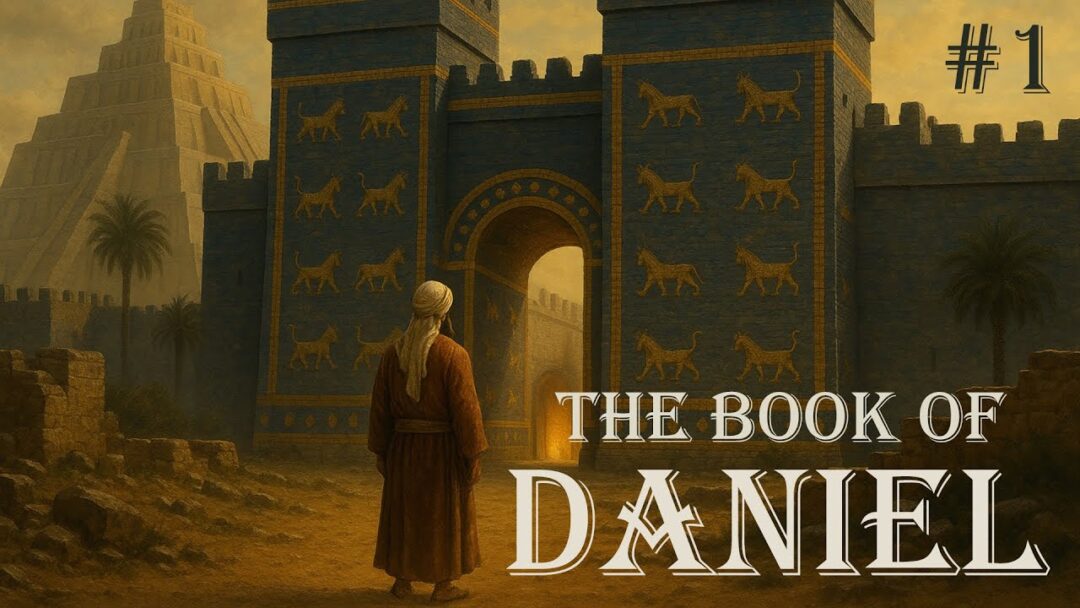
From our Sunday service on April 27, 2025, Daniel 1, with Jeremiah 25 and 29 and 2 Kings 24. This is part 1 of our Daniel series. Watch the full message: Undefiled – Daniel Series #1 on YouTube.
We’re starting a brand new series on the book of Daniel. Daniel has some prophecy in it about the end times, so we’ll get the story of Daniel, and at the end a little of that Revelation vibe. I hope you’re as excited as I am to study Daniel, learn about his life and see how God used him.
Instead of giving historic background first and then the lesson, today I’m going to let Scripture explain the background of Daniel, because the background is laid out clearly in the Bible. So we’ll start outside of Daniel and work our way there. The proposition for this first chapter is: God wants you to remain faithful despite life’s circumstances. Let’s see how Daniel teaches us this.
Why Israel Went Into Exile
Our first stop is Jeremiah 25, where Jeremiah gives a prophecy about the nation of Israel. “Hosts” means armies, so this is the Lord of armies speaking:
Therefore thus saith the LORD of hosts; Because ye have not heard my words, Behold, I will send and take all the families of the north, saith the LORD, and Nebuchadrezzar the king of Babylon, my servant, and will bring them against this land, and against the inhabitants thereof, and against all these nations round about, and will utterly destroy them, and make them an astonishment, and an hissing, and perpetual desolations. Moreover I will take from them the voice of mirth, and the voice of gladness, the voice of the bridegroom, and the voice of the bride, the sound of the millstones, and the light of the candle. And this whole land shall be a desolation, and an astonishment; and these nations shall serve the king of Babylon seventy years.
Jeremiah 25:8–11
We might be surprised. Nebuchadnezzar is not part of Israel, yet God calls him “my servant.” God is going to use a pagan king. Scripture says the king’s heart is in the hand of the Lord. The people who run our government are allowed to be there because God allowed it. A ruler may be there as punishment for a nation or to bless it. Here Nebuchadnezzar was put in power by God to correct Israel. So no matter how we feel about our government or our country, we can know that God has allowed that person to be there and has a purpose for it.
Nebuchadnezzar was a powerful, egotistical, maniac of a man. When he built his buildings, he stamped his name in the bricks. We know so much about him because he was so full of himself that he wrote everything about himself on every building he built, and sometimes he put his name on other people’s buildings. God says, “I’m going to use this man and his thirst for power to teach you something.”
Then God lists what he will take away. The voice of mirth and gladness: I’m going to make you sad for a while. The voice of the bridegroom and the bride: no more wedding parties in a foreign nation. The sound of the millstones, which is business: you won’t be grinding your own grain, your farms won’t be profitable, and you’ll lose everything. The light of the candle: candles, really oil lamps, were very expensive in those days, and you won’t be able to afford the oil to stay up at night. It will be a dark, desolate time, and it will last 70 years.
God was tired of Israel. They had not honored him. They had ignored his instructions and fallen into idolatry and immorality, and they did not love their neighbors as he had said. So God says, “Nebuchadnezzar is coming, and he will take your nation.” Skipping down to 2 Kings 24:
At that time the servants of Nebuchadnezzar king of Babylon came up against Jerusalem, and the city was besieged. And Nebuchadnezzar king of Babylon came against the city, and his servants did besiege it. And Jehoiachin the king of Judah went out to the king of Babylon, he, and his mother, and his servants, and his princes, and his officers: and the king of Babylon took him in the eighth year of his reign. And he carried out thence all the treasures of the house of the LORD, and the treasures of the king’s house, and cut in pieces all the vessels of gold which Solomon king of Israel had made in the temple of the LORD, as the LORD had said. And he carried away all Jerusalem, and all the princes, and all the mighty men of valour, even ten thousand captives, and all the craftsmen and smiths: none remained, save the poorest sort of the people of the land. And he carried away Jehoiachin to Babylon, and the king’s mother, and the king’s wives, and his officers, and the mighty of the land, those carried he into captivity from Jerusalem to Babylon. And all the men of might, even seven thousand, and craftsmen and smiths a thousand, all that were strong and apt for war, even them the king of Babylon brought captive to Babylon.
2 Kings 24:10–16
Nebuchadnezzar came to the gates of the cities of Judah, captured the king, and that’s not all he captured. He took thousands of Jewish people, the best the nation had to offer, and left the poorest of the poor to scrounge for themselves.
This defeat of Israel was more than a conquest. It was a slap in the face to what had become an empty religion. God allowed all the valuables of the temple to be carried away. If you’ve read the story of Solomon building the temple, it was a big celebration, a huge excitement about God. Generations built it and made beautiful artifacts that represented God. But the temple itself had become idolatry, because what they practiced in the temple didn’t match their lives. So God says, “If you’re going to forget my instructions, celebrate in my temple and enjoy the blessings of worship, I’m taking it away.” Nebuchadnezzar took the temple items and the priests and prophets, and eventually he would come back, destroy Solomon’s temple and burn it to the ground. During this very invasion the ark of the covenant disappears from history. Some historical accounts say it was hidden in a cave and lost, but in the Old Testament’s history we never hear about the ark of the covenant again.
God was done with Israel’s empty religion. “You followed the rituals and the outside behavior, but in your hearts you haven’t followed my law. I’m going to take away the table of showbread, the ark of the covenant and the altar, and you’ll have no choice but to worship me in your heart instead of falsely in the temple.”
I would love to talk about this someday, but throughout the whole Bible, God’s attitude toward the temple was more “I will allow you to do this.” Jesus says in the New Testament that Moses wrote the bill of divorcement because of the stubbornness of their hearts. I deeply believe the temple was given to them for the stubbornness of their hearts too. Ancient Egyptian temple worship is very similar, and the people who had worshiped in Egyptian culture just didn’t know how to worship God. Think of Jacob setting up a stone and pouring oil over it. That was a pagan Babylonian practice, but God respected it because Jacob didn’t know any better. So the temple was a way for God to meet mankind in the middle: “I want you to worship me, and I know you don’t get it all, so I’ll make something you can understand.” But over time the temple became a distraction. God says, “I don’t care about the temple the way you do, or about the rituals and how pretty the ephods look. I care about your heart. Since you’ve missed it, I’m going to take away your empty symbols of worship and shake away your empty religion.”
God’s Message to the Captives
But God doesn’t give up. He delivers a message to his people. Skipping to Jeremiah 29, this is what Daniel, one of the captives, was told:
Now these are the words of the letter that Jeremiah the prophet sent from Jerusalem unto the residue of the elders which were carried away captives, and to the priests, and to the prophets, and to all the people whom Nebuchadnezzar had carried away captive from Jerusalem to Babylon; … Thus saith the LORD of hosts, the God of Israel, unto all that are carried away captives, whom I have caused to be carried away from Jerusalem unto Babylon; Build ye houses, and dwell in them; and plant gardens, and eat the fruit of them; Take ye wives, and beget sons and daughters; and take wives for your sons, and give your daughters to husbands, that they may bear sons and daughters; that ye may be increased there, and not diminished. And seek the peace of the city whither I have caused you to be carried away captives, and pray unto the LORD for it: for in the peace thereof shall ye have peace. For thus saith the LORD of hosts, the God of Israel; Let not your prophets and your diviners, that be in the midst of you, deceive you, neither hearken to your dreams which ye cause to be dreamed. For they prophesy falsely unto you in my name: I have not sent them, saith the LORD. For thus saith the LORD, That after seventy years be accomplished at Babylon I will visit you, and perform my good word toward you, in causing you to return to this place. For I know the thoughts that I think toward you, saith the LORD, thoughts of peace, and not of evil, to give you an expected end. Then shall ye call upon me, and ye shall go and pray unto me, and I will hearken unto you. And ye shall seek me, and find me, when ye shall search for me with all your heart.
Jeremiah 29:1, 4–13
What a message to deliver. Verses 5 and 6 are pretty simple: “You’re in captivity under oppression, but you need to live your lives.” Don’t mourn forever. Don’t look back at what you had and let it hold you back. You need to get married, have kids, raise them and teach them the ways of the Lord. Just because the present doesn’t look as good as the past doesn’t mean it’s time to give up. Life goes on.
Then verse 7 gives a huge challenge: “Seek the peace of the city whither I have caused you to be carried away captives, and pray unto the Lord for it.” Pray for the Babylonians. Pray for the people who hold you prisoner. Pray for Babylon to be blessed. Later in the book, Daniel will be arrested for praying, and if you know what Jeremiah told them to pray about, you know what he was doing when he was arrested. And “in the peace thereof shall ye have peace.” If you pray for the peace of your oppressors, you will have peace too. If you pray against them and fight them, you’ll have war and suffering.
Then God says not to listen to the false prophets. They’ll say you can overthrow Babylon and come back. But God says, “I told you through Jeremiah, this is 70 years. Don’t fight. This is your time out in the corner to get right with God, to learn what following me looks like.” It looks like praying for your enemies, being content with what you have, and finding the best in any circumstance. When your prophets say, “God’s going to free you, it’s time to uprise,” don’t believe them. It’s time to sit back and learn a lesson, bring peace to your new prison and pray for the prosperity of your oppressor.
And how do they return home? Verse 13: “Search for me with all your heart.” When you’ve discovered me in your heart, then you will find hope and return home. When you worship me with your heart and not your lips, there you will find me. God didn’t punish them to wipe them out. He punished them to bring them home again, better than they were before. In this difficult and chaotic time in exile, God called his people to remain faithful to him. And that’s how we get to the book of Daniel.
Daniel Is Taken to Babylon
In the third year of the reign of Jehoiakim king of Judah came Nebuchadnezzar king of Babylon unto Jerusalem, and besieged it. And the Lord gave Jehoiakim king of Judah into his hand, with part of the vessels of the house of God: which he carried into the land of Shinar to the house of his god; and he brought the vessels into the treasure house of his god. And the king spake unto Ashpenaz the master of his eunuchs, that he should bring certain of the children of Israel, and of the king’s seed, and of the princes; Children in whom was no blemish, but well favoured, and skilful in all wisdom, and cunning in knowledge, and understanding science, and such as had ability in them to stand in the king’s palace, and whom they might teach the learning and the tongue of the Chaldeans.
Daniel 1:1–4
This is the same story we read in 2 Kings. These people were taken into Babylonia, the best Israel had to offer, and the items from the temple were taken into the house of Nebuchadnezzar’s god, Bel. Bel and Baal are sometimes thought to be the same god, but they’re not. Bel is a short form of Baal, shortened to one syllable, and in this Eastern culture, where cultures were mixed, Baal was used for both the Babylonian god and the Canaanite god. They’re both storm gods with similar etymologies, but Bel should be understood as Marduk, the Babylonian god of thunder and storms. Babylon worshiped its own pantheon, very distinct from the others, and they were a violent, war-torn people. So all of God’s treasure sits in Bel’s temple, in pagan hands, until God’s time to return it to his people.
Nebuchadnezzar’s instructions to Ashpenaz: go find the best of the best and bring them to my house. Babylonia was going to conquer the world, and it needed the brightest minds from every nation. They were looking for people with no blemish, meaning no defects. Good-looking, of course, because if you’re going to be a diplomat, you have to be. Skillful in all wisdom means not talented in only one area. Understanding knowledge means they had to be able to advise the king and know the right decision so they could delegate responsibility. And they had to be able to stand in the king’s palace, which means they could be taught the writing and language of the Chaldeans, in other words Babylonian Aramaic. It was a very tall order: skilled in multiple areas of life, and good enough in language to learn it, write it and do diplomacy in it.
And the king appointed them a daily provision of the king’s meat, and of the wine which he drank: so nourishing them three years, that at the end thereof they might stand before the king. Now among these were of the children of Judah, Daniel, Hananiah, Mishael, and Azariah: Unto whom the prince of the eunuchs gave names: for he gave unto Daniel the name of Belteshazzar; and to Hananiah, of Shadrach; and to Mishael, of Meshach; and to Azariah, of Abed-nego.
Daniel 1:5–7
This was basically a three-year, college-level education. Every day for three years they would be taught first the language and writing, then all the responsibilities, and the best of the best would get positions in the king’s palace. These were people from Judah, the kingly tribe, nobles taken from the king’s palace and probably somehow associated with the line of David. Daniel was probably some descendant of David.
New Names, Same Identity
The chief of the eunuchs gave each of them a new name. In Hebrew the word is “appointed,” and it matters because there’s wordplay coming. Each name reflected Babylonian culture.
Daniel’s name in Hebrew means “he is God’s judge,” a very honorable name for a man who represents God and discerns right from wrong. They gave him Belteshazzar, which means “Bel protect the king.” Daniel’s name now praised a pagan god, and having his name changed that way must have been very hurtful. Bel protect the king was the name he carried every day.
Hananiah means “Yah, short for Yahweh, has favored.” They named him Shadrach, “Aku’s commander,” saying he belonged to a Babylonian god. Mishael, “who is like God,” became Meshach, “who is like Aku,” the moon god of Babylon. Azariah, “Yah has helped me,” became Abednego, “servant of Nabu,” the god of art, writing and vegetation. All of them had their identities taken away, immersed in Babylonian culture and forced to take on new identities.
Daniel Purposed in His Heart
But Daniel purposed in his heart that he would not defile himself with the portion of the king’s meat, nor with the wine which he drank: therefore he requested of the prince of the eunuchs that he might not defile himself.
Daniel 1:8
In the Hebrew, the chief of the eunuchs “appointed” them names, but Daniel “appointed” in his heart that he would not defile himself. They had been appointed new identities, but Daniel appointed in his life that the new name wouldn’t change who he was, and he would stay dedicated to God by his original identity.
The “king’s meat” is some kind of delicacy. We don’t know for sure, but the idea is a fancier, more indulgent food, clearly better than normal citizens had access to. But the issue wasn’t that the food was delicious or fancy. The issue was that the king’s food was blessed by pagan idols and used in the worship of Bel, Aku and Nabu. That made it unclean, and under Hebrew law they couldn’t eat it. So Daniel says, “You’ve appointed me a name, but I have appointed myself to be faithful to God.” Daniel wasn’t going to risk disobeying God. He had heard Jeremiah’s call and had chosen to be faithful even in this difficult time. Daniel was appointed a new name, but he was appointed to be faithful.
Now God had brought Daniel into favour and tender love with the prince of the eunuchs. And the prince of the eunuchs said unto Daniel, I fear my lord the king, who hath appointed your meat and your drink: for why should he see your faces worse liking than the children which are of your sort? then shall ye make me endanger my head to the king.
Daniel 1:9–10
Here we see something similar to the story of Joseph. Joseph was sold into slavery in Egypt, but everywhere he went he found favor with his oppressor. Daniel finds the same thing. “Favour and tender love” means the chief of the eunuchs liked him and had compassion on him. He felt bad for his situation. He says, “Daniel, I like you and I understand your situation, but I’m afraid of my king. If I don’t listen, off with my head.” There was no questioning Nebuchadnezzar. This was an egomaniac who wrote his name on the wall. “If I make you look scrawny and weak by not giving you this good-quality food, my head’s on the table.”
So what does Daniel do?
Then said Daniel to Melzar, whom the prince of the eunuchs had set over Daniel, Hananiah, Mishael, and Azariah, Prove thy servants, I beseech thee, ten days; and let them give us pulse to eat, and water to drink. Then let our countenances be looked upon before thee, and the countenance of the children that eat of the portion of the king’s meat: and as thou seest, deal with thy servants. So he consented to them in this matter, and proved them ten days.
Daniel 1:11–14
Daniel was a wise man even as a young person. He must have been a teenager, I don’t think an adult yet. He says, “Give us a 10-day test run. We’ll take a vegetarian diet, since those foods aren’t used to worship your idols. We know they’re safe. Then have us stand next to the people who ate the king’s fancy, luxurious food. If we look worse, judge based on what you see. If we look better, judge based on what you see, and we’ll go from there.” That pleased Melzar, who figured 10 days wasn’t going to cost him his head.
And at the end of ten days their countenances appeared fairer and fatter in flesh than all the children which did eat the portion of the king’s meat. Thus Melzar took away the portion of their meat, and the wine that they should drink; and gave them pulse. As for these four children, God gave them knowledge and skill in all learning and wisdom: and Daniel had understanding in all visions and dreams.
Daniel 1:15–17
Melzar is surprised. These young men are healthier than the others, even a couple of pounds heavier from eating vegetables. So he says, “Sure, keep doing it. I’ve taken away the king’s food, and you’re free to do vegetables as long as you want.” And God gave these four young men knowledge, skill, learning and wisdom, exactly what the king was looking for. Because they chose to be faithful and follow his instructions, God blessed them in that nation.
One sad thing is that this implies nobody else did it. It doesn’t say these four and others followed after they saw the success. There were thousands of people from Judah captured, and only four were willing to speak up for what God had told them to do. There’s no doubt in my mind that Melzar told the other Judeans, “They switched to a vegetarian diet. Why don’t you do it too?” And I imagine they said, “Why would I do that? This food is luxurious. You don’t get it just anywhere. I will defile myself with the king’s meat because I enjoy the indulgence.” Just four stepped up and stood out, and God blessed them.
And Daniel, who spoke up for the others, was given a special gift: “understanding in all visions and dreams.” We’ll see how that plays out later in the book. This 10-day trial became a permanent meal plan. Because they prioritized honoring God, God enabled them to learn faster than their peers and eventually surpass even the Babylonians. And Daniel was granted a gift above the others for taking that leadership role, a gift God would use greatly in his life.
Ten Times Better
Now at the end of the days that the king had said he should bring them in, then the prince of the eunuchs brought them in before Nebuchadnezzar. And the king communed with them; and among them all was found none like Daniel, Hananiah, Mishael, and Azariah: therefore stood they before the king. And in all matters of wisdom and understanding, that the king enquired of them, he found them ten times better than all the magicians and astrologers that were in all his realm. And Daniel continued even unto the first year of king Cyrus.
Daniel 1:18–21
Nebuchadnezzar sat down and talked with them, and he was blown away. These young men were ten times better than the best men he had, men who had probably been his administrators for decades with years of experience. He found these young people, maybe young adults by now, so far beyond everybody else that he appointed them to serve him. Daniel even continued to the first year of King Cyrus, a Persian who conquered Babylon. Daniel’s service to the king outlived the entire nation of Babylon. That’s how talented he was. Daniel had decided, “I am going to remain faithful to God no matter my circumstances. I’m going to listen to the words of the prophet and the words of God and dedicate myself to him.” Because of that, God greatly blessed him.
Closing
In the face of judgment, exile and uncertainty, God calls his people with a clear calling: be faithful. Israel’s defeat and the destruction of the temple were not signs that God had abandoned them but that he was stripping away their false securities to bring them back to himself. God didn’t knock Israel down for no reason. He knew the distractions that took them away from him every day weren’t going to go away on their own. So he took them away, to a place where they were uncomfortable and every day was uncertain, so that when all their comfort was gone they would turn to him because they had nothing else. He hadn’t abandoned them. Through Jeremiah, God instructed them to build lives in exile, to seek the peace of their captors, and most importantly to seek him with all their hearts.
In Daniel 1, Daniel and his friends embodied that calling perfectly. Even in a foreign land under foreign rule, they chose faithfulness over compromise, and God honored their devotion. Their story reminds us that no matter how dark and chaotic our circumstances, God is still at work. God is tired of empty rituals. He wants changed hearts, and he’s always ready to restore and reward those who seek him with sincerity and truth.
God wants you to remain faithful despite life’s circumstances. So will you choose to remain faithful today?

Recent Comments