
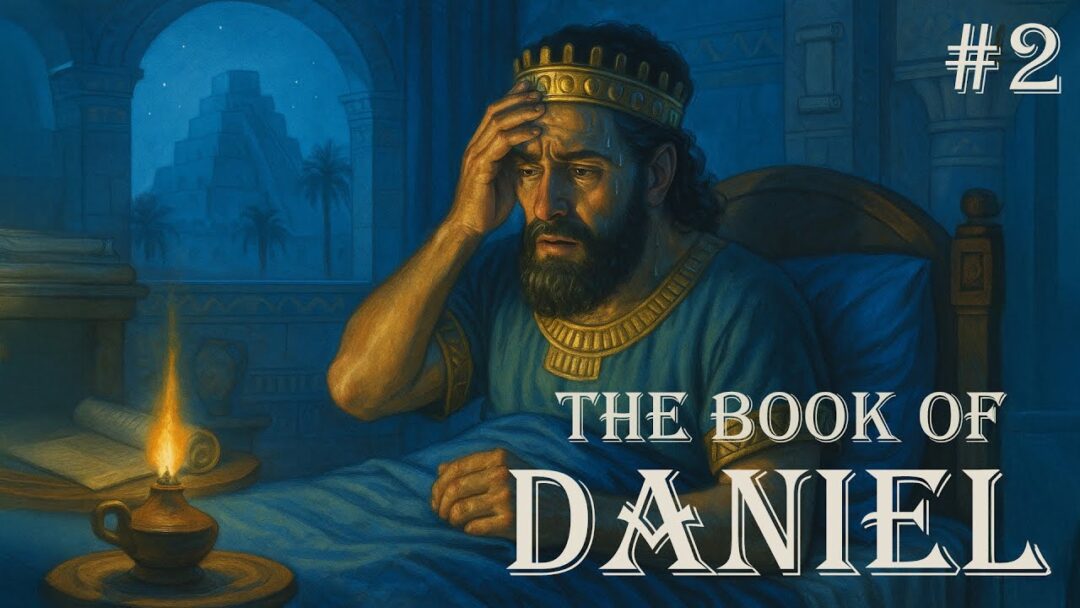
From our Sunday service on May 4, 2025, Daniel 2. This is part 2 of our Daniel series. Watch the full message: The Revealer of Secrets – Daniel Series #2 on YouTube.
Daniel chapter 2 is one I’m very excited to do. During my study it turned into a rabbit hole of rabbit holes, because this is where you start to get into the prophecy part of Daniel.
Last time we left Daniel standing up for himself and his friends, Hananiah, Mishael and Azariah, as they were taken from their family and friends as captives of war. We started the book of Daniel in Jeremiah, looking at the prophecy of Israel’s captivity, and saw that it was God’s allowing it that enabled it. God had chosen to use Nebuchadnezzar and his father as correction for his children, because the nation of Israel was supposed to be his representatives and time and again they failed. So God took away their empty religion and put them in a captive land, where he wanted them to pray for the land, live out their faith, get married, have children, and let their worship of him prosper despite their circumstances. And Daniel kindly asked that he and his friends not have to eat unclean food and disobey the commands of their God. By wisdom and humility, he convinced the king’s court to let him stay on a vegetarian diet and avoid defiling himself.
But last week was about comfort and preference. Eating unclean food wasn’t going to put Daniel or his friends in immediate danger, and we have no indication that any of the other Israelite captives took the vegetarian diet. That would have been an easy situation to let slide. Today Daniel is put in a situation far outside his control, a dire one that affects not only him and his friends but all of Nebuchadnezzar’s advisers. It’s a matter of life and death. So what I want you to take away today is that God wants you to respond to crises with faith, humility, and wisdom.
A Dream That Won’t Let Go
And in the second year of the reign of Nebuchadnezzar Nebuchadnezzar dreamed dreams, wherewith his spirit was troubled, and his sleep brake from him. Then the king commanded to call the magicians, and the astrologers, and the sorcerers, and the Chaldeans, for to shew the king his dreams. So they came and stood before the king. And the king said unto them, I have dreamed a dream, and my spirit was troubled to know the dream.
Daniel 2:1–3
We’re immediately introduced to the issue. Nebuchadnezzar is deeply disturbed by something he can’t understand. A frightening image appeared to him in the middle of his dream, and the thought of it now pounds constantly in his mind like the beating of a heart. The word “troubled” is literally the Hebrew word used for a heartbeat.
I don’t know about you, but I’ve had times when something bothered me like that. Young people, it might be when you’ve asked someone out and you’re waiting for the answer. Will they say yes or no? The thought pounds and thumps in your head while you try to do something else. For some of the older folks, it’s when your job is cutting positions and you wait to hear whether you’re next: is this my last paycheck? Maybe you’ve had a medical test and you’re waiting for the results. Is today the day? You want to get on with your life, but thump, thump, thump, the thought comes back.
That’s Nebuchadnezzar. He doesn’t understand the dream, but the feeling it gave him was so unsettling that he can’t forget the image. His spirit is troubled, and his sleep breaks from him. Like the Pharaoh in Genesis, he knows there is something important to learn from the dream, but the wisdom to understand it escapes him, and this existential dread fills his life and keeps him from sleep.
Now he calls his pagan advisers, four categories of them. The words are very old and not very clear, but we know a little about them. The magicians were some kind of scribe who used writing in their magic and practiced divination, something like a fortune teller with tarot cards or palm reading. The astrologers, or conjurers, claimed to commune with the dead. If no one can tell me my future, maybe someone in the nether realm will know the answer to my dream. The sorcerers: the Greek translation of the Old Testament uses the word that gives us “pharmacy.” These people mixed elixirs, what we’d today call psychedelic drugs, to create an experience that might reveal truth. And the Chaldeans were an ethnic group of wise men, the wise men of all wise men, the greatest and smartest. The king is desperate. It’s all hands on deck: I need to know the answer now.
An Impossible Demand
Then spake the Chaldeans to the king in Syriack, O king, live for ever: tell thy servants the dream, and we will shew the interpretation. The king answered and said to the Chaldeans, The thing is gone from me: if ye will not make known unto me the dream, with the interpretation thereof, ye shall be cut in pieces, and your houses shall be made a dunghill. But if ye shew the dream, and the interpretation thereof, ye shall receive of me gifts and rewards and great honour: therefore shew me the dream, and the interpretation thereof.
Daniel 2:4–6
The Chaldeans spoke to the king in Aramaic, which the King James calls “Syriack.” Humbly they say, “O king, live for ever. Would you kindly tell us the dream, and then we will tell you the interpretation?” The king makes things very serious. He basically issues the Babylonian equivalent of an executive order. “The thing is gone from me” means that what he’s about to say is law. Later in Daniel, when a king makes a law, it can’t be undone even by the king himself, so he’s saying, “This is an unbreakable law. Nothing you say can change it.” The way “cut in pieces” is worded in Aramaic, you will be a pile of limbs. Nebuchadnezzar does not mess around. And your houses will be made a dunghill: we will dump all the city’s trash on your home, and it will be a landfill, and no one will ever remember you or your family. We have to take this guy pretty seriously.
The king’s demand is intentionally impossible. Nebuchadnezzar knew the pagan system he used was completely inadequate to give an honest understanding of divine matters. He doesn’t want niceties. He wants the truth. He will only trust someone who can explain the meaning of the dream and also tell him what the dream was without being told. He knows his advisers are yes men who tell him what he wants to hear. Nebuchadnezzar is a maniac, to be quite honest. History shows him to be a crazy man, and we’ll talk about that more later. But he says, in effect, “I want this to be impossible, because if I get an answer, I want to know with 100 percent certainty that I understand what the dream means.” He realizes it’s very important for his kingdom.
They answered again and said, Let the king tell his servants the dream, and we will shew the interpretation of it. The king answered and said, I know of certainty that ye would gain the time, because ye see the thing is gone from me. But if ye will not make known unto me the dream, there is but one decree for you: for ye have prepared lying and corrupt words to speak before me, till the time be changed: therefore tell me the dream, and I shall know that ye can shew me the interpretation thereof.
Daniel 2:7–9
The advisers say, “King, I need to know the dream to tell you what it means,” and he goes, “No, I knew this was going to happen. You’re trying to buy time.” He knew the second he made the decree that they would try to buy time to figure out what the dream meant, because “the thing is gone from me”: the decree is out and their lives are on the line. “Stop wasting my time. I need an answer.” If they really could do what they claimed, getting the information should be no problem. If these sorcerers, magicians and conjurers can talk to the dead, talk to the gods and read the stars, it should be as easy to find out what the dream was as to understand it. “If you can’t figure out what the dream is, how in the world are you supposed to tell me what it means? You’re lying, and if you’re lying now, you’ve probably been lying to me all along. What good to me are lying advisers?”
The Chaldeans answered before the king, and said, There is not a man upon the earth that can shew the king’s matter: therefore there is no king, lord, nor ruler, that asked such things at any magician, or astrologer, or Chaldean. And it is a rare thing that the king requireth, and there is none other that can shew it before the king, except the gods, whose dwelling is not with flesh.
Daniel 2:10–11
Now the advisers know that, as the kids would say, they’re cooked. They don’t have a chance of doing what the king says. This time they don’t even say, “May the king live forever.” They panic. “No one on earth could do this. This request is ridiculous. No king, lord or ruler in the history of the world has asked their advisers to do this. No king has said, ‘Tell me what my dream was last week.'” It’s not even common for a king to ask for the interpretation of dreams. And their final excuse is that no one knows except the gods, and the gods don’t interact with humanity. That’s a theological statement: the gods don’t care about us, the gods don’t communicate with us, and there is no way for us to know what a god was trying to tell you. The Chaldeans rightly point out that the task is impossible for them, and their excuse is that the gods don’t do this kind of thing for humanity, so it’s unfair to ask.
For this cause the king was angry and very furious, and commanded to destroy all the wise men of Babylon. And the decree went forth that the wise men should be slain; and they sought Daniel and his fellows to be slain.
Daniel 2:12–13
Here we see how short Nebuchadnezzar’s patience is. Rather than give them time, he immediately calls for the execution of all of Babylon’s wise men. He doesn’t call a different group and ask them. He hears the excuse of the first group, gets angry and says, “Kill every wise man in the city of Babylon. They’re lying to me, none of them is trustworthy, and I want to get rid of them all.”
Nebuchadnezzar was a man of great ego. Archaeology shows he happily carved his name over all his building projects, and he even occasionally put his name on things he didn’t build himself so he could get credit. Some of his projects, such as the completion of Etemenanki and the renovation of the Ishtar Gate, were impressive, but he wasn’t known for patience. He was known for pride. His brick factories would stamp his name into every couple hundred bricks, so that if a wall fell down, the other wall would still have his name. If he completed only the last two bricks of a project, he wanted his name on the whole thing. He wanted nothing more than to be the greatest man in the room and have everybody think he was the best. So when somebody tells him something can’t be done, his patience is cut and his anger comes out. And this is the man of ego that Daniel has to deal with.
Daniel Answers With Counsel and Wisdom
Then Daniel answered with counsel and wisdom to Arioch the captain of the king’s guard, which was gone forth to slay the wise men of Babylon:
Daniel 2:14
How do we fight egomania? With counsel and wisdom, discernment and discretion. Daniel answered Arioch, the captain of the king’s guard, who had gone out to slay the wise men of Babylon. That’s pretty bold. The word suggests Arioch was a kind of butcher and executioner. When someone is sent to kill you, normally you run away. Instead, Daniel comes with boldness and confidence that God will protect him, and he goes to the very man whose job it is to put him to death.
He answered and said to Arioch the king’s captain, Why is the decree so hasty from the king? Then Arioch made the thing known to Daniel.
Daniel 2:15
“Why is this order so abrupt? Where is it coming from? It’s so irrational. Why is he going to kill every adviser he has? There must be more to the story.”
Then Daniel went in, and desired of the king that he would give him time, and that he would shew the king the interpretation. Then Daniel went to his house, and made the thing known to Hananiah, Mishael, and Azariah, his companions: That they would desire mercies of the God of heaven concerning this secret; that Daniel and his fellows should not perish with the rest of the wise men of Babylon.
Daniel 2:16–18
Daniel is faced with a moment of crisis. Christian, in these days you will face moments of crisis just as Daniel did, and your response is as important as any other choice you make. Daniel does the right thing. He takes counsel and wisdom, discernment and discretion. Instead of panicking, running or trying to weasel his way out, he says, “Okay, God, what can I do?” He goes to the king and asks for time, and says he’ll show the interpretation. Daniel is bold. He knows his God can do anything. Without even praying about it first, he says, “My God can do anything, and I know he loves me and cares for me, so I know he wants to protect me.”
But he doesn’t stop there and simply rely on the attributes of God. He does something quite beautiful. He goes to his house and tells Hananiah, Mishael and Azariah. Daniel didn’t face this crisis alone. Yes, he was the one going before the king, and if he didn’t have the interpretation, it was his head on the line. But in this crisis it wasn’t just him and God. He brought in his fellow believers: “Friends, let’s pray to the God of heaven that he would reveal this.”
Christian, you don’t have to face all your crises alone. You have brothers and sisters in Christ who can face them alongside you. We have a prayer list in our church. You can send your needs to the prayer list, and people in this church will pray with you about your crisis. Daniel knew that the prayer of a righteous man accomplishes much, so how much more will be accomplished when four people pray together? He explains what’s going on and the difficulties they face, and together as friends they go to God in prayer.
Unlike the king, who responds in anger and immediate choices, Daniel responds with wisdom and tact. His ability to stay calm and collected in the face of a death sentence is truly impressive. He embodies the principle of Proverbs 15:1:
A soft answer turneth away wrath…
Proverbs 15:1
Rather than trying to manipulate the king or run away, Daniel asks for time to do what the wise men couldn’t. He knows his God can do anything, so why not ask him? He turns to God in prayer and involves his friends in seeking God’s mercy, which shows the importance of intercessory prayer and the strength of a godly community.
Often we isolate ourselves in times of difficulty. We don’t want others to see our hardships or struggles, and to protect our reputation we push people away rather than calling them in to help. The Bible tells us the opposite: we should come together and pray for each other. A threefold cord is not quickly broken. It’s important that we as a church build community, pray for each other and care for each other in our times of difficulty.
Praise Before Anything Else
Then was the secret revealed unto Daniel in a night vision. Then Daniel blessed the God of heaven. Daniel answered and said, Blessed be the name of God for ever and ever: for wisdom and might are his: And he changeth the times and the seasons: he removeth kings, and setteth up kings: he giveth wisdom unto the wise, and knowledge to them that know understanding: He revealeth the deep and secret things: he knoweth what is in the darkness, and the light dwelleth with him. I thank thee, and praise thee, O thou God of my fathers, who hast given me wisdom and might, and hast made known unto me now what we desired of thee: for thou hast now made known unto us the king’s matter.
Daniel 2:19–23
God answers the prayer of Daniel and his friends with a vision in the middle of the night. What is Daniel’s first response? Not to go tell the king, and not to go tell his friends. He bursts into praise. He attributes all authority and wisdom to God, declaring that God is in control of everything: the times, the seasons, the kings and the kingdoms. He affirms God’s sovereignty over history. And in acknowledging that God gives wisdom to the wise, Daniel shows humility. He understands that this miracle wasn’t about him or his ability. He was completely dependent on God for the insight.
How often have we prayed for something for weeks, months or years, and then when it happens we say, “Wow, God did it,” and that’s it? Daniel shows the proper response to an answered prayer. Before he told anyone or solved the situation, he stopped. Verse 20 says “Daniel answered and said,” and that word can also be translated “Daniel responded.” God gave him an answer and Daniel responded. How many times does God answer a prayer and we don’t take the time to respond? We ask, we get it, and we go, “Transaction complete, end of story.” Daniel teaches us that an answered prayer is the start of a new conversation. When God answers a prayer, the proper response is to go back in prayer and thank God for what he did. Christian, take an example from Daniel and take time to thank God for what he does.
Daniel Before the King
Therefore Daniel went in unto Arioch, whom the king had ordained to destroy the wise men of Babylon: he went and said thus unto him; Destroy not the wise men of Babylon: bring me in before the king, and I will shew unto the king the interpretation. Then Arioch brought in Daniel before the king in haste and said thus unto him, I have found a man of the captives of Judah, that will make known unto the king the interpretation.
Daniel 2:24–25
I love how often the passage brings up that Daniel is going to his executioner. It won’t let you forget it. And I like that Arioch brought Daniel to the king “in haste.” In Aramaic that implies this man was waiting desperately for anyone to do anything to stop this. He has probably worked for Nebuchadnezzar for years and knows how crazy he can be, and he’s probably praying to his gods that somebody will step up and stop this atrocity. The second Daniel shows up, he’s ready to run to the king and say, “Everybody stop the commands. We don’t need to kill every wise man in Babylon.”
The king answered and said to Daniel, whose name was Belteshazzar, Art thou able to make known unto me the dream which I have seen, and the interpretation thereof? Daniel answered in the presence of the king, and said, The secret which the king hath demanded cannot the wise men, the astrologers, the magicians, the soothsayers, shew unto the king; But there is a God in heaven that revealeth secrets, and maketh known to the king Nebuchadnezzar what shall be in the latter days. Thy dream, and the visions of thy head upon thy bed, are these; As for thee, O king, thy thoughts came into thy mind upon thy bed, what should come to pass hereafter: and he that revealeth secrets maketh known to thee what shall come to pass. But as for me, this secret is not revealed to me for any wisdom that I have more than any living, but for their sakes that shall make known the interpretation to the king, and that thou mightest know the thoughts of thy heart.
Daniel 2:26–30
Notice that Daniel answers “in the presence of the king.” In the presence of the king you’re in danger, because at any moment an executioner can slice off your head, yet he stands right in front of him. Daniel comes with humility. He doesn’t just say, “I have the interpretation of the dream.” He makes sure to say it comes from the God of heaven, the true God. He sets it up so that when the king hears the answer, it’s not Daniel who gets the glory but God. He also says, “I don’t want you to think I’m better than anybody else on your advisory board. This wasn’t revealed to me because of any wisdom I have more than anyone alive. I’m not better than anybody else. I just know the greatest God there is.” And God let him do it “for their sakes”: God didn’t want the king to kill all these people, so he gave it to Daniel not just to tell the king but to save them as well. And “that thou mightest know the thoughts of thy heart.”
It’s important for us as Christians not to give ourselves more credit than we deserve. Daniel refuses to take any credit for the revelation he’s about to give. He insists on giving the glory to God. This reminds me of Romans 12:3:
For I say, through the grace given unto me, to every man that is among you, not to think of himself more highly than he ought to think; but to think soberly, according as God hath dealt to every man the measure of faith.
Romans 12:3
It’s easy to overcredit ourselves for what we accomplish. Everything we do as Christians is done with God’s help, and it’s really easy to give ourselves too much credit. It’s always better to be undercredited than overcredited, better to be humble than lifted up. Daniel knew this and set an example. When you do something with God’s help, make sure you give God the glory.
The Dream
Thou, O king, sawest, and behold a great image. This great image, whose brightness was excellent, stood before thee; and the form thereof was terrible. This image’s head was of fine gold, his breast and his arms of silver, his belly and his thighs of brass, His legs of iron, his feet part of iron and part of clay. Thou sawest till that a stone was cut out without hands, which smote the image upon his feet that were of iron and clay, and brake them to pieces. Then was the iron, the clay, the brass, the silver, and the gold, broken to pieces together, and became like the chaff of the summer threshingfloors; and the wind carried them away, that no place was found for them: and the stone that smote the image became a great mountain, and filled the whole earth.
Daniel 2:31–35
“Terrible” carries the idea of existential dread. Daniel perfectly describes what happened in Nebuchadnezzar’s dream: an enormous statue made of metals of decreasing value from head to toe, smashed by a stone cut without human hands. When the stone hit the statue, it shattered into dust that blew away in the wind and was never found again, and then the stone covered the whole earth.
I don’t know how many of you watch the Marvel movies, but in Infinity War there’s a snap and people turn into dust. I want you to know they didn’t get that on their own. It actually comes from the Bible, because that’s the image that happens here. When the rock hits the statue, it shatters into fine particles of dust that blow away from top to bottom. The dream disturbed Nebuchadnezzar so much because it was nothing he’d ever seen and he didn’t understand it.
The Interpretation
This is the dream; and we will tell the interpretation thereof before the king. Thou, O king, art a king of kings: for the God of heaven hath given thee a kingdom, power, and strength, and glory. And wheresoever the children of men dwell, the beasts of the field and the fowls of the heaven hath he given into thine hand, and hath made thee ruler over them all. Thou art this head of gold.
Daniel 2:36–38
Daniel says to Nebuchadnezzar, “Your kingdom is the head. You are the head because God has set you up to rule these kingdoms and bring your people into exile. God enabled you and your father to build this kingdom, and you are valuable to God for this purpose that you serve.” The statue represents all the kingdoms of the earth together, and the head is gold, the most valuable.
And after thee shall arise another kingdom inferior to thee, and another third kingdom of brass, which shall bear rule over all the earth. And the fourth kingdom shall be strong as iron: forasmuch as iron breaketh in pieces and subdueth all things: and as iron that breaketh all these, shall it break in pieces and bruise. And whereas thou sawest the feet and toes, part of potters’ clay, and part of iron, the kingdom shall be divided; but there shall be in it of the strength of the iron, forasmuch as thou sawest the iron mixed with miry clay. And as the toes of the feet were part of iron, and part of clay, so the kingdom shall be partly strong, and partly broken. And whereas thou sawest iron mixed with miry clay, they shall mingle themselves with the seed of men: but they shall not cleave one to another, even as iron is not mixed with clay.
Daniel 2:39–43
Now we see a series of future kingdoms. After Nebuchadnezzar, the gold kingdom, comes the silver kingdom, the Medo-Persian Empire led by Cyrus the Great. In only a few years King Cyrus would conquer all of Babylon, and God would use him to send his people out of exile to rebuild the temple and worship in Jerusalem. After the silver kingdom fell, the bronze kingdom came, the Greeks led by Alexander the Great. But Greece would not last forever, because then came Rome, the iron kingdom, led by Caesar Augustus.
Over time the iron kingdom changed into what I call the 4.5 kingdom, because in all the commentaries I read they couldn’t agree on the numbering, so I figured the numbering doesn’t matter. The Roman Empire split into East and West, the two legs of the statue. Then it splits further into toes mixed of clay and iron, which don’t mix and have no structure. Commentaries disagree on what this means, but the most reasonable one I saw was from Hippolytus of Rome in AD 235. He says the toes signify the democracies that would rise after the fall of the Roman Empire. What’s great is that he wrote this before any of the democracies came about. Today we have a world filled with democracies and nations that work together. We have the United Nations, they trade with each other and try to be friendly, but they don’t cleave together. They’re still distinct.
So all the kingdoms of the world are foretold. God was going to raise up the Roman Empire so he could bring Jesus in the flesh to the world and spread the gospel to all the earth. Cyrus the Great, Alexander the Great, Caesar Augustus: all these leaders were ordained by God for a purpose, to set in motion the course of events for the last kingdom that will follow all these kingdoms.
And in the days of these kings shall the God of heaven set up a kingdom, which shall never be destroyed: and the kingdom shall not be left to other people, but it shall break in pieces and consume all these kingdoms, and it shall stand for ever. Forasmuch as thou sawest that the stone was cut out of the mountain without hands, and that it brake in pieces the iron, the brass, the clay, the silver, and the gold; the great God hath made known to the king what shall come to pass hereafter: and the dream is certain, and the interpretation thereof sure.
Daniel 2:44–45
“In the days of these kings,” plural, means we’re in the last age. We have the last kingdom, which I’ll call kingdom number five, the kingdom of heaven. The kingdom of heaven is on earth now, but not in its full reality. The church operates as the kingdom of heaven. But one day Christ will return and set up an eternal kingdom, and all the separate kingdoms of this world will be dissolved and unified under Jesus Christ.
The passage says the kingdoms mingle themselves with the seed of men, which I take to mean that they tried to give each other in marriage and create diplomatic relations. Through the dark ages kings married their families together and tried to make peace treaties through bloodlines, trying again and again to bring unity across culture and ethnicity, and it failed time and time again. Daniel’s prophecy says that though these artificial constructions try to unify us, one thing unifies all people on earth: the blood of Jesus Christ and the kingdom that will come. There are people who worship God in every part of the world. Here in America we’re in church today, and there are believers in Africa, China, Europe, Asia, South America and Central America. There’s probably someone meeting for Bible study in Antarctica. It doesn’t matter where you’re from. One day the kingdom of heaven will join us all together in faith and unity.
The stone cut out of the mountain without hands represents Jesus Christ. Jesus himself says:
And he beheld them, and said, What is this then that is written, The stone which the builders rejected, the same is become the head of the corner? Whosoever shall fall upon that stone shall be broken; but on whomsoever it shall fall, it will grind him to powder.
Luke 20:17–18
What happened in Daniel’s vision? The stone struck the image and it turned to dust. Jesus says, “I am the uncut stone that brings about the kingdom of heaven.” It is not cut with human hands because Jesus Christ is not of human origin. He is uncreated, the ever-existing God and King, and one day he will come and bring his throne to the earth forever.
The Revealer of Secrets
Then the king Nebuchadnezzar fell upon his face, and worshipped Daniel, and commanded that they should offer an oblation and sweet odours unto him. The king answered unto Daniel, and said, Of a truth it is, that your God is a God of gods, and a Lord of kings, and a revealer of secrets, seeing thou couldst reveal this secret.
Daniel 2:46–47
“Worship” here doesn’t mean he worshiped Daniel as a god. The word in Aramaic literally means to bow on your knee. An oblation and sweet odors would be a gift of food and some perfumes. Nebuchadnezzar is so amazed that even the prideful king falls on his knees in front of Daniel. He acknowledges the supremacy of Daniel’s God as God of gods and Lord of kings. This shouldn’t be understood as a conversion statement. He’s not saying he’ll worship only God or devoting himself to God, but it is an important recognition of God’s divine authority. A faithful witness accompanied by God’s power can lead even pagan rulers to see a glimmer of the truth.
Then the king made Daniel a great man, and gave him many great gifts, and made him ruler over the whole province of Babylon, and chief of the governors over all the wise men of Babylon. Then Daniel requested of the king, and he set Shadrach, Meshach, and Abed-nego, over the affairs of the province of Babylon: but Daniel sat in the gate of the king.
Daniel 2:48–49
God honors those who honor him. Just as Joseph rose to prominence in Egypt, Daniel is promoted to a position of high authority, and he makes sure his faithful friends, who prayed with him through this, are also honored. Daniel uses his blessings to bless others. This is an example of the importance of integrity, prayer and courage in shaping the world for God’s glory. I think it’s beautiful that he involved his friends. He went to them to pray, and when his prayer was answered, he didn’t forget them. He told Nebuchadnezzar, in effect, “My friends helped me in this. Can you also put them in positions?” Not only Daniel was blessed, but his friends alongside him.
Closing
Daniel gives us a powerful example of how God causes people to live in response to impossible situations. When his world was collapsing around him, he didn’t fear or panic. He trusted God in faith and asked for wisdom. He stepped forward with humility. He didn’t run from his problems, and he didn’t compromise his standards. He gathered his fellow believers, sought the Lord with them in prayer, and trusted God to reveal the path forward. And guess what? God showed up.
That same God still reigns today. He is not distant and he is not silent. He is the King of Kings and Lord of Lords, and all the kingdoms of this world answer to him. He is still giving wisdom, and he still honors those who honor him.
So, Christian, when the pressures around you build, when you face big decisions and impossible situations, uncertainty or even danger, how will you respond? Will you act out of fear and rage like King Nebuchadnezzar, or will you be like Daniel and respond with prayer, humility and confidence in the God who reveals all? God wants you to respond to crises with faith, humility, and wisdom. So the question today is, how will you respond?

Recent Comments