
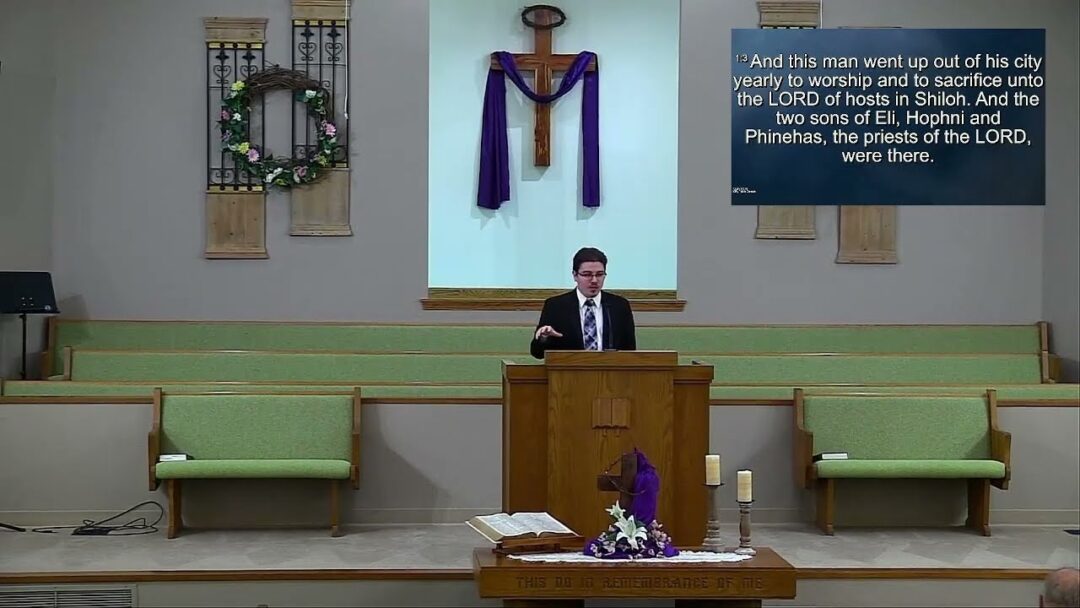
From our Mother’s Day service on May 11, 2025, 1 Samuel 1. Watch the full message: A Mother’s Prayer – 1 Samuel 1 on YouTube.
On Mother’s Day we want to thank the Lord for the mothers and grandmothers in our lives. Today we’re going to look in 1 Samuel chapter 1 at a mother, the story of Hannah, and see a woman’s prayer.
A Time of Corrupt Leadership
We need a little context going in. This story takes place right at the end of the book of Judges, right before the story of King David, where we’re introduced to the origin of the prophet and judge Samuel.
What’s really important to understand is that the religious leadership at the tabernacle was corrupt. The current judge of Israel, the one who was supposed to be the spiritual leader and director of the morals of the nation, is named Eli. He’s not just somebody who deals with political and military issues. He also happens to be the high priest of Israel, in charge of the tabernacle, the temple of their day, and of the worship of God and all the sacrifices. But Eli isn’t really engaged with his ministry like many of the judges before him. He never really commits himself to the calling of being a spiritual leader.
In this context of religious turmoil and chaos, we meet a young woman who is barren. She has no children and she’s struggling with that difficulty. What does she do? She goes to prayer and uses her relationship with God to get close to him and pray for a child. Today we’ll learn something about how we should interact with God, and how we should be spiritual leaders, through the story of Hannah.
Our proposition, what God wants you to take away from this passage, is that God wants spiritual leaders who will pour out their hearts to him in faith.
A Faithful Man With a Broken Family
Now there was a certain man of Ramathaim-zophim, of mount Ephraim, and his name was Elkanah, the son of Jeroham, the son of Elihu, the son of Tohu, the son of Zuph, an Ephrathite: And he had two wives; the name of the one was Hannah, and the name of the other Peninnah: and Peninnah had children, but Hannah had no children.
1 Samuel 1:1–2
Here we meet our three main characters. They’re from the city of Ramah, which is the short version of that long name. Elkanah’s name means “purchased by God.” The names in this story are significant. If you’re given that name, your parents took God pretty seriously. It talks about the redemptive quality of God, how he forgives our sin and buys us back. His mother gave him this spiritual name, so we learn that he was raised from childhood to be a follower of God.
During the time of the Judges there was a lot of idolatry. You couldn’t assume that the average person grew up in a God-honoring home, and people served god after god instead of dedicating themselves to the one true God. But Elkanah was born into a God-honoring household and was a God-honoring man, and we see through the story that he’s very devout. He lived in Mount Ephraim, but he came from the Levite line, the priestly tribe. He himself was not a priest, but that came with a responsibility to be people of faith and loyal to God. He followed the law.
Unfortunately, this man so dedicated to God made the mistake of taking two wives. Many men in Scripture took on polygamous relationships, but Scripture is always quick to highlight the tension, conflict and heartache that came with them. You’ll never find a place in Scripture that praises polygamy. It always points out the negatives and downsides. God allowed Moses to write a bill of divorcement because of the stubbornness of the nation, and polygamy was allowed to continue because of the stubbornness of the nation as well.
Hannah’s name means “grace,” a very pretty name. The other wife was Peninnah, whose name means “jewel,” which is appropriate for the way she sees herself. By the order, Hannah is supposedly the first wife, and it seems Elkanah took a second wife because Hannah was unable to conceive. It’s very important in Israel to pass down your land and have offspring, because God said to multiply. So this man of God, wanting to follow God’s will, says, “My wife is infertile, so I’ll marry somebody else.” In wanting to follow God, he ignored God’s design for marriage and tried to solve the problem his own way. If you remember Abraham, it was a very similar situation with Sarah and Hagar. Elkanah makes the same mistake as his forefathers, and now we have a broken marriage: a woman with no children, and Peninnah, who has many.
A Faithful Man in a Corrupt Temple
And this man went up out of his city yearly to worship and to sacrifice unto the LORD of hosts in Shiloh. And the two sons of Eli, Hophni and Phinehas, the priests of the LORD, were there.
1 Samuel 1:3
This is the first indication that Elkanah is a very faithful man. He went every year to Shiloh to offer sacrifices. The tabernacle was set up in Shiloh, the center of worship before Jerusalem, and the law required him to go and offer sacrifices every so often during the year. As a faithful Jew he made the pilgrimage, about a half day’s journey, year after year, like three times a year.
But who is in charge of worship at Shiloh? Eli, and his two sons, Hophni and Phinehas. They were absolutely running amok in the tabernacle. Instead of doing temple worship, they were corrupting the entire process. They are known for stealing sacrifices and for improper relationships with the women who served at the front of the tabernacle. When you made an offering, part was burned and sacrificed to God, and part was given back to the family. It was supposed to be a picture of how God communed with them: God would get part, you’d take part, your family would sit down and eat it, and you’d commune with God together. Hophni and Phinehas, under threat, took the food that belonged to the family and indulged themselves. The passage doesn’t say what they threatened. And the women who kept the gate of the temple they took advantage of.
So the temple worship was extremely corrupt, and yet Elkanah makes a faithful pilgrimage to worship God despite the leadership. There’s a lesson for us. Spiritual leadership is never going to be perfect. A lot of times people leave the church because such-and-such a teacher, pastor or church member did such-and-such. Here is the example of a faithful person. It doesn’t matter how much other people fail. God never fails. Though the leadership in the temple was corrupt, that didn’t make what God asked them to do any less important, so Elkanah and his family went to make those sacrifices every year despite the failure of the leadership.
The Favorite and the Rival
And when the time was that Elkanah offered, he gave to Peninnah his wife, and to all her sons and her daughters, portions: But unto Hannah he gave a worthy portion; for he loved Hannah: but the LORD had shut up her womb.
1 Samuel 1:4–5
Here’s a little tradition from the culture. They offered the sacrifice and received a portion back to give to the family. In my wife’s culture in Brazil, when you cut a cake, you give the first piece to the person who means the most to you. In Jewish culture there’s something similar: you give the largest portion to the person who means the most to you. So Elkanah gives Peninnah and all her children a portion, but to Hannah he gives the largest. He’s saying, “Hannah, I know you don’t have kids. I know our relationship has been rough, but I want you to know I love you the most.” If you know anything about relationships, that’s going to make people jealous when you have two wives. This is where we start to see the problem with polygamy. From here on it’s not going to be a nice story about a man going to worship. Things get messy because of his improper relationship.
And her adversary also provoked her sore, for to make her fret, because the LORD had shut up her womb. And as he did so year by year, when she went up to the house of the LORD, so she provoked her; therefore she wept, and did not eat. Then said Elkanah her husband to her, Hannah, why weepest thou? and why eatest thou not? and why is thy heart grieved? am not I better to thee than ten sons?
1 Samuel 1:6–8
Things are getting messy now, so let’s take it step by step. “Her adversary” is Peninnah. She sees Hannah get the largest portion and she can’t take it. She thinks, “I’m the wife who gave him all the kids. I’m the wife who gave him a future. Why is Hannah the favorite?” Probably because he loved Hannah, married her because he loved her, and only took another wife because they couldn’t have kids. So in return for being the favorite, Peninnah harassed her, irritated her, provoked her sore to make her fret and anxious, because the Lord had shut up her womb. Peninnah was bullying her. Every year they went to the tabernacle and offered the sacrifice, and in the moment that was supposed to be worship to God, Peninnah made it all about herself. She talked about how she had all these kids, how Hannah did nothing to benefit her husband, and mocked her: you’ll never have what I have. Hannah didn’t take it well. She wept, and she didn’t eat.
One thing that really gets me is that this was supposed to be communion with God, a meal eaten in the presence of God. Peninnah has so little respect for God that she takes the moment and ruins it for Hannah. We see a very big spiritual difference between the two women. Hannah is going to be all about God, and Peninnah is all about herself. This family was supposed to share time in worship, and instead she makes it about getting a one-up on the other wife. Peninnah’s hostility wasn’t a one-off. It was a constant, repeated problem on every single trip to worship at Shiloh, and the emotional difficulty became so bad that Hannah could no longer eat and just wept and wept.
“Am I Not Enough?”
At this broken family dinner table the husband speaks up, and man, does he not have the right thing to say. I’ll paraphrase: “Why are you crying, Hannah? Why aren’t you eating? Why are you upset by what Peninnah said? Am I not better to you than ten sons? Am I not enough? Why are you being a big baby?”
Husbands, men, we have an application here. I’m not going to say whether I’ve ever said something similar, but I think a lot of men have said something like what Elkanah says here. Men, never use the phrase “Am I not enough?” as an attempt to encourage your wife. Wives, don’t say that to your husbands either. It works both ways. A loving marriage does not negate the hardship of infertility, or the loss of a child, a parent or a family member. Difficulty is difficulty. If you’re ever in this situation, instead of saying that, be compassionate. Listen, and if for some reason you still can’t understand the grief they’re going through, that’s okay too. Recognize their grief and show support, but don’t pretend to have the solution, and don’t say, “Am I not good enough for you?”
Even the most loving marital relationship cannot fulfill every longing of the soul alone. That’s one of the main themes of Song of Solomon. Even the broken relationships we have on earth are nothing compared to the relationship with God. A marriage relationship is not the same as a parent-child relationship. Elkanah has children. Hannah does not. She carries an emotional burden that her husband just cannot understand. Elkanah genuinely loved his wife, but even good men can have difficulty understanding and communicating in marriage. He means well, and it’s sweet that he thinks about how valuable his relationship with his wife is to him. But he’s completely misguided and misses the point of her sorrow. Men, sometimes your wives are going to be going through something, and you won’t have all the answers, but try to be compassionate and understand.
Hannah Pours Out Her Heart
What does Hannah do? She’s brokenhearted. The other wife is abusive, and her husband is disengaged from the problem. Instead of rebuking the woman who’s harassing her, he just says, “What’s the problem?” Nothing Peninnah said was wrong, after all: she doesn’t have kids. So after the meal Hannah gets up and leaves. But she doesn’t just wallow in her pity. She runs to the temple to talk to God.
So Hannah rose up after they had eaten in Shiloh, and after they had drunk. Now Eli the priest sat upon a seat by a post of the temple of the LORD. And she was in bitterness of soul, and prayed unto the LORD, and wept sore. And she vowed a vow, and said, O LORD of hosts, if thou wilt indeed look on the affliction of thine handmaid, and remember me, and not forget thine handmaid, but wilt give unto thine handmaid a man child, then I will give him unto the LORD all the days of his life, and there shall no razor come upon his head.
1 Samuel 1:9–11
In her brokenness Hannah does the one thing all of us should do. When we feel like nobody understands us and nobody is listening, we should get alone with God in prayer. She goes into the temple and gets as close to God as she can. She walks past Eli, who is sitting by the post, and prays a promise: “God, if you will see me in my suffering and give me a child, then I will give that child back to you.”
She makes a Nazarite vow by saying no razor shall come upon his head. A Nazarite vow put a few rules on a person. They were not allowed to drink wine or grape juice, never to cut their hair and never to touch a dead body. A Nazarite was someone consecrated, dedicated to God for a short period or their entire life. So here she says, “If you give me a son, I will dedicate him to your service for all the days of his life. He won’t be my son anymore. He’ll be yours.” This woman struggling with infertility just wanted to know what it was like to be a mother, to hold a child in her arms. She says, “God, if you’ll give me that experience, I’ll dedicate that child to you.”
Eli Misjudges Her
The family went their separate ways after the meal, but Hannah wasn’t done communing with God. She ran into the temple, she prayed, and Eli sat at the post and watched. The thing we need to know about Eli is that he’s a very passive, hands-off kind of person. He figures things will work themselves out if you leave them alone. The reason his sons are such a mess is that he was clearly a passive parent. He isn’t really active in the temple. He’s sitting, not engaged with what’s going on. When Samuel comes to him later in the middle of the night, he kind of puts him off. He didn’t deal with the rampant corruption of his own sons. He just said, “God will deal with it. It’ll work itself out.”
And it came to pass, as she continued praying before the LORD, that Eli marked her mouth. Now Hannah, she spake in her heart; only her lips moved, but her voice was not heard: therefore Eli thought she had been drunken. And Eli said unto her, How long wilt thou be drunken? put away thy wine from thee.
1 Samuel 1:12–14
Here we see Eli’s passive attention at play. He’s sitting there not paying attention, he sees this woman kneeling in the temple, and he thinks, “What in the world?” Instead of having the discernment of a judge of Israel and the high priest and realizing she’s praying to God, he assumes she’s a drunken babbler. It reflects the day. Apparently drunkenness was a problem in the temple at this time, with people drunk and babbling. So he says, “Woman, what are you doing? Put your wine away. How long are you going to stay drunk here in the temple?”
This gives us a glimpse of the failure of the spiritual leadership of this era. Eli is unable to tell the difference between a heartfelt prayer and someone drunk and babbling to themselves. Hannah is pouring out her heart to the Lord, and the leadership of worship is completely disengaged. He doesn’t ask a question. He doesn’t ask how she’s doing or what’s going on. He lashes out in a judgmental tone, with a condescending attitude full of prejudice, and talks down to her like everybody else.
Hannah Answers With Respect
What does Hannah do when she’s met with that judgmental attitude, when people mischaracterize her in her prayer?
And Hannah answered and said, No, my lord, I am a woman of a sorrowful spirit: I have drunken neither wine nor strong drink, but have poured out my soul before the LORD. Count not thine handmaid for a daughter of Belial: for out of the abundance of my complaint and grief have I spoken hitherto.
1 Samuel 1:15–16
Hannah could easily have responded in anger and disrespect toward the leadership. Eli was completely wrong to judge her this way. But instead of lashing back, she answers respectfully: “No, my lord. No, sir. I’m not drunk. I’m sorrowful. I’ve been through a lot. I’m pouring out my spirit before the Lord. I went into his presence to let him know what’s going on and to commune with him.”
“A daughter of Belial” means a child of worthlessness, someone who belongs to a category of people who have nothing to offer society but pain and suffering. She’s saying, “Don’t consider me one of those useless drunks. That’s not what I’m here for. All I’ve done is bring my complaint and my grief to God.” She isn’t complaining, “God, why don’t I have a child?” She’s saying, “God, I just don’t understand why this is happening. I don’t understand why I’m in this marriage. It started off so good. I married a good man, but my marriage is falling apart. I can’t have a child. The other wife he married to fix the child problem is abusive toward me. I just wanted to come here and worship and everything is falling apart.” And when she goes to God, the equivalent of the pastor of her day beats her down even more. Instead of giving up and responding in bitterness, she responds with respect.
Here’s the application. Hannah modeled the right approach to prayer. She wasn’t like many of the Pharisees in Jesus’ day, or the false prophets who were all about themselves. Prayer is not a flowery public show of spirituality. Hannah doesn’t even pray out loud. She knows God can understand her heart, so she prays silently before God, weeping. She knows she doesn’t need to show anything, and that there’s nothing the priest can do for her. It’s God alone. So she has an internal, heartfelt, personal prayer, and she’s vulnerable in her conversation with God. She knew Eli was sitting there at the post, but she wasn’t concerned with what other people in the temple thought, or what the priests thought. God knows my heart, she says. God knows what I’ve been going through. This is just about me and him.
We don’t need big niceties or rituals in our prayer. It doesn’t need to be showy. We don’t need to worry about what others think of how we style our prayers or what words we use. We just need to pour out our hearts to the Lord in sincerity, because what God values more than anything is a sincere heart. Others may judge us. They may say we were disrespectful in the way we prayed, or that this isn’t how we do things here. This story shows that other believers likely will judge us for a sincere and raw prayer. But that’s the kind of prayer God desires. Jesus himself was accused of being crazy, a drunk and demon-possessed because of the way he interacted with God. Hannah’s experience shows us that those who earnestly seek God will often find themselves misunderstood, even by the religious leadership.
Then Eli answered and said, Go in peace: and the God of Israel grant thee thy petition that thou hast asked of him. And she said, Let thine handmaid find grace in thy sight. So the woman went her way, and did eat, and her countenance was no more sad.
1 Samuel 1:17–18
Despite Eli’s lack of spiritual discernment about what’s going on with Hannah, God still uses Eli to answer her prayer. Although Eli’s spiritual insight is weak and lacking in a lot of areas, God still uses him as his messenger. There’s a truth for us today: we don’t have to be perfect to be used by God. I would hope we’re all doing a better job than Eli did in this moment, but it doesn’t matter how messed up you are or how bad you are at your job, God can still use you for his purposes.
And Hannah leaves happy. She just had another bad experience, but she leaves happy. She still doesn’t have a child in her womb, but she has faith in the promises of God. So she’s no longer sad, she eats, she takes of that meal in communion with God, and she leaves in joy.
God Remembers Hannah
And they rose up in the morning early, and worshipped before the LORD, and returned, and came to their house to Ramah: and Elkanah knew Hannah his wife; and the LORD remembered her. Wherefore it came to pass, when the time was come about after Hannah had conceived, that she bare a son, and called his name Samuel, saying, Because I have asked him of the LORD.
1 Samuel 1:19–20
In God’s perfect time, he opens Hannah’s womb and she conceives and delivers a child whom she calls Samuel. The name Samuel means “God has listened.” She wants Samuel’s testimony to be so clear that it’s the very name he holds. She went to the temple that day and poured out her heart to God, and she said, “God, listen to me.” He heard her cry. He heard her difficulty. When Samuel goes to minister to God in the future, people are going to say, “Why did your mom call you Samuel?” Names were really important in this day, and every time somebody asked him, he could say, “Let me tell you about my mom’s prayer and what God did for her.” Samuel’s name would forever be a testimony of what God did.
Keeping the Vow
And the man Elkanah, and all his house, went up to offer unto the LORD the yearly sacrifice, and his vow. But Hannah went not up; for she said unto her husband, I will not go up until the child be weaned, and then I will bring him, that he may appear before the LORD, and there abide for ever. And Elkanah her husband said unto her, Do what seemeth thee good; tarry until thou have weaned him; only the LORD establish his word. So the woman abode, and gave her son suck until she weaned him.
1 Samuel 1:21–23
Year after year Elkanah continues to be the faithful man who goes to offer his sacrifices and makes those trips to Shiloh, but Hannah stays back to take care of Samuel. She says, “I will go only one time more, and when I go, I will fulfill my promise.”
Some might ask why Hannah isn’t going to offer sacrifices. Aren’t the Jews required to? In this case, no. It was only required that the man of the household go to offer sacrifices on behalf of the household. It was completely optional for the woman to go with him. That tells us a little more about Hannah, because she wasn’t required to go worship at Shiloh. She could have stayed home, but she didn’t. Now she chooses to stay home because she doesn’t want to offer anything to the Lord until she has fulfilled her promise to him. She doesn’t want to make a sacrifice while she hasn’t kept her promise to God.
The application for us is that we should make sure we aren’t worshiping God with our lips while avoiding surrendering our lives to his purposes. How easy it is to go to church every Sunday and say, “I worship God, I worship God,” and at the same time be telling God, “Nope, not going to do that. I don’t know about that. I don’t want to do it.” We come and worship and sing songs, and yet we know God is putting something on our heart to do. Hannah says, “I’m not going to go and worship God with vain worship. I’m not going until I can fulfill my vow.” She couldn’t fulfill it right now, because the child wasn’t able to live without her. So she says, “I will do my duty to God here in raising this child.”
Elkanah agrees to do what she thinks best. That shows a little of the respect they had in their relationship. He’s saying, “I trust that you have the wisdom to do what is right.” Then he adds, “The Lord establish his word.” He doesn’t put the weight on her, and he doesn’t put the weight on Samuel. He says, “No matter how we approach this, I know God will keep his promise. I know God will do great things with our child.” So the woman stays and takes care of him. Now she is the mother she has always wanted to be, and her job is to raise this child, probably until the age of about four.
And when she had weaned him, she took him up with her, with three bullocks, and one ephah of flour, and a bottle of wine, and brought him unto the house of the LORD in Shiloh: and the child was young. And they slew a bullock, and brought the child to Eli. And she said, Oh my lord, as thy soul liveth, my lord, I am the woman that stood by thee here, praying unto the LORD. For this child I prayed; and the LORD hath given me my petition which I asked of him: Therefore also I have lent him to the LORD; as long as he liveth he shall be lent to the LORD. And he worshipped the LORD there.
1 Samuel 1:24–28
Now the child is old enough to live without his mother, and she goes to fulfill her promise to God. We have to remember that the temple leadership was completely passive and apathetic. Samuel is not going to learn about following God from Eli, or from Hophni and Phinehas, or from the other priests who allowed them to run amok in the temple. In the rest of the Bible, Samuel is the most faithful judge of all the judges. He is the last judge before King David. Samuel will go on to anoint King David against the will of the king of Israel, putting his head on the line to follow God’s will. Where did Samuel learn all those traits? I imagine he learned them from those four years with his mother, because every day he was reminded of the goodness of God and how important it is to be faithful even in difficult times. I’m sure she told him time and again the story of how she went to the temple when she felt defeated and alone and broken and without a future, and poured out her heart, and the leadership mocked her and her husband didn’t understand her. But God was faithful. I believe Samuel held that to himself his whole life, and that’s what made him the most successful judge in Israel’s history.
When the time came, she brought far more offering than was required. She brought three bullocks. One was for the burnt offering, and that one was required. The second was for a sin offering, and the third for a peace offering. Only the sin offering and the burnt offering were required, but she brought a third for a peace offering. She brought the flour for a meal offering and the wine for a drink offering. She went above and beyond to show her gratitude to the God who listened to her cry, and she set an example for her son on his first trip to the temple.
“Lent” here isn’t in the modern sense of giving it and then taking it back. It’s the idea of surrendering something to somebody else. She goes to Eli and she’s very serious about this. She says, in effect, “I don’t know if you remember me. About four years ago I came to this temple and was crying, and you called me a drunk.” She doesn’t say that. She doesn’t hold a grudge. She says, “I prayed for this child, and I made a promise to God that if he gave me this child, I would dedicate him to his purposes. I’m going to keep my promise. I’m going to offer my child to God for his service all the days of his life.”
That’s a good example for mothers and fathers today. Give your children over to God. Don’t hold on to them for yourself. God can do so much with your children. How different would Israel’s history have been if they hadn’t had a faithful man like Samuel to transition them into the monarchy? How hard would it have been with King Saul running amok in Israel and Samuel not there to set things straight, if Hannah had been selfish and said, “I’m not going to keep my promise to God. This is my child. I’m going to hold him tight. I don’t want God to use him. I don’t want him to take him from me”?
When I was growing up, I heard parents say, “I’ll never give my children to the mission field. I’ll never let my children be a missionary. I need to keep them near me.” Hannah had the same dilemma. It’s only a half day’s journey, but a journey was a lot of work in those days. “I don’t want to give my child all the way in Shiloh. I want to keep him close, where I know he’s safe and fed and everything’s going to be okay. Do you know these priests and what they’re doing? I don’t want them to be a bad influence on my child. If he goes out into the world, I might lose him.” But Hannah didn’t do that. She said, “I need to have faith in God that he will take care of my child if I give him to him.” And so she says to Eli, here it is. This is the moment I’m giving my child back.
Then we see something very beautiful at the very end of the last verse of the chapter: “And he worshipped the LORD there.” Our chapter ends with Samuel worshiping God on his own for the first time. A mother’s duty is not done until her child knows the Lord. Hannah’s parenting journey is only complete when Samuel can go and worship God on his own. No longer was it the God of my mom or the God of my dad. It was Samuel’s God. He went there as a young boy of about four or four and a half, and he worshiped on his own with his own sacrifice. A mother’s journey ends when her children can worship God on their own. A mother’s job is to raise them both physically and spiritually.
Hannah’s Song
We don’t have time to look at it today, but in the next chapter Hannah pours out her heart in prayer to God. If you remember the story of Daniel we talked about, Daniel got his prayer answered and the first thing he did was pray back to God about all the good things God had done for him. Hannah does the same. She says her heart rejoices in the Lord, and that she is enlarged because God has given her victory over her enemies. She says there’s no one like him, no one who listens like he does. He brings down the mighty, brings bread to the poor and lifts up all who need him. But I think the most beautiful verse is verse 10 of chapter 2:
The adversaries of the LORD shall be broken to pieces; out of heaven shall he thunder upon them: the LORD shall judge the ends of the earth; and he shall give strength unto his king, and exalt the horn of his anointed.
1 Samuel 2:10
Here Hannah speaks a little about the coming Messiah. She talks about how the Lord’s anointed will come and this king will give strength.
Closing
Hannah exemplifies a faithful follower in every aspect of her life. She’s faithful in the difficult times. She prays when it’s hard. And she has faith for God to move mountains. In the middle of a messy family dynamic, a failing religious leadership and a time of grief, we find a woman who demonstrates the power of faith and prayer. Where the spiritual leaders failed, Hannah excelled. Despite her pain, she kept faith in God. She prayed and poured out her soul.
This story is not just about a woman receiving a child. It’s an example of what a spiritual woman and mother should be. She prayed for the child and received him, and even after she received the promise she was still faithful as Samuel’s mother, taking care of his physical needs and his spiritual ones alike. Samuel would go on to be the last judge of Israel, and the most faithful of all the judges. Why? Because as a young boy he had a mother who told him the story of his birth and the power of faith, worship and dedication to God. As the years went by and Elkanah and his wife came to the yearly sacrifices, Samuel’s mother would visit him and bring him a new coat each time. Eventually God would bless Hannah with three more boys and two girls. Samuel would grow up and transition Israel into the monarchy, and despite all the difficulty he would face in his life, he would remain faithful to his calling, just like his mother.
Hannah demonstrated what it means to be a spiritual leader, and God wants spiritual leaders who will pour out their hearts to him in faith. So will you choose to be a spiritual leader today?

Recent Comments