
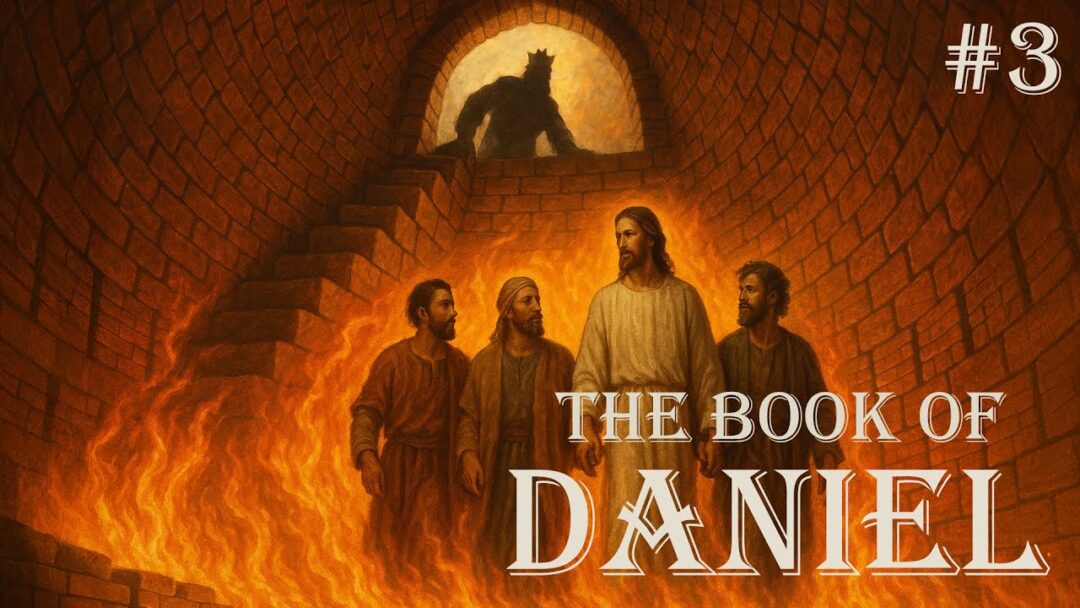
From our Sunday service on May 18, 2025, Daniel 3. This is part 3 of our Daniel series. Watch the full message: Faith in the Fire – Daniel Series #3 on YouTube.
Last time we were with Daniel, he had just saved all the wise men of Babylon, which is not a small task, and he was promoted to a very high position. But Daniel didn’t do it alone. Through prayer, he and his friends Shadrach, Meshach and Abednego received a vision from God and were able to correctly interpret King Nebuchadnezzar’s dream. As a reward for this impossible feat, Daniel was promoted to overseer of the whole province of Babylon, and his three friends were promoted to lesser positions alongside him.
Today we’re in the book of Daniel, but this passage is not about Daniel. It’s about his three friends, and we’ll be following them as they face their next challenge in this pagan city. In our first lesson we talked about Jeremiah, and how he encouraged the people in exile to remain faithful to God no matter what. Once again they’re going to be challenged in following that instruction. The main lesson we want to take from this story is that God wants you to keep your faith even through the difficulties of life.
A Giant Golden Image
Nebuchadnezzar the king made an image of gold, whose height was threescore cubits, and the breadth thereof six cubits: he set it up in the plain of Dura, in the province of Babylon. Then Nebuchadnezzar the king sent to gather together the princes, the governors, and the captains, the judges, the treasurers, the counsellors, the sheriffs, and all the rulers of the provinces, to come to the dedication of the image which Nebuchadnezzar the king had set up.
Daniel 3:1–2
Right off the bat we’re introduced to the conflict. Nebuchadnezzar has made a golden statue about 90 feet tall and 9 feet wide, roughly the height of a nine-story building. That’s a very big statue. The text doesn’t tell us exactly what it looked like, but notice those measurements: 90 by 9 is a 10 to 1 aspect ratio. In Sunday school we often picture a humanoid figure, but a humanoid statue is very unlikely to be ten times taller than it is wide. What we’re more likely looking at is something like an Egyptian obelisk, a very tall monument that Nebuchadnezzar coated in gold.
This was very common for Nebuchadnezzar. We’re fortunate to have a lot of information about the reign of Nebuchadnezzar II, including a document in the British Museum that tells of him making many gold-covered statues. He once covered a statue of the god Nabu completely with gold. He made a giant bronze statue of a bull and covered it in gold. He even covered some boats. He loved covering things with gold. Sometimes he would cut down trees, carve them up and coat the entire tree in gold to use as pillars. So here he’s doing something very similar: he makes a large pillar-shaped statue, covers it in gold, and probably puts inscriptions on it to the god Marduk or Nabu or Aku, any of those Mesopotamian gods. And, of course, Nebuchadnezzar being the prideful man he was, he always wanted credit for every project and praise for it, and he always wanted to be the biggest man in the room.
He invites all his officials from the region. The first three, the princes, governors and captains, are the provincial, regional and local governors, the ones over varying sizes of the region. But he also invites his advisers, treasurers, lawyers and magistrates, basically any official in the Babylonian government he could find. These events were really common for him. One of his big feats was making the roads of Babylon wider because he wanted bigger idols that he could roll down through the streets. We don’t find this specific statue in the archaeological record, but we know it was the kind of thing he was known to do. This one was just too big to roll through the streets, so he sets it up in an area and says, “Everybody come down. We’re going to dedicate this statue and celebrate together,” and, in effect, give him a pat on the back for all the great works he does for his pagan idols.
The Command and the Furnace
Then the princes, the governors, and captains, the judges, the treasurers, the counsellors, the sheriffs, and all the rulers of the provinces, were gathered together unto the dedication of the image that Nebuchadnezzar the king had set up; and they stood before the image that Nebuchadnezzar had set up. Then an herald cried aloud, To you it is commanded, O people, nations, and languages, That at what time ye hear the sound of the cornet, flute, harp, sackbut, psaltery, dulcimer, and all kinds of musick, ye fall down and worship the golden image that Nebuchadnezzar the king hath set up: And whoso falleth not down and worshippeth shall the same hour be cast into the midst of a burning fiery furnace.
Daniel 3:3–6
What an announcement. Tell me before I come down, Nebuchadnezzar. The crowds are probably as far as the eye can see, everybody important in the entire nation of Babylon. The herald says this is a command, and it applies to “people, nations, and languages.” It doesn’t matter whether you’re a Jew, a Persian, a Babylonian or a Chaldean. Every single person, regardless of religious beliefs or how they feel about it, is required to worship this statue. The signal will be the music. Some of those instrument names we might not recognize. In modern terms we’re talking about horns, a pipe like a piccolo, a lyre, a trigon, a psaltery and even bagpipes. All types of musical sound, a beautiful noise, and whenever you hear it, you’d better bow on your knees and worship. If you don’t, something is waiting for you. Whoever does not fall down and worship will at that hour, literally at that moment in the Aramaic, be thrown into the middle of a burning fiery furnace.
When we picture this in Sunday school, we confuse it with what a furnace does today. A modern furnace heats our houses. That’s not the kind of furnace being talked about here. I’ve been foreshadowing this in every message by talking about Nebuchadnezzar’s building projects. How did he make all the bricks for those projects? Throughout Babylon he had many brick-burning furnaces. You’d make the clay bricks and mix in the straw, but then you’d have to bake them at very high temperatures to make them strong enough to build structures. He was repairing Etemenanki, a giant ziggurat, so he was making bricks around the clock. It’s estimated that during his reign he produced over 15 million bricks. Any day, any hour, these furnaces were running at full power for his next building project, so everybody in Babylon knew about them. When Nebuchadnezzar says, “I’m throwing you in the furnace,” they know exactly what he’s talking about. This is not an idle threat. This is a promise.
The furnace would have been a massive kiln used to burn thousands of mud bricks at once. They don’t always come in the same shape, but to visualize it, assume a cylinder. Your first step would be to dig a hole in the ground in the shape of a cylinder and pull out all the dirt. Then you turn that dirt into muddy clay and build walls around it, and you might even make a dome with an opening at the top. When you dig the hole you dig stairs down to the bottom, so that when the bricks are done you can carry them out. On the outside you build steps to the top of the furnace so you can throw in fuel. This is the type of furnace they’re talking about. These furnaces needed to reach pretty high temperatures. Some of them still exist today, so we have good scientific evidence for how hot they got. They burned at roughly 1,832 degrees Fahrenheit, hot enough to melt both aluminum and silver, though not quite hot enough to melt iron or gold, and they burned around the clock.
The Accusation
Therefore at that time, when all the people heard the sound of the cornet, flute, harp, sackbut, psaltery, and all kinds of musick, all the people, the nations, and the languages, fell down and worshipped the golden image that Nebuchadnezzar the king had set up. Wherefore at that time certain Chaldeans came near, and accused the Jews. They spake and said to the king Nebuchadnezzar, O king, live for ever. Thou, O king, hast made a decree, that every man that shall hear the sound of the cornet, flute, harp, sackbut, psaltery, and dulcimer, and all kinds of musick, shall fall down and worship the golden image: And whoso falleth not down and worshippeth, that he should be cast into the midst of a burning fiery furnace. There are certain Jews whom thou hast set over the affairs of the province of Babylon, Shadrach, Meshach, and Abed-nego; these men, O king, have not regarded thee: they serve not thy gods, nor worship the golden image which thou hast set up.
Daniel 3:7–12
In the previous chapter, some of those Chaldean rulers had been displaced by familiar Jews. Upon Daniel’s recommendation, Shadrach, Meshach and Abednego had taken positions that Chaldeans held. So the Chaldeans knew these three were faithful followers of Yahweh and that there was no way they would bow down to this god. They knew what the three had done in their training, how they didn’t eat meat from the king’s table. In the Aramaic, “accused the Jews” literally means “ate pieces of them,” taking a bite out of them. We have a chance to deliver a blow, to take a shot, as the modern idiom would say. “Yes, we won’t get all the revenge on the Jews who took our jobs, but maybe a thing or two will land, and we’ll see some consequences.”
I love how they always butter him up with “O king, live for ever” before they ever ask for anything. They always talk so kindly when they want something.
Obviously Shadrach, Meshach and Abednego aren’t going to bow down to a pagan idol. That’s a given. But we still have to consider that most of the other Jews who were there likely did. I’m assuming there were more Jews. Remember that exiles were brought in to be wise men, and some of the officials listed were his advisers, so there were probably other Jews invited. It seems they bowed down and gave in because their lives weren’t worth risking. But these three didn’t. It’s interesting that Daniel isn’t mentioned here. Somebody proposed that the statue was actually erected in Daniel’s honor, which would explain why he wasn’t asked to bow to it. I don’t know if there’s any credence to that. Maybe, maybe not. We don’t know. Daniel wasn’t here for one reason or another and wasn’t asked to bow to the idol. Most of the Jews gave in, but these three young men were not like the others.
Then Nebuchadnezzar in his rage and fury commanded to bring Shadrach, Meshach, and Abed-nego. Then they brought these men before the king.
Daniel 3:13
Nebuchadnezzar, quick to anger, is immediately furious. These are very high-ranking officials: Nebuchadnezzar, then Daniel in charge of the region, and under Daniel these three men, so the third level of authority in the kingdom. They’re not obeying the king. We like to be mean to Nebuchadnezzar and call him a mean old man, but you have to look at it from the secular perspective. These are the third in command of the nation, and they’re insubordinate to their authority. Of course he’s going to be angry.
A Second Chance
Nebuchadnezzar spake and said unto them, Is it true, O Shadrach, Meshach, and Abed-nego, do not ye serve my gods, nor worship the golden image which I have set up? Now if ye be ready that at what time ye hear the sound of the cornet, flute, harp, sackbut, psaltery, and dulcimer, and all kinds of musick, ye fall down and worship the image which I have made; well: but if ye worship not, ye shall be cast the same hour into the midst of a burning fiery furnace; and who is that God that shall deliver you out of my hands?
Daniel 3:14–15
Nebuchadnezzar is angry, but he’s not unreasonable. First, he doesn’t just believe the accusation. He asks them, “Is it true? Can you confirm whether you’re insubordinate to my authority as king? You are in charge of this region. Is it true that you disobeyed a direct order?” Second, he gives them an opportunity to make it right. He’s saying, “I’m going to play the music again. If you worship this time, it’s all going to be hunky-dory. You can go home to your families, eat dinner, go to bed, and we’ll forget this whole thing happened. But if you do not, the moment I see you don’t get down on your knees and worship, I will throw you in one of my brick kilns.”
Then he makes a slam at their God, and it’s very important to the story because it’s the real theme of the chapter: “Who is that God that shall deliver you out of my hands?” The word in Aramaic carries the idea of liberating or freeing you, allowing you to escape. So Nebuchadnezzar shows restraint. He doesn’t punish them immediately. He asks whether they’re ready for another chance, and he says there’s no way out: your God can’t save you if you don’t listen.
“But If Not”
Shadrach, Meshach, and Abed-nego, answered and said to the king, O Nebuchadnezzar, we are not careful to answer thee in this matter. If it be so, our God whom we serve is able to deliver us from the burning fiery furnace, and he will deliver us out of thine hand, O king. But if not, be it known unto thee, O king, that we will not serve thy gods, nor worship the golden image which thou hast set up.
Daniel 3:16–18
They respond pretty bluntly. Nebuchadnezzar is being reasonable. He’s not just trusting another person’s word. He’s giving them a second chance. He asks them a question, and their response is, “We don’t need to answer you, king.” I wouldn’t imagine a king would take that very well. But they don’t just say something rude and leave it there. They explain why: “We don’t need to answer this, because even if you throw us in the furnace, our God can save us.” They’re not saying it just to spit in his face. They’re saying, “We don’t need to give you an answer, because if you do it, you’ll see it for yourself.”
But they don’t presume God is going to do it. They say, “But if not, we want you to know that even if our God doesn’t save us, we will not worship your gods. Even if for some reason God doesn’t free us from this situation, I want you to have it on the Babylonian record. Take out your cuneiform tablet and write it down. We will not bow down no matter what.” They weren’t saying, “I’m better than you.” They were saying, “I don’t need to answer, because God will answer.” If Nebuchadnezzar threw them into the furnace, they still believed God was able to free them from it.
This reminds me of the story of Job, who said:
Though he slay me, yet will I trust in him…
Job 13:15
It’s the importance of saying that even if God decides to let me be a martyr for his sake, I will still be okay with that. I will not challenge God’s authority on the matter. It also reminds me of Hebrews 11. We see that hall of faith of all these successful people, Abraham and Isaac and Samson and how they all did great things, but then at the end of that list of successful people, it talks about those who were sawn asunder. Not all of them got a happy ending, and yet they were faithful to God. A lot of times we like to say, “God’s going to save Shadrach, Meshach and Abednego.” But God does not always save. Sometimes he allows his servants to die for a greater cause. Here the three surrender to that fact: “We’re not going to presume that God will save us from this. But I want to tell you, he can. And if he doesn’t, we’ve still done our part.”
Seven Times Hotter
Then was Nebuchadnezzar full of fury, and the form of his visage was changed against Shadrach, Meshach, and Abed-nego: therefore he spake, and commanded that they should heat the furnace one seven times more than it was wont to be heated. And he commanded the most mighty men that were in his army to bind Shadrach, Meshach, and Abed-nego, and to cast them into the burning fiery furnace. Then these men were bound in their coats, their hosen, and their hats, and their other garments, and were cast into the midst of the burning fiery furnace. Therefore because the king’s commandment was urgent, and the furnace exceeding hot, the flame of the fire slew those men that took up Shadrach, Meshach, and Abed-nego. And these three men, Shadrach, Meshach, and Abed-nego, fell down bound into the midst of the burning fiery furnace.
Daniel 3:19–23
Nebuchadnezzar’s attitude and favor toward these men changed when they challenged his authority and said, in effect, “My God is bigger than you, king.” Notice “the form of his visage was changed”: the way he looked at them and felt about them was altered. He tells the men to throw in seven times more fuel. They didn’t measure heat by temperature, because they had no way to, so “seven times hotter” means seven times more charcoal or wood. Make it as hot and torturous as humanly possible. “I’m not just going to kill them. I’m going to make a statement out of them.” He throws in seven times more fuel just to spite them for questioning his authority, and because they said God could deliver them from his hand, he makes sure they can’t escape. He has his strongest men tie them up as tightly as possible: “I want zero percent chance of them getting out of my hands before they’re thrown in that furnace. They say their God can liberate them. I say try.” Every choice he makes is meant to slander their God and their claim even more.
He doesn’t even take their clothes off. He wants them to burn and feel pain as quickly as possible, so their clothes catch fire first and then they slowly die from the heat. Because the king’s command was urgent and the furnace exceedingly hot, because he was so hasty and they had heated it too much, the flame slew the men who took up Shadrach, Meshach and Abednego. Picture the cylinder kiln with its opening at the top. The guards take the steps on the outside to the top of the opening to throw the men in, all tied up so they can’t escape. But the furnace has become so hot, and they aren’t used to that, that the guards die immediately from the heat, and instead of throwing the three in, they kind of tumble in as the guards die. The three fall bound into the middle of the burning fiery furnace.
The Fourth Man
Then Nebuchadnezzar the king was astonied, and rose up in haste, and spake, and said unto his counsellors, Did not we cast three men bound into the midst of the fire? They answered and said unto the king, True, O king. He answered and said, Lo, I see four men loose, walking in the midst of the fire, and they have no hurt; and the form of the fourth is like the Son of God.
Daniel 3:24–25
Notice that key word “loose.” They said God is able to free us. When they go into the fire, the things that bound them burn off, and they walk freely in their time of trial. Nebuchadnezzar looks in. The men who threw them in died immediately, but he looks inside and doesn’t see three people. He sees four, and he says, “What in the world is going on?”
In some modern translations you’ll see “a son of the gods.” That’s because this isn’t a Hebrew passage but an Aramaic one. Not all the chapters of Daniel are in Aramaic, but this one is, because that’s what they spoke in Babylon. In Aramaic it says “a son of the gods,” but that is supposed to be clearly understood as a reference to Jesus Christ, God the Son. You see a similar idiom in the book of Judges, where they say “the sons of Benjamin,” and that’s understood as meaning he is a Benjamite. So “a son of the gods” means he is one of the divine, an offspring of the divine, and knowing that the God of Israel has a Son, we know that’s Jesus Christ. In their trial, Jesus Christ comes before his birth, as God the Son, and walks through the difficulty with them in the fire. The angel of the Lord is with them. They were thrown into the fire bound, but the fire did not harm them. It was meant to harm them, and the only thing it did was free them from the bonds that held them.
Then Nebuchadnezzar came near to the mouth of the burning fiery furnace, and spake, and said, Shadrach, Meshach, and Abed-nego, ye servants of the most high God, come forth, and come hither. Then Shadrach, Meshach, and Abed-nego, came forth of the midst of the fire. And the princes, governors, and captains, and the king’s counsellors, being gathered together, saw these men, upon whose bodies the fire had no power, nor was an hair of their head singed, neither were their coats changed, nor the smell of fire had passed on them.
Daniel 3:26–27
They’re walking up the stairs on the inside, so they just walk straight out. Nobody has to go get them. Nobody has to wait for the fire to stop. What Shadrach, Meshach and Abednego said would happen did in fact happen. They were freed from Nebuchadnezzar’s hand, not by loosening the ropes themselves, but by the fire of trial burning the ropes off them, and they walked out of that burning kiln on their own two feet. What was meant as a punishment to destroy them and stop them from expressing their faith in God was used to liberate them.
What the Fire Does
What’s the application? God can use the difficulties of our lives to liberate us from the things that restrain us and hold us back. Sometimes God will allow us to go through hardship so he can burn away the sinful habits that tie us down and stop our spiritual growth. God could have told Nebuchadnezzar, “Do not throw my people into the fiery furnace. I forbid it.” He could have had the angel of the Lord come before him with a flaming sword and threaten him not to do it. But that’s not what God did. God allowed Shadrach, Meshach and Abednego to walk slowly toward that kiln, to watch the men throw in the fuel, to see them light the fire and carry them up to the top. God does not free us from every difficulty of life. But he will use those difficulties, and as we saw with Jesus in the fire, he will be with us through them.
The difficulty we face may be a raging fire that brings us anxiety or stress. But on the other side we will find ourselves more free than we were before. Maybe we had wrong priorities before we went into the fire, or a wrong perspective, or a wrong type of faith in the wrong thing. Sometimes it’s the fires of trial that burn away the wrongful ties that bind our hearts and make us lose the joy of the Lord. James reminds us of the same truth:
My brethren, count it all joy when ye fall into divers temptations; Knowing this, that the trying of your faith worketh patience. But let patience have her perfect work, that ye may be perfect and entire, wanting nothing. If any of you lack wisdom, let him ask of God, that giveth to all men liberally, and upbraideth not; and it shall be given him.
James 1:2–5
When you face the difficulties of life, thank God, because it’s through the difficulties of life that God frees us from the shackles that hold us.
Nebuchadnezzar’s Decree
Then Nebuchadnezzar spake, and said, Blessed be the God of Shadrach, Meshach, and Abed-nego, who hath sent his angel, and delivered his servants that trusted in him, and have changed the king’s word, and yielded their bodies, that they might not serve nor worship any god, except their own God. Therefore I make a decree, That every people, nation, and language, which speak any thing amiss against the God of Shadrach, Meshach, and Abed-nego, shall be cut in pieces, and their houses shall be made a dunghill: because there is no other God that can deliver after this sort. Then the king promoted Shadrach, Meshach, and Abed-nego, in the province of Babylon.
Daniel 3:28–30
Nebuchadnezzar is shocked. He did everything in his power to make sure they couldn’t escape, and even throwing them into a burning fiery furnace at a thousand-plus degrees, their God was still able to save them. He says, “Wow. Respect these men.” They surrendered their bodies to their God. They challenged the king’s order knowing punishment would come, but they were dedicated to not serving any god except their own. So to honor this, Nebuchadnezzar made a new decree. Before, he decreed that everybody bow down to his statue. Now he wants to recognize this God.
Nebuchadnezzar is a polytheist. He believes in hundreds of gods. At this point he’s not going to say that Adonai, Yahweh, the Most High, whatever title you want to use, is the only God. But he does say this God is definitely superior to the gods he worships, because his gods weren’t able to challenge him in this impossible task. Their God came out on top. So his new decree is that anyone who speaks against the God of Shadrach, Meshach and Abednego will be cut in pieces and have their house made a dunghill. A real trademark Nebuchadnezzar punishment, as he did before to Daniel and the wise men. What he’s saying is, “I don’t want to mess with the God of Israel, because he can do things the others can’t.”
If you remember Daniel interpreting the dream in the last passage, the advisers said that the gods don’t interact with man, that the gods of Babylon don’t deal with people in any meaningful way and don’t even talk to us directly. For Nebuchadnezzar this would have been groundbreaking. There’s a God in Israel who doesn’t just talk through the stars but actually walked in the fire with his people. So the story ends with Shadrach, Meshach and Abednego convincing Nebuchadnezzar that their God truly was able to deliver them from the fire. Now he has no choice but to believe their God is a God of great power. He announces God’s ability to deliver to his entire kingdom and threatens anyone who would dare speak ill of him. And just like Daniel in the previous chapter, they are promoted for their faith.
Closing
Every trial we face in this life is an opportunity to grow in the Lord. What this story teaches us is that trials are important because they teach us what is truly important. When we go through trials, there are things we lose, and we find that God is really what we need. We grow in patience and understanding. We learn about contentment and what matters most. When the fire begins to burn away the distractions of our life, then we truly learn what matters.
Maybe you are going through a hard time now, or maybe one is coming your way in the near future. When that next trial comes, will you choose to be faithful like Shadrach, Meshach and Abednego? Will you say, “Whether or not God spares me from this hardship, I will trust him”? Or will you let the fire of worry singe your soul and burn you alive? When you choose to trust God, you can walk freely in the fire alongside Christ and watch the things that hold you back slowly burn away. And most of all, when you go through that trial, you can show the world the power of faith in Christ.
So how will your story end? Will people know about your God? Will they tell others how they saw God deliver you? Will they see you walking with faith through the fiery trials life throws your way? And most importantly, will you choose to find freedom in that fire? Next time you face hardship, choose to say, “No matter what happens, I will trust my God.” God wants you to keep your faith even through the difficulties of life. So will you choose to dedicate yourself to keeping that faith today?

Recent Comments