
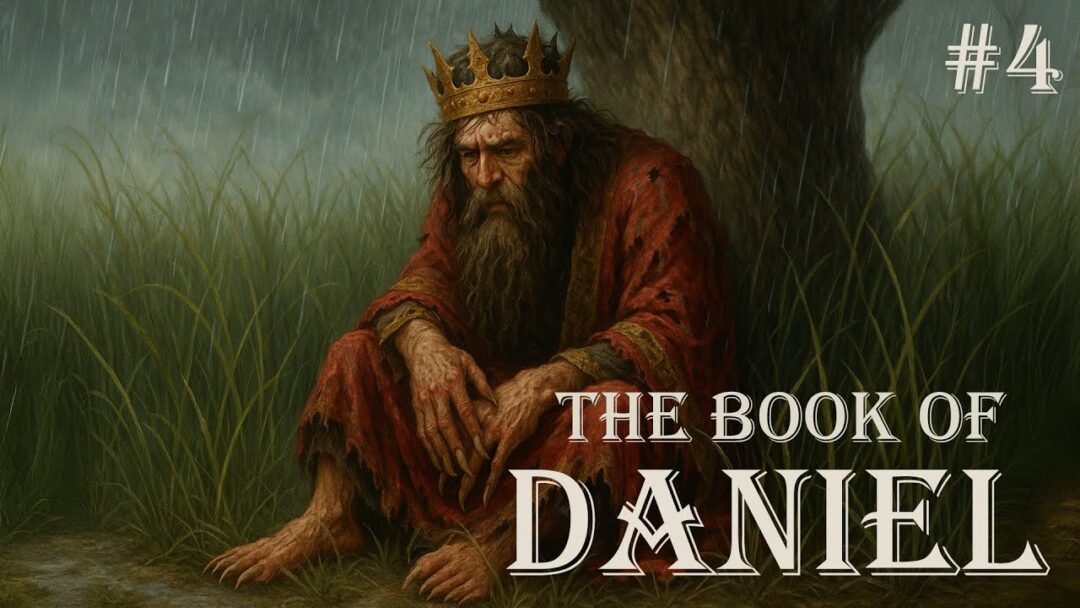
From our Sunday service on May 25, 2025, Daniel 4. This is part 4 of our Daniel series. Watch the full message: Nebuchadnezzar Speaks – Daniel Series #4 on YouTube.
Today we’re in Daniel chapter 4, the vision of the great tree. I really wish I could come up with a better title for this lesson, because that one tells you nothing about it. Alternatively, I entitled this message “Nebuchadnezzar Speaks.”
Last week we left off with Daniel’s three friends, Shadrach, Meshach and Abednego, facing the dangers of the fiery furnace. This week we pick up Daniel’s story in a very unique passage of Scripture. I love doing these unique passages, because I get to tell you something you probably haven’t noticed or maybe don’t know yet.
A Pagan King Writes Scripture
What’s really unique is that this passage was not recorded by a prophet, a priest, or even someone who believes God is the true God. It was written by the pagan king Nebuchadnezzar himself. That sets it apart from most of Scripture, which is usually written by a believer. Today we get someone who doesn’t believe God is the one God writing inspired Scripture. How does that work? We’ll learn a little about that today. In this chapter Nebuchadnezzar records the events that happened to him when he showed pride before the God of Israel, and he gives a stern warning to all who think little of the Most High God.
What Do History and Archaeology Say?
I always like to give a little history outside the Bible, a little archaeology and a little science when it lines up with and supports the Scriptures. As I’ve mentioned in previous lessons, we know a lot about Nebuchadnezzar and Babylon, and this passage is one that shows up in history. But if you talk with an atheist, they may bring up an accusation against the Bible: that it gets wrong who this king is, because the events of Daniel 4 didn’t happen to Nebuchadnezzar. Historians argue about two understandings. Either the king was Nabonidus, or he was Nebuchadnezzar II.
First, was it Nabonidus? Some of you may be familiar with the Dead Sea Scrolls, a bunch of scrolls dug up at Qumran. They’re the oldest copy of the Hebrew Scriptures we have. They contain all the books of the Bible except one (I can’t remember off the top of my head which one is missing), and they’re the oldest copy that’s mostly intact. Alongside them there were also some other fragments of stories. One of those separate accounts records a king of Babylon named Nabonidus, the last king of Babylon, who had a very similar experience to the one in the Bible. He received an ailment from God, Daniel was there to help him with it, and there was a seven-year period when Nabonidus was insane. Nabonidus and Nebuchadnezzar have very similar names in Aramaic and may have been transliterated the same way at certain points in history. We have some evidence of this. Herodotus, a Greek historian who traveled to Babylon about 90 years after Nebuchadnezzar’s reign, referred to both Nebuchadnezzar II and Nabonidus by the same name, Labynetus. So very shortly after the events of Daniel, these names were either conflated or one name was used for both individuals.
Nabonidus’s son was named Belshazzar, which may be familiar because in our next chapter we’ll talk about Belshazzar. Nabonidus also married Nebuchadnezzar II’s daughter, so they were a close-knit family, and he may have been considered part of the same lineage of kings. This is important because Nebuchadnezzar II wasn’t actually related to Nebuchadnezzar the first. It was a kingly name he took on in honor of an ancient Babylonian king from the past. So it’s possible that Nabonidus is the Nebuchadnezzar in this story, because he was Nebuchadnezzar’s son-in-law and a king shortly after his reign, and we know he takes part in the story in the next chapter. And there’s an archaeological record that says Nabonidus suffered a mental illness in the wilderness of Teima for seven years, just like the passage today says about Nebuchadnezzar.
But we also have the possibility that this really is Nebuchadnezzar II. He was extremely active for his first 11 years. I talked about how he built project after project and put his name on everything he did. But after those first 11 years, history becomes silent. From 570 to 562 BC, references to Nebuchadnezzar II in buildings and royal annals go completely silent. If you’re not good at math, that’s an eight-year gap in his history, and our story today has a seven-year gap. There’s also a cuneiform tablet saying that officials reported to Evil-Merodach, Nebuchadnezzar’s son, that Nebuchadnezzar II no longer valued his life, gave contradictory orders, no longer listened to his palace advisers, neglected his own sons and daughters, and stopped performing his religious duties as king. They were very concerned about his mental state, so this could also reflect the events talked about in this chapter.
Which is the right answer? It’s hard to say, because shortly after Nabonidus’s reign he was sometimes referred to as Nebuchadnezzar. Either way, there’s enough archaeological evidence to support that this story actually happened, because both of them have silent years where they were struggling with mental illness. So if anybody says the Bible got Nebuchadnezzar wrong, actually the Bible got it right. Archaeology is always catching up with us. For hundreds of years they said Nebuchadnezzar II never went crazy because there was no record of it, and then within the last hundred years we dug up a tablet showing that the officials were worried about his mental state. The Bible has the truth, and archaeology just takes a while to catch up. Give it another hundred years and we’ll probably have this nailed down. What’s important is that we know it happened. The Bible is true, and as we go along, archaeology confirms it time and time again.
In today’s lesson, what we want to take away is that God wants you to be humble so he can lift you up in his time.
The King’s Testimony
Nebuchadnezzar the king, unto all people, nations, and languages, that dwell in all the earth; Peace be multiplied unto you. I thought it good to shew the signs and wonders that the high God hath wrought toward me. How great are his signs! and how mighty are his wonders! his kingdom is an everlasting kingdom, and his dominion is from generation to generation.
Daniel 4:1–3
Right off the bat we get a shocking revelation: this is not written by a believer in God. It’s written by Nebuchadnezzar, king of Babylon, and it’s very different from the Nebuchadnezzar we’ve been hearing about. He’s praising God. He says “the high God,” which is Aramaic. It would be rendered “the Most High” in Hebrew, but he means the God who is higher than all the others. Here we see the unique biblical author Nebuchadnezzar himself writing the testimony of how God worked in his life.
We shouldn’t take away from this that Nebuchadnezzar converted to Judaism. There’s plenty of evidence in this passage alone that he only believed the Most High to be one of the many gods he worshiped. So we have a good reminder right off the bat to be mindful and attentive when reading inspired Scripture. I believe the Bible is the inspired word of God. I believe Daniel 4 is inspired, and that if God wants to work through a pagan king to write inspired Scripture, he can do so. But we have to be careful, because inspired does not always mean factually correct. God inspired Nebuchadnezzar to record an accurate account of the events that happened. That does not mean God endorses all the events that occur, or that everything Nebuchadnezzar says about God is right.
This matters in a few spots in the Bible. The most common one I go to is Job. A huge portion of the book is Job’s friends arguing with him, chapter after chapter, and you could make an entire message from what one of Job’s friends said and preach it like truth. But then you get to the end of the book, and God speaks up:
And it was so, that after the LORD had spoken these words unto Job, the LORD said to Eliphaz the Temanite, My wrath is kindled against thee, and against thy two friends: for ye have not spoken of me the thing that is right, as my servant Job hath.
Job 42:7
Three chapters of Eliphaz talking about what is true about God, and God calls him out and says that what he said was wrong. If you made a message from Eliphaz’s speeches, you wouldn’t be teaching true things about God.
Another example is Ecclesiastes 1:2:
Vanity of vanities, saith the Preacher, vanity of vanities; all is vanity.
Ecclesiastes 1:2
Pointlessness after pointlessness. If we take that and preach it at face value, we aren’t taking the entire book of Ecclesiastes in context. The Preacher is talking about his personal feelings there, not saying that there’s no meaning to life. At the end of the book he tells you God is the meaning of life and gives purpose to life. If we take that passage on its own, we’ll get the wrong lesson.
Another example is Lamentations 3, where Jeremiah says:
He hath led me, and brought me into darkness, but not into light. Surely against me is he turned; he turneth his hand against me all the day. … Also when I cry and shout, he shutteth out my prayer. … And I said, My strength and my hope is perished from the LORD:
Lamentations 3:2–3, 8, 18
Are we supposed to take from Jeremiah that God literally hates him and doesn’t answer his prayers anymore? Should we preach from the pulpit that God is going to shut out your prayers and he hates you and doesn’t love you? No. You have to read the rest of the chapter, where Jeremiah breaks down that this is how he feels, not how things are. Today we have a passage written by someone who doesn’t completely understand God, and we need to keep that in mind as we study it. We’ll see some reasons today why we need to be careful.
A Dream That Terrifies the King
I Nebuchadnezzar was at rest in mine house, and flourishing in my palace: I saw a dream which made me afraid, and the thoughts upon my bed and the visions of my head troubled me. Therefore made I a decree to bring in all the wise men of Babylon before me, that they might make known unto me the interpretation of the dream. Then came in the magicians, the astrologers, the Chaldeans, and the soothsayers: and I told the dream before them; but they did not make known unto me the interpretation thereof.
Daniel 4:4–7
We have a very similar situation to Daniel chapter 2: the king has a dream. Pagans always saw dreams as really meaningful, so they kept advisers at hand to explain what the dreams were and how the gods were talking to them. Nebuchadnezzar has had this experience before, and he’s had Daniel involved before, but instead of calling Daniel, who gave him the answer last time, he calls all his wise men.
His line about being “at rest in mine house, and flourishing in my palace” is important because it shows the state of his kingdom. “At rest in my house” means a very strong time of peace. If he was at war, he wouldn’t be resting in his house. He would be busy managing the affairs of his armies. But here he’s in Babylon, at peace. The battles have been fought and the wars have been won. Festivals have been held, people are happy, and everything seems to be going great for him. Sadly, this is going to change soon. “Flourishing” in the original language is the word for “green,” the idea of health, like a plant that is very green when it’s doing well. He was green and flourishing and healthy. He had a lot of stuff. This is going to be important, because a tree is going to be in this dream in a moment. He’s resting in his house and flourishing, his kingdom is alive and he has no problems, and in the middle of this peace he’s interrupted by a dream that terrifies him.
Because God needs to get the glory for this, he makes Nebuchadnezzar call his pagan advisers first. And they probably said similar things to what they said last time: “King, this is a weird request. Gods don’t talk to people. We told you this last time. Daniel’s an exception. Why are you bothering us?” So what’s the king going to do? He’s going to call Daniel.
But at the last Daniel came in before me, whose name was Belteshazzar, according to the name of my god, and in whom is the spirit of the holy gods: and before him I told the dream, saying, O Belteshazzar, master of the magicians, because I know that the spirit of the holy gods is in thee, and no secret troubleth thee, tell me the visions of my dream that I have seen, and the interpretation thereof.
Daniel 4:8–9
Finally he calls the one adviser who’s in charge of everybody. We finally learn what Daniel’s position was in the king’s court: head of the magicians, which is funny, because he doesn’t practice magic, but that’s the role he has. Nebuchadnezzar doesn’t understand how Daniel’s God works. He says, “You have the spirit of the holy gods,” as if the divinity of multiple deities is within him. What he’s recognizing is the Spirit of the one true God, but because of his pagan perspective he can’t identify it for what it truly is. If we take this as inspired Scripture and read it the wrong way, we could say there are multiple gods, but that’s not what we should take away. We’re seeing it from Nebuchadnezzar’s perspective.
“No secret troubleth thee” means nothing can be hidden from you because you have this spirit in you. Once again, Daniel told him in chapter 2 that it’s not him who reveals the secrets, but Nebuchadnezzar isn’t convinced. He says, “It’s not hard for you. You’ve got this special talent.” Daniel’s like, “No, no, no. That was God. I told you.” And yet again Nebuchadnezzar can’t wrap his head around it. “I know it’s in there. You can reveal this in no time at all. So tell me what this dream means, head magician of my court.”
The Great Tree
Thus were the visions of mine head in my bed; I saw, and behold a tree in the midst of the earth, and the height thereof was great. The tree grew, and was strong, and the height thereof reached unto heaven, and the sight thereof to the end of all the earth: The leaves thereof were fair, and the fruit thereof much, and in it was meat for all: the beasts of the field had shadow under it, and the fowls of the heaven dwelt in the boughs thereof, and all flesh was fed of it. I saw in the visions of my head upon my bed, and, behold, a watcher and an holy one came down from heaven…
Daniel 4:10–13
This is the first part of Nebuchadnezzar’s dream. It’s about a giant tree that provides food for the entire world, animals included. Then an angel comes down from heaven and messes things up.
What’s unique to this book of the Bible is the term “watcher.” This is where you have to be careful with books written by Nebuchadnezzar and not by a believer. The term appears only in this chapter, where Nebuchadnezzar is writing, and for hundreds and really thousands of years people have argued and debated what it means. As far back as 300 BC people were writing books about the watchers. Most famously, the book of Enoch falls into this category. The book of Enoch is not Scripture and should not be taken as Scripture. There was a period of 400 years we call the intertestamental period. After the book of Malachi, God sealed Scripture until the time of the Messiah, and during those 400 years of silence nobody was receiving prophecy from God. In the absence of prophecy, people who believed in Judaism but didn’t have respect for it started writing books trying to fill in the gaps of the old stories. The book of Enoch goes back to Genesis and tries to fill in what the sons of God and the daughters of men were, and what the flood was all about. They took this unexplained term “watcher” from the book of Daniel and wrote a story about what the watchers were: some kind of interbreeding between angel and human.
Thousands and millions of people have fallen into the trap of thinking the watchers are a biblical concept. I knew people at my Bible college, with Bible degrees, who were convinced the watchers are real beings just because they show up once in Daniel 4, from King Nebuchadnezzar. They say, “If the watchers are in Daniel and in the book of Enoch, then the book of Enoch must be true. Jude references something the book of Enoch references, so it must be true. Peter sometimes says things that sound like the book of Enoch, so it might be true.” I can tell you the book of Enoch contradicts Scripture in many, many places. It is not inspired Scripture. Just because people talk about the same thing doesn’t mean both support each other. It’s possible these things came from ancient records far older than the book of Enoch, and both took them from the same source. We need to be careful not to take these words and run with them.
Only Nebuchadnezzar uses this term, and I don’t like to steal people’s excitement, but the most likely explanation is that this is a pagan concept from Mesopotamia. If you look at the book of Enoch and the Babylonian myths, you’ll find a lot in common between the watchers in Babylon and the watchers in the 300 BC book. So it’s more likely that this isn’t a biblical concept but a type of syncretism, where the exiles in Babylon took some of the Babylonian religion and mixed it with the true word of God.
To support the idea that the watcher is just an angel, look back at verse 13: “a watcher and an holy one.” Notice that going forward in the story, only one angel speaks. There are not two angels. The way to understand it is that there was a watcher, even a holy one. When they recorded this for the Bible, they knew Nebuchadnezzar’s text was going to be confusing, so they put in “a holy one” in parentheses, in other words an angel, so we wouldn’t get confused. But despite this being in there, and despite them doing it twice, people still get tripped up. The text calls it a holy one specifically to tell us that what he calls a watcher is to be understood as an angel like you’d see anywhere else in Scripture. And the term “watcher” simply means “the awake one,” those who never sleep, angels who are always watching and waiting to execute God’s will.
He cried aloud, and said thus, Hew down the tree, and cut off his branches, shake off his leaves, and scatter his fruit: let the beasts get away from under it, and the fowls from his branches: Nevertheless leave the stump of his roots in the earth, even with a band of iron and brass, in the tender grass of the field; and let it be wet with the dew of heaven, and let his portion be with the beasts in the grass of the earth: Let his heart be changed from man’s, and let a beast’s heart be given unto him; and let seven times pass over him. This matter is by the decree of the watchers, and the demand by the word of the holy ones: to the intent that the living may know that the most High ruleth in the kingdom of men, and giveth it to whomsoever he will, and setteth up over it the basest of men.
Daniel 4:14–17
We have a beautiful, magnificent tree that is a good thing. Every animal and all flesh, birds and humans alike, get food from it and rest under its shade. Yet for some reason the angel says, “Cut down this thing that is such a blessing.” Based on how the word is used in Ezekiel, it’s probably a cedar tree, by the way. But this beautiful cedar is going to be cut down, with its branches cut off, its leaves shaken off and its fruit scattered. The watcher says specifically in this dream that this is a prophetic message from heaven, meant to teach the hearer that the God of Israel rules the kingdom of men. This beautiful tree that provides for the world is cut down to a stump, and a giant chain of brass and iron is placed on it to imprison it. “Seven times” means literally seven periods, in other words seven years.
The purpose, as verse 17 says, is “that the living may know that the most High ruleth in the kingdom of men, and giveth it to whomsoever he will.” God gives the kingdom of men to whoever he wants, even the lowest men on earth. Ouch. Maybe Nebuchadnezzar got that one right off the bat: God gives the kingdoms to whoever he wants, even the lowest, most humble, most useless of people, if that’s what he wants to do.
Daniel Is Stunned
This dream I king Nebuchadnezzar have seen. Now thou, O Belteshazzar, declare the interpretation thereof, forasmuch as all the wise men of my kingdom are not able to make known unto me the interpretation: but thou art able; for the spirit of the holy gods is in thee. Then Daniel, whose name was Belteshazzar, was astonied for one hour, and his thoughts troubled him. The king spake, and said, Belteshazzar, let not the dream, or the interpretation thereof, trouble thee. Belteshazzar answered and said, My lord, the dream be to them that hate thee, and the interpretation thereof to thine enemies.
Daniel 4:18–19
Nebuchadnezzar says, “Daniel, don’t hold back. Give me the interpretation. I know you can do it,” because, once again, the spirit of the holy gods is in you. Nebuchadnezzar can see the effects of God’s Spirit, but he fails to identify it with the true God. He doesn’t believe in one God. He thinks there’s a pantheon of gods and that Daniel just happens to worship the most powerful one.
We can apply this to our lives. When we truly live like Christ wants us to, people will notice there’s something different about us. They’ll want to know why you have hope in a desperate situation, and how you keep pushing forward when things are so bleak. They’ll see the difference in you but struggle to identify it. Even if you tell them, “It’s because of God,” they might not believe it. They might try to understand it through the lens of science. Maybe it’s the placebo effect, and prayer just works because people think they’re going to get better, so they do. They’ll see a difference but explain it away through something that fits their worldview. That doesn’t mean we shouldn’t be a witness. It means we need to continue to be a witness, because people can notice a difference in the life of a believer who is faithful, even if they don’t exactly understand it right now.
When he’s told the dream, Daniel is “astonied for one hour.” In Aramaic that’s like “one moment.” It’s not literally an hour. He was stunned for a moment and didn’t know what to say, and Nebuchadnezzar is waiting: “Daniel, hello. Just tell me. Don’t be afraid.” Daniel is visibly distressed, and this also reveals his compassion and care for this pagan king. Despite Nebuchadnezzar’s past tyrannical actions toward him and his friends, Daniel isn’t excited to hear about the king’s upcoming downfall. This reflects the heart of a true servant of God. A true Christian should speak the hard truths, but still desire repentance and restoration for those they have to speak them to.
“It Is Thou, O King”
The tree that thou sawest, which grew, and was strong, whose height reached unto the heaven, and the sight thereof to all the earth; Whose leaves were fair, and the fruit thereof much, and in it was meat for all; under which the beasts of the field dwelt, and upon whose branches the fowls of the heaven had their habitation: It is thou, O king, that art grown and become strong: for thy greatness is grown, and reacheth unto heaven, and thy dominion to the end of the earth.
Daniel 4:20–22
Right off the bat we find out that Nebuchadnezzar was the tree. Remember how he said he was flourishing in his house, green like a plant? Here we find out that in the dream he was the plant. Notice that Daniel says it directly: “It is thou.” Usually he would use niceties to soften the blow, but it’s so important here that he addresses the king directly, which you’re not supposed to do. He boldly proclaims the truth, and that becomes very important for Nebuchadnezzar’s next few choices. He makes the truth direct, unrestrained and unsugarcoated for the king.
There’s also a revelation here. If Nebuchadnezzar is the tree that God gave the kingdoms of the world as a place of refuge for humanity to rest in, then our governments are set there for our protection. This tree was set up to feed people, to protect them in the shade from the scorching sun and to give them refreshment. It was a blessing and it was beautiful. Government is supposed to be a beautiful thing, meant to provide for and care for the people who live under it. God chooses those leaders and allows them to come to power, either to bless a nation or to judge it. But sometimes rulers abuse the powers God gives them, and that destroys the purpose God has for the kingdoms of the earth. Nebuchadnezzar has abused his power, and because of that the tree needs to be cut down and regrown.
And whereas the king saw a watcher and an holy one coming down from heaven, and saying, Hew the tree down, and destroy it; yet leave the stump of the roots thereof in the earth, even with a band of iron and brass, in the tender grass of the field; and let it be wet with the dew of heaven, and let his portion be with the beasts of the field, till seven times pass over him; This is the interpretation, O king, and this is the decree of the most High, which is come upon my lord the king: That they shall drive thee from men, and thy dwelling shall be with the beasts of the field, and they shall make thee to eat grass as oxen, and they shall wet thee with the dew of heaven, and seven times shall pass over thee, till thou know that the most High ruleth in the kingdom of men, and giveth it to whomsoever he will.
Daniel 4:23–25
I like that Daniel is very specific. Nebuchadnezzar has already misattributed who this is from, so Daniel goes out of his way to say this is the decree of the Most High. This is from my God, King of Kings and Lord of Lords, not the gods, as you think. The takeaway is direct: Daniel is telling him that his arrogance will bring humiliation, but this humiliation will invite restoration. Nebuchadnezzar is told he’ll be driven away from mankind and eat grass like an animal. He’ll lose his mind and enter into insanity for seven years because he hasn’t given God the praise for his position. He spent all these years building up a name for himself, building up glory to himself and worshiping himself, and God has had enough of his pride.
Proverbs 16:18 reminds us of this:
Pride goeth before destruction, and an haughty spirit before a fall.
Proverbs 16:18
Anyone who allows arrogance to reign in their life is inviting God to humiliate them and knock them down a notch. But God doesn’t just knock people down. He always gives them an opportunity to be restored. The band of iron and brass is to lock him down, but it’s also there to preserve the stump. If you’ve ever tried to cut down a tree, you know how hard it can be to stop it from regrowing. You have to really work to get the roots out of the ground. But here the angel is told, “Leave the stump. I don’t want to destroy him. I don’t want to end his life, but I want him to learn the lesson and grow a better tree than he was before.”
I have a bush that is expanding onto my sidewalk, and at some point I’m going to have to cut it back, because it’s going beyond the place it’s supposed to be. It has a space, but now it’s going out of its rightful place and expanding into the sidewalk. Nebuchadnezzar had a place and a purpose and a domain in which to serve God, even as an unsaved person. Now he’s expanding out of it, and he must be cut down and regrown to fit back into the mold God has for him. God chooses who rules the kingdoms of humanity. Nebuchadnezzar thought he got everything because he worked for it. Really, it was because God allowed his efforts to be successful. At any point God could have moved people to step in Nebuchadnezzar’s way and end things right there. But God did not.
A Year to Repent
And whereas they commanded to leave the stump of the tree roots; thy kingdom shall be sure unto thee, after that thou shalt have known that the heavens do rule. Wherefore, O king, let my counsel be acceptable unto thee, and break off thy sins by righteousness, and thine iniquities by shewing mercy to the poor; if it may be a lengthening of thy tranquility.
Daniel 4:26–27
Daniel begs the king to learn his lesson the easy way. “King, I am begging you. If my advice is acceptable to you, then break off your sins and do righteously. Stop your sins and replace them with righteousness. And cut off your iniquities by showing mercy to the poor.” This gives us a little glimpse into what God was so angry about. It seems Nebuchadnezzar was hoarding wealth for himself. Remember that in Babylon they coated so much in gold and built so much. Nebuchadnezzar was putting all this money into making his kingdom fancier, more spectacular and more magnificent. It’s said that his rooftop walking place was like six miles long, six miles of walls to walk on at night. It shows how insanely the money of the kingdom was funneled into building projects for his pride. Daniel is saying, “Replace your injustice. Take all this money you’re hoarding to make yourself look good and take care of the people in your nation who are suffering.” And if he does, maybe God will have mercy on him and this judgment won’t come upon him. God might extend Nebuchadnezzar’s prosperity if he chooses to humble himself. Judgment is never God’s goal. Transformation is. If Nebuchadnezzar had said, “I will heed God’s warning,” he would never have had to go through any of this prophecy. But did Nebuchadnezzar listen? No.
All this came upon the king Nebuchadnezzar. At the end of twelve months he walked in the palace of the kingdom of Babylon. The king spake, and said, Is not this great Babylon, that I have built for the house of the kingdom by the might of my power, and for the honour of my majesty? While the word was in the king’s mouth, there fell a voice from heaven, saying, O king Nebuchadnezzar, to thee it is spoken; The kingdom is departed from thee. And they shall drive thee from men, and thy dwelling shall be with the beasts of the field: they shall make thee to eat grass as oxen, and seven times shall pass over thee, until thou know that the most High ruleth in the kingdom of men, and giveth it to whomsoever he will. The same hour was the thing fulfilled upon Nebuchadnezzar: and he was driven from men, and did eat grass as oxen, and his body was wet with the dew of heaven, till his hairs were grown like eagles feathers, and his nails like birds’ claws.
Daniel 4:28–33
Nebuchadnezzar doesn’t learn the lesson the easy way. God gave him 12 months, an entire year to change his attitude. I’m sure that as the year ran out he thought, “What Daniel said was nonsense. I haven’t changed a thing and everything’s going great.” Maybe that’s us. Maybe the pastor told us in church to be humble, to open up our hearts a little bit more, and we think, “I’ve been doing the same thing, nothing’s gone wrong, everything’s okay.” But God was giving him time to make the right decision, and when that time was up, the trigger was ready to fire and the prophecy was ready to be fulfilled.
Nebuchadnezzar is walking on his enormous palace, with something like six miles of rooftop, on this great new building project, this wonderful feat of engineering he was responsible for. As he looks over his city, he says, “Is not this great Babylon? This beautiful household I have built. My family lives in the most fancy building in the entire world. I built it all by my power, my authority and my strength, for my glory and my majesty. And everyone can see it.” What he didn’t know is that the year had passed and his time was up. He tripped the switch. He showed his pride, and at that moment everything was taken away from him.
He would be quickly expelled from his kingdom. As time passed his hair would grow matted and interwoven, like feathers on an eagle. His fingernails would go uncut and grow long and curl and become disgusting and nasty. Because people were so afraid to be around him, he was left out in the wilderness, in the cold and the wet, as a mad, insane individual. The mighty majesty of King Nebuchadnezzar was now something to be feared and avoided. For those seven years, no one would say anything good about him. If he ever came up, I’m sure they’d say, “I don’t know where he is. I don’t know that I want to know.” Suddenly his pride was taken from him.
The King Looks Up
And at the end of the days I Nebuchadnezzar lifted up mine eyes unto heaven, and mine understanding returned unto me, and I blessed the most High, and I praised and honoured him that liveth for ever, whose dominion is an everlasting dominion, and his kingdom is from generation to generation: And all the inhabitants of the earth are reputed as nothing: and he doeth according to his will in the army of heaven, and among the inhabitants of the earth: and none can stay his hand, or say unto him, What doest thou? At the same time my reason returned unto me; and for the glory of my kingdom, mine honour and brightness returned unto me; and my counsellors and my lords sought unto me; and I was established in my kingdom, and excellent majesty was added unto me.
Daniel 4:34–36
Nebuchadnezzar doesn’t regain his mind until he decides to surrender his pride to God and looks up to the true God for help. He finally praises God as the supreme authority and gives him credit for his appointment as ruler of Babylon. What’s awfully sad is that at any point during those seven years he could have realized this. He could have said, “I’ve lost everything. My mind is constantly trapped inside my head. I don’t know what to do.” But it took him seven years to say, “God, I get it. You’re in charge. You’ll do what you will. I didn’t do all these things in my life on my own. You allowed them to come to pass. Lord, I’m going to give you the credit for the work you’ve done in my life.”
The application is that true wisdom begins when we acknowledge our limits and yield to the lordship of Jesus Christ. We won’t have true wisdom until we understand that we can’t take all the credit for our achievements in life. A lot of times we like to think we’re self-made men and women, and that everything we have, we deserve. That’s not usually true. Usually there’s luck involved, or God did something to help you, or you started in a better position than those around you, and that brought you success. God reminds us that we need to humble ourselves.
Now I Nebuchadnezzar praise and extol and honour the King of heaven, all whose works are truth, and his ways judgment: and those that walk in pride he is able to abase.
Daniel 4:37
That is the key phrase of this entire passage: “those that walk in pride he is able to abase.” Those who are prideful, he is able to humble. First Peter 5:6 says:
Humble yourselves therefore under the mighty hand of God, that he may exalt you in due time:
1 Peter 5:6
The story of Nebuchadnezzar is a warning to us. Christians are called to walk in humility before God, knowing that all authority, opportunity and ability comes from him. When we understand our place before God, our hearts will be moved to worship him, and our lives will become testimonies of his goodness and grace.
Closing
In the end of this story, Nebuchadnezzar learned the hard way that what Daniel tried to tell him from the beginning was true. God is the only one who rules over the kingdom of men. God’s power is unmatched and his authority is unquestionable. This chapter is a powerful reminder that God is patient with us, but he is also just. He will give us warnings and offer opportunities to humble ourselves and repent, but he does not allow arrogance to go unchecked forever.
So what does that mean for us? We should take the lesson taught here very seriously. Whether you’re in a place of power or you feel like just another face in the crowd, God is calling you to a life of humility, not because he wants to tear you down but because he wants to build you up in his timing. Let Nebuchadnezzar’s story remind you that God wants you to be humble. Only when we’re humble can we truly see God for who he is and become who he wants us to be. God wants you to be humble so he can lift you up in his time. So the question today is, will you wait on his timing?

Recent Comments