
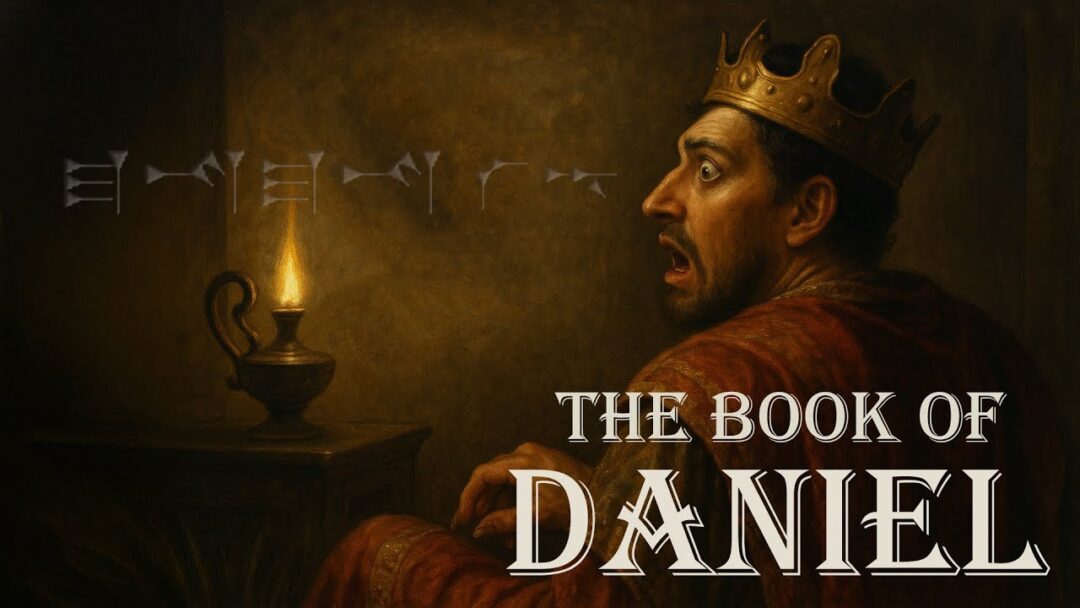
From our Sunday service on June 1, 2025, Daniel 5. This is part 5 of our Daniel series. Watch the full message: Writing on the Wall – Daniel Series #5 on YouTube.
Daniel 5 is really short. I could have had you out of here in twenty minutes, but I thought, let’s really dig into the meat of what’s going on in this story. So I took some time this week to get some ancient records out and go through Babylonian tablets. I wanted to get to the bottom of some details the Bible doesn’t dive into, because it assumes you know the history of Babylon. Today we’re going to add some context to this passage that you wouldn’t get just by looking inside Scripture. It comes from a very unique time in history, one we have a lot of information about. Thousands upon thousands of Babylonian tablets recount it.
Last week we heard Nebuchadnezzar’s letter to the world, in which he proclaimed how God showed him that the Most High was the one who controlled the kingdom of men and could appoint whoever he wanted to rule over them. I mentioned that there’s debate on whether that letter was written by Nebuchadnezzar II or by a man named Nabonidus. In my studies this week, I am almost 100% certain it was Nebuchadnezzar II, based on the way Nabonidus talks in his own writings. He does not sound like the king in the Bible at all, but Nebuchadnezzar II sounds a lot like how he wrote in his own writings.
Today’s story jumps two decades from where we were last week, to the year 539 BC. Today we’ll look at the life of Belshazzar to learn this lesson: God wants you to reverence him.
What Happened in the Gap
A lot of time has passed between those two chapters, so let’s look at the gap. In 562 BC King Nebuchadnezzar II died, and his son, Evil-Merodach, took the throne. The Bible tells us that this new king released Jehoiachin, the king of Judah, in his thirty-seventh year of captivity, in the first year of his reign (2 Kings 25:27). What’s interesting is that we have Babylonian tablets that record his release happening at the same time the Bible says. Some things we take by faith, but other things are backed up by archaeology, and that is one of them.
Evil-Merodach didn’t last long. Two years into his rule he was murdered, and someone usurped his throne. In 560 BC Neriglissar killed Evil-Merodach and took the throne for himself. He then married Nebuchadnezzar II’s daughter to solidify his right to the throne, officially making him part of Nebuchadnezzar’s dynasty. His kingship lasted only four years, and his son, Labashi-Marduk, took over in 556. Within weeks or months, he too was overthrown and murdered.
In 556 Nabonidus, another outsider to the royal family, whom we talked about a little last week, was quickly declared the new king at the age of 60. It was very unexpected. Together with his son, Belshazzar, he ruled Babylon for seventeen years. Our story takes place on the very last night of their rule, one of the most famous moments in history, which historians have recounted for thousands of years. Since Nabonidus and Belshazzar are important to this story, let’s learn about them before we read what happened.
Nabonidus and Belshazzar
Nabonidus was suddenly and unexpectedly made king when Labashi-Marduk, Nebuchadnezzar II’s grandson, was deposed and killed. Before that he was a somewhat prominent figure in the kingdom, though we don’t know exactly what his role was. A stele of Nabonidus has him saying, “I am the real executor of the wills of Nebuchadnezzar and Neriglissar, my royal predecessors.” So he does claim some kind of political continuation from Nebuchadnezzar. That is going to be important because of how the relationship is talked about in the Bible.
He also says his father was known as “the wise prince,” and gives a name for his father that shows up nowhere in history. He was very strange about who his father was, and we don’t know much about him, but we do know Nabonidus claims he was not related to Nebuchadnezzar. Herodotus, the ancient Greek historian, says Nabonidus married Nebuchadnezzar II’s daughter, Nitocris. We mentioned that Neriglissar did a similar thing. We also know Nabonidus’s mother, Adad-guppi, had a close connection to Nebuchadnezzar II, to his father and to his son, and was able to give input and influence during their rule.
So Nabonidus wasn’t born into the royal family, but from what we can glean he was married into it. When the king was murdered, he was quickly taken as someone experienced in the kingdom and made king as a quick replacement. We know this relationship with Nebuchadnezzar is true, because of Jeremiah 27:6-7.
And now have I given all these lands into the hand of Nebuchadnezzar the king of Babylon, my servant; and the beasts of the field have I given him also to serve him. And all nations shall serve him, and his son, and his son’s son, until the very time of his land come: and then many nations and great kings shall serve themselves of him.
Jeremiah 27:6–7
Jeremiah’s prophecy is that Israel will be in exile until Nebuchadnezzar’s son and grandson rule. If the line of kings was broken, he needs a grandson, so Nabonidus needs to be Nebuchadnezzar’s son-in-law, so that his son can be the grandson who fulfills Jeremiah’s prophecy. So Nabonidus had to be Nebuchadnezzar’s son-in-law.
A fun fact about Nabonidus’s personality: he’s known to history as the first archaeologist. He was always excited to excavate the building projects of those who came before him. He would discover ancient tablets from hundreds of years back, from the early days of Babylon, and create new versions of them to preserve their legacy. But he was also obsessed with the moon god Sin. With these two obsessions at the forefront of his life, he fell out of line with the desires of the regular Babylonian population. That made him very unpopular, and may be a reason why he is about to disappear.
So who is Belshazzar? He was the acting king of Babylon, the son of Nabonidus and the grandson of Nebuchadnezzar. Very shortly after his reign began, Nabonidus went into a self-imposed exile at Tayma, an Arabian oasis, from at least the fourth year to the thirteenth year of his reign. Some say he left even during his third year as king. He stayed there for unknown reasons. He originally went to start a war against Arabia, but when he conquered the city of Tayma, he never came back. When he arrived there, he killed the ruler and worked the people to death, constructing a recreation of his Babylonian palace for him to live in. What a strange thing to do. You have a palace in Babylon, so why go into Arabia, kill the king there and have the people recreate your palace?
Some theorize it was actually Belshazzar who was behind the actions that deposed the previous king. He was the only one who truly benefited, since his father was very old at the age of 60 and he knew the kingdom would quickly fall to him at his father’s death. We wonder whether it was Belshazzar who sent his own father into exile.
Yet the Bible calls Belshazzar king, and for hundreds and thousands of years people said the Bible wasn’t right: Belshazzar wasn’t king, Nabonidus was. All the royal tablets say Nabonidus is king, all the buildings were in Nabonidus’s name, and Belshazzar showed up nowhere. But about a hundred years ago, I think in the early 1920s or 30s, they found a tablet with Belshazzar’s name on it. They call it the Babylonian Chronicles. It says, “When the third year was about to begin, he, Nabonidus, entrusted the army to his oldest son, his firstborn. The troops in the country he ordered under his command. He let everything go and entrusted the kingship to him. And himself, he started out for a long journey. The military forces of Akkad marching with him, he turned to Tema deep in the west.” So from the Babylonian Chronicles we see that Nabonidus left the kingship to Belshazzar. Once again, archaeology hadn’t found it out yet, and the Bible was right. Belshazzar was the acting king of Babylon.
The Feast
Belshazzar the king made a great feast to a thousand of his lords, and drank wine before the thousand. Belshazzar, whiles he tasted the wine, commanded to bring the golden and silver vessels which his father Nebuchadnezzar had taken out of the temple which was in Jerusalem; that the king, and his princes, his wives, and his concubines, might drink therein. Then they brought the golden vessels that were taken out of the temple of the house of God which was at Jerusalem; and the king, and his princes, his wives, and his concubines, drank in them. They drank wine, and praised the gods of gold, and of silver, of brass, of iron, of wood, and of stone.
Daniel 5:1–4
Right off the bat we are introduced to the biggest truckload of information imaginable. This story is short, but it is jam-packed with details. In verse 1 we see a feast for a thousand of his lords, the noblemen of Babylon. What’s interesting about this in history is that the feast is at a very strange time. They were in the middle of a war with Persia, yet Belshazzar’s biggest supporters had all gathered in one place to party all night. Historians disagree on whether Belshazzar was aware of it, but just outside the city gates, a couple of miles down the road, the entire Persian army was ready to invade Babylon.
Some say he knew this and wasn’t afraid, because Babylon had enough food to last for years, and a river ran through the center of the city, so there was no shortage of fresh water. Others say he had no idea. Regardless, this is a weird time to throw a party. Your people are fighting and dying on the battlefield, and you’re sitting in your castle drinking wine and engaging in debauchery.
Verse 2 says, “whiles he tasted the wine,” which implies he wasn’t in his right mind. He had been drinking the finest wines Babylon had to offer, and in his drunken state his mind was dulled and a bad idea sounded good to him. He says, “I want you to take the gold and silver vessels that my father took.” The word for grandfather and father is the same in Aramaic, which doesn’t have separate words for them. Nebuchadnezzar had stolen these ritual items from the temple in Jerusalem, where they were used to worship Yahweh. “Grab those. This is going to be a real party. We’re going to drink out of them tonight.”
These would have been the cups, bowls, plates and other items used for the rituals at the temple. They were dedicated to temple use only, and Belshazzar knew it. It was very common for the kings of Babylon to take the gods and idols from the cities they conquered to demoralize the population. Nebuchadnezzar II had taken these items to show his power over the God of Israel, but even he didn’t dare desecrate them in the way Belshazzar wanted to. Belshazzar wanted to show off that he was bigger than the God of Israel by drinking from God’s own cup and allowing his whole royal court to do the same.
One thing you might not think about while reading this is that Jeremiah had prophesied that Babylon’s fall would come seventy years after the exile. Belshazzar would have known about this prophecy, since he was close to a number of Israelite leaders. He knew the time was coming due for Israel to be liberated, so he may have been doing this intentionally to mock God: “They’re going to leave their exile? Let me show my power over you.”
It also says that while they drank from the temple cups, they praised the gods of gold and silver, directly attempting to blaspheme the God of Israel. You could say that drinking out of the cups might not have been an attempt to blaspheme, that maybe he didn’t understand what they were. But the fact that he uses them while he worships the Babylonian gods says otherwise. They would offer things to the gods and then eat them, so this was probably wine offered to the gods and poured into the temple cups. He is obviously trying to blaspheme the God of Israel on purpose.
On top of all this, it was a wicked, wicked event. Herodotus describes the feast as filled with “all kinds of debauchery.” We see that in the text too, when it includes the fact that both his wives and concubines were there. If you know what a concubine is, you know what’s going on at this feast, and he has brought God’s holy artifacts into it.
The Hand Appears
In the same hour came forth fingers of a man’s hand, and wrote over against the candlestick upon the plaister of the wall of the king’s palace: and the king saw the part of the hand that wrote. Then the king’s countenance was changed, and his thoughts troubled him, so that the joints of his loins were loosed, and his knees smote one against another. The king cried aloud to bring in the astrologers, the Chaldeans, and the soothsayers. And the king spake, and said to the wise men of Babylon, Whosoever shall read this writing, and shew me the interpretation thereof, shall be clothed with scarlet, and have a chain of gold about his neck, and shall be the third ruler in the kingdom. Then came in all the king’s wise men: but they could not read the writing, nor make known to the king the interpretation thereof. Then was king Belshazzar greatly troubled, and his countenance was changed in him, and his lords were astonied.
Daniel 5:5–9
As quickly as Belshazzar blasphemed, God showed up to set him straight. “In the same hour” is an idiom meaning at that very moment, the same as last week. A hand appears and starts writing on the plaster of the wall. In artistic recreations we usually see a giant hand, but I don’t think that’s what happens. If it were a giant hand, the text would have said so. It implies a normal, human-sized hand floating there and engraving into the plaster. This would probably have been written in cuneiform, which you engrave, an Aramaic inscription in cuneiform that he could understand. You would be watching a hand chisel into the wall.
It says Belshazzar saw “the part of the hand.” The Aramaic word there is the palm, or the back of the palm, so he saw the back of the hand. He is behind it, seeing the writing directly where he can read it, facing him, right where he is looking. Whatever this message is, wherever it came from, it is for him. So Belshazzar is terrified. He knows something outside of humanity has just happened. His legs become weak like Jell-O and his knees start knocking together.
He calls for his wise men as usual, but no one can figure out what the words mean. “Cried aloud” literally means he shouts: “Come quick! Get in here, wise men, now!” He has never seen anything like this and he knows something is very wrong. He offers whoever can translate it the third position in the kingdom. There were two kings at the time, Nabonidus and Belshazzar, so he is offering to have three rulers together. Some people say he may have been scheming again to throw out his dad: if two of them were on the same side, they could push out the king and be just two. I don’t know if there’s any credibility to that, but I thought I would mention it.
It says his countenance was changed, meaning he was disturbed to the extent that his face couldn’t hide it anymore. A king tries to keep a straight face, but in front of all his noblemen he couldn’t hold it together. His lords were “astonied,” amazed and confused. They had no idea what was going on and nobody knew what to do.
The Queen Speaks
Now the queen, by reason of the words of the king and his lords, came into the banquet house: and the queen spake and said, O king, live for ever: let not thy thoughts trouble thee, nor let thy countenance be changed: There is a man in thy kingdom, in whom is the spirit of the holy gods; and in the days of thy father light and understanding and wisdom, like the wisdom of the gods, was found in him; whom the king Nebuchadnezzar thy father, the king, I say, thy father, made master of the magicians, astrologers, Chaldeans, and soothsayers; Forasmuch as an excellent spirit, and knowledge, and understanding, interpreting of dreams, and shewing of hard sentences, and dissolving of doubts, were found in the same Daniel, whom the king named Belteshazzar: now let Daniel be called, and he will shew the interpretation.
Daniel 5:10–12
The reason for the queen’s coming is “by reason of the words of the king and his lords,” which you can understand as all the chatter going on. It implies she was not in the room but somewhere nearby in the palace, and when she heard the screaming and all the noise, she came down. This queen is almost certainly Nitocris. She was not his wife but his mother. As I said, she served on Nebuchadnezzar II’s council, so she knew Daniel and had worked alongside him for years. She comes to give advice to a king who has made a really big mistake.
History kind of corroborates that this woman would have known him, because the tablets are clear that she was in that court advising the king all the time. While the king was off in Arabia, the queen stayed in Babylon and for years worked on building projects in the city, building up temples, bridges, roads and community projects. That will come into play at the very end of our message. She says, “You don’t need to worry. I’ve been around the block a while. I’ve been working here for decades, and the last time something like this happened, with weird visions from God, we called Daniel, and he was able to sort it out.” She uses the same phrasing Nebuchadnezzar used earlier, that Daniel has “the spirit of the holy gods,” which I think implies she was there during that original event.
Our language has changed since this was translated. In modern English you could say Daniel had an extraordinary spirit, knowledge, insight, the interpretation of dreams, riddle solving and the ability to untangle complex problems. In the Aramaic, “dissolving of doubts” is literally the ability to untie knots, an idiom for solving complex problems and unraveling them piece by piece. Daniel could take something twisted, tied up in a knot and complicated, and with the Spirit of God slowly untangle it and give wisdom on how to deal with it.
Daniel Before the King
Then was Daniel brought in before the king. And the king spake and said unto Daniel, Art thou that Daniel, which art of the children of the captivity of Judah, whom the king my father brought out of Jewry? I have even heard of thee, that the spirit of the gods is in thee, and that light and understanding and excellent wisdom is found in thee. And now the wise men, the astrologers, have been brought in before me, that they should read this writing, and make known unto me the interpretation thereof: but they could not shew the interpretation of the thing: And I have heard of thee, that thou canst make interpretations, and dissolve doubts: now if thou canst read the writing, and make known to me the interpretation thereof, thou shalt be clothed with scarlet, and have a chain of gold about thy neck, and shalt be the third ruler in the kingdom.
Daniel 5:13–16
Belshazzar’s first interaction with Daniel is slightly dismissive. He clearly doesn’t know who Daniel is. It seems Daniel had fallen out of prominence while the kings were trading positions through murder, so Belshazzar doesn’t take him seriously. He is only doing it because his mother said, “This guy is good.” He doesn’t say, “Were you not the former master of the magicians, the former head advisor?” He says, “Are you one of those Judean exiles my father talked to?” He has no respect for Daniel. He is out of choices, so he goes through the motions and gives his big spiel again: interpret this and you’ll be clothed in scarlet, with a chain of gold around your neck, and be the third ruler of the kingdom.
The word “scarlet” should be understood as purple. The language uses the same word for purple and red. He is talking about a purple garment, a royal one, with a gold chain, a necklace. We’re going to make you look royal, and we’re going to give you the power to go with it.
Then Daniel answered and said before the king, Let thy gifts be to thyself, and give thy rewards to another; yet I will read the writing unto the king, and make known to him the interpretation.
Daniel 5:17
Daniel had already read the writing on the wall. He definitely saw it when he walked in, and he already knew what it meant: this king’s kingdom was soon going away. So he says, “I don’t need your rewards. You’re offering me the third position in the kingdom, but by tonight it will be lost, because things are about to get messy. You keep your reward and give it to somebody else.” Someone is coming to take the authority he is offering.
Learn from Other People’s Mistakes
O thou king, the most high God gave Nebuchadnezzar thy father a kingdom, and majesty, and glory, and honour: And for the majesty that he gave him, all people, nations, and languages, trembled and feared before him: whom he would he slew; and whom he would he kept alive; and whom he would he set up; and whom he would he put down. But when his heart was lifted up, and his mind hardened in pride, he was deposed from his kingly throne, and they took his glory from him: And he was driven from the sons of men; and his heart was made like the beasts, and his dwelling was with the wild asses: they fed him with grass like oxen, and his body was wet with the dew of heaven; till he knew that the most high God ruled in the kingdom of men, and that he appointeth over it whomsoever he will.
Daniel 5:18–21
Daniel retells the story of the last chapter. Your father, your grandfather here, was very powerful. God had given him the authority to conquer Israel as part of Israel’s correction, and he gave Nebuchadnezzar permission to take these exiles. But Nebuchadnezzar was proud. He knew he had authority to kill whoever he wanted, keep alive whoever he wanted, raise up to a position of authority whoever he wanted and humble whoever he wanted. When he realized this, his heart was lifted up in pride, and God cast him out and made him live in the wilderness for seven years until he humbled himself and realized it was God who allowed him to have that power. When Nebuchadnezzar realized that God sets whoever he wants over the kingdom of men, his kingdom was restored.
Belshazzar had every opportunity to humble himself before God, the same as his grandfather did. His grandfather’s story was not a mystery to him. Daniel says Belshazzar knew it. He could have taken the lesson, listened to the story his grandfather told, taken it to heart and said, “I will not make the same mistake my grandfather did.” But he did not listen.
The warning here is simple: when you ignore learning from God’s discipline in the lives of others, you do so at risk to yourself. As Christians, we have a lot to learn from what other people do wrong. There are plenty of people in our lives we like to dismiss because they’re making all these mistakes, and we say, “I’d never want to learn anything from them.” One thing I was always told growing up by my parents is never to dismiss someone who is living a horrible life. There is a lot to learn from somebody who makes a lot of mistakes. Every mistake you see someone else make is an opportunity to look at their life and not make the same one.
Daniel is telling Belshazzar, “You’ve had an opportunity to learn a really big lesson from your grandfather. He lost seven years of his life because of his pride, and he told you not to make the same mistake.” But Belshazzar went further than his grandfather had. He took the sacred artifacts from the temple and used them to mock the God of Israel, the God who exiled his grandfather for seven years. So the lesson for us from this section is to pay attention to the mistakes other people make and apply those lessons to our own lives. It’s a lot easier to learn from someone else’s mistake than to go through that difficulty yourself.
And thou his son, O Belshazzar, hast not humbled thine heart, though thou knewest all this; But hast lifted up thyself against the Lord of heaven; and they have brought the vessels of his house before thee, and thou, and thy lords, thy wives, and thy concubines, have drunk wine in them; and thou hast praised the gods of silver, and gold, of brass, iron, wood, and stone, which see not, nor hear, nor know: and the God in whose hand thy breath is, and whose are all thy ways, hast thou not glorified:
Daniel 5:22–23
You haven’t honored the God who holds your life in his hands and has directed every step of your life to allow you to be here. Not only did Belshazzar ignore God, but he went out of his way to slander and blaspheme the God who allowed him to be in the position he was given. He praised a bunch of statues that can’t see anything, can’t hear his requests and can’t understand anything going on around them. Despite knowing the story, he made the same mistake and followed the same worthless idols. He bragged that he was bigger than the Lord of heaven. He refused to glorify the God who held his life and allowed him to come to power in the first place.
The Writing Explained
Then was the part of the hand sent from him; and this writing was written. And this is the writing that was written, MENE, MENE, TEKEL, UPHARSIN. This is the interpretation of the thing: MENE; God hath numbered thy kingdom, and finished it. TEKEL; Thou art weighed in the balances, and art found wanting. PERES; Thy kingdom is divided, and given to the Medes and Persians.
Daniel 5:24–28
Daniel is saying, “Because of those actions of yours, this hand appeared to you immediately and wrote this down for you.” He very quickly explains what the writing on the wall means. It is a direct response to the king. Just as Nebuchadnezzar’s message was for his enemies, this one was a warning about Belshazzar’s incoming invasion.
As I said before, the writing would have been in Aramaic, the formal language Belshazzar spoke and wrote. So why couldn’t anybody understand it? For one thing, it was written in incomplete grammar. All the words are nouns: mene, mene, tekel, upharsin. Translated literally, they mean “number, number, weight, divide.” People were unsure what that meant. It obviously had something to do with money, because it uses a bunch of monetary terms, which probably threw people off more than if it were something else. They said, “It’s just a bunch of nouns.”
So how do we get the meaning? Mene means “number,” or a mina, a specific unit of 50 shekels. Seeing “fifty, fifty, weight, divide” on my wall would confuse me more. But Daniel says it means God has set a number of years for your kingdom, and they are now out. Remember Jeremiah prophesied seventy years. The numbers have been counted, and the time is up.
Tekel means your weight is off. You have an expected value to uphold on these balances. In this day and age, the only way to determine whether someone’s money was legitimate was to put their coin on a scale against a coin of known weight, 100% silver or 100% gold. If they weighed the same, you knew it was a legitimate payment. Here they are saying, “We put your coin on the scales and found out you’ve been dishonest. You’ve been rubbing off the corners of the coin and keeping it for yourself, or your gold isn’t pure.” In other words, Belshazzar, you had a standard to uphold as king, and you haven’t lived up to the standard God set for you.
Some people bring in the Egyptian concept of the scales. You may remember from Exodus that Pharaoh hardened his heart. The phrase comes from an Egyptian belief that, in the afterlife, the gods would place your heart on a scale, and it had to weigh less than a feather or you wouldn’t make it in. Some say this could have been a Babylonian version of that, where his heart needed to be weighed and was too sinful, so he had to be cast out. I prefer the first, the simple economic one that everybody would understand. Either way, when his actions were weighed, they lacked. “You’re short. You haven’t paid what’s due. I’m coming to collect on your debt.”
The last word, upharsin or peres, “divided,” says your kingdom is divided, and this is true in two senses. First, some of the people were against you. A lot of people didn’t like Belshazzar and Nabonidus. Nabonidus had thrown out the Babylonian god Marduk and replaced him with Sin, which caused a lot of uproar. For the last ten years the king had been absent, and they hadn’t been allowed to have their yearly New Year feast, which was the center of Babylonian culture and the biggest event of the year. They were saying, “We haven’t had our holy day for a decade. We need to overthrow this king so we can have our feast days again. He’s not even here.” So the kingdom was divided in the sense that some of the people were for him and some against him. Second, his kingdom was about to be divided between the Medes and the Persians, who were marching on the city while Daniel was reading this.
Then commanded Belshazzar, and they clothed Daniel with scarlet, and put a chain of gold about his neck, and made a proclamation concerning him, that he should be the third ruler in the kingdom.
Daniel 5:29
Daniel is rewarded with his royal robe, his necklace and the decree that he is the third highest ruler in the kingdom.
The Fall of Babylon
In that night was Belshazzar the king of the Chaldeans slain. And Darius the Median took the kingdom, being about threescore and two years old.
Daniel 5:30–31
We are told all of this in only two verses, so let’s look at history and see what exactly happened. Daniel read the writing, was rewarded and was given his kingly coat and necklace. But as Daniel walked away, the Euphrates River was slowly getting lower and lower. The walls of Babylon were too big to assault head-on, and the city had food and water supplies that could last for literal years. But the water supply would become the city’s weakness. The Euphrates divided the city into two parts. To invade, the Persians began digging trenches to divert the water from the city and lower the river enough to get through the dry riverbed. Actually, they didn’t have to dig very much, because Queen Nitocris had already dug trenches to divert water during a building project a couple of years earlier. The Bible tells us Darius the Median took the kingdom, and it gives his age as about sixty-two.
The Persians were marching to Babylon, and they didn’t know how they were going to get in. They couldn’t climb the walls, which were thick and tall, and by the time they reached the top, someone would have shot them down. As they marched, they went past some channels that had been dug. The queen had lowered the water level of the Euphrates to make repairs and left the channels there, and it gave Cyrus an idea. The river is almost a mile wide in places, but couldn’t they lower it and march through the riverbed under the city walls? So he said, “Start digging more trenches.”
The building projects Nebuchadnezzar II was so proud of, the greatest things the world had ever seen, the things they worshiped and celebrated most of all, ended up becoming their downfall, because in their pride to build bigger and better, they left a security vulnerability. One thing you might not know is that Etemenanki, the ziggurat Nebuchadnezzar II built, is usually identified as the original location of the Tower of Babel. Nebuchadnezzar II said, “I’m going to rebuild the Tower of Babel.” Once again, the vanity of man to show himself over God would lead to his own downfall.
Just as they were finishing the trenches, Cyrus heard there was going to be a feast in Babylon with all the nobles gathered in one place. He said, “This is perfect. This will be the day we attack. Break these barriers and flood the water out quickly. They’ll be drunk and all in one place, and we can take the city without a war.” As I said, the kingdom was divided. Half of the people didn’t even want to fight, and half actually wanted Cyrus to conquer Babylon. Xenophon, Herodotus and Daniel all back up this claim about the invasion happening on the night of the feast. That night, as the writing appeared on the wall, the water channels were opened, the Euphrates began to lower, and Cyrus’s men marched into the city. Here’s the account from Xenophon’s Cyropaedia:
“Making their way by the quickest route through the riverbed and into the city, they soon found themselves before the king’s palace. Here the detachment under Gobryas and Gadatas found the gates closed, but the men appointed to attack the guards rushed on them as they lay drinking round a blazing fire, and closed with them then and there. As the din grew louder and louder, those within became aware of the tumult, till the king, bidding them see what it meant, some of them opened the gates and ran out. Gadatas and his men, seeing the gates swing wide, darted in, hard on the heels of the others who fled back again, and they chased them at sword’s point into the presence of the king. They found him on his feet, with his drawn scimitar in his hand. By sheer weight of numbers they overwhelmed him, and not one of his retinue escaped.”
Xenophon, Cyropaedia (as read in the sermon)
While they were all in their castle feasting and partying and drinking, Cyrus walked through the city. It’s said he only had to kill thirty-some people. Nobody fought him. God had already written down that the kingdom was ended and had prepared the way for it to fall. Cyrus marched through and nobody dared stop him. He marched straight up to the palace, where Daniel had just been, found a bunch of people drunk outside and the guards not paying attention, knocked them out and killed them, and eventually started sieging the palace. Someone panicking tried to escape, left an opening, and they got inside. Eventually they found the king with his scimitar drawn, and as Daniel had said, his kingdom ended. Belshazzar was killed, and shortly after Nabonidus was captured.
Will You Reverence God?
Belshazzar’s story is a sobering reminder that ignoring the lessons of those who came before us is dangerous. He had seen what happened to Nebuchadnezzar when his pride took over, but instead of humbling himself before God, he defied him outright. Belshazzar knew the truth but chose rebellion, and in one night everything he had was taken from him.
The writing on the wall isn’t just written there for Belshazzar. It’s written in history as a warning for us all. God sees what we do, he weighs our actions, and he judges those who fall short. When a person, a nation or a kingdom refuses to honor God and give him the glory he deserves, the time begins running out, and judgment can appear quickly. We’ve mentioned this time and again as we’ve looked through the book of Daniel: people think judgment isn’t going to come. “It hasn’t happened to me yet. I can get away with it.” Nebuchadnezzar was warned a year before his judgment hit him, but the time was ticking down even while he mocked God.
For us, let’s learn the lessons of others’ mistakes. Let’s not forget to revere our God and give him reverence and the fear of the Lord in our lives. Let’s not do our own thing, only what benefits us, but do the things that bring glory to the name of Jesus Christ. Judgment can come swiftly. It can be right outside our walls and we don’t know it. We may think we’re safe, but judgment can come at any time.
So the question today is this: will you revere God? Will you give God the glory? Or will you wait until the writing is already on the wall and time is up? Let’s learn from the past, honor God in the present and live with reverence before the one who rules over the kingdom of men. God wants you to reverence him. So will you reverence God in your life today?

Recent Comments