
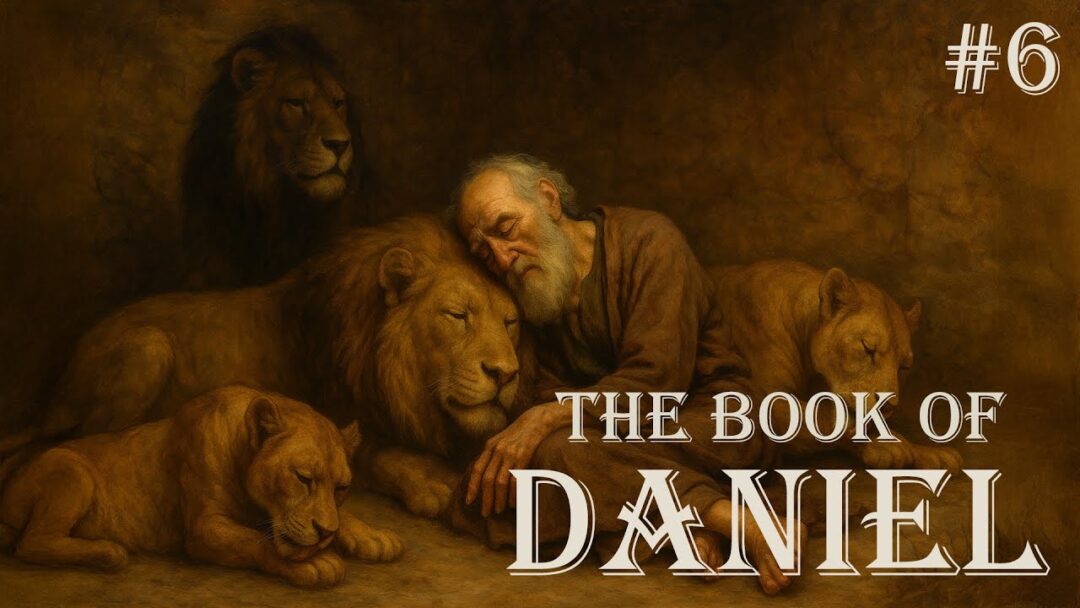
From our Sunday service on June 8, 2025, Daniel 6. This is part 6 of our Daniel series. Watch the full message: In the Lions’ Den – Daniel Series #6 on YouTube.
Today we’re in Daniel chapter 6, a familiar story: Daniel in the lions’ den. Last week we left off with Babylon falling into the hands of the Medes and the Persians. The time of the Babylonian kings has come to an end, and the Medo-Persian Empire, which you may also see referred to as the Achaemenid Empire, has risen to prominence.
For the last 66 years Daniel has been in exile in Babylon. Now, as an elderly man, he is facing a new king who may or may not remember him and think fondly of him. Through all these years Daniel has remained faithful to God. Today we’re going to see him face the last big challenge of his life, and the lesson we want to take away is that God wants you to serve him consistently.
Daniel Promoted Again
It pleased Darius to set over the kingdom an hundred and twenty princes, which should be over the whole kingdom; And over these three presidents; of whom Daniel was first: that the princes might give accounts unto them, and the king should have no damage. Then this Daniel was preferred above the presidents and princes, because an excellent spirit was in him; and the king thought to set him over the whole realm.
Daniel 6:1–3
Right off the bat we’re in a situation similar to the one we saw when Daniel was in Babylon under the Babylonian kings. Darius sets over the kingdom 120 princes, people in charge of regions of the kingdom. One man can’t control all these people and take care of all their needs, so he needs to delegate his power. With Babylon fallen, history tells us that Belshazzar fell at the hands of Cyrus and that Nabonidus was taken to Persia and stayed with Cyrus. So there was no leadership in Babylon, and that needed to be dealt with, because there were people who needed food, wars that needed to be fought and a lot of administration to be done. So Darius looks for people who can lead, and he doesn’t have to look far, because Daniel has been there. For the last 66 years he’s been serving the kingdom of Babylon. He’s very experienced, so he is placed in one of the three top positions in the government. There were three presidents, which you could call administrators, and Daniel was the first one appointed. This old man, probably in his late 70s or early 80s, is appointed to a position of power in the kingdom.
What was the point of this position? “That the princes might give accounts unto them, and the king should have no damage.” In other words, they were to keep track of the affairs of the kingdom, make sure there weren’t any major problems, and make sure no political damage was done to the Persian Empire. The Medes and the Persians were great at propaganda. I mentioned last week that when they marched into Babylon, almost no one fought against them. Why? For years they had been pushing the narrative that Cyrus would come in, liberate your kingdom, and you would live in a kingdom of peace. The Babylonians were upset with Belshazzar and Nabonidus’s pacifistic leadership and were tired of their needs not being met, so they weren’t that invested in their kingdom, and the Persians and Medes promised them what they wanted. They needed these appointees to make sure that story stuck: “We’ve convinced them that we will take care of them. Now we need to prove it.” If Daniel failed at this job, there would be civil war, and that is not what the Medes and Persians wanted.
So we have our main theme, that God wants you to serve him consistently. But there’s also a subtheme in the phrase “the king should have no damage.” The word “damage” in Aramaic comes up multiple times in this passage. So a secondary theme is that a believer should be one who does no harm. A believer should walk consistently with God, but also bring no harm to others. Daniel served the Babylonian Empire as a man in exile, basically a prisoner, and during all that time he never tried to undermine the Babylonians, never tried to create an uproar or a conspiracy. Daniel was one who did no harm, and we’re supposed to learn that lesson from him today.
Verse 3 says Daniel was preferred “because an excellent spirit was in him.” Under Babylon they called it “the spirit of the holy gods.” They didn’t identify it as the Holy Spirit, God’s Spirit being with him. Here the Persians don’t say it’s a spirit from the gods, but they do say there’s something different about the spirit of this man, something about the way he lives that’s different from all the other leadership. During Belshazzar’s reign, Daniel had fallen out of prominence. They had kind of forgotten him. Belshazzar was a very young man, probably in his 30s, and when he saw the writing on the wall he never thought to call Daniel. It wasn’t until the queen said, “Maybe you should go talk to Daniel. He was helpful under Nebuchadnezzar.” The Persians don’t make the same mistake. They’ve heard about Daniel, and they take it seriously: he has an excellent spirit, he can do things other people can’t, and he’s someone you can always rely on. Daniel is the outcast of outcasts, a prisoner inside a country that’s now prisoner to another country. Though he’s two prison levels deep, his testimony of faithfulness to God speaks for him.
Who Was Darius?
You’ll find in the Bible that multiple people are called Darius, and they’re not all the same person. This one is Darius the Mede, who is probably who we call Gubaru today. He’s not to be confused with Darius the Great, Darius I, or with King Cyrus, and the end of our passage tells us they’re different people. The Nabonidus Chronicle, which I mentioned last service, lists a man named Gubaru as the new governor of Babylon in 539 BC when Babylon fell. Daniel says this Darius appointed 120 subgovernors, and the Chronicle says Gubaru appointed subgovernors. Daniel states that Darius started at age 62, and Xenophon says in his historical account of the fall of Babylon that Gubaru was an elderly man when he began his rule. Darius was Gubaru’s royal title. “Darius” means “the upholder” or “possessor,” and the new Persian word for it also means “king,” so you can see how it’s a royal title rather than a name. The Bible does this all the time; one you see often is “Pharaoh” in Egypt. All we have in archaeology agrees with what we have in Scripture, and in fact Scripture is more detailed than archaeology. So Gubaru was a Median general who helped Cyrus the Great conquer Babylon, and after the conquest he was given control of it. He’s a military general who comes in, conquers a place and has to run a kingdom, but he’s just a general with no political background. So he has these appointees, and he picks Daniel as one of them.
A Plot Against Daniel
Then the presidents and princes sought to find occasion against Daniel concerning the kingdom; but they could find none occasion nor fault; forasmuch as he was faithful, neither was there any error or fault found in him. Then said these men, We shall not find any occasion against this Daniel, except we find it against him concerning the law of his God.
Daniel 6:4–5
The other leaders are jealous that Daniel is offered this massive position alongside them. To them he doesn’t deserve it, because he’s an outsider of all outsiders, a Judean prisoner of war. Sure, maybe he was nobility in Judea and had some kinship to David, but that doesn’t matter in Babylon, and it definitely doesn’t matter in the Persian Empire. So they say, “This guy has been in our court for 66 years. Finally we get new leadership that’s going to listen to us, and what do they do? They put Daniel back in charge. We just can’t get rid of this guy. We’ve got to find a way to get him impeached.”
They look for an opportunity to accuse him day by day. “Let’s watch him. When he does something illegal, we’ll report it to the king.” There are two words there, “fault” and “error.” The word “fault” is a sign of corruption; in Aramaic it’s literally “to corrode.” They were looking for corruption in Daniel. Maybe he was pocketing money, maybe he was pushing the Jewish agenda, maybe he was skirting some of the laws. But after carefully watching, they found that Daniel wasn’t a corrupt politician. He did everything by the book. So they thought, “Maybe he’s not corrupt, but surely he’s incompetent in some area.” That’s the second word, “error,” which you could say means negligence: a mistake. “One of these days he’s going to be lazy on the job, and when he makes that mistake we’ll report it to the king.” But day by day they watched, and Daniel never made a mistake. He crossed his t’s and dotted his i’s, he was good at his job, and he wanted to do it faithfully.
So they said, “There’s one thing Daniel has that the other people here don’t: he’s faithful to his God. The only way we’re going to get Daniel kicked out is if we find a way where he has to choose between doing his job and following his God, because that is the only thing Daniel cares about more than doing his job right.” They realized they couldn’t find a rule he was breaking, so they needed to create a new rule that they knew he would break.
Then these presidents and princes assembled together to the king, and said thus unto him, King Darius, live for ever. All the presidents of the kingdom, the governors, and the princes, the counsellors, and the captains, have consulted together to establish a royal statute, and to make a firm decree, that whosoever shall ask a petition of any God or man for thirty days, save of thee, O king, he shall be cast into the den of lions. Now, O king, establish the decree, and sign the writing, that it be not changed, according to the law of the Medes and Persians, which altereth not. Wherefore king Darius signed the writing and the decree.
Daniel 6:6–9
That word “assembled” carries the idea of rushing together as a mob. They rush in with their plot and pressure him into a split-second decision. In their attempt they actually commit a crime of their own: they lie to the king. Notice what it says: “All the presidents of the kingdom … have consulted together.” There were three presidents, and one of them was Daniel. So for them to expose corruption in Daniel, they had to take part in corruption themselves. They go to the king under false pretenses, saying, “Everybody here is unanimous on this. All you need to do is take this clay tablet, read it, and put your name on it, and we’ll make this a law today. No need to overthink it. We think it’ll be a great way to celebrate your new position as leader of Babylon. It’ll be good for everybody to come to you for their needs rather than to their gods.”
Babylonians worshiped their Babylonian gods like Marduk and Sin, and Darius is an outsider to that religion. He probably thinks, “I know the Babylonian gods are pretty important to them. It wouldn’t hurt for them to stop asking their gods and try to see the Persian Empire as one that will help.” Remember, the Persians’ whole philosophy and propaganda is that they’re the nation that will solve your problems. Instead of going to the temple of Marduk and praying to Marduk, come to my royal court and ask me to fix your problem, and I’ll fix it. That fits their public agenda, so Darius doesn’t think much of it. “If everybody agreed, then I don’t need to think about it.”
What’s interesting is that the law “altereth not.” The Persians and Medes had a very unique system of government at this time in which any law they enacted could not be undone. The purpose was to make you very careful about which laws you passed, because once you passed one, it would be law forever. That matters here because Darius is going to come to regret it, and these men are going to use the law against the king. This also comes up in the book of Esther, where the king signs a decree to kill all the Jews and can’t undo it. His solution is to sign another decree that makes it legal for the Jews to defend themselves, and that’s how Israel was saved. So we know that at this time it was a law for at least a few kings. It didn’t stay that way forever, because eventually they realized it’s a really bad idea not to be able to change your laws.
Why a Den of Lions?
The decree says that whoever breaks it will be cast into the den of lions. Now think about that for a moment. When I was doing my study and got to the den of lions, I wondered why the Persians had a den of lions sitting around to begin with. A more accurate translation for modern English would be a lions’ pit. The word in Aramaic means a hole in the ground. It’s not a den like a cave in the side of a cliff. If you know anything about lions, they don’t really live in caves; they live in savannah plains, where they can see around them and chase down prey. So it’s a hole in the ground with lions in it, and that alone doesn’t tell me why.
There isn’t a lot of archaeological evidence for lion pits, but if it was just a hole in the ground, as the Bible calls it, that makes sense. A hole in the ground isn’t going to last a thousand years. So we have to make some conjecture from what we do know. In both Babylonian and Persian culture lions are engraved everywhere in their art, and they’re ascribed to royalty. In a few carvings we see kings fighting lions, and we have at least one account of a king who did a royal lion fight. So it appears that during this time lions were kept, at least in cages, for kings to fight them in a royal ceremony, to show that the king was strong and able to defend the nation. If he can fight off a lion, you’d better bet your king can defend you. Well, these Persians had just gotten to Babylon, so maybe they didn’t have cages, and they dug a hole and put the lions in it. We also know they had royal hunts, and some people believe they also had occasional arena fights with lions. So our best guess is that the Medes and Persians had just taken over Babylon, which had no place to store lions, so they dug a pit. The lions were saved for ritual royal events, and since lions were a sign of royalty, they made the royal punishment to be killed by the royal lions. The king signs the decree, thinking it fits with their culture and their political agenda, and thinks nothing of it.
Daniel Prays as Always
Now when Daniel knew that the writing was signed, he went into his house; and his windows being open in his chamber toward Jerusalem, he kneeled upon his knees three times a day, and prayed, and gave thanks before his God, as he did aforetime.
Daniel 6:10
In this verse we get a sneak peek into Daniel’s personal life, which we don’t often see. Usually we see Daniel at work or in the barracks, but this time we see him at home and what he does in his free time. Three times a day he goes to his chamber, opens the window that faces Jerusalem, kneels and prays.
If you remember way back to Daniel chapter 1, I pulled in the book of Jeremiah and Jeremiah’s instruction to the exiles: pray for the city where God sent you into captivity, that it would prosper, and you would prosper alongside it. For 66 years Daniel has remained faithful to that instruction. The kingdom has changed, but Daniel’s obedience to God has not. He goes to his window and does what God said to do. It doesn’t matter that it’s no longer Babylon, now it’s the Medes and Persians. Daniel is going to follow God and pray.
He gives two types of prayers. He makes requests, and that’s the violation, because the rule is that you can’t make a request to any god other than Darius. He also gives thanks to God, so every day he shows thankfulness for what God has done in his life. And notice a very important detail: he did it “as he did aforetime.” This was not an act of rebellion. He wasn’t lashing out against the rules. Sometimes we act out of the flesh: someone makes a rule that we don’t like, and we start new habits just because somebody said we couldn’t. That’s not what Daniel’s doing. He didn’t say, “Oh, you say I can’t pray? I’ll show you.” He had been doing this faithfully for decades, and he continued despite the decree. Had he not been praying before and just started, it wouldn’t have been about his consistency with God. It would have been about showing up the king and being prideful.
If we’re going to be good Christians, we have to have the consistency of Daniel. Our testimony can’t just be a testimony when we want to show someone how Christlike we are. It needs to be a testimony every single day. Daniel was consistent in his job, and he did it as unto the Lord day in and day out. No one could find anything wrong with what he did. He was also consistent in his walk with God. He didn’t start praying just when the times got hard. He prayed every day, with requests and to thank God for answering the requests he’d already prayed.
Then these men assembled, and found Daniel praying and making supplication before his God. Then they came near, and spake before the king concerning the king’s decree; Hast thou not signed a decree, that every man that shall ask a petition of any God or man within thirty days, save of thee, O king, shall be cast into the den of lions? The king answered and said, The thing is true, according to the law of the Medes and Persians, which altereth not. Then answered they and said before the king, That Daniel, which is of the children of the captivity of Judah, regardeth not thee, O king, nor the decree that thou hast signed, but maketh his petition three times a day.
Daniel 6:11–13
Remember, Daniel’s praying at a window. All they have to do is go outside his house and look up, and they’ll see Daniel praying there. He didn’t change a thing. He didn’t hide in his closet to pray. He said, “I’m going to be honest about what I’m doing. I’m not going to pretend I’m following the king when I’m not. I’m going to do what God told me to do.” So they rush in and see Daniel praying. Darius answers, “The thing is true,” that is, “That’s a true statement, and it’s a law that cannot be changed.” He has no idea the shock that’s about to come to him.
They say Daniel “regardeth not thee.” In other words, he’s not in compliance with the decree or with you, king. He’s disrespecting you and the law of your nation. This needs to be dealt with.
A King Who Can’t Undo His Law
Then the king, when he heard these words, was sore displeased with himself, and set his heart on Daniel to deliver him: and he laboured till the going down of the sun to deliver him.
Daniel 6:14
Darius realizes the second the words come out of their mouths that he has been played, and that this decree was specifically an attack on his administrator Daniel. He’s grieving. He loves Daniel, cares about Daniel and respects Daniel, and he thinks, “There has to be a way I can fix this.” To “set his heart on Daniel” means he put his mind to finding a way to set Daniel free. He exerted himself until the sun went down, trying to find a loophole, anything that could save Daniel from the lions’ pit. But the sun started setting and time was running out.
Then these men assembled unto the king, and said unto the king, Know, O king, that the law of the Medes and Persians is, That no decree nor statute which the king establisheth may be changed.
Daniel 6:15
When the sun goes down, they remind the king, “You have a responsibility. You’re not above the law. You need to act now.” And remember, he’s an appointee. He is not the king of kings. He’s not king of the entire Medo-Persian Empire. He’s just king of Babylon. If he doesn’t follow the rules, he’ll be impeached, and impeachment in those days was a little different from impeachment now. You didn’t just retire and go on with your life. You usually lost a couple of limbs, or maybe your head. So he says, “I have no choice. My time is up.” I like how disrespectful they are here. At first they came to him with respect. Now they come with demands.
Then the king commanded, and they brought Daniel, and cast him into the den of lions. Now the king spake and said unto Daniel, Thy God whom thou servest continually, he will deliver thee. And a stone was brought and laid upon the mouth of the den; and the king sealed it with his own signet, and with the signet of his lords; that the purpose might not be changed concerning Daniel. Then the king went to his palace, and passed the night fasting: neither were instruments of musick brought before him: and his sleep went from him.
Daniel 6:16–18
Darius carries out the decree. He doesn’t have anything else to say, but he says, “Daniel, you’ve been faithful to your God every day. He will deliver you.” I don’t know if Darius truly believed it at the time. Maybe he’s just saying it to calm himself. I’m sure the guilt at this moment is immense. But he makes a statement of faith: you’ve been faithful to him, and he will be faithful to you.
Because they knew the king liked Daniel, they were very careful in how they carried out the punishment. They put a stone over the top of the pit and put a signet-ring seal on it. Usually the king’s seal would be enough, but they impressed the wax not just with the king’s seal but with the seals of all the other administrators of the region. If you open that and take Daniel out, you break the wax seal, and you’d need all those rings to reseal it. Knowing Darius would prefer to release Daniel, they made sure there was no way he could sneak him out in the middle of the night.
The king “passed the night fasting.” I don’t think this is a spiritual fast. He was so upset that he didn’t eat his dinner before bed. He was sick to his stomach. Kings always had court musicians to comfort them if they couldn’t sleep, but Darius didn’t feel like he deserved it. “If Daniel’s out there in a den of lions all night, I’m not going to bring music to comfort myself.” And lastly, his sleep went from him. He stayed up that entire night.
“Is Thy God Able to Deliver Thee?”
Then the king arose very early in the morning, and went in haste unto the den of lions. And when he came to the den, he cried with a lamentable voice unto Daniel: and the king spake and said to Daniel, O Daniel, servant of the living God, is thy God, whom thou servest continually, able to deliver thee from the lions?
Daniel 6:19–20
Part of the reason Darius stayed up all night is that he wanted to let Daniel out of the lions’ den as soon as he legally could. There are no alarm clocks, and if his court was against him on this, they weren’t going to wake him up. So he says, “I’m going to stay up all night, and as soon as I can legally release Daniel, I’m going to do everything I can to get him out.” When he gets there he cries “with a lamentable voice,” which implies that he didn’t have high hopes that Daniel would answer back. Like I said, I don’t know that he believed his earlier statement. Now he asks it as a question: “Is your God whom you serve continually able to deliver you?” I said that he was. The night has passed. I can let you out. Now I’m going to see if God is as faithful to you as you were to him.
Then said Daniel unto the king, O king, live for ever. My God hath sent his angel, and hath shut the lions mouths, that they have not hurt me: forasmuch as before him innocency was found in me; and also before thee, O king, have I done no hurt.
Daniel 6:21–22
Remember the word “damage”? It’s the same word in Aramaic, “damage” and “hurt.” Daniel answers with an honorable response, and says that God defended him because he knew Daniel had done no harm. “The lions have not harmed me because I have done no harm.” Here’s that secondary theme: the believer ought to be someone who does no harm. Why was Daniel protected from the lions? One, because he believed God, but two, because he was faithful and not harming others in his daily walk. He uplifted those around him instead of tearing them down, and he brought blessings to people instead of curses. He says, in effect, “Both before God and before you, king, I’m faithful in my spiritual life and in my work life. Whether I’m serving my God or my fellow man, I have set my heart to be faithful and consistent.”
Here’s the big lesson for us: spiritual consistency requires secular consistency as well. We can’t be faithful in our walk with the Lord if we’re not faithful in how we treat those around us. We can’t be faithful if we have corruption in our jobs or scandals in our roles. We have to be consistent across the board.
Then was the king exceeding glad for him, and commanded that they should take Daniel up out of the den. So Daniel was taken up out of the den, and no manner of hurt was found upon him, because he believed in his God.
Daniel 6:23
Why? “Because he believed in his God.” If Daniel had lost faith, maybe it wouldn’t have happened. But Daniel knew the God he served, who had protected him for 66 years in a foreign land. While Daniel remains faithful, God blesses, because Daniel knew his God was bigger than the gods of Babylon, the gods of Persia, or any earthly authority. And the king is exceedingly glad that his friend Daniel is alive. A new era begins for Daniel’s life.
The Accusers
And the king commanded, and they brought those men which had accused Daniel, and they cast them into the den of lions, them, their children, and their wives; and the lions had the mastery of them, and brake all their bones in pieces or ever they came at the bottom of the den.
Daniel 6:24
The word “accused” there means “to snap at.” A lot of people say, “Wow, this is a pretty brutal punishment, throwing their wives and children in there too.” But remember that in this whole process they committed high treason against the king. They lied. The entire punishment of Daniel was founded on a lie to the king in the king’s courtroom. This is the highest punishment available in the kingdom. They betrayed their king’s trust and were never going to be allowed to work in the kingdom again, and because they committed treason, the punishment affected their entire family.
The cost of sin is great. You might think you’ll just get in trouble, but when the consequences of sin come down, it usually doesn’t just affect you. It affects your wives and children as well. Men, as you lead your family, don’t bring them into the consequences of sin. Remain faithful to God and walk circumspectly, and don’t find yourself in the position of these men, who did corruption and scandal, sneaked behind the backs of the people they worked for, expected punishment would never come their way, and thought they could maneuver their way to a higher position. That usually doesn’t end well.
We also see that God divinely protected Daniel. It says the lions “had the mastery of them” and broke all their bones “or ever they came at the bottom of the den,” which tells us it was a pit. Those lions were probably kept pretty weak, since they were used in arena fighting and the king’s supposed to win. You don’t want a really strong lion, but you do want one that’s angry and ready to fight. So they were really hungry and ready for the meal they’d been waiting for, and the men were torn to pieces before they hit the bottom of the pit. That shows that God truly did stop the lions’ mouths for Daniel.
Darius’s Decree
Then king Darius wrote unto all people, nations, and languages, that dwell in all the earth; Peace be multiplied unto you. I make a decree, That in every dominion of my kingdom men tremble and fear before the God of Daniel: for he is the living God, and stedfast for ever, and his kingdom that which shall not be destroyed, and his dominion shall be even unto the end. He delivereth and rescueth, and he worketh signs and wonders in heaven and in earth, who hath delivered Daniel from the power of the lions. So this Daniel prospered in the reign of Darius, and in the reign of Cyrus the Persian.
Daniel 6:25–28
Darius writes a poetic decree just praising Daniel’s God for his faithfulness, just like Nebuchadnezzar did before. Notice that Daniel prospered “in the reign of Darius, and in the reign of Cyrus the Persian,” so Darius and Cyrus aren’t the same individual, as some people think. He declares a few things. One is that God is active in the kingdom of men. Their philosophy of the day was that the gods were distant and didn’t get involved, and that the only way you could get in touch with them was through roundabout ways like talking to the dead or looking at the stars. Now he proclaims that there is a God who directly interacts with his people, the God of Daniel, not like the idols they worshiped. He’s also a God who frees and rescues his people.
This would have been really encouraging to the Israelites. There was a prophecy from Jeremiah that their exile would end in 70 years. When Persia took over the Babylonian kingdom, those 70 years were completed, and the Jews would have recognized Persia taking over as a sign that God was returning them to the land. Imagine being an Israelite when Darius the Mede sends this decree that God frees his people. They would have been jumping for joy, recognizing that Jeremiah’s time was coming: “He freed Daniel. Soon he will free us.” We’ll see that this does quickly come to happen.
He also decrees that God’s rule is unending. God was faithful to Daniel during the Babylonian Empire. The Babylonian Empire fell, but God was still on the throne when the Medes and Persians took over. Babylon’s kingdom ends, but God’s does not, and he still controls those in power, whether they are lifted up or taken down. And he works signs and wonders in heaven and in earth. We’re reminded again that it was God who caused Daniel to prosper.
Closing
Daniel’s life reminds us that faithfulness to God does not go unnoticed. His consistency in prayer, his integrity, his leadership and his trust in God became a testimony not only to his Jewish peers but to multiple kings and kingdoms. Daniel didn’t wait until it was convenient to serve God. He never adjusted his devotion based on who was in power or what the law of the day said. He simply decided to remain faithful day by day, in both his public and private life. When the difficulties arose and his devotion was tested, God demonstrated that he was able to deliver those who trust in him.
So what do we take away? The same God who closed the mouths of lions for Daniel still works today. He still honors the faith of those who serve him with integrity, and he still uses consistent, faithful believers to make his name known in places of influence. Whether you’re in a place of power or obscurity, whether the world is applauding you or attacking you, God wants you to serve him. Stay faithful and trust that your God sees you, your God knows you, and your God is truly able to deliver you. God wants you to serve him continually. So the question is, will you be faithful to serve him today?

Recent Comments