
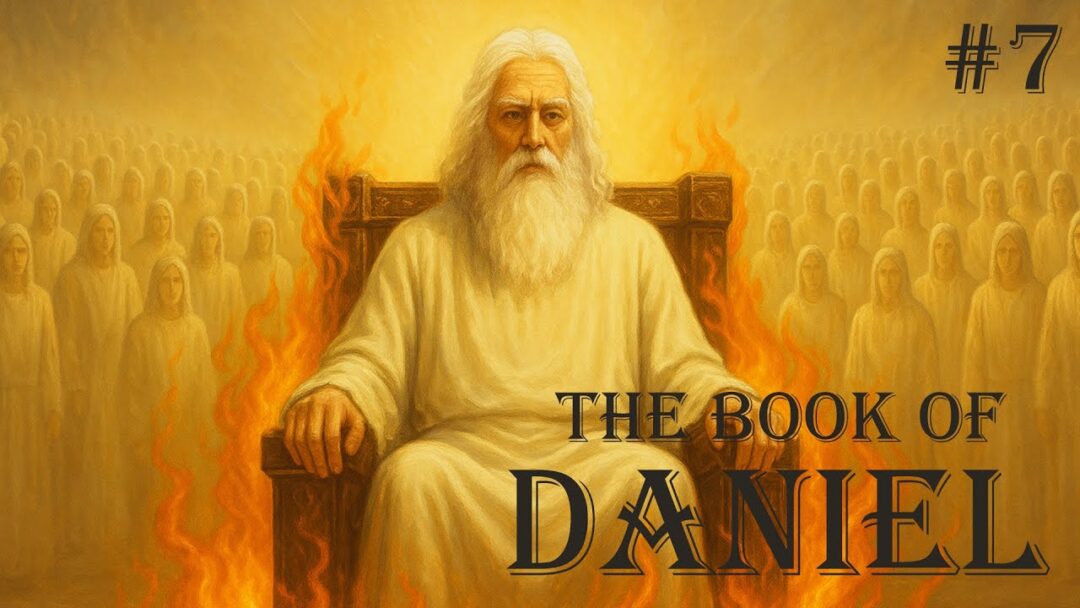
From our Sunday service on June 22, 2025, Daniel 7. This is part 7 of our Daniel series. Watch the full message: The Ancient of Days – Daniel Series #7 on YouTube.
Today we’re in Daniel chapter 7. As we continue our series through Daniel, you could almost consider this a completely new series. From chapter 1 through chapter 6 we’ve had historical narrative, and that is now complete. We’re moving into a new section of the book, the prophetic visions of Daniel.
This is also the last chapter of the book that is written in Aramaic, the language of the Chaldeans and the Babylonians. Next week we move back into Hebrew. That tells us a few things. Because this is a new section, it actually takes place before the events of Daniel 5, while Belshazzar is still king. And because it’s written in Aramaic and not the language of the Jews, the main audience of this prophecy appears to be everyone in the world, the Gentiles, and not only the Jewish people.
If you know anything about me, I don’t go out of my way to do messages on prophecy. Scripture says, “Be not many masters, knowing that we shall receive the greater condemnation” (James 3:1). If you teach something wrong, you are accountable for it, and I don’t want God to have to correct Pastor Zach. This is my first prophecy passage since I became senior pastor, so I’ll stick to what the Bible says and what the text says about it, and I won’t make a bunch of assumptions. I don’t want you to take away a lesson or an application that’s wrong and be misled in your lives.
Daniel’s Dream and Visions
In the first year of Belshazzar king of Babylon Daniel had a dream and visions of his head upon his bed: then he wrote the dream, and told the sum of the matters.
Daniel 7:1
Right away we learn a few things. This prophecy predates Daniel 5, when the Medes and the Persians conquered Babylon. We know that because Belshazzar is the king. Belshazzar and Nabonidus were both kings at this time and shared the kingdom, with Belshazzar the active ruler while Nabonidus was out in Arabia. Daniel is kind of forgotten at this point. He’s not really in the king’s court, and nobody is dealing with him much. Then suddenly, at night, he has a dream and visions.
These are meant to be understood differently from an ordinary dream. Anybody can have a dream. I have dreams, and that doesn’t mean God is giving me a message. But these are visions. They are dreams that happen while he is still awake, and pictures appear in his mind that he can’t understand right away. This would be roughly 553 BC, the first year of Belshazzar. That is about sixteen years before the prophecy of Jeremiah is fulfilled in 537 BC. So Daniel is beginning to understand what was going on in Jeremiah’s prophecy, and because Jeremiah’s seventy years are soon coming to pass, God is going to reveal some of the next steps in his plan.
Before we get into prophecy, let me give you my definition of it. Prophecy is God saying beforehand what he is going to do. If you look at prophecies in the Bible, you won’t find that they’re about what John is going to do next week or what Sarah or Hannah is going to do. Prophecy isn’t about other people. It is only about one person, God. It’s God telling his plans for the future and what he will do.
Isaiah tells us why God does this. God gives visions so that when his plan comes to pass, you know it was him that did it and it didn’t just happen by chance. People are liberated from their captors all the time. How do we know God did it when Israel was freed from the Babylonians and then the Medes and Persians? Because God says, “I’ll tell you beforehand.” He told Jeremiah seventy years, which gave a very specific time frame, and at the end of those seventy years, in 537 BC, the Israelites were sent back to their land. That was not a coincidence. God told Jeremiah the date long before, and that was the date they went home. God tells things beforehand so that when they come to pass, his people can see him at work.
The verse says Daniel “told the sum of the matters.” “Sum” is short for “summary.” Daniel wrote this section to give a summary of the visions he had. We’ve seen Daniel interpret other people’s dreams. Now he receives another gift for his boldness in his youth: he is given prophecies like the prophets. He says, “If God is telling me, I’d better write it down.” So we need to remember not the chaos that the vision starts with, but the eternal kingdom that it ends with.
The Four Beasts
Daniel spake and said, I saw in my vision by night, and, behold, the four winds of the heaven strove upon the great sea. And four great beasts came up from the sea, diverse one from another.
Daniel 7:2–3
Right off the bat, a lot is going on. When we see “beasts,” we think of terrifying monsters, but they’re pictured as animals, or in this case as combinations of animals, taking attributes of different creatures. Are we supposed to take them as literal animals that will exist? No. They represent things in this world metaphorically.
First, “the four winds of heaven strove upon the great sea.” When we think of the word “wind,” we should think of the word “spirit.” When the Holy Spirit is first introduced in Genesis, he is hovering over the surface of the water, fluttering like a bird, like the wind blowing. The word for “spirit” is the same word as “wind,” in Aramaic. So when you see physical wind in this vision, you should understand it as a metaphorical use of that word, the Spirit. The four winds of heaven are a Spirit of heaven, and the one at work here is God.
These four winds blow across a great sea. Throughout the Bible, the sea is a metaphor for the chaotic political identity of a nation or the world at any given time. Who can agree that politics is chaotic? Ancient people saw the same thing. They saw life in the political realm as chaotic, and probably more so than it is here. A lot of the kings of Israel were killed and usurped by someone else, multiple times in one lifetime. So politics were pictured as a sea in prophecy because of its chaotic nature. In this opening we see a chaotic political world, and God is going to work through it by his Spirit. There is chaos, but God is going to use the chaos to bring about change.
Out of this chaotic climate, the wind of God blew on the sea, and out of the sea rose four animals. Each is a kingdom. Out of the chaos of the fall of earlier empires like Babylon, God was going to take the chaos and structure it to complete his purpose.
Why animals? Because kingdoms are wild, fleshly human constructs, and the picture is meant to show that the way man works is like an animal. What do kingdoms do? They try to maximize their profitability. Kings want to make themselves rich. Sometimes they oppress. They do whatever they need to do to stay in power. They’re ravenous, always trying to protect themselves. A lion, a leopard and a bear are wild and uncontrolled. Bears don’t form an LLC. They don’t start a neighborhood watch or a committee. They act on instinct. The worst case for a person is to act purely on instinct, on how the flesh feels. These kingdoms are not following the Spirit of God. They are following the flesh to the point that they are like wild animals.
Here is an application right off the bat. Christians are reminded not to place our ultimate trust in human governments. Human governments are made to follow the ideas of the flesh and satisfy the needs of the flesh, while God tells us to focus on the needs of the soul and the heart and on what he has taught us to do. Human governments are not protected from corruption or instability the way the word of God is. God’s word is not a political sea that blows you around left and right. It is a stable, fixed standard that we can follow.
The Lion: Babylon
The first was like a lion, and had eagle’s wings: I beheld till the wings thereof were plucked, and it was lifted up from the earth, and made stand upon the feet as a man, and a man’s heart was given to it.
Daniel 7:4
The lion with eagle’s wings represents Babylon, and specifically Nebuchadnezzar. The lion was the animal of Babylon, engraved over all kinds of things. They loved their lions, so God used a lion to represent them. Nebuchadnezzar was lifted up on wings, and God allowed him to bring all the kingdoms together into a great empire. But he was lifted up in pride, and God plucked his wings and made him fall to the ground. For those years he was like a wild animal wandering in the wilderness. He had an animal’s heart, as the historical narrative of Daniel says. Then the prophecy says he was lifted up from the earth and made to stand on his feet as a man, and a man’s heart was given to him. At the end of that story his man’s heart returned. So the first kingdom is Babylon.
The Bear: Medo-Persia
And behold another beast, a second, like to a bear, and it raised up itself on one side, and it had three ribs in the mouth of it between the teeth of it: and they said thus unto it, Arise, devour much flesh.
Daniel 7:5
The bear represents the Medes and the Persian Empire, which we saw conquer Babylon a few chapters ago. It is raised up on one side. The Medes and the Persians were one empire, but they were two distinct groups, and each side of the bear represents one side of the kingdom. The Medes are the two back paws on the ground, and the Persians are the two front paws in the air. The bear is on its feet ready to strike. The three ribs in its mouth show that it has already made its attack.
The voices in the vision say, “Arise, devour much flesh.” We know from the earlier chapters of Daniel that God allowed Persia to conquer Babylon, so this is the voice of God saying, “Get up and conquer Babylon, and the other empires.” God is going to use the Medes and the Persians to send his people back to the promised land and rebuild the temple. The Persian Empire is not a perfect empire. Remember, they’re wild animals, flawed and not free from the trappings of human government. But God says, “I’m going to use your desire to conquer in order to send my people home at the end of the seventy years I determined for them.”
The Leopard: Macedonia
After this I beheld, and lo another, like a leopard, which had upon the back of it four wings of a fowl; the beast had also four heads; and dominion was given to it.
Daniel 7:6
The leopard is still in the future at the time Daniel wrote this. It would be the Macedonians, led by Alexander the Great. A leopard is smaller than a lion, but it’s faster and attacks from out of sight. The Macedonians were not the biggest empire or the strongest threat, but they came out of nowhere, attacked rapidly, and quickly conquered the Medes and the Persians. Was Alexander’s campaign moral? Was the Macedonian government a perfect government? No. It was a wild, ravenous leopard following human instinct. But God says, “I have prophecies to fulfill, and they’re a tool I can use to get there.”
The leopard has four wings and four heads. Later chapters explain that these represent the four kingdoms into which the Macedonian Empire would be divided when Alexander died. The four wings become four subkingdoms, and the four heads exist for a time, until the next kingdom arrives.
The Fourth Beast: Rome
After this I saw in the night visions, and behold a fourth beast, dreadful and terrible, and strong exceedingly; and it had great iron teeth: it devoured and brake in pieces, and stamped the residue with the feet of it: and it was diverse from all the beasts that were before it; and it had ten horns.
Daniel 7:7
This beast is so terrifying that Daniel doesn’t say it resembles any other animal. All the other beasts had an animal to represent them, but this one is unlike anything he’s ever seen. It is “diverse,” different from everything before it, more violent, and absolutely massive. This indescribable kingdom would be the Roman Empire. It has iron teeth, and if you remember Nebuchadnezzar’s dream of the statue made of different materials, Rome was represented by iron. That is how we know this is Rome. It also has ten horns, which match the ten toes of iron and clay in Nebuchadnezzar’s vision.
From this extremely violent, conquering kingdom, more kingdoms would come, ten of them. We talked about how even before the fall of the Roman Empire there were Christians who said Rome would fall apart and ten kingdoms would come out of it, with which the rest of prophecy would be fulfilled. Two hundred years after one of them said that, Rome fell and was split into multiple kingdoms. These ten horns are the ten kingdoms Rome is divided into, led by ten leaders, not necessarily kings.
I thought there were two Roman empires that split, so why does this say Rome is divided? Because this is talking about the concept of Rome and its government. Rome was originally a democracy, so pretty much all the democracies we saw after it were made in the image of the Roman Republic. America is one of those countries that took the idea of the Roman Republic and said, “Let’s try this again, let’s do this great experiment and see if we can make it work.” When Rome fell, it didn’t end. The ideas and culture of Rome spread. They had the Latin language, which split and became new languages and new kingdoms. Ten kingdoms directly from Rome have a role in God’s plan for the future.
I considered the horns, and, behold, there came up among them another little horn, before whom there were three of the first horns plucked up by the roots: and, behold, in this horn were eyes like the eyes of man, and a mouth speaking great things.
Daniel 7:8
Now something deeply unsettling. Daniel looks at the horns, confused, and as he looks more closely, a tiny horn slowly pops up between these ten kingdoms, and three of the first horns are plucked up by the roots. Because this horn has the eyes of a man and a mouth, we understand that it represents not just a kingdom but a specific person who will come out of these ten kingdoms and knock out three of them.
The Courtroom of Heaven
I beheld till the thrones were cast down, and the Ancient of days did sit, whose garment was white as snow, and the hair of his head like the pure wool: his throne was like the fiery flame, and his wheels as burning fire. A fiery stream issued and came forth from before him: thousand thousands ministered unto him, and ten thousand times ten thousand stood before him: the judgment was set, and the books were opened.
Daniel 7:9–10
It’s not hard to understand what’s going on. This is a courtroom being set up. We have the picture of the beast, and now we’re in heaven, where a trial is being prepared, and where there is a trial there is judgment. “The thrones were cast down” doesn’t mean they were thrown. It means they were placed, set and appointed. You can’t have a courtroom without somewhere for everybody to sit. Things haven’t happened yet, but they are being prepared. We are looking at the end times, at how God is going to end things.
“The Ancient of days did sit.” This is God, the one who is the oldest. He has been here since before time began, and there is nobody older than him. He is the ancient of the ancient, and he will endure forever. His garment is “white as snow” and the hair of his head “like the pure wool.” That whiteness represents his purity. He doesn’t sit down in red robes, which would represent violence. He sits in white robes because his judgment is pure. There is no filth in his ability to decide what is justice and what is injustice. He is the righteous judge who knows what the law is.
“His throne was like the fiery flame, and his wheels as burning fire.” In prophecy, fire almost always represents purification. When you take copper out of the ground, it comes in a rock full of impurities, so you throw it in a furnace and melt the copper out of it. The more you burn it, the purer it gets. At least in that time, that’s how they did it. To purify something, you have to heat it. So his throne is burning. The time to purify is now. The “fiery stream” coming from before him is on the move, on its way to purify the world.
“Thousand thousands ministered unto him, and ten thousand times ten thousand stood before him.” This refers back to the Old Testament, to Deuteronomy 33.
…The LORD came from Sinai, and rose up from Seir unto them; he shined forth from mount Paran, and he came with ten thousands of saints: from his right hand went a fiery law for them. Yea, he loved the people; all his saints are in thy hand: and they sat down at thy feet; every one shall receive of thy words.
Deuteronomy 33:2–3
When God gave the law, there were ten thousands of his saints there as witnesses. At the end of time we have that same picture of ten thousands of his saints witnessing. It’s implied that these are the same saints who sat there when God gave the law, the people at Sinai who saw it. They come back and say, “We are the witnesses in this courtroom. We were there when he gave the law, and we’re here when he judges it.”
“The judgment was set” means the courtroom was in session, “and the books were opened.” These books represent evidence against the nations and against individuals who have sinned against God, along with the laws that God has written that would convict them. The Bible tells us that if God had not given the law, there would be no punishment for sin. If God never told man what to do, how could he hold them accountable? There are certain things we know in our hearts, but God says, “I have more laws to show you, to be more specific.” He says, “I’ll use the laws I’ve given the world, the ones they know about, and judge them according to what I have written down. I’ll pull out my evidence and compare it to the law. We’re going to do this fair and just, and there will be no excuse.”
I beheld then because of the voice of the great words which the horn spake: I beheld even till the beast was slain, and his body destroyed, and given to the burning flame. As concerning the rest of the beasts, they had their dominion taken away: yet their lives were prolonged for a season and time.
Daniel 7:11–12
“Great words” should be understood as boastful things. While Daniel is in the courtroom, he hears in the background the little horn boasting about how great, how proud and how wonderful he is, blaspheming the name of God while God’s judgment is going out. The courtroom convenes, and God says, “I find you guilty.” The horn boasts and boasts until suddenly it is cut off, its body destroyed and thrown into the burning, purifying flame. I believe that represents the lake of fire, the second death. The horn didn’t repent. It sinned against God, and now its judgment has come and it is thrown into hell for all eternity.
As for the rest of the beasts, “their dominion taken away, yet their lives were prolonged for a season and a time.” Those earlier kingdoms continued. They didn’t prosper like they did before, and they weren’t big empires, but they were allowed to exist until God’s kingdom was ready to be fulfilled. Even when the earth has no major world powers, it still needs kingdoms. The Bible tells us that kingdoms are appointed by God to keep evil at bay, and that a righteous person has nothing to fear from the government, because it is there to execute God’s judgment. They’re not perfect, but they’re there to make sure evil does not go unchecked. God says, “I’ll leave these kingdoms on the earth. My perfect kingdom is coming. I’m working on it, but it’s not quite here yet.”
The Son of Man
I saw in the night visions, and, behold, one like the Son of man came with the clouds of heaven, and came to the Ancient of days, and they brought him near before him. And there was given him dominion, and glory, and a kingdom, that all people, nations, and languages, should serve him: his dominion is an everlasting dominion, which shall not pass away, and his kingdom that which shall not be destroyed.
Daniel 7:13–14
While the kingdoms hold the peace, the Son of Man arrives, and I think most of us know who the Son of Man is. That’s Jesus Christ. All the kingdoms up to this point were animals, which represented human flesh, the animal instinct to do what feels good. Now who arrives? Is it another beast? No, it’s the Son of Man, one who walks after the Spirit. He is not controlled by human desire. As mankind descends to be more like the animal, God descends to become more like man to do something about it. In the chaos of the world, God would become man, and this Son of Man from heaven would come to fix the problems of this chaotic ocean of political chaos and destruction that continues generation after generation. One day he would arrive and restrain mankind’s sinful tendencies.
His kingdom is different because it has no end. “Dominion and glory, and a kingdom, that all people, nations, and languages should serve him.” It is not like Nebuchadnezzar, Cyrus or Alexander the Great. “His dominion is an everlasting dominion, which shall not pass away, and his kingdom that which shall not be destroyed.” And we know, because we’re in the kingdom age of the church, that this kingdom hasn’t been fully realized yet, but it has started. When God gave the Holy Spirit, he created his church to be the forerunner of the coming eternal kingdom here on earth. The kingdom is within us as Christians, and one day God will fulfill it ultimately as a physical kingdom on this earth when he returns.
This kingdom will not be destroyed. The Roman Empire tried to knock out Christianity pretty early on. Even the strongest empire in the world couldn’t take down God’s kingdom, and it survived. In North Korea, Christians are still persecuted. It’s illegal to talk about God and illegal to pray, and yet the government there cannot silence Christ’s kingdom. It doesn’t matter whether you go to China, Tajikistan or Iran, God’s kingdom is still there, and it is still growing. It will be unstoppable.
The Angel Explains
I Daniel was grieved in my spirit in the midst of my body, and the visions of my head troubled me. I came near unto one of them that stood by, and asked him the truth of all this. So he told me, and made me know the interpretation of the things.
Daniel 7:15–16
Daniel doesn’t understand what he’s seeing yet. We have the benefit of hindsight, where I can compare Scripture with Scripture and get some answers. Daniel didn’t have that comfort. He’s confused, so he goes to someone standing nearby in his vision, probably an angel. In effect he says, “I know these animals represent something, and this ocean represents something, but what in all this is real?”
These great beasts, which are four, are four kings, which shall arise out of the earth. But the saints of the most High shall take the kingdom, and possess the kingdom for ever, even for ever and ever.
Daniel 7:17–18
The angel says, “These animals are kingdoms, Daniel. These four kingdoms are what’s real. They will really happen. But God will create a kingdom that never ends.”
Then Daniel asks about the fourth beast, which is so different from the others.
Then I would know the truth of the fourth beast, which was diverse from all the others, exceeding dreadful, whose teeth were of iron, and his nails of brass; which devoured, brake in pieces, and stamped the residue with his feet; And of the ten horns that were in his head, and of the other which came up, and before whom three fell; even of that horn that had eyes, and a mouth that spake very great things, whose look was more stout than his fellows.
Daniel 7:19–20
We learn a little more about this last beast. It had iron teeth, and now we see it also has nails of brass and was brutal in the way it killed the other creatures. It was also larger, “more stout” than its fellows. We know that about the Roman Empire. It was bigger than Babylon, bigger than the Medes and the Persians, bigger than Alexander the Great, and Rome was good at war. The angel continues the vision so Daniel can see what happens.
I beheld, and the same horn made war with the saints, and prevailed against them; Until the Ancient of days came, and judgment was given to the saints of the most High; and the time came that the saints possessed the kingdom.
Daniel 7:21–22
Daniel sees that this kingdom almost ended believers until God stepped in to stop it. We also see the Ancient of days connected to Jesus Christ as the Son of Man. They are the same person. It’s God. It’s not just a human who follows the Spirit of God. It’s God himself. We see this in Revelation 1, where the Son of Man is described the way we just saw the Ancient of days described. Listen to this.
And in the midst of the seven candlesticks one like unto the Son of man, clothed with a garment down to the foot, and girt about the paps with a golden girdle. His head and his hairs were white like wool, as white as snow; and his eyes were as a flame of fire; And his feet like unto fine brass, as if they burned in a furnace; and his voice as the sound of many waters.
Revelation 1:13–15
Here is the same picture ascribed to Jesus Christ, the Son of Man. He has a robe and white hair, and at his feet a fire burns to purify the world of its evil. The Son of Man who comes is God himself.
And we see that this little horn turns on the believers and is allowed to almost defeat them. We might ask why God would let his people almost be defeated. If you’ve read the Old Testament, you know that happens quite a bit. Sometimes God has to let hardship come so that when he arrives, we notice. Christians will be on the chopping block under this king, and they’ll think all hope is lost. They’ll pray to God, and God will show up and turn the tide of the conflict. Let’s look at the angel’s response.
Thus he said, The fourth beast shall be the fourth kingdom upon earth, which shall be diverse from all kingdoms, and shall devour the whole earth, and shall tread it down, and break it in pieces. And the ten horns out of this kingdom are ten kings that shall arise: and another shall rise after them; and he shall be diverse from the first, and he shall subdue three kings. And he shall speak great words against the most High, and shall wear out the saints of the most High, and think to change times and laws: and they shall be given into his hand until a time and times and the dividing of time.
Daniel 7:23–25
Rome would split into ten kingdoms that would continue. Later another kingdom would arise from among the ten, different from the others, and take down three other kingdoms. The leader of this eleventh kingdom will be the antichrist. He will boast against God, and he will wear out the saints, who will tire and be exhausted. Now, I don’t know whether this happens in my lifetime or in a thousand years, but one day it will happen. The Christians will be tired of the persecution and of the world’s hypocrisy. They’ll be exhausted, and only then will God step in.
He will “think to change times and laws.” The Jews had their cultural feast days, and “times” is the word they used for those. He’ll change the cultural identity of the nations. He’ll change the laws to fit his views, and he’ll do it without anybody’s permission. Then God will allow the antichrist to prosper against believers for “a time and times and the dividing of time,” which means three and a half periods, in other words, years. And this kingdom will end with an antichrist.
Many Antichrists
One thing about prophecy that is important to notice is that sometimes prophecies have double fulfillments. In the Old Testament, a prophet had one shot. Any prophet who gave a false prophecy was immediately put to death. So God had to make a way to give prophecy about the distant future. Take “a virgin shall conceive a child,” which God gave to Isaiah. Jesus wasn’t coming for a really long time, and Isaiah had only so much time before the people would say, “You’re a false prophet. The Messiah didn’t come.” So God said, “Use a specific wording. Use the Hebrew word for a young woman, which implies a virgin, and we’ll double-fulfill the prophecy.” If you look at the next chapter, Isaiah fulfills the prophecy of a young woman conceiving, because his wife gives birth to a son. That protected him from being put to death for a false prophecy, because God showed that the prophecy came true. So in Scripture you’ll often see prophecies with multiple fulfillments.
The antichrist is one of those. The New Testament tells us there will be many antichrists before the antichrist, and even in this story we see a few people who act like antichrists. One was Belshazzar in Babylon. He desecrated the temple cups and made fun of the religion of the Jewish people. People also saw the antichrist fulfilled in the time of Alexander the Great, when Antiochus Epiphanes defiled the temple by erecting an altar to Zeus and sacrificing pigs on it. The Jewish people recognized that as the abomination of desolation in the book of Daniel, which comes up next week, and they saw him as an antichrist. In Rome, I believe Nero was one the Christians believed was the antichrist.
So we have a challenge today not to be too presumptuous about who the antichrist is. Since I was a kid I’ve seen many different people supposedly identified as the antichrist. It’s easy to be tempted to read into prophecy and say, “It’s got to be what’s on the news channels this week.” We start making assumptions. But I have to tell you, there are going to be many, many antichrists before the final antichrist. When he comes it will be devastating to us as believers. He will wear us out, and he’ll be given time to prosper before ultimately being defeated. But we don’t want to end with bad news.
The Judgment Sits
But the judgment shall sit, and they shall take away his dominion, to consume and to destroy it unto the end. And the kingdom and dominion, and the greatness of the kingdom under the whole heaven, shall be given to the people of the saints of the most High, whose kingdom is an everlasting kingdom, and all dominions shall serve and obey him. Hitherto is the end of the matter. As for me Daniel, my cogitations much troubled me, and my countenance changed in me: but I kept the matter in my heart.
Daniel 7:26–28
Although all the chaos goes on, with kingdoms warring, splitting, prospering and falling, eventually the Ancient of days will carry out his final judgment. The courtroom is being set up. The chairs are being brought in and the books are on their way. One day the antichrist will rise, God will knock him out, and we as Christians will inherit an eternal kingdom on this earth. Everything the antichrist gains will be transferred to the ownership of faithful followers, and we will be able to judge the earth alongside Christ. That kingdom will never be defeated again. We’re told in Revelation that there will be a thousand years for that kingdom, when Satan is bound. On this earth it will prosper. Satan will try to rise again and take down the kingdom of heaven on earth, but we know the end of the story, that he is quickly defeated by the word of Christ’s mouth and cast into the lake of fire forever. Then we gain a new heaven and a new earth and a new kingdom that never ends.
Keeping the Matter in Our Hearts
“Hitherto is the end of the matter.” That’s where the vision ended. Daniel’s reaction is, “That was a lot.” “My cogitations much troubled me.” I’ve got anxiety about this. “My countenance changed in me.” You could see it on his face how stressed he was by all the chaos coming. Kingdoms are going to come and fall apart, economies are going to fall, and the world is going to fall apart time and time again. I’m worried. But that isn’t where it ends. “But I kept the matter in my heart.”
Today, that’s what we need to do. The temptation is to go home and think, “There’s a lot of stuff coming. One day the Lord is going to take us away, and I don’t know when that will be, and I don’t know if I’ve got my life together yet,” and to sit around and worry and show it on our faces that we’re unsure. We need to do something instead. We need to keep the matter in our hearts. We need to remember not the chaos that the vision starts with, but the eternal kingdom that it ends with. One day the kingdom is going to come, and those who aren’t ready are going to miss out. As Christians, that should challenge us to invite people into this kingdom, to put their faith in God, and to make sure they will be there when the kingdom is fulfilled.
We’ll be talking a lot about prophecy in the coming weeks, because the rest of the book is about prophecy. It’s easy to get fixated on trying to figure out the when and where of the last days, but like Daniel, we’ll never have all the answers. The best we can do is ponder it in our hearts. So when you get home today, don’t try to read prophecy in the news or your social media feeds. Focus instead on being the faithful servant who in the end will inherit the kingdom in God’s timing.
Daniel 7 gives us a sweeping vision of world empires and God’s ultimate plan to establish an eternal kingdom over them all. Much of what Daniel saw was troubling and mysterious, but ultimately it points to the hope we have in the reign of our Savior Jesus Christ, the Son of Man, whose kingdom will never be destroyed. In the weeks ahead, as we dive deeper into these prophecies, let’s approach them not only with curiosity about what is going to happen, but with attentiveness to what they tell us about our God. Like Daniel, may we hold these truths close to our hearts, trusting in God’s sovereignty and preparing ourselves to be part of the kingdom that is to come.

Recent Comments