
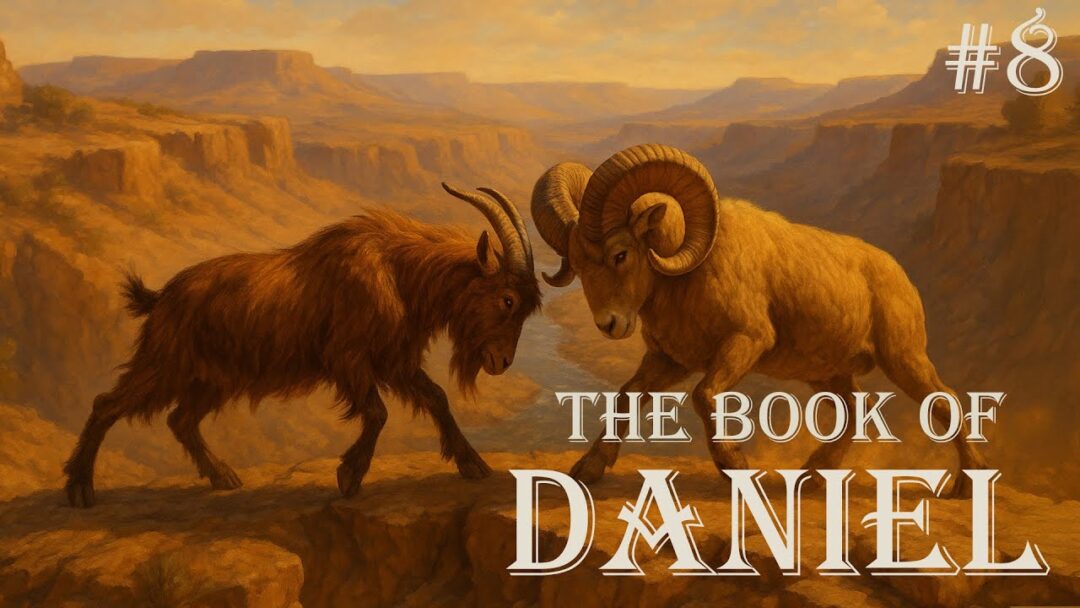
From our Sunday service on June 29, 2025, Daniel 8. This is part 8 of our Daniel series. Watch the full message: Desolation and Renewal – Daniel Series #8 on YouTube.
Today we return to the book of Daniel, and we are now in the Hebrew portion of the book. Last week was the last Aramaic section, and it was also the first section of prophecy. The book of Daniel is made of two sections, the historical narrative and the visions of Daniel, and we’re on vision number two. This section deals with a variety of visions about future empires and dark periods of Israel’s history.
Since we’re in the Hebrew language, we know this prophecy is mainly meant for the nation of Israel. Last week’s was more for all the nations, because it was written in the language of the biggest empire at that time, the Chaldeans. Today it is written in Hebrew, so it relates to the Hebrews.
This one is pretty significant, because today’s passage relates to the religious holiday of Hanukkah. It’s one of only two passages in the Bible that deal with the topic. When I was looking at this, I wondered whether to look at it or skim over it, since there’s not a lot in it. But most people don’t really know what Hanukkah is about. The other time it comes up is in John 10, where Jesus is in Jerusalem to celebrate the feast of dedication. That is what Hanukkah means, dedication. It’s there that he says, “I and my Father are one.” With all there is to cover in that message, we won’t have time to teach about Hanukkah, and we may not have another opportunity for years. Daniel prophesies the conflict that would eventually bring about Hanukkah as a religious observance, so let’s learn about it today.
Daniel 8 also foreshadows the antichrist. Our enemy to Israel here is a glimpse of the character traits the antichrist will have. So learning about Hanukkah isn’t useless for the Gentile, for the non-Jew. The person who started this Hanukkah tragedy is said to be a reflection of what is coming in the last days. From this lesson we want to take away that God wants you to beware of deception.
A Vision at Susa
In the third year of the reign of king Belshazzar a vision appeared unto me, even unto me Daniel, after that which appeared unto me at the first.
Daniel 8:1
Once again we have an introductory statement like the one in the last chapter. It tells us this is a vision, that it is for Daniel, and that it happens in the third year of King Belshazzar. So this takes place before the last two chapters of our narrative, around 550 BC. This is before the fall of Babylon and before the Medes and the Persians come to power.
Daniel is not going to understand a lot of this, and we can compare that to ourselves and the antichrist. The antichrist is coming in the future. We know character traits and rough details about him, and we know what his personality will be like. But we don’t know exactly when he is coming, what nation he is coming from, or what the situation will look like when he arrives. Daniel is in the same position. He is going to see a lot and know metaphorically what it means, but he won’t understand exactly what it looks like. That’s because Daniel is a kind of pre-revelation revelation. It lays down prophecy that Jesus will add to, and that the book of Revelation will add to and give us a little more clarity on. We’ll know from the context of all of Scripture a little more of what’s going on than Daniel did. Last week I told you I’m careful not to add to the text. The only reason we know so much about this vision is that we’ve already seen it fulfilled, so we can look back through history to understand what was going on.
And I saw in a vision; and it came to pass, when I saw, that I was at Shushan in the palace, which is in the province of Elam; and I saw in a vision, and I was by the river of Ulai.
Daniel 8:2
Unlike the first vision, this dream has a very specific geographical setting. “Shushan” is the Hebrew word for Susa, the capital of the Medo-Persian Empire. This is where Esther would be with the king, when she was taken as a bride and lived in the king’s palace. It is also the palace Nehemiah worked out of when he wrote the book of Nehemiah. It is going to be very significant in the future. But when Daniel sees this vision, he doesn’t know exactly what it is. The palace wasn’t even built until roughly ten years after this vision, I believe around the year of Cyrus. God told Daniel after this vision to seal it up, because the time to tell everyone about it had not yet come. In hindsight he can tell us it is Susa, but when he recorded the vision, he had no idea. So he’s in Susa, looking at the capital of the Persian Empire, and he is standing by the river Ulai, which flowed and provided water for the city.
The Ram
Then I lifted up mine eyes, and saw, and, behold, there stood before the river a ram which had two horns: and the two horns were high; but one was higher than the other, and the higher came up last. I saw the ram pushing westward, and northward, and southward; so that no beasts might stand before him, neither was there any that could deliver out of his hand; but he did according to his will, and became great.
Daniel 8:3–4
Once again, as in the last chapter, we are introduced to animals. Why are kingdoms pictured as animals and not as people? Because the kingdoms of this earth are driven by animal instinct and fleshly desires. Here it is a ram, which is normal, but the two horns aren’t the same. These two horns represent the combined empire of the Medes and the Persians. With Susa as the setting, that should be pretty clear. The big horn is Media and the little horn is Persia, until King Cyrus arrives from the land of Persia. Persia was the smaller kingdom, relatively weak and outpaced by the Medes. Both horns are high, meaning they have high authority and power, but one is higher than the other, and the higher came up last. As Daniel watches, it starts to grow until the second horn surpasses the first. Eventually, during the wars of the empire, Persia would take on more power than the Medes and become the driving force for the conquest of Babylon.
Remember Darius the Mede, who conquered Babylon and became king there. The prophecy is dealing with what would happen after the Persians take over. Darius the Mede marched down the dried riverbeds into Babylon, and the Medes controlled Babylon. For a moment it would look like Israel was going to be stuck under the Medes forever. But remember that Darius was about 62 years old, frail, and kept his power for only two years before Cyrus quickly overtook him. In the power vacuum, the Persians took the opportunity to take over the Babylonian Empire. But it was through them that God would start to restore his people. This ram would be used to send his people back to Israel, where they would restore the temple and rebuild the walls of Jerusalem under Ezra and Nehemiah.
I get that the two horns represent the two parts of the kingdom, but why a ram? Rams are very territorial and aggressive creatures. If you’ve ever watched the BBC or Animal Planet, you’ve seen videos of rams climbing a mountain and butting heads and knocking each other off cliffs. That is exactly the image here. A ram on the side of a mountain knocks off any animal that tries to enter its territory, from the west, from the north and from the south. The Medes and Persians would eventually push west and conquer Babylon, Mesopotamia, Syria and Asia Minor. They pushed north and conquered Colchis, Armenia, Iberia and the Caspian Sea. They pushed south and conquered Judea, Egypt, Ethiopia, Libya and India. But it doesn’t push from the east, because that is where the Persian Empire comes from, its place of origin. So the ram is the Medo-Persian Empire, a very territorial animal that is going to conquer the regions around it. But that’s not where it ends.
The Goat
And as I was considering, behold, an he goat came from the west on the face of the whole earth, and touched not the ground: and the goat had a notable horn between his eyes. And he came to the ram that had two horns, which I had seen standing before the river, and ran unto him in the fury of his power.
Daniel 8:5–6
Now we have a ram and a goat, two very similar animals, both territorial, and they are going to reach a conflict. This goat comes from the west, and “touched not the ground.” You might think of the hover-cat meme, but that’s not the picture. The picture is that this animal ran so fast you couldn’t see its legs, like Sonic the Hedgehog, whose legs become a blur. This kingdom is going to come on the scene from the west out of nowhere, as if you couldn’t see it coming.
The goat has “a notable horn.” Another way to translate that is a strange or peculiar horn. There’s something distinct about it, something different from the other kingdom. The Medes and Persians were really friendly to the nation of Israel, but this horn makes Daniel uncomfortable. There’s something about it that is off-putting. It’s not as friendly as the other one.
This goat represents Macedon under Alexander the Great. I understand why the ram is a ram, because it’s territorial, but why a goat and not two rams? There was a legend in Macedonian culture that Caranus, the first king of Macedon, was led by a bunch of goats to the location of their capital city, Aegae. Because of that legend, goats took on a very significant role in their culture, and when they named their capital city, they named it “goat.” Their capital was Aegae, which meant goat in their language. It’s a bit on the nose, but it is much like Babylon being the lion: the culture was so focused on the goat as its national identity that the prophecy represents it as a goat.
The ram and the goat meet beside the river. When Alexander the Great eventually came into conflict with Persia and won his first battle against the Medes and the Persians, it happened at a river, the Granicus. So we are seeing a foreshadowing of a future battle between the Medes and Persians, whom Daniel hasn’t yet met, and Macedon, a nation that seems small and insignificant and that they probably didn’t know much about at the time. Can you see why Daniel is confused? In hindsight it seems obvious that Macedon is the goat when they named their capital city “goat.” For Daniel, it was mysterious. We can understand the future the same way. We look at the book of Revelation and wonder what in the world is going on, with its beasts with many heads and eyes and horns and trumpets and bowls. For us they seem like a mystery, but in hindsight we’ll say, “How did I miss that? It seems so obvious.” Here, Daniel is just confused.
And I saw him come close unto the ram, and he was moved with choler against him, and smote the ram, and brake his two horns: and there was no power in the ram to stand before him, but he cast him down to the ground, and stamped upon him: and there was none that could deliver the ram out of his hand.
Daniel 8:7
“Moved with choler” literally in the Hebrew could just be translated as “he was enraged.” The goat is encroaching on the ram’s territory. Alexander the Great begins his conquest and starts conquering nation after nation. The goat charges at the ram at full speed, their heads meet, and the two horns shatter. If you know anything about rams, the whole power of the ram comes from the horn. The Medes and the Persians shatter. Their kingdom divides and falls apart, and there’s no power left to fight Alexander’s conquest. Without defense, the ram is cast to the ground and stamped upon, and there is none that can deliver the ram out of his hand. Alexander is enraged by the conflict, Persia is enraged by Alexander’s conquest, and in the end Alexander conquers.
The Little Horn
Therefore the he goat waxed very great: and when he was strong, the great horn was broken; and for it came up four notable ones toward the four winds of heaven.
Daniel 8:8
Here we see what happens after Alexander the Great conquers. We’re getting into the conflict where Hanukkah comes from, and where our challenge to remain dedicated begins. The great horn is broken, and four winds take up the kingdoms that fell from it. The four are Seleucus, Cassander, Ptolemy and Lysimachus, who took Alexander’s empire when he fell, absorbed its kingdoms and divided it among themselves. Alexander didn’t die from war. He died from sickness. This great man of war, who conquered many nations in his young life, was way younger than most conquerors. His kingdom wasn’t the biggest, yet he managed to conquer most of the known world at the time, and he was taken down by mere sickness. In the power vacuum there was nobody to carry on his kingdom, and it split into other kingdoms.
And out of one of them came forth a little horn, which waxed exceeding great, toward the south, and toward the east, and toward the pleasant land. And it waxed great, even to the host of heaven; and it cast down some of the host and of the stars to the ground, and stamped upon them.
Daniel 8:9–10
The little horn starts to expand like the other kingdoms did. Isn’t that what kingdoms do? They take land. They become dissatisfied with what they have, expand and start conquering others. It expands toward the south, the east and “the pleasant land.” What’s that? The pleasant land is Israel. This new kingdom starts expanding its territory closer and closer to Israel’s border.
Verse 10 says it “waxed great, even to the host of heaven.” This Greek culture, a pagan culture that worships Zeus and other false deities, gets closer and closer to Israel’s borders. It starts to take down “the host of heaven.” That sounds like it’s talking about angels, but here it means the army of the Lord, the nation of Israel. Remember, this is metaphorical. Some of the Israelites begin to fall into Hellenistic, or Greek, society and take on some of its practices. They start to compromise with the people on their border. They start to worship gods other than Yahweh, take on idols and take on a Greek cultural identity. Eventually the borders of Greece increase until Greece has control over Israel.
It says some of the stars were cast to the ground and stamped upon. Because the Israelites compromised and brought themselves down low, they put themselves in a position where they could be hurt. Had they stayed faithful to God, stayed up in heaven following the law and his commands, they would never have lowered themselves to the point of danger. The prophecy tells Daniel that the Israelites will face a temptation: the culture will tell them to be one thing, and God will tell them to be another. The danger is that they get away from his standard and start lowering themselves closer and closer to the cultural identity of those around them. When they fully surrender and reach the ground, as far from God as possible, then because of their sin God will allow them to be trampled out and punished for their lack of faithfulness.
So the challenge for us today is clear: do not compromise with society on what God tells us we should be. If we stay with God and the stars of heaven, he will protect and preserve us. This applies to us as a nation. If our nation strays from God, that opens us up to correction. But more important than the nation is the individual. There’s not a lot you can do to change everybody else, but there is a lot we can do to protect ourselves. To make a nation blessed starts with making sure we ourselves are right with God.
Yea, he magnified himself even to the prince of the host, and by him the daily sacrifice was taken away, and the place of his sanctuary was cast down.
Daniel 8:11
Here the little horn is once again boasting and prideful, lifting himself up. If you remember last chapter, we also had a little horn that boasted. These horns are not supposed to be the same person, but this one is a representation of what it will look like when the antichrist comes later. This is not the antichrist, but it is an antichrist, a person from history that God uses as an example to show us what to look for in the future. He put himself on a pedestal and made himself equal with God. “The prince of the host” is the leader of the army, and the army is Israel, so the leader of Israel is God. This horn says, “I am as good as God. My identity, my culture and my leadership should be worshiped as if it is truth incarnate.”
His name is Antiochus Epiphanes. He became king of the Seleucid Empire in 175 BC. He is a foreshadowing of the antichrist but not the antichrist who has yet to arrive. He is the first of the double fulfillment of the antichrist prophecy, the evidence God gave us that Daniel’s prophecy about the last days is true. Remember I talked about how God uses double prophecy: in order to prove that a prophecy is legitimate, he fulfills it once in the short term and leaves the ultimate fulfillment for the long term. Isaiah’s son was born to fulfill the prophecy of the young woman in the short term, so that we would know Christ would be fulfilled in the long term. Here we have the same thing: Antiochus Epiphanes as the first fulfillment of the antichrist, an example of what will come and a promise that what God said about the future will come to pass.
Antiochus was proud and lifted himself up, and made himself equal with God. What he is probably most known for is replacing the Israelite worship of God with Zeus worship. He was the first foreign king to attack the Jews’ freedom to worship. When the people were in Babylonian captivity they could still worship their God. There were those one-off times in Daniel when the king made a decree not to worship any other god, but those were short-term, off-script events. The Babylonians didn’t say the Israelites couldn’t worship God, and the Persians didn’t either. But Antiochus said, “When I conquer the Jews, I’m going to take away their right to worship their God, and I’m going to force them to worship Zeus and all the other Greek gods I worship.” This Hellenizing herald forced the Jews into a situation they’d never faced before.
He waxed great even to the host of heaven. He went up to the religious leaders and the chosen people and went to war with them. He set traps for them, pushed Greek culture on the Israelites and tempted them to compromise. Even the army of heaven gives in. Even the Levites and the leadership start to compromise, and their religious beliefs change. You see sects like the Sadducees come about, who don’t believe everything in the Bible anymore. You see the Hellenized Herodians in the New Testament, people so in love with Greek culture that they sacrificed their Jewish identity to make Greek culture part of their lives. Think of all the things the flesh can enjoy in that culture. It was so tempting that the stars of heaven were distracted and fell into the trap set by Antiochus.
Because of that we see a tragedy in the second half of verse 11: “by him the daily sacrifice was taken away, and the place of his sanctuary was cast down.” After Antiochus invaded the Jewish people with culture, he invaded them with war. When the Israelites were weakened and God no longer had patience with them for their sin, he marched into Jerusalem and the temple and looted it. In 169 BC Antiochus stormed into Jerusalem and robbed the temple. He took the golden altar, the lampstand, the utensils, the golden censers, the curtains and the golden facade of the temple, and left. It was a warning to the Israelites to wake up, to stop falling for the trap culture had set that distracted them from God. Your worship and faithfulness to God are at risk. Yet the time had not yet come.
Eventually he returned, in 167 BC, and we see it in verse 11. The Jews made it by for a couple of years without all the ornaments of the temple, but then Antiochus drew a line. “Jews, you’re no longer allowed to worship your God. I’m taking away the daily sacrifices.” Every morning and night the Jews made a sacrifice to God, and now they couldn’t. The sanctuary was cast down, so there was no worship of God there. Antiochus erected his own gods and his own worship.
And an host was given him against the daily sacrifice by reason of transgression, and it cast down the truth to the ground; and it practised, and prospered.
Daniel 8:12
The host was given to him, meaning the Israelites, the army of God, were handed over to him. Why? “By reason of transgression.” This isn’t Antiochus’s sin. It is the Israelites’ sin. They compromised with Greek culture, took on a secular identity and involved themselves in secular perspectives and truth. God says, “Because you’ve given up, because you’ve sinned and thrown truth to the ground, I’m going to take away the daily sacrifice. If you’re going to practice a false religion, I’m going to take away the comfort of that false religion. You want to come to my temple and worship me as a hypocrite? Then I’ll take your temple away.” He has done this before, many times, and here he does it again. The army is given over to Antiochus, and whatever he does and wants to do, God allows him to prosper.
The Prophetic Timeline
Then I heard one saint speaking, and another saint said unto that certain saint which spake, How long shall be the vision concerning the daily sacrifice, and the transgression of desolation, to give both the sanctuary and the host to be trodden under foot? And he said unto me, Unto two thousand and three hundred days; then shall the sanctuary be cleansed.
Daniel 8:13–14
Daniel doesn’t actually ask the question himself. God, in this vision, wants to tell him the timeline of this prophecy. Why does God give us prophecy? Because he tells us in advance what he will do so that when it happens, we know he did it. God was going to allow the people of Israel to be taken into a new form of captivity, where their worship and freedom of religion were taken away. But he was only going to do it for a time, and when they were liberated, he didn’t want them to think they did it themselves. He wanted them to know that he was the one who freed them to worship again. So he gave them a specific time here.
It’s 2,300 days in our King James. I study this in the original language, and if you look at the Hebrew, the word “days” there is “evening-morning.” Another way to translate this is 2,300 morning and evening sacrifices, or 2,300 daily sacrifices. So the number is not 2,300 literal days but 2,300 evenings and mornings. Because it’s talking about sacrifices, you cut it in half, and everything else in the passage is about the morning and evening daily sacrifice. That would be 1,150 days.
I wanted to get as close as I could on the timeline, to fit the exact days that are spoken about. But you have to understand that there are multiple conflicting calendars in use in this time period. The Seleucids, whom Antiochus was from, had the Seleucid calendar, the Jews had the Jewish calendar, and there were all kinds of calendars in common use. So it’s hard to nail down exact days. If you go to one person, they’ll give you one day, and another will give you another, and all will have a good reason. These are estimates. I couldn’t find the exact dates that worked, but it’s very close.
In 169 BC, Antiochus stormed into Jerusalem and looted the temple, taking the utensils, the golden candlesticks and the golden exterior of the building, all the niceties of their worship. But that’s not when the countdown of 1,150 days starts. On December 6, roughly 167 BC, Antiochus returned to Jerusalem and committed what is called the abomination of desolation, which we’ll talk about in the next chapter. He erected a pagan altar inside the Jewish temple and offered a pig on it, an unclean animal. You’re not allowed to touch pigs. They’re unholy. He erected an altar to Zeus in the Jewish temple, killed an unclean animal on it and offered it to Zeus. In this act he defiled the entire temple of God. After this Antiochus made his decree that all further sacrifices to God were forbidden, that any Scriptures you find must be burned wherever you find them, and that the daily sacrifices would stop. On this day, whatever it is, since people disagree, the prophetic clock starts.
Jump into the future to around December 14, 164 BC. Antiochus dies. The temple is restored and the altar is rededicated to God. The temple was defiled, so it needed to be rededicated, and they brought everything back. Because it was a dedication, they call that day Hanukkah. So the celebration of Hanukkah is the prophetic fulfillment of this chapter in Daniel, where the Israelite people are tempted by the culture to compromise on their standards. For a time they compromise. But as time goes on and God allows them to suffer, they begin to realize that dedication to God is important. They form a revolt, called the Maccabean revolt, which you can read about outside your Bible, and they eventually overthrow Antiochus. When they rededicated themselves to God, they reopened the temple and dedicated not only the temple but themselves to God.
Based on my estimated dates, you get 1,111 days, not 1,150, so my dates are obviously a little off. Maybe if I had three months to figure this out, I could get exact dates. But that gives you enough idea of what happened. For years they suffered without a temple because they didn’t dedicate themselves to God.
Gabriel Explains the Vision
And it came to pass, when I, even I Daniel, had seen the vision, and sought for the meaning, then, behold, there stood before me as the appearance of a man. And I heard a man’s voice between the banks of Ulai, which called, and said, Gabriel, make this man to understand the vision. So he came near where I stood: and when he came, I was afraid, and fell upon my face: but he said unto me, Understand, O son of man: for at the time of the end shall be the vision.
Daniel 8:15–17
A man calls out from the middle of the river. I believe this is Jesus, pre-incarnate, calling out to Gabriel: “Daniel has a problem here. He has no idea what this vision means. This is happening in the future. The kingdoms he’s talking about don’t exist, and the places he sees are not yet built. Help him understand.” If you’re wondering what Gabriel means, it means strength of God.
Now as he was speaking with me, I was in a deep sleep on my face toward the ground: but he touched me, and set me upright. And he said, Behold, I will make thee know what shall be in the last end of the indignation: for at the time appointed the end shall be.
Daniel 8:18–19
“I was in a deep sleep” is kind of funny. It means he was unconscious. Not that he was taking a nap, but that he passed out. It was just overwhelming to him, everything going on. So Gabriel says, “Daniel, wake up,” shakes him up, and Daniel wakes up confused. Then Gabriel starts to explain: “I will make thee know what shall be in the last end of the indignation.”
We like to read into this that it is talking about the end times. But this is written in Hebrew, to the Israelites, about a specific time in history. The end of the indignation is about God’s wrath during the time of Antiochus. The Israelites gave in to the pagan society around them, so God was angry with them and set a time of wrath to bring them back. While it doesn’t talk specifically about the end times, remember that this is a type of the antichrist. Just as an antichrist made a time of wrath here, there will also be a time of wrath at the end of history. This one is not specifically that time, but it gives us a picture of what it will look like. Because of Israel’s sin, they had a time of suffering to purify them. Because of the world’s sin in the future, there will be a time to purify them.
Sometimes we don’t learn a lesson until we go through hardship, and God knows this better than anyone. He has seen more lives than any of us, and he knows that if we don’t have something to wake us up, we’ll never wake up. So God has to wake us up through this time of wrath. “At the time appointed the end shall be.” This wrath doesn’t last forever. There is an end for it, both for Israel during the time of Antiochus and for the people at the end of world history.
The ram which thou sawest having two horns are the kings of Media and Persia. And the rough goat is the king of Grecia: and the great horn that is between his eyes is the first king. Now that being broken, whereas four stood up for it, four kingdoms shall stand up out of the nation, but not in his power.
Daniel 8:20–22
The great horn, the first king of Greece, is Alexander the Great. The four kingdoms inherit Alexander’s territory, but not with his authority or military power to back it up.
And in the latter time of their kingdom, when the transgressors are come to the full, a king of fierce countenance, and understanding dark sentences, shall stand up.
Daniel 8:23
At the end of the Greek Empire, when everything falls apart, there will be transgression, specifically the children of Israel falling into sin and giving up their commitment to the law. But this is also a foreshadowing. At the time of the end, the same thing will happen. Transgression and sin will increase, and believers will begin to compromise and lessen their closeness to God. In this time transgression will come to the full, and God’s wrath can no longer be restrained. In his justice and righteousness he has to correct, so he allows a king “of fierce countenance,” a fierce appearance, to come. Somebody who looks terrifying, who makes you shake in your boots when you stand in his presence.
“Understanding dark sentences” means he will be evil, scheming and crafty. He’ll know just the words to say to get what he wants, and exactly what to do to get people to lower their moral standards just a little. He doesn’t need you to fall in line with his philosophy in a day. He has a long-term strategy. Antiochus didn’t conquer Jerusalem in one night. He slowly let his culture invade their nation. He slowly allowed the temple to be looted, taking everything that made it beautiful. When the beauty was gone, he allowed the practice of their religion to continue until eventually he came to snuff it out entirely.
Since this is a foreshadowing of the antichrist, what can we say? The antichrist will come and seem okay. He’ll be on our borders. He’ll chip away at our faith and our standards and our morals and get us to compromise. He’ll come one day and take away the beauty of the religion. I think for Christianity this means the greatest commandments: love the Lord thy God with all thy heart, soul and mind, and love thy neighbor as thyself. If I had to guess, I believe the antichrist is going to go for those two things. He’ll take away the beauty of Christianity, and when a couple of years have passed and Christianity doesn’t look anything like it was supposed to look, he’ll come in and betray the Christians and oppress them.
Can you see the application for us from this passage? It’s important for us to be dedicated to God, because the Bible says not just one antichrist will come but many, and there will be many opportunities for this cycle to repeat itself. Many people will come and chip away at our Christian standards little by little. “That’s not so bad, I’ll give that up. That’s not so bad, I’ll give that up,” until the beauty of Christianity is gone and an empty shell remains. Christian, beware of antichrist. Beware of people who want to take away the beauty of your love for Christ.
And his power shall be mighty, but not by his own power: and he shall destroy wonderfully, and shall prosper, and practise, and shall destroy the mighty and the holy people.
Daniel 8:24
This man will be manipulative. He’ll be powerful, but it’s not him. There’s a force behind everything going on here, and it is implied to be Satan. The antichrist works for Satan and pushes Satan’s agenda. When the Greeks were on our borders, it didn’t seem so bad. They worship idols, but they’re not that bad. But we start to take in their culture and their identity, and Satan says, “This is part of my scheme. I’ve been behind this all along, and nobody has a clue.” By the time we figure out it’s Satan who has been tripping us up, it’s too late. “He shall destroy wonderfully” means the devastation to the believer will be insurmountable and indescribable. Whatever he does, he will accomplish, because he has weakened the believers so much that there is nothing left to withstand him.
And through his policy also he shall cause craft to prosper in his hand; and he shall magnify himself in his heart, and by peace shall destroy many: he shall also stand up against the Prince of princes; but he shall be broken without hand.
Daniel 8:25
His craftiness will allow him to prosper. He’ll lift himself up and be proud and boastful. But “by peace shall destroy many.” When an antichrist or the antichrist comes, he doesn’t come to destroy believers by force. That’s the one thing I think we forget when we project in the future who the antichrist may be. The antichrist is not going to force believers to give in. Christians are going to go peacefully to the side of the antichrist, because their standards were so slowly eroded that they don’t even know they’re switching sides.
The Israelites faced this under Antiochus. Satan got into Antiochus’s military strategy and successfully weakened the Israelite people until he could walk in and peacefully turn them over. During the time of Jesus, the Herodians existed. There were people who looked at the ministry of Jesus and said, “I don’t like this Jewish stuff. I like the Greek culture.” Antiochus was so successful at eroding the Jewish identity that 150 years later there were still people around the time of Christ who were content just being Greek inside the city of Jerusalem. They were fine with Greek leadership and Greek laws and Greek standards. Christian, beware the mistake the Jews made.
“He shall also stand up against the Prince of princes”, that is God himself, the King of kings. “But he shall be broken without hand.” Does mankind defeat the antichrist? No. “Without hand” means not with hands. Remember Nebuchadnezzar’s vision: a stone not carved by hands crushed the statue. It’s the same image here. A force not made by human hands, God himself, comes and defeats Antiochus. The only reason the Maccabean revolt worked was that they rededicated themselves to God and, in the power of God, defeated this foreign invasion.
And the vision of the evening and the morning which was told is true: wherefore shut thou up the vision; for it shall be for many days.
Daniel 8:26
This prophecy was not meant for Daniel. He was not going to see any of this happen. So God says, “Don’t tell anybody yet. I’m going to give you this vision and you write it down, but people in the future are going to need to know this, because I’m going to do some things and I want you to know exactly why and how it happened. I want you to know that when you were taken captive, it was because your hearts were already captive before I let Greece invade. Before Antiochus stepped foot in your nation, you had already given up your heart. Daniel, write this down, because one day it will come true.”
And I Daniel fainted, and was sick certain days; afterward I rose up, and did the king’s business; and I was astonished at the vision, but none understood it.
Daniel 8:27
Daniel gets the right reaction to all this. He sees all the tragedy that is going to happen to his nation, and he passes out. He is a faithful Jew who has been teaching the truth, and when he sees how far his nation will fall, he’s exhausted and physically ill. But afterward he rose up and went to do his work as normal. It wasn’t his generation that was going to face it but one in the future. He was astonished at the vision, but nobody understood it. Nobody knew what was so significant about the Susan palace, because it wasn’t built yet. But one day the trial would come.
We have the same thing. We’re not going to see an Antiochus, but we may see the antichrist. When he comes, may we be among the faithful believers who don’t fall into his trap or his compromise, who remain dedicated to Christ and not him.
Beware of Deception
Daniel 8 gives us a glimpse of both history and prophecy. It reminds us that God is sovereign over empires and the unfolding of his plans. The vision of the ram, the goat and the little horn pointed forward to a very real and tragic event in Israel’s history, the brutal oppression under Antiochus Epiphanes, which led to the events now commemorated at Hanukkah. But this vision is not just about history. It is a warning for our future. It foreshadows the antichrist, a future deceiver who will rise with similar arrogance, craftiness, deception and hatred for God’s people. That makes Daniel 8 more than a record of what was. It is also a warning about what will be.
God wants you to beware of deception. Many antichrists will come. Antiochus didn’t just one day march into Jerusalem and conquer all the cities. He started by conquering the heart. He lured God’s people into compromise, into Hellenistic culture and away from their covenant with God. That’s the same strategy Satan uses today. He often uses subtle persuasion and spiritual erosion through tiny little steps of compromise.
So let this passage be a wake-up call and an invitation to renew our dedication to God. Just as the Jews rededicated the temple at Hanukkah, let’s be a people who refuse to trade truth for convenience, who resist the temptation to flow with the cultural tides and stand firm when deception rises. Just as the temple was cleansed and restored, our hearts too can be rededicated to the Lord. May we all choose today to hold fast to God’s truth and walk faithfully, knowing that while the enemy deceives, God always prevails.

Recent Comments