
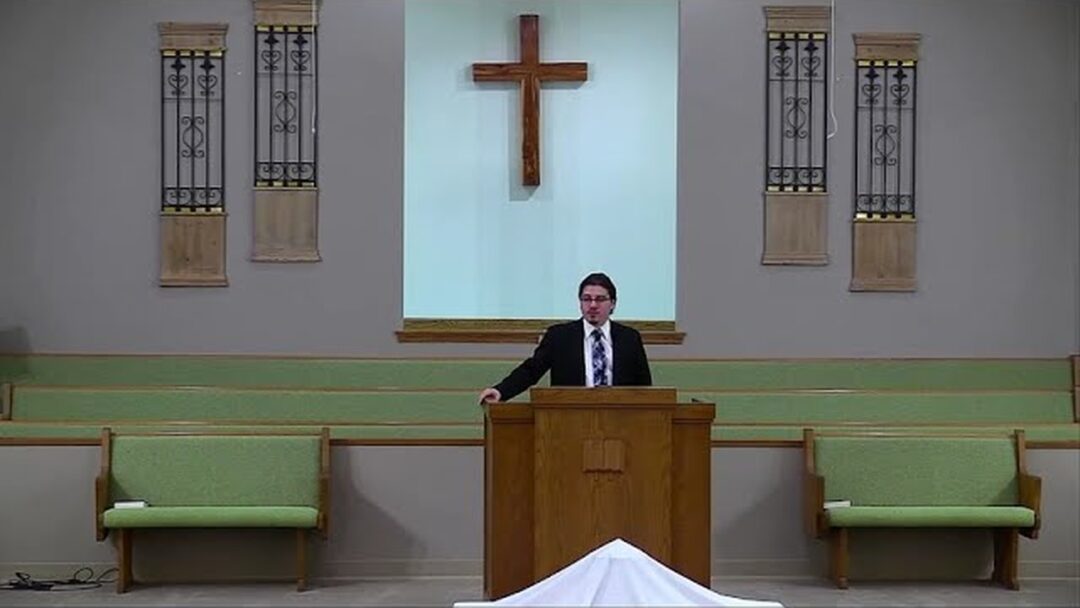
From our Sunday service on July 27, 2025, John 5:1-15. Watch the full message: When Is My Turn? The Pool of Bethesda – John 5:1-15 on YouTube.
Soon we will be getting into our next series, the parables of Christ, and I’m really excited about that. But before we get there, I thought I would take a little detour and talk about the healing at the pool of Bethesda. This passage has been on my heart for a couple of months, and today felt like the right day.
I’ve entitled this message “When Is My Turn?” I think the topic is very relatable, because all of us have been in a position similar to this man at the pool of Bethesda. John 5 is a famous passage. We’ve heard this story a thousand times, and it’s one of the most famous miracles Jesus did.
In it we are introduced to two perspectives. There is an earthly perspective that comes from the man at the pool, and a heavenly perspective that comes from Jesus. A lot of times we miss this when we read the story. The title “When Is My Turn?” emphasizes the earthly perspective. It’s meant to get your attention, and it’s not the actual point of the message.
A lot of times we ask God this question. God, when is it my turn to receive the blessing? When is it my turn to be freed from the hardship? When is it my turn for whatever your need is? We get stuck in that earthly philosophy and miss what God is actually trying to tell us.
Here we see a conversation between a poor, homeless, disabled man without any hope in his life and Jesus. If we pay attention to the text, we realize they’re talking about two totally different things. The man is concerned with his earthly needs, and Jesus is concerned with his spiritual needs. We often approach this passage from the disabled man’s perspective and miss the lesson Jesus was trying to teach us.
So today the lesson I want us to get is this: God wants you to stop making excuses and take a step of faith so that he is able to bless your efforts.
A Feast and a Pool
We’ll read just verse 1 to set up the scene.
After this there was a feast of the Jews; and Jesus went up to Jerusalem.
John 5:1
What happens before this passage isn’t really relevant, but the feast of the Jews is important, because it sets a perspective that I overlooked for years. The book of John is pretty good at setting up a timeline, yet John doesn’t tell us which feast this is. That means the feast being celebrated isn’t relevant to the application of the story. John must have been concerned that if he said it was the feast of tabernacles, which it probably was, we would grab a conclusion from it that we weren’t supposed to.
If you know anything about Jewish culture, you know people made this pilgrimage to Jerusalem at least three times a year as ordered by the law. So Jesus going up to Jerusalem was a common thing. He would go there for every feast. This was the second year of Jesus’s ministry, so he would already have been here during the first feast of tabernacles, doing miracles. It was not the first time Jesus had been in Jerusalem. He had been there every year since he was a baby, and it was not the first time since he started his earthly ministry of healing.
The feast of tabernacles was a harvest festival to celebrate God’s provision and restoration. The Jewish people thanked God for his provisions for the year, and for a week they would spend time in a tabernacle, an outdoor booth like one of those little canopies you sit under at a picnic. Why? Because when they wandered in the wilderness, they lived in booths. It was supposed to remind them how much God had done for them. They spent forty years in the wilderness, and eventually they made it to the promised land. God said, “Don’t forget where you came from. Don’t forget how much I blessed you. Now you have farms. Now you have agriculture. You don’t have to wander around in booths. But once a year, go hang out in the booth, spend time with your family, spend time in prayer, spend time with me, and remember where you came from.” That’s what Jesus is doing, coming to spend a week outdoors with family and friends and remember what God has done.
Verses 2 through 4 continue with the context.
Now there is at Jerusalem by the sheep market a pool, which is called in the Hebrew tongue Bethesda, having five porches. In these lay a great multitude of impotent folk, of blind, halt, withered, waiting for the moving of the water. For an angel went down at a certain season into the pool, and troubled the water: whosoever then first after the troubling of the water stepped in was made whole of whatsoever disease he had.
John 5:2–4
By the sheep market in Jerusalem there was a pool called Bethesda. There’s a lot of debate about this pool. For centuries they couldn’t find it, but eventually it was found, and now we know a lot about it because we dug it up and looked at it. It had five porches. If you want to picture this, think of the number eight on a digital calculator display: four porches on the outside and one in the middle, with two pools in a square eight pattern. These were water reservoirs. In the city of Jerusalem there would be a lot of runoff, and you have to collect the water somewhere. People going into Jerusalem for the feast could use it to wash and purify themselves before going up the steps to the temple.
The building was originally outside the city, but as the population grew and the walls pushed outward, it ended up inside the city at the bottom of the pathway to the temple, right next to what would eventually be the sheep market. That’s where you buy your sacrificial sheep to sacrifice at the temple if you didn’t want to travel with them. So this place sits between where the sacrifice is picked up and the temple where you sacrifice it. As you walk up the steps, you pass it every time you go to worship, on your right side. Jesus was very well acquainted with this area. It was not the first time he had walked by and looked into the pool.
The name Bethesda means “house of mercy.” And we know from archaeology that this site was actually a pagan temple, associated with the worship of Asclepius, the Greek god of healing and medicine. We assume that because it’s in Jerusalem, it’s a Jewish site associated with the temple, but that’s not what happened. It was originally outside the city walls, and the Jewish people tolerated it as a pagan temple outside their holy city. Eventually it ended up in the center of Jewish worship, the holy city itself.
This pagan shrine had an interesting mythology: an angel went down at a certain season and troubled the water. A lot of times we take that at its word and say there was actually an angel at this pool. But in the context of archaeology, I think this was meant as a note explaining why the pool was there. The book of John was written before AD 70, before the destruction of Jerusalem. When John wrote, everybody knew what the pool of Bethesda was, because it was there. Shortly after AD 70 Jerusalem was destroyed and the pool was buried in dirt by the Romans, and people no longer knew what it was. So John added an explanation of what this place was for.
So in a pagan temple inside the holy city of God, people were waiting for some kind of miracle. We’re told the water was stirred. We don’t know exactly what that was, but shrines of Asclepius were often built around natural sources of water, whether hot springs, regular springs or reservoirs. What’s possibly happening is that the cult found a spring near this retaining pool that occasionally bubbled, and said, “It must be an act of the gods. Let’s make it a holy healing spring, and tell our people to sit here and jump in when the water stirs.” Is it possible for pain to be removed in a hot spring? Yes. Heat soothes sore bones and achy joints. But here what’s likely happening is not something miraculous but something the pagans believed was miraculous. The Babylonian Talmud tells us that Rabbi Akiva was asked to explain why people afflicted with diseases sometimes returned cured from their pilgrimage to a shrine of an idol in Jerusalem. So we have some indication from history that this was going on, if not at this location, then at other pagan shrines in Jerusalem. It’s very clear to me this passage is talking about that specific situation.
A Man With Two Disabilities
Let’s meet this hopeless man in verses 5 through 7.
And a certain man was there, which had an infirmity thirty and eight years. When Jesus saw him lie, and knew that he had been now a long time in that case, he saith unto him, Wilt thou be made whole? The impotent man answered him, Sir, I have no man, when the water is troubled, to put me into the pool: but while I am coming, another steppeth down before me.
John 5:5–7
This man carries the earthly perspective we so often relate to. We’re only told a few things about him. He’s unable to walk, so he can’t get to this spring when it bubbles. He lived here, because Jesus says he’s been there a long time. He didn’t have this situation his whole life, because he had an infirmity for thirty-eight years, not since birth. And we know he was Jewish, because of the way Jesus interacts with him.
So we learn something that may not be apparent unless we know the context. This man was not only physically disabled, he was spiritually disabled as well. He was a Jew who lived in the holy city of Jerusalem, and yet he was found at a pagan shrine, a cult of healing, hoping in a desperate attempt for his situation to be solved.
There’s no doubt in my mind that this faithful Jew, raised to be faithful in this culture, sought God for healing for years before this. I don’t think he came to this pool the moment he was disabled. I think he waited on God and said, “God, heal me. I want to be able to walk again.” Time after time no healing came, and over time the man lost his faith. He became desperate for anything that would solve his situation, and in desperation he brought himself out to this shrine and hoped that maybe he could make it into the water when it stirred. His heart was disabled. He was no longer walking with God. He had abandoned his faith for the myths and legends of the Greeks.
He’d been there thirty-eight years. We can’t help but think how many times Jesus had seen this man over the years. Jesus walked up this pathway past the pool at least three times a year, and he was over thirty years old at this point. How many times had Jesus walked by this man, seen him crippled, disabled and hopeless? Things are about to change. Why now? Surely Jesus walked by the year before, after his ministry had already started, saw that man and said, “I’m sorry, but it’s not yet time for you to be healed. Wait a little longer.”
Notice the man’s response. Jesus asked a question: “Wilt thou be made whole?” In other words, do you want to be healed? Here’s where we see that Jesus and this man are not talking about the same thing. Does the man answer the question? No. He starts making excuses. Jesus asks if he wants to be healed, and the man answers with all the reasons why he can’t be. He had given up his hope in God. He was seeking help from another source, and that source had nothing to offer him. Though he may have thought there was a slim chance he could make it into the pool, he found no hope and no future. When Jesus said, “Do you want to be healed?” his answer was, “It’s not really possible. There are so many problems holding me back. It’s just not doable.”
Rise, Take Up Thy Bed
Jesus saith unto him, Rise, take up thy bed, and walk. And immediately the man was made whole, and took up his bed, and walked: and on the same day was the sabbath.
John 5:8–9
Jesus doesn’t even engage with his excuses. Did you notice? He says, “Rise, take up thy bed, and walk.” He didn’t engage with the problems in this man’s life. He gave a command: get up. The implication spiritually is that this man was there because of his own choices, and he needed to take some initiative to be healed. Don’t make excuses for why you can’t do it. And immediately the man was made whole.
The application for us today is that God isn’t looking for our excuses for why we can’t do things for him. He’s looking for action in our lives, for us to step up and do something so that he can act. The man had to take the first step even when he didn’t think he could do it, and when he started to get up, he was healed and able to walk again. Faith has to act before it sees the results.
So often we struggle with our faith, with the difficulties we have, and because of them we say, “God, I can’t handle serving you right now because of these things holding me back.” And Jesus doesn’t want to engage with that. In his mind he’s telling you, “What do you mean those things are holding you back? Am I not greater than all those things? What excuse can you have? Why do you make excuses?” Do you want to be healed? Do you want your spiritual walk with God to be restored? Do you want to thrive?
And instead of answering yes or no, we say, “I have no money in my bank account. I’m struggling with this health issue right now. I don’t have the speaking skills to minister that way. I don’t have the physical skills to bring my talents to the church or a nonprofit. I don’t have the ability or wisdom to accomplish this or that. God, I can’t do it.” Jesus isn’t asking you if you can do it. That’s not the point. We’re having two different conversations. He knows he can do it already. He’s asking a simple question: do you want to be healed? Jesus wasn’t so concerned about this man’s physical disability. He was concerned about his spiritual disability, how his heart had given up on God and said, “I can’t do anything else.”
Controversy Over a Miracle
The Jews therefore said unto him that was cured, It is the sabbath day: it is not lawful for thee to carry thy bed. He answered them, He that made me whole, the same said unto me, Take up thy bed, and walk. Then asked they him, What man is that which said unto thee, Take up thy bed, and walk? And he that was healed wist not who it was: for Jesus had conveyed himself away, a multitude being in that place.
John 5:10–13
Even though something amazing happened and a man’s life was transformed, he immediately faced scrutiny from the religious leaders. They were more focused on how the miracle had occurred than that it had occurred at all. The situation was obviously problematic for the culture of the time. First, Jesus goes to a pagan shrine. Second, he heals a man in a pagan place. Third, he violates the oral law of the Pharisees by healing on the Sabbath. And then he tells the man he heals to violate the oral law as well.
It’s important to mention that the oral law is not the law of Moses. It’s not the law given by God. It’s the law given by man. It was the Pharisees who said no one could pick up a bed and carry it on the Sabbath day. We learn from this that legalism is destructive. This man’s life was transformed and he had hope again, and the Pharisees came up and started knocking him down. Legalism always notices when someone picks up their mat, but it never wants to help somebody get up and walk again.
The Pharisees would never have walked into the pool of Bethesda, a pagan shrine. They would have said they were too spiritual to enter such a sinful place. Jesus wasn’t like that. He wasn’t full of hypocrisy, and he wasn’t afraid to go where the people who needed him were. This is an example of Jesus leaving the ninety-nine to go after the one. Maybe in other years that man wasn’t ready to give the right answer. But this year, in the second year of Jesus’s ministry, as Jesus walked by, that man’s heart was ready to have faith to stand up and walk. How many other people did Jesus walk by that day who weren’t healed? That place was full of people, but that man was ready to make a change in his life. He was ready to stand when told.
The Pharisees weren’t willing to go to that man who needed faith and lift him up and encourage him. They were more concerned with their own rules than with helping the disabled person who stood beside them. We ought not be like the legalistic Pharisees. We should be like Jesus, looking for opportunities to help those who need to stand up again. And don’t let others’ confusion rob God’s miracles in your life. Sometimes people will oppose good things because they disagree on how they’re done. They may have different preferences about how things are carried out, or the way God’s ministry is accomplished doesn’t fit their expectations. But don’t let that rob you of God’s miracles. Stand by what you know is true and right by the word of God.
Sin No More
Let’s continue in verses 14 and 15. Jesus had disappeared and the Pharisees were looking for him. Now Jesus comes back and finishes what he started.
Afterward Jesus findeth him in the temple, and said unto him, Behold, thou art made whole: sin no more, lest a worse thing come unto thee. The man departed, and told the Jews that it was Jesus, which had made him whole.
John 5:14–15
I told you this man’s heart wasn’t ready to be healed. He was forsaking God and sitting in a pagan shrine. What’s the first thing he does when he’s healed? He goes up the stairs right next to the pool and into the temple to worship. His heart wasn’t ready for that miracle until it was ready to go back to worship. Then God healed him, and he walked up those steps on his own two feet and worshiped in the temple. And then Jesus meets him to finish the conversation he didn’t get to finish in the beginning.
The healing Jesus offered that man was not about being able to walk again. It was for his soul. “You are whole, not just in your feet but also in your heart. You’re back here worshiping God. Be careful. Don’t sin anymore, or a worse thing will come to you. Be faithful. Don’t backslide when things get difficult.”
Jesus was not just concerned with a man’s physical condition, but also his spiritual condition. He follows this model constantly throughout his ministry. First he takes care of people’s immediate physical needs, and then, when the distraction of life is removed, he deals with the spiritual things. If we can, we should emulate this ministry philosophy. If we have the ability, we should care for the physical needs of others so we can remove those distractions and have an opportunity to deal with their spiritual needs as well. It’s hard to get people to think about coming to church when they’re struggling to get gas in their car to go to work the next morning. It’s hard to convince someone to drive all the way to your church on Sunday when they’re not sure they can make it to work on Monday. If we want to be truly effective in ministry, we have to take that example of Jesus and try to remove the distractions Satan has put in the way, so we can reach people more effectively.
God’s Timing Is for His Glory
What was the point of this healing? I’d say it’s that God’s timing is for his glory. Habakkuk 2 has the same vibe this man was going through. It’s about a vision in the future.
For the vision is yet for an appointed time, but at the end it shall speak, and not lie: though it tarry, wait for it; because it will surely come, it will not tarry. Behold, his soul which is lifted up is not upright in him: but the just shall live by his faith.
Habakkuk 2:3–4
Habakkuk was told that God’s promises are coming about, and the Messiah will come. The world is chaotic right now, and no matter what time period you live in, you can always say the world is chaotic. “At the end it shall speak, and not lie. Though it tarry, wait for it; because it will surely come.” If there’s a difficulty in your life, then God has a purpose for it. If you’re faithful to him, he will make it worth it, and he will bring more good out of it than there ever was bad. “His soul which is lifted up is not upright in him.” The man who’s proud, his soul is not in the right place. “But the just shall live by his faith.” God will bring you through it.
We don’t need to ask, “When is it my turn?” We should know God is there for us. We should be asking, “Am I right with God right now? Am I making excuses for why I can’t walk with him? Maybe God is waiting to heal me until I give him what I have held back.” Stop making excuses every time he asks, “Do you want to be healed?” and say, “God, yes, heal me. God, yes, use me. God, yes, transform me. I don’t want that sin anymore. I don’t want that excuse anymore. I don’t want to be in this state anymore.”
Bethesda was called the house of mercy. But mercy’s house is not a pagan shrine. It’s a person named Jesus Christ, God who came in the flesh.
So What Do We Do?
First, bring your deepest disappointments to Christ, but don’t make excuses. Act on Christ’s word. He asks you in the Bible to step up. Act on his word even when the outcome is unseen. Faith should move first, and then allow God to move in and complete it.
Second, expect opposition. Obedience is often challenged by man-made traditions.
Third, serve like Jesus. Seek to meet the tangible needs of others in order to open their hearts to spiritual truth.
Fourth, wait well, knowing that God’s timing will ultimately magnify his glory.
I also leave you with a question. Are you waiting for something you shouldn’t be waiting for? That man wasted years of his life waiting at a pagan shrine for a miracle that was never going to come. Maybe some of us have been waiting for something that’s never going to come, and we haven’t surrendered to God. We just make an excuse for why we can’t move on. Are you pointlessly waiting for the water to move instead of taking the next step God has already commanded you to take? Have you made excuses for why you’re stuck in the condition you’re in, and yet at the same time still compromised on your faithfulness to God?
How long has Jesus walked by you, sitting on your mat, waiting for you to choose to set your sight on a source of healing that can actually change you, instead of waiting on a source that has nothing for you? God wants you to stop making excuses and take a step of faith so that he can bless your efforts. So the question today is, will you choose to step forward and let God use your life?

Recent Comments