
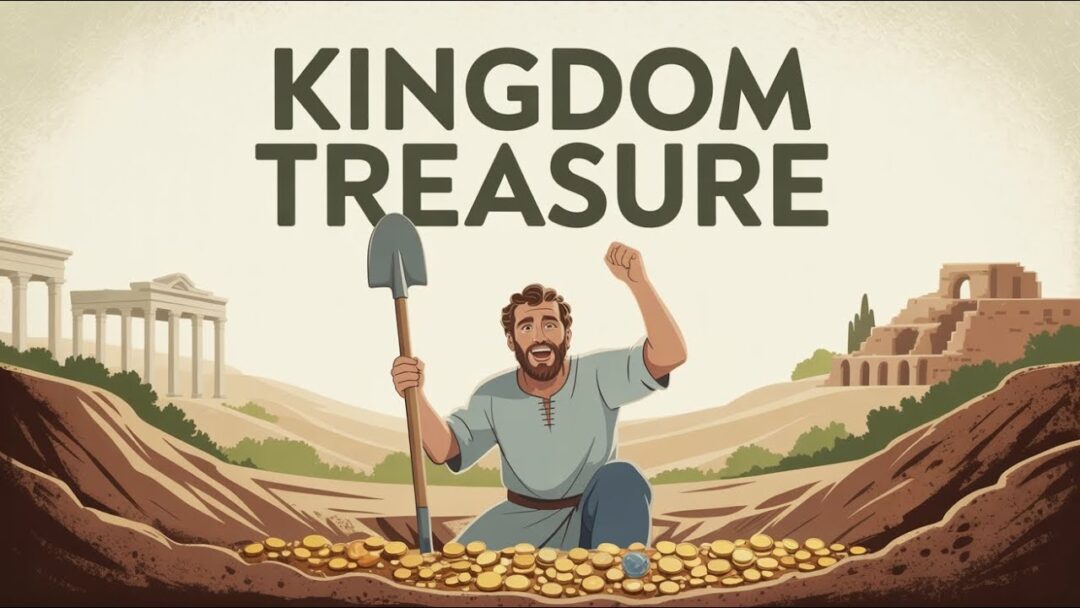
From our Sunday service on August 24, 2025, Luke 12, Luke 16, Matthew 13, and Luke 14. This is part 2 of our Parables of Christ series. Watch the full message: Kingdom Treasure – The Parables of Christ #2 on YouTube.
We’re continuing our series on the parables of Christ, and today’s topic is kingdom treasure. We can really take the parables in any order, but to keep some cohesion I’m grouping together parables that talk about the same topic. Last week we looked at the parable of the sower, which tells us how the gospel is spread. This week we’re going to talk about the value of the gospel and the kingdom in our lives.
Through these parables, Jesus encourages us to avoid the mistake of misplaced investment. First we’ll look at the dangers of misplaced investment through the parable of the rich fool and the rich man and Lazarus. Then we’ll look at the value of the kingdom through the parables of the hidden treasure and the pearl of great price. We’ll conclude with the parables of the tower builder and the warring king.
God wants you to forsake everything for his kingdom.
The Rich Fool
For context, Jesus is in the middle of a sermon on the leaven of the Pharisees. He’s warning that their false teachings will poison your walk with God. In the middle of this sermon, a man interrupts to bring up a personal matter.
And one of the company said unto him, Master, speak to my brother, that he divide the inheritance with me. And he said unto him, Man, who made me a judge or a divider over you? And he said unto them, Take heed, and beware of covetousness: for a man’s life consisteth not in the abundance of the things which he possesseth.
Luke 12:13–15
This is a very abnormal situation. Jesus is teaching the importance of pure doctrine, and a man steps in and says, in effect, “Tell my brother to split the inheritance with me fairly. I’m getting cheated. You’re a moral teacher, so tell him he’s a sinner.” The man assumes that because Jesus teaches righteousness, he would be happy to rebuke his brother. We can understand how he got there. A lot of us, if we met Jesus, might have done the same thing: “So and so did this to me. Can you talk to them? Everybody respects you, and I know I’m in the right.” But from an unbiased perspective we have to ask, what are you doing? You just interrupted Jesus’s teaching to ask him to deal with something personal. Healing may be part of Jesus’s ministry, but this is a legal dispute. The man expected a positive response, and instead he got a very firm rebuke.
Notice that in verse 4 Jesus called the people he was talking with “my friends.” But when this man starts making Jesus’s kingdom about personal matters, Jesus doesn’t say “my friend.” He says, “Man.” He immediately distances himself from the man’s attitude. In modern terms, “Who made me a civil judge or a probate lawyer? Do I look like the government to you? This is a job for the courts, not for my ministry.” Then he turns to the crowd and says, “Take heed, and beware of covetousness.” In other words, look closely and watch out, and don’t be like this man. You go to Jesus for help and he rebukes you in front of dozens, if not hundreds, of people. Why? Because this man has covetousness. He wants what his brother has, and he has decided in his heart that the value of life comes from possessing things.
You might ask, did the man have a right to the inheritance? Almost certainly yes. The firstborn son got a double portion of his father’s inheritance, and whatever was left was split evenly among the other sons. So you might ask, why didn’t Jesus help him? Didn’t Jesus give the law to Moses? Why wouldn’t he want it enforced? The answer is that this was not his role. The man needed to go to the judges assigned by Israel’s government. Jesus’s role was spiritual teacher and Savior, not lawyer. The truth about ministry is that you cannot mix it with law, politics or business without compromising your ability to minister. If a pastor endorsed a business and something went wrong, people would be mad at him, and it would hamper his ability to minister to them. If he stood up and endorsed a political candidate, half the church would be for it and the other half would say, “I hate this guy now.” Ministry like Jesus’s cannot be combined with those things without compromising what God called you to do. That’s why Jesus rebukes the man, and in response he gives a parable.
And he spake a parable unto them, saying, The ground of a certain rich man brought forth plentifully: And he thought within himself, saying, What shall I do, because I have no room where to bestow my fruits? And he said, This will I do: I will pull down my barns, and build greater; and there will I bestow all my fruits and my goods. And I will say to my soul, Soul, thou hast much goods laid up for many years; take thine ease, eat, drink, and be merry. But God said unto him, Thou fool, this night thy soul shall be required of thee: then whose shall those things be, which thou hast provided? So is he that layeth up treasure for himself, and is not rich toward God.
Luke 12:16–21
Here is a rich fool, a farmer whose harvest this year unexpectedly came in at multiple times what he expected, probably several years’ worth of wheat or grain in one season. His barns aren’t big enough. Instead of using the opportunity to minister to other people, he decides to tear down his barns, build bigger and better ones, store all the produce for the next five to ten years, and take it easy. To our human minds this seems pretty normal. He had a very productive yield and a problem of what to do with it, and he decided to maximize his profits.
Note how many times he says “my” and “I.” “I have no room where to bestow my fruits.” “There will I bestow all my fruits and my goods.” “I will say to my soul.” Everything in this story is about how he can benefit himself the most. He feels he deserves all the blessings of the yield: “It’s my field. It’s my grain.” But his field produced ten times more though he put in no more work. He hoards it all. He doesn’t give extra to his workers or to the poor who are starving, and he doesn’t lower his prices to move the excess. He uses the excess to make himself richer and do less work. If he will do nothing, what will his employees do? Are there still people starving in his city? He closes the opportunity God gave him to minister to others in order to minister to himself.
God calls him a fool and takes his life, saying, “Then whose shall those things be?” You can hoard for yourself all your life, saying “for me, for me, for me,” but at the end it won’t be yours anymore. It goes to somebody else against your will. Will a wise man use it for good, or a foolish man waste it? Jesus says, “So is he that layeth up treasure for himself, and is not rich toward God.” If we prioritize our comfort over ministry, God looks at us from heaven and says, “That person is poor.” You’ve seen someone on the side of the road suffering from addiction, and it breaks your heart. God sees us the same way when we hoard up all the blessings he’s given us. We’re poor, broken and addicted to wealth, wasting our lives.
The Rich Man and Lazarus
In Luke 16, verses 19 to 31, we have another illustration of the same situation.
There was a certain rich man, which was clothed in purple and fine linen, and fared sumptuously every day: And there was a certain beggar named Lazarus, which was laid at his gate, full of sores, And desiring to be fed with the crumbs which fell from the rich man’s table: moreover the dogs came and licked his sores. And it came to pass, that the beggar died, and was carried by the angels into Abraham’s bosom: the rich man also died, and was buried;
Luke 16:19–22
“Fared sumptuously” means he lived luxuriously every day. He had more than he could ever need, and anything he wanted he could have. He had both everything he needed and everything he could ever want. But Lazarus sat outside his gate. Not only did he have a fancy home, he had a gate to keep people out. He didn’t need a gate, but he was so afraid of losing what he had that he put one there so that nobody would come to what was his. And Lazarus didn’t ask for money or for a meal. He asked for the table scraps, the leftovers the rich man was going to throw out. From the context it’s implied the rich man said no. We’re not told why. Maybe he wanted Lazarus to go somewhere else so he wouldn’t have to look at him. Maybe he thought that if he started feeding him, Lazarus wouldn’t leave. Maybe he thought Lazarus hadn’t worked hard enough to deserve it. We’re not told. But he decided he’d rather throw the food away than help him. And both of them die. This was something that probably could have been avoided by one simple act of the rich man. We’re not told whether Lazarus died of sickness or starvation, but if he’d had food, he probably would have lived longer. The rich man, who could have fed or sheltered him, dies himself.
And in hell he lift up his eyes, being in torments, and seeth Abraham afar off, and Lazarus in his bosom. And he cried and said, Father Abraham, have mercy on me, and send Lazarus, that he may dip the tip of his finger in water, and cool my tongue; for I am tormented in this flame.
Luke 16:23–24
The Greek word used here is Hades, which should be understood as the Hebrew Sheol, the abode of the dead before the resurrection of Jesus. Before Jesus died on the cross, nobody could make it to heaven, so everybody went to Sheol, the grave or underworld. Those destined for salvation were in one spot and those destined for eternal punishment in another. Lazarus is in the good spot, and the rich man is in the bad spot. The rich man asks Abraham for a simple thing, some water to cool his tongue. Why Abraham and not God? Jesus hasn’t died on the cross yet, and the bridge hasn’t been made yet. So the best option he has is Abraham, the father of the Israelite people. But Abraham has no power to do anything here. He’s not God. There’s a division between them, and nobody on one side can help the other.
Abraham reminds the rich man that all his life he lived in comfort and Lazarus in suffering, and now Lazarus is comforted and the rich man suffers. Abraham is hinting that the rich man let this man die on his porch because he wouldn’t give him leftover food he was going to throw away.
Then he said, I pray thee therefore, father, that thou wouldest send him to my father’s house: For I have five brethren; that he may testify unto them, lest they also come into this place of torment. Abraham saith unto him, They have Moses and the prophets; let them hear them. And he said, Nay, father Abraham: but if one went unto them from the dead, they will repent. And he said unto him, If they hear not Moses and the prophets, neither will they be persuaded, though one rose from the dead.
Luke 16:27–31
The rich man realizes he’s where he belongs, but his brothers haven’t died yet. Abraham can’t send Lazarus back from the dead. Only God can raise the dead. But Abraham reminds him that they had the Scriptures, preached in the synagogues of their city, telling them to love their neighbor as themselves. They had the law of Moses and the prophets’ rebuke to Israel in the past when they despised the poor. They knew Israel went into exile over this, and still they did it. If Lazarus were sent back from the dead, the brothers would make the same excuses. If the teachings of God don’t convince you to do right, nothing else will. Scripture is clear about how to treat your neighbor, and there are multiple books of the Bible dedicated to helping people see how they should treat the less fortunate. And the rich man completely missed the point. Those are our two parables of warning.
The Hidden Treasure
Now let’s look at the value of the kingdom, in Matthew 13:44 to 46.
Again, the kingdom of heaven is like unto treasure hid in a field; the which when a man hath found, he hideth, and for joy thereof goeth and selleth all that he hath, and buyeth that field.
Matthew 13:44
This parable is very short, one line. A man is digging in a field. We’re not told why. While digging he finds a buried treasure. This isn’t pirate treasure. The historian Josephus records that during the Roman wars, people often buried all their possessions to protect them from the invading Romans. Anything outside the walls of Jerusalem was fair game for the invaders to loot, so when people heard the Romans were on their way, they would dig a hole, bury their valuables, and keep the army from stealing them. Sometimes people forgot where they had buried everything, or died in the war, and their valuables were lost, so it became fairly common for someone to dig up a lost treasure in his field. There was a debate over who it belonged to: the family line of the person who buried it, or the person who bought the land. The religious leaders looked at the Torah and decided that whoever owns the land owns the treasure.
That is the situation here. A man digs up one of these treasure troves, someone’s life savings, worth millions of dollars in today’s money. He thinks, “This will set me up for life, but it’s not mine.” So he hides it, and for joy goes and sells all that he has and buys the field. Land in Israel is expensive, but he knows what’s in the field is more valuable than everything he owns. He sells his property, his home, his donkeys, everything that gives him sustenance. Is that a dumb decision, to sell everything you have to get more than you have? No. It would be completely foolish for him not to take the opportunity to buy this field. We’re talking about immeasurable generational wealth that could sustain his family for ten generations. That’s why the kingdom of heaven is like this treasure. If you want to be a part of the kingdom, it should be a joy to surrender everything to Jesus so you can gain something greater.
The Pearl of Great Price
Again, the kingdom of heaven is like unto a merchant man, seeking goodly pearls: Who, when he had found one pearl of great price, went and sold all that he had, and bought it.
Matthew 13:45–46
A merchant is looking for pearls for his business. In the first century, pearls were among the most valuable things you could buy and sell. To get them, divers had to go down without diving gear to a depth of about forty feet, using only a rock to weigh them down and a rope to pull them up, and grab oysters off the sea floor by hand. There was major loss of life in this business, and every dive doesn’t turn up an oyster with a pearl. So pearls were very expensive.
How much were they worth? Pliny the Elder gives the price of one pearl, the largest in the world at the time, as 58.6 tons of silver. At today’s silver value that’s about $71.5 million, or in Roman wages about 15 million days of work for a single pearl. Suetonius records that Julius Caesar gave a pearl to his favorite mistress that was valued at 5.86 tons of silver, about $7.15 million today, or 150,000 days of Roman wages. That’s the lower end of the pearl market. So a pearl went anywhere from millions of dollars into the tens of millions. When the merchant found a pearl of great price, he sold all that he had and bought it, because the pearl was worth more than all he had.
The application is that the value of the gospel and the kingdom of heaven is incomprehensible. It goes far beyond the value of any earthly item. Have any of us seen $7 million in our life? I haven’t. But if you were given the opportunity to make $7 million in a day, wouldn’t you take it? Jesus says, “I’m offering you something of incomprehensible value, a place in my kingdom. Wouldn’t you be willing to sacrifice everything for it?”
Counting the Cost
Now let’s go to Luke 14 and look at Jesus’s call to his followers, starting in verse 25.
And there went great multitudes with him: and he turned, and said unto them, If any man come to me, and hate not his father, and mother, and wife, and children, and brethren, and sisters, yea, and his own life also, he cannot be my disciple. And whosoever doth not bear his cross, and come after me, cannot be my disciple.
Luke 14:25–27
Here Jesus is giving the context for his next parables. He turns to the people following him half-heartedly and tells them what it truly means to follow him, and it’s strong: hate your family and your own life. We need to understand that this word “hate” is used in the Hebrew sense, not the Greek or English sense. In Hebrew, love and hate were often used idiomatically to mean “preferred” and “less preferred.” So it’s not saying you must literally despise your family. It’s saying you must love them less than Jesus. If you prioritize any of these things over Christ, you can’t truly follow him as a disciple, and your walk with God will end because of your preference for someone else.
Jesus gives two parables of what this looks like. First, the tower builder.
For which of you, intending to build a tower, sitteth not down first, and counteth the cost, whether he have sufficient to finish it? Lest haply, after he hath laid the foundation, and is not able to finish it, all that behold it begin to mock him, Saying, This man began to build, and was not able to finish.
Luke 14:28–30
If you’re building a new house, of course you’ll sit down first and look at your finances to see whether you have enough in the bank, or can get a loan big enough, to finish it. You wouldn’t build the foundation and then check whether you have money for the walls. Everyone would make fun of you. Jesus is saying, if you do this in your physical life, why not in your spiritual life? There were people following him, being yes men to his ministry, who said, “I love Jesus. I want to be part of Jesus,” but they hadn’t sat down and counted the cost. Jesus was preparing to enter Jerusalem and offer himself on the cross. He was saying, “You don’t understand what it’s like to be part of this kingdom. It’s not all sunflowers, roses and sunshine. I’m going to die on a cross, and if you can’t pick up the cross and follow me, there’s no point in you following me.”
A lot of people want to walk with God, say “I want to be a Christian,” and then see the expense of it and say, “I don’t want to invest in that.” They see the pearl of great price, “Wow, that’s a pretty pearl,” and the treasure buried in the field, “That’s a lot of money.” But they have things in their life they aren’t willing to surrender to Christ. And Christ says, “If you can’t say you love all those other things less than me, you can’t be my disciple. I can’t use you unless you put me first. There’s no point pretending to be a follower of Jesus if you’re not willing to make the sacrifice.”
The second illustration is the warring king.
Or what king, going to make war against another king, sitteth not down first, and consulteth whether he be able with ten thousand to meet him that cometh against him with twenty thousand? Or else, while the other is yet a great way off, he sendeth an ambassage, and desireth conditions of peace. So likewise, whosoever he be of you that forsaketh not all that he hath, he cannot be my disciple.
Luke 14:31–33
This king is in a tough situation. An army of 20,000 is coming against his city of 10,000 soldiers. Whether he likes it or not, that army is coming to his doorstep, and he’ll have to decide whether he has the strength to stand against it. Will each soldier take down two? Probably not. These are not great odds. We aren’t supposed to be rooting for a war. Jesus says the king has two options: go to war and hope to overcome insurmountable odds, or meet the other king on the road before the invasion comes, surrender and save lives. Waste human life in a meaningless defense, or surrender and save life.
Do you see the picture? One day the eternal King, King Jesus, is coming to your city with an army bigger than any other. You have two choices. Do you fight against insurmountable odds and say, “I can get to heaven on my own”? Or do you surrender to the King before the day of judgment and say, “I will yield to you and become your servant”? Jesus will return. Will you war, or will you surrender all?
Do Not Fear
That sounds pretty devastating, so let’s wrap up with one more passage, Luke 12:29 to 34. Jesus assures us that although we need to surrender to the King, that’s not a bad thing.
And seek not ye what ye shall eat, or what ye shall drink, neither be ye of doubtful mind. For all these things do the nations of the world seek after: and your Father knoweth that ye have need of these things. But rather seek ye the kingdom of God; and all these things shall be added unto you. Fear not, little flock; for it is your Father’s good pleasure to give you the kingdom. Sell that ye have, and give alms; provide yourselves bags which wax not old, a treasure in the heavens that faileth not, where no thief approacheth, neither moth corrupteth. For where your treasure is, there will your heart be also.
Luke 12:29–34
He calls you to surrender not just some, but all. But Jesus doesn’t say that surrendering all leaves us with nothing. He says, “Fear not, little flock,” little sheep. It’s the Father’s good pleasure to give you the kingdom if you surrender everything to God. If you stop hoarding for yourself like the foolish rich men in the parables, and choose to surrender to God and use what you have for his kingdom, he says, “I will take care of every need you ever have.” There may be a day of judgment and a difficult choice: I’m going to leave everything I have, sell everything I have, and buy something of greater value. But the people who bought the buried treasure or the pearl didn’t lose anything in the end. They made the choice to surrender in the short term for the long-term benefit. We have to surrender the priority of our wealth, our family, our friends and ourselves if we want to be a true disciple of Jesus.
Where Is Your Treasure?
Today we’ve seen Jesus warn us about the dangers of misplaced investment through the parable of the rich fool and the rich man and Lazarus. Both men lived for themselves, storing up treasure on the earth, but entered eternity empty-handed. Their wealth could not save them, and their self-centeredness revealed that their hearts were far from God.
In contrast, Jesus shows us the value of the kingdom through the hidden treasure and the pearl of great price. The kingdom of God is so precious that any sacrifice is worth it. To cling to earthly wealth or reject the eternal treasure of Christ is the greatest mistake we can make. Finally, Jesus calls his disciples to consider the cost of following him through the tower builder and the warring king. To follow Jesus means forsaking everything, including our possessions, our pride and even our own lives. But this is not a loss, because when we surrender everything to Jesus, we gain a treasure that cannot be stolen, corrupted or lost, and our God will ensure that all our needs are met.
So the question today is simple: where is your treasure? If it’s in this world, it will pass away. If it’s in Christ, it will last forever. God wants you to forsake everything for his kingdom, because what you gain in him is infinitely greater than anything you could ever lose. Will you choose to forsake everything today?

Recent Comments