
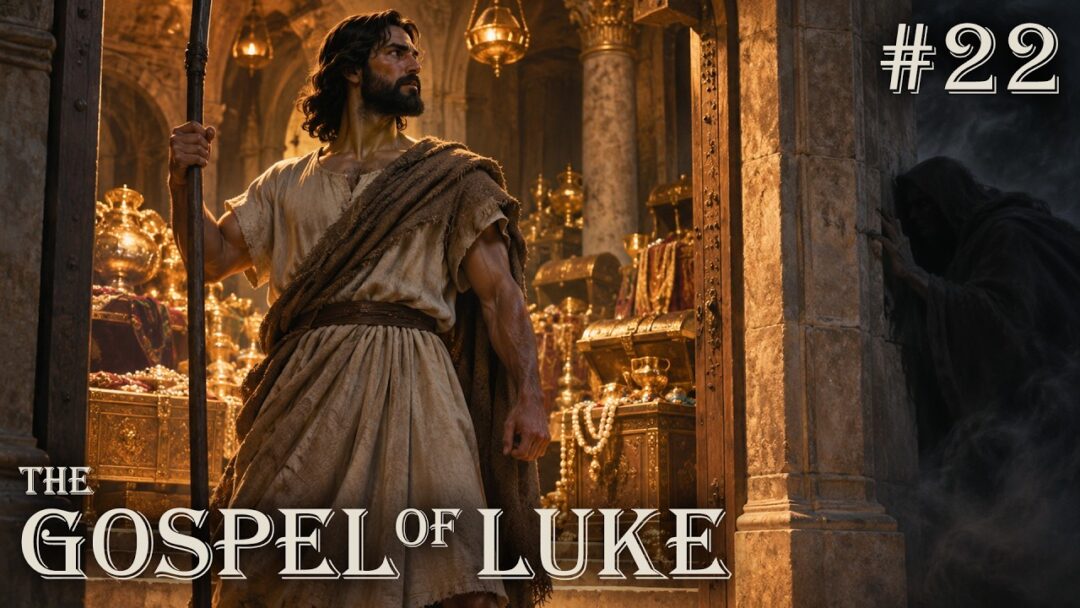
From our Sunday service on November 1, 2026, Luke 11:14-36. This is part 22 of our Gospel of Luke series. Watch the full message: No Neutral Ground – The Gospel of Luke #22 on YouTube.
We’re continuing our series in Luke, in Luke chapter 11 starting in verse 14. Last week, we looked at three pillars of faithful discipleship as we saw Jesus interact with a lawyer, with Mary and Martha, and with his disciples. From that, we learned that there are three really important steps to your Christian walk.
Today we’re picking up from that story as Jesus continues his ministry. As he travels town to town, he is interrupted by a man after casting out a demon. And from our time in Scripture today, here is what God wants you to know:
God wants you to embrace his light and walk in his truth.
A Miracle Interrupted
We pick up in verses 14 through 16, where Jesus is interrupted.
And he was casting out a devil, and it was dumb. And it came to pass, when the devil was gone out, the dumb spake; and the people wondered. But some of them said, He casteth out devils through Beelzebub the chief of the devils. And others, tempting him, sought of him a sign from heaven.
Luke 11:14–16
This is the context that brings up the main topic of today’s lesson. As Jesus had always done, he travels town to town healing the sick and casting out demons. In this case, we’re introduced to a man who is possessed by a demon that makes him unable to speak. He is dumb. That’s not talking about his intelligence, like the modern use of the word, but the ancient, more proper use of the word: the man is unable to speak. This demon has taken control of him and removed his ability to use his vocal cords. The account in Matthew also tells us that this demon made him blind.
So this man is in a very difficult state. I can’t imagine how horrible it would be to be both mute and blind. The needs you would have, and the inability to communicate them, must have been horribly frustrating. So you would think that with this situation resolved, everyone would celebrate: “Wow, look at what Jesus has done for this man. He was unable to speak, unable to see, and his whole life was misery, and what was once horrible, Christ has transformed into something beautiful again.”
But that’s not what happens. A man steps forward and says, “This man is not doing miracles through the power of God. He’s doing them through Beelzebub.” Why would he do that? That seems like a strange position to take. Matthew tells us it was in fact a Pharisee who said this. This Pharisee, or teacher of the law, depending on how you want to look at it, says, “It’s impossible that this man is doing things for the glory of God, because he contradicts the way I teach.” He thought the way he taught was the right way. Because Jesus’ teachings contradicted it, he reasoned, “This man must not be doing things in the power of God, because I do things in the power of God. And since this challenges my authority, I must reject it.”
The Lord of the Flies
So who is Beelzebub? Baal-zebub, as it is in the Hebrew, means literally “the lord of the flies.” It comes from the title of a Philistine god of the city of Ekron. In Old Testament times, when the Philistines were around the land of Israel worshiping this lord in Ekron, they referred to him as Baal-zebul, the lord of heaven. But the Hebrews wanted to make a pun there, and “lord of the flies” was very similar: take that L and change it to a B, and now it’s Baal-zebub, lord of the flies.
The flies there were meant to insinuate the flies that eat dung. We can see the insult to the Philistine god: “Your god is the god of eating dung.” So to say someone is doing things in the power of the lord of the flies is to insinuate that he is doing them through the power of the god of excrement. And it’s not as nice as that; they would use harsher words than that. In modern English, you’d probably say it’s a bunch of bull. The words the Pharisee uses here are very vulgar, meant to be extremely insulting and demeaning: “This guy isn’t doing miracles through the power of God. He’s doing it through the god of excrement. That’s how little I think of him.” He demeans Christ, he rejects Christ, and he insults him to his face.
Three Groups in the Crowd
We’re told that not everyone joined in on this insult. Verse 16 says, “And others, tempting him, sought of him a sign from heaven.” Not everybody is responding the same way. I’m sure there was also a third party: those who saw this and praised God that the man was healed. Then you have the Pharisees, who said, “This man is full of nothing. He’s not doing anything he says he is. He’s actually working for Satan.” And then you have the group that says, “I’m not sure where I land. Can you give us a test? Can you prove to us through a miracle of some sort that this is actually the God of heaven doing these miracles?”
So we have people who are for Jesus, people who are against Jesus, and people on the sideline. And as we look at this lesson today, we’re going to see Jesus say, “You can’t be on the sideline with me. Either you are for me, or you are against me.”
A Kingdom Divided
We see Jesus’ first response in verses 17 through 20.
But he, knowing their thoughts, said unto them, Every kingdom divided against itself is brought to desolation; and a house divided against a house falleth. If Satan also be divided against himself, how shall his kingdom stand? because ye say that I cast out devils through Beelzebub. And if I by Beelzebub cast out devils, by whom do your sons cast them out? therefore shall they be your judges. But if I with the finger of God cast out devils, no doubt the kingdom of God is come upon you.
Luke 11:17–20
Jesus just lays the facts down in front of them. It’s impossible for a kingdom that opposes itself to stand. If Satan were fighting Satan, how would Satan get anything done?
A Nation and a Household Divided
A kingdom divided against itself cannot stand. That’s an important reminder for us today. It’s election season; it’s time to go out there and vote. You can’t have two sides fighting each other constantly and expect that kingdom to have success. It’s only when they have unity and work together that the kingdom can survive.
But Jesus also extends another lesson for us: even in a household, this rule applies. If you and your family are divided, you’re not going to be able to stand. If one family member splits from another and says, “I can’t talk to you. I can’t negotiate with you. I can’t relate with you. I don’t want to be around you,” guess what? That household will not stand. It’s going to be split apart, and that relationship is going to be completely destroyed.
So if we have division in a household, it’s important that we take care of it, because if our families are divided, they’re not going to stay together, and God’s not going to be glorified in it. We need to mend things in our nation, and we need to mend things in our households, because a nation or a household divided cannot stand on its own. I don’t think any of us want that in our lives, in either our nation or our house.
Jesus uses this as an illustration to say, “I can’t be satanic here. Satan doesn’t fight Satan. Satan helps Satan.” If Satan were dividing his kingdom against himself, his kingdom would quickly come to ruin, because nothing could be accomplished.
He Knew Their Thoughts
What’s interesting here is that nobody had to tell Jesus this. Verse 17 says, “But he, knowing their thoughts, said unto them.” They never said it to Jesus. Mark tells us that he calls them to him while they’re thinking it: “Come over here. I have something to say to you.”
Wouldn’t that be scary if that could happen today? Imagine being in high school or college, and your teacher can read your mind and calls you up to the front of the class. That’s exactly what Jesus does here: “You think Satan can oppose Satan? Come to the front of the class, in front of this crowd.” The passage tells us it hasn’t grown into a huge crowd yet, but there’s at least a significant number of people. “Come here. I want to talk to you about something.”
By Whom Do Your Sons Cast Them Out?
In verse 19, he confronts them directly: “And if I by Beelzebub cast out devils, by whom do your sons cast them out? therefore shall they be your judges.” The Pharisees had trained their sons in exorcism. It was very common in that day for Pharisees and priests to go and cast out demons. So Jesus says, “If the religious leaders in Jerusalem and Judea can cast out demons, and I’m casting them out through the power of Satan, then what are your sons doing? When your sons cast out demons, you praise them and say, ‘I’m so proud of you for representing the power of God.’ But I come here and do the same thing, and suddenly I’m the enemy because I don’t agree with the way you teach. You hold me to a higher standard than you hold yourselves. You can’t have it both ways. Your sons can’t be doing what’s right and me doing what’s wrong when we’re doing the same thing.”
Then verse 20: “But if I with the finger of God cast out devils, no doubt the kingdom of God is come upon you.” In other words: “You can’t just deny what you see and make an excuse. You know well and good what is happening right now. You know I have the finger of God, because when your sons do it, you praise them. It’s not what I’m doing that you disagree with. It’s me you disagree with. And you don’t want to admit that I have the power of God on my side to back up the claims I’m making.”
And so these people say, “Can you give us a sign? Can you give us a sign?” And Jesus says, “I’ve already given you a sign, and you’re rejecting it. I’ve given you the truth, and you’re not holding on to it.”
The Strong Man
To drive this point home a little more, Jesus gives an illustration in verses 21 through 23. He wants them to understand that what they’re saying makes no sense, and unless they change their ways, they too are in danger. He begins in verses 21 and 22:
When a strong man armed keepeth his palace, his goods are in peace: But when a stronger than he shall come upon him, and overcome him, he taketh from him all his armour wherein he trusted, and divideth his spoils.
Luke 11:21–22
Here Jesus starts talking about demonic possession and the power of God that drives out demons, and he begins by comparing Satan holding a man to a strong man defending a house. “When a strong man armed keepeth his palace, his goods are in peace.”
Imagine the strongest man you know or have ever seen. Imagine those men in the bodybuilding competitions who can lift hundreds of pounds. Now, if he lived in an apartment, and you knew where he was, and he had a golden trophy sitting there, would you, as a normal person, go to his house on your own and try to steal his golden trophy? How many of you would say, “I’d go”? No. If a man who can lift 600 pounds lives in the house and has a golden trophy, guess what? You are not stealing his trophy. That’s what Jesus is saying. If you want to take from the strong man, you’ve got to be stronger than the strong man.
The strong man here is Satan. Satan, or one of his demons, has possessed a man. He’s moved into this palace, and he’s protecting it. So how do you get the strong man out of the palace? How do you get a demon to flee, especially one that made the man blind and mute?
Someone Stronger Than Satan
Verse 22: “But when a stronger than he shall come upon him, and overcome him, he taketh from him all his armour wherein he trusted, and divideth his spoils.” If the strong man is Satan, who is stronger than Satan? That’s Jesus. That’s the Holy Spirit. That’s God, the Godhead. If you want to cast out Satan, you need somebody stronger than Satan. And when somebody stronger than Satan comes, guess what? He overcomes him, and he takes from him all his armor wherein he trusted, and divides his spoils. All those things Satan used to have control over that person are no longer there. When Jesus comes in victory, he removes the power Satan has.
Then the question is, what is the source of Satan’s strength? What is it that’s taken away? If you look at all the times in the Bible Christ talks about victory, what does he say he has victory over? “I have the keys of hell and of death.” Jesus takes victory over death. That’s the thing Satan uses to have power over us: death. “We need to live it up now. We’ve got to live in the moment. We don’t know how long our lives will be.” Satan uses that fear of death to drive us to live in stupid, idiotic, self-destructive ways.
Jesus says, “When I come as the stronger man, I will cast out Satan. I will take away the things that give Satan power over you. Those keys to death and hell, I’m taking them. Satan’s not getting back in. The power he had to convince you to live in his evil, wicked ways is gone.” And guess what? Satan is not coming back, because someone stronger is there. When you see that 600-pound man, you’re not going to go mess with him. Satan sees me and says, “Uh-uh. I’m not going back into that house, because the Spirit of God now lives there.”
No Neutral Ground
Jesus gives this illustration, and then he gives them a warning in verse 23.
He that is not with me is against me: and he that gathereth not with me scattereth.
Luke 11:23
Here Jesus directly confronts them about the stance they have taken. He gives a clear warning to this crowd who is unsure about him and asking for a sign: “If you are not for me, that leaves only one other option. You are against me. Your unwillingness to believe in me is actively a force that fights against me. You cannot sit on the sidelines of this battle.” Dead weight is the ammo the enemy of God uses.
These people who doubted were diminishing Christ’s ability to minister. Their doubt was a stumbling block for other people who would come to see Jesus. When you’re undecided on Jesus, you become a stumbling block for others. You can’t be neutral. You can’t say, “I don’t know if I’m sure about this Jesus.” If you’re unsure, guess what? You’re on the side of the enemy. There is no middle ground. Either you are for Jesus or you are against Jesus. Either you believe him or you do not. There is no sitting on the sidelines.
The Pharisee and his friends claimed that Jesus worked for Satan. But Jesus warns them, “No, it’s you who side with the enemy. Because of your lack of faith, his power here remains.”
No Bleachers
Imagine what would have happened if the Pharisees had professed faith in Jesus openly. We’re told that some of the Pharisees believed in Jesus, but they were cowardly about it; they followed him secretly. How much would the ministry of Jesus have been transformed if the Pharisees had come right out and said Jesus was the Messiah, if the religious leaders had embraced him? That would have been a whole different story.
But they didn’t. They were too afraid of losing their power. They sat on the sidelines saying, “I’m not going to participate in the Jesus movement. I don’t want to be seen as a lunatic who has lost the traditional way of doing things. I don’t want to be an outcast in my society by following this wilderness preacher from who knows where. What was that, Nazareth, he said?” They didn’t like the idea of being seen as crazy people in the world. So they said, “I’m not going to go all out. I’ll follow Jesus from the sidelines.”
And Jesus says, “No. There are no bleachers of fans of Jesus. You can’t sit in the bleachers and say you’re on the team.” We like to do that when we watch sports on TV: “My team won this week.” Guess what? If you’re watching Jesus on TV, you’re not a follower. You’re not in the game. You’re on the sidelines. Jesus says, “You can’t be on the sidelines with me. You’ve got to be sold out for me and fully devoted to me, or you’re just dead weight that gives the enemy power to take my ground.”
The Unclean Spirit’s Journey
Jesus continues with an example of an unclean spirit’s journey. Here we get a slight insight into the unseen realm of the spirit world, in verses 24 through 26.
When the unclean spirit is gone out of a man, he walketh through dry places, seeking rest; and finding none, he saith, I will return unto my house whence I came out. And when he cometh, he findeth it swept and garnished. Then goeth he, and taketh to him seven other spirits more wicked than himself; and they enter in, and dwell there: and the last state of that man is worse than the first.
Luke 11:24–26
This is a sneak peek into demonic activity that we just can’t see as humans. We don’t see how this happens, but Jesus, being God, understands very well what demons do and how they work.
The first thing we’re told, in verse 24, is that when a demon is made to leave the person it possesses, it will wander around looking for another home. If you cast out a demon, it’s going to go out and try to find some other sucker to latch on to and influence. If it doesn’t find somebody it likes better, it keeps wandering, looking for another home.
In the meantime, the person who had the demon cast out will probably start to get his life in order. He doesn’t have the demon’s influence anymore. He’s going to start improving. His life is going to look better, and he’s going to feel better. That’s the idea of the house being swept and garnished. His spirits are going to be up. He’s going to be more positive. He’s going to have more energy.
But if that demon doesn’t find a better host, guess what? It’s going to come back. And when it comes back, it’s going to find that the man’s life has gotten a little bit better. The demon will say, “This place was a mess when I left, and now it’s nicer.” So he returns, and instead of the man’s situation being better, it gets worse.
The Root Problem
It’s not enough to just cast out the demon, because that leaves an empty void in a person’s life, a void that only God can fill. This is why we feel so empty without Christ: we’re missing this part of our existence as human beings. And demons come into that void and try to take control of it. So you can cast out a demon, but if you don’t deal with the root issue of not having God, it’s going to come back: “Okay, this person is more set, more prepared, more ready to go. Let’s go for round two.”
Read verses 25 and 26 again: “And when he cometh, he findeth it swept and garnished. Then goeth he, and taketh to him seven other spirits more wicked than himself; and they enter in, and dwell there: and the last state of that man is worse than the first.” The truth is, if they cast out a demon, it’s only a temporary fix. If that person gets his life in order and gets back to normal, but doesn’t deal with the root cause of not having God in his life, of not being saved, that demon will return. He’ll find the house better and say, “Let me bring some friends.”
We know what that looks like. We’ve seen the story of Legion and the 2,000-plus demons that lived in him. Even if those Pharisees had cast the demons out of Legion, they could never fix the root cause of his needing God in his life.
See how this ties in with the parable of the strong man. The palace is the person, his soul and his body. The strong man lived there. He was cast out, and the palace was cleaned and made nice. After a while, the house was just sitting empty, but it was ready. So the strong man returned, and when he took the home back, he fortified it and brought more defenses. Now you’ve got a strong man plus friends. You’ve got strong men, and now this palace is even harder to break into. It becomes harder and harder as people harden their hearts to the gospel and give up every opportunity.
The only way that house is going to be secured is if the strongest one enters, and the strongest one is God himself, the Holy Spirit. That’s why demons have no power over the born-again believer. When we are baptized in the Holy Spirit, he indwells us and protects us from these forces. But those in the world are not this way.
Jesus is telling them, “If you don’t deal with the root problem that you need me for, guess what? Things are only going to get worse. You have to be on my side.” It’s not enough to clean up the outside. Jesus calls them whitewashed sepulchres. It’s not enough to be clean on the outside. “You need a strong man inside your heart to protect you. You need me.”
Your religious traditions, your routines, and your mental wellness practices are not going to protect you when Satan comes knocking on your door. I’m sorry, but they won’t. The only thing that can protect you is the power of God. You need the Holy Spirit. You need the strong man to keep the demons out.
More Blessed Than His Mother
As Jesus preaches this, a woman chimes in, in verses 27 and 28.
And it came to pass, as he spake these things, a certain woman of the company lifted up her voice, and said unto him, Blessed is the womb that bare thee, and the paps which thou hast sucked. But he said, Yea rather, blessed are they that hear the word of God, and keep it.
Luke 11:27–28
The woman in the audience was happy to hear the strong man analogy. She was happy to hear how God can give victory. She got the idea of the lesson, and she says, “It must have been such a blessing for your mother to have you as a son.”
Jesus knows that this may be a true statement, but it detracts from what he’s trying to say. So what does he say? “Yes, but more importantly, what I’m trying to say here is, blessed are they that hear the word of God, and keep it. You know what’s better than being my mother? Obeying me. These Pharisees have rejected me. They’re not keeping my word. Let’s point back to what we’re talking about here: accepting me, listening to me, being saved through me. Let’s focus on the topic at hand.”
The Sign of Jonah
Then Jesus rebukes the crowd in verses 29 and 30.
And when the people were gathered thick together, he began to say, This is an evil generation: they seek a sign; and there shall no sign be given it, but the sign of Jonas the prophet. For as Jonas was a sign unto the Ninevites, so shall also the Son of man be to this generation.
Luke 11:29–30
As the crowd grew in size, Jesus began to express his dissatisfaction with the people listening. You’ll see this get worse and worse as we approach Jesus’ death on the cross; he’s going to get more and more grieved over the response of the people. The times you see Jesus cry are not because of his own pain and suffering, but because he keeps talking to these people, begging them and begging them to get what he’s saying, and it goes over their heads every single time.
When Lazarus died, Jesus wept. Not because his friend Lazarus died (sure, that was sad), but because he had already told them multiple times that he is the resurrection and the life, and they just didn’t get it. Imagine being the most important person in history, God in the flesh, the Savior of the world, and no one understands who you are. Even the people closest to him: he’s in the garden, dealing with the death on the cross that’s coming, and his disciples fall asleep, because they just don’t get it. His closest friends, his loved ones, like John, the disciple he loved, just don’t get it. At the most important time to stay awake and be with Jesus, they fall asleep.
How Many Times Do I Need to Show You?
So here we see Jesus frustrated with the crowd. He’s telling them the truth. He’s trying to help them and keep them safe from Satan. And all they do is keep missing the point over and over again. In his frustration, he says, “This is an evil generation. They keep seeking a sign. I’ve given you a sign. I just cast out a demon. I’ve done wonderful things in your lives. And time and time again, you come to me and ask, ‘Lord, please show me. Please show me again.’ How many times do I need to show you who I am for you to just believe me?”
Does that hit any of us here today? How many times in our struggles have we gone to God and said, “God, please just show me you’re still here”? How frustrating must it be for God when we do that, when so many times in our lives he has taken care of problem after problem after problem? We thought we were at the end of our rope, and we’re still here. And then we say, “God, please just show me you’re here again.” And he says, “What are you talking about? I’ve been here the whole time. I’ve been helping you every step of the way. I’ve been telling you, and it’s going straight over your head every time. Stop sitting on the sidelines. Follow me. Trust me. Believe me just once.”
Jesus confronts them: “You’re not getting another sign. I already gave it to you. There shall no sign be given but the sign of Jonas.” Matthew tells us Jesus doesn’t just call them evil. He also calls them adulterous: a generation of people who betrayed their God for other things. Whether it was the teachings of the Pharisees, or the comfort of the Roman culture and its gods, whatever it was, they were adulterous in that they stopped following God to go do something else. Their lack of faithfulness and trust in God just did not deserve a sign. Enough evidence had been given.
The Sign of the Resurrection
So Jesus tells them that the only sign they’re going to get is the sign of Jonas, or Jonah. Matthew tells us Jesus also adds this:
For as Jonas was three days and three nights in the whale’s belly; so shall the Son of man be three days and three nights in the heart of the earth.
Matthew 12:40
What Jesus is saying is that the story of Jonah descending into Sheol for three days in the fish’s belly is a representation of the death and resurrection of Jesus Christ. Jonah was in the belly of the whale three days and three nights. He says he descended into hell: “out of the belly of hell cried I, and thou heardest my voice.” Then he was spewed out alive on dry ground three days later. Jesus says he is going to do the same thing. Peter tells us that when Jesus died, he went and preached to the spirits in prison. So Jesus descends into the lower parts of the earth, preaches to the spirits in prison, and then rises from the dead.
We’re told time and time again in the Bible that the purpose of the resurrection was to prove the authenticity of Jesus’ claims. It’s the reason the disciples stopped hiding and started going around the Roman Empire, risking their lives to tell the truth about Jesus. Without the resurrection, the disciples would never have done anything ever again. Why? Because the Bible tells us they were hiding in a room, fearing for their lives. But when Jesus showed up from the dead, boy, did that change things. The resurrection is the evidence that Christianity is the truth. So Jesus says, “You’re going to receive your sign, but only the sign of the resurrection.”
A Greater Than Jonas Is Here
He continues in verses 31 and 32.
The queen of the south shall rise up in the judgment with the men of this generation, and condemn them: for she came from the utmost parts of the earth to hear the wisdom of Solomon; and, behold, a greater than Solomon is here. The men of Nineve shall rise up in the judgment with this generation, and shall condemn it: for they repented at the preaching of Jonas; and, behold, a greater than Jonas is here.
Luke 11:31–32
Matthew puts these in the opposite order, which tells us verse 32 was a response to his talking about the sign of Jonah. “You’re going to get the sign of Jonah. You’re going to see the resurrection, and that’s going to confirm to you that I really am God, because no one raises himself from the dead. When you see that, you’re going to know it’s the truth. And guess what? Even the people who were alive in Nineveh’s day are going to sit on the judgment seat on God’s side and condemn you on the day of judgment for your lack of belief in me.”
Why? Because Jonah wasn’t even a good preacher, by the way. He preached the bare-minimum sermon you could ever preach. He didn’t explain anything. He just said they were going to be destroyed. Worst message in the world. But even with the worst message in the world, the people of Nineveh responded, repented, and got right with God. And Jesus says, “You Pharisees who are so self-righteous, who are rejecting me, guess what? Those wicked Assyrians who murdered and killed and plundered: when I told them to repent, they repented. And they’ll be on the judgment seat right next to me as witnesses against you. And you’re going to hell because you couldn’t decide whether I was the Messiah or not. Even the people you think are the worst of the worst are going into heaven before you.”
A Greater Than Solomon Is Here
Then he says, “The queen of the south shall rise up in the judgment with the men of this generation.” He’s telling us about the Queen of Sheba in Solomon’s day. She was from a southern kingdom, below Judah, a remote country, and she heard about this wise King Solomon who knew a lot about God. She said, “Solomon knows these great truths about God. I’m going to go to him and inquire about this God.” Jesus tells us here that she got saved. She believed in the God of Israel when Solomon told her about him. And guess what? The Queen of Sheba will sit on the judgment seat, because she went and sought out wisdom from Solomon.
And Jesus says, “Guess what? One who has more wisdom than Solomon is here.” Solomon’s wisdom came from God. And who is Jesus? He’s God. He’s the giver of Solomon’s wisdom. He stands before them preaching the wisdom of God in its fullness, and they don’t even want to hear it. So the Queen of Sheba, too, will judge them in the day of judgment, because they rejected Jesus.
The Light of the Body
In verse 33, Jesus goes back to a parable about a lit candle.
No man, when he hath lighted a candle, putteth it in a secret place, neither under a bushel, but on a candlestick, that they which come in may see the light.
Luke 11:33
This might sound familiar; we heard an illustration like this before. Jesus is once again using the illustration he used with the disciples: his teachings are a light meant to illuminate the world. Here he uses it to say that he has come to teach, not to keep his teachings secret, but so that people will come and hear them and obey them. “I’m not telling you this just to be ignored. I lit the candle. I have enlightened you on these truths, and I’ve come to invite you to see the light.” And what are they doing? They’re rejecting the light. We see that in verses 34 through 36.
The light of the body is the eye: therefore when thine eye is single, thy whole body also is full of light; but when thine eye is evil, thy body also is full of darkness. Take heed therefore that the light which is in thee be not darkness. If thy whole body therefore be full of light, having no part dark, the whole shall be full of light, as when the bright shining of a candle doth give thee light.
Luke 11:34–36
This is very weirdly worded for us in our modern English. We don’t think about the eye the same way the ancient Israelites did. But to break it down: your eyes are what illuminate you to the information in the world around you. If I want to know how many people are here today, I have to use my eyes, look, and count. That’s how I’m illuminated with the knowledge of how many people are around me. I can’t really know that just by hearing. If your eyes are clear, your whole body has the information illuminated. But if you have bad eyes, your whole body will be dark and deprived of that information. A blind person won’t be able to tell you how many people are in a room. He can’t count them unless they’re all talking. So Jesus says, “You need good eyes if you want to get good information.”
Jesus is teaching them, but their spiritual understanding is so darkened that they’re unable to see what is right in front of them. They have bad eyes. The way they look at things has been so distorted by the beliefs they hold that they can’t see clearly what Jesus is saying.
When the Light in You Is Darkness
He tells them, “Take heed therefore that the light which is in thee be not darkness.” They were saying, “Jesus doesn’t have the light. He’s from the synagogue of Satan. We, the Pharisees, have the light.” And Jesus says, “Look again. That self-righteous, legalistic nonsense in you that says you’re good enough to get to heaven on your own, that you’re a good person who needs no repentance: that light in you is not light. That light is darkness. You are darkened by the lie that you are good enough. You’re darkened by the lie that you can sit on the sidelines and still be in favor with God. You are lying to yourselves, and you’re believing your lies as if they were the truth.” And because they believe their lies, when the truth comes to them, they’re never going to be able to listen.
If you are fully blind, even the brightness of the sun is not going to help you see. Jesus is bringing all the light of the truth, all the wisdom of Solomon and more. And yet, even with such a bright light in front of them, their spiritual darkness blinds them, and the stubbornness of their hearts stops them from accepting the truth in front of them.
In verse 35, Jesus says they had mistaken the darkness inside them for light. They thought their teachings illuminated the truth of God’s Word, but in reality what they were preaching was dead works. And when their teachings were incompatible with what Jesus said, they said, “Well, I’m right, and Jesus must be wrong.”
How often today is that why so many people reject Jesus? They think their own moral standards, their own truth, so to speak, is more truthful than what the Bible says: “I disagree with this stance. I disagree with what Jesus says about this. And if it disagrees with me, it must not be true.” Oh, how heartbreaking it is that so many people will miss heaven because they’ve mistaken the darkness inside them for light.
Jesus tells them in verse 36, “If thy whole body therefore be full of light, having no part dark, the whole shall be full of light, as when the bright shining of a candle doth give thee light.” He says, “If you had had the right teachings in you the whole time, even a little light would have fully illuminated you to receive the wholeness of the truth. But because your foundation was corrupt, and you can’t build on a broken foundation, there’s no light for you to see the truth outside you.” And so Jesus gives them this sad condemnation.
Embrace His Light
To tie all these thoughts together: throughout this passage, Jesus confronted people who had seen his miracles and heard his teachings, yet still refused to believe him because what he said disagreed with what they thought. Some even accused him of working for Satan, while others just demanded more evidence that what he said was truly something good. However, their problem wasn’t a lack of light. Their problem was that they refused to accept the light sitting right in front of their eyes. Jesus had a message for them, and they refused to accept it.
Jesus made it clear that there is no neutral ground when it comes to him. Either you are with him, or you are against him. Simply cleaning up your life to make it look better isn’t enough. Being religious isn’t enough. Even hearing God’s Word every week is not enough if you still refuse to accept Christ and obey him. Jesus said in verse 28, “Yea rather, blessed are they that hear the word of God, and keep it.” He’s saying, “That’s what I’m trying to get you to see. Stop being blind to the truth of God’s Word. Live it.” It’s no good to sit by and say, “I like it,” if you don’t play the game.
So the question we need to ask ourselves today is this: What are we doing with the light God has given us? Are we allowing his Word to change the way we think and the way we live? Or are we resisting his truth because it challenges what we already think is right and the way we already live? You cannot remain neutral toward Christ. You must decide what you will do with the truth he has revealed to you in his Word. God wants you to embrace his light and walk in his truth. So will you walk in truth with him today?

Recent Comments