
From our Sunday service on November 15, 2026, Luke 12:4-34. This is part 24 of our Gospel of Luke series. Watch the full message: Fear God Alone – The Gospel of Luke #24 on YouTube.
Today we continue our series in Luke with a very important topic: fearing the Lord and not the things of this world. Last week, Jesus rebuked the Pharisees and the lawyers, both to their faces and in front of the crowds of people that gathered to hear him. Today Jesus continues that same dialogue by telling the people not to fear the Pharisees, their condemnation, or the dangers of their harsh teachings, but instead to stop fearing them and fear God alone. From our time in Scripture today, here is what God wants you to know:
God wants you to know that if you fear him, then you have nothing else to fear.
Fear God Alone
We’ll start in Luke chapter 12, verses 4 and 5, where Jesus says to fear God alone.
And I say unto you my friends, Be not afraid of them that kill the body, and after that have no more that they can do. But I will forewarn you whom ye shall fear: Fear him, which after he hath killed hath power to cast into hell; yea, I say unto you, Fear him.
Luke 12:4–5
Today’s section opens with a very compassionate introduction. Did you notice it? “I say unto you my friends.” Believer, if you have faith in God, then you are a friend of God. Just as Abraham was called a friend of God, you too share in that. Jesus addresses this crowd, but not just anybody in the crowd: not the Pharisees, not the Sadducees, not the religious leaders, but the people who faithfully followed him. And he refers to them lovingly as “my friends.”
Right off the bat, that should give us a lot of comfort. In our relationship with him, God sees us as friends. It’s not a distant relationship. It’s not a far-off relationship. It’s not an unemotional relationship. It is an intimate relationship that we have with our God. He’s not oppressive and vindictive. He is loving and caring, and he is to be our greatest friend. That means today’s lesson is addressed to those who have already placed their faith in Christ, who have already been saved by grace through faith.
In this crowd there were people following Jesus who faced a very real risk of death for their commitment to him. We just saw last week how Jesus was confronted by a Pharisee for not doing things the way the Pharisees said. The people were oppressed by these religious leaders, because the religious leaders weren’t just going to tell you to follow their rules. They were going to make you follow their rules whether you liked it or not.
And so Jesus says, “My friends, don’t be afraid of these Pharisees who can oppress you in this world. There’s only one person you should fear, and that is God.” Though the Pharisees may oppress you in this world, once you’re on the other side, they can’t oppress you anymore. You’re going to be with your friend who sticks closer than a brother, God himself, who in the new world will give you blessings beyond anything you can have here.
The Pharisees threatened people who didn’t obey with death, but God says that after the Pharisees die, they are going to have to face a greater judgment. These Pharisees professed to teach what God taught, but in their hearts they were prideful and resentful, and they didn’t really care about the rules God set for them to live by. They only cared that they looked good in their community. These Pharisees weren’t afraid of anything, because they were in charge. But when they stand before God, who is going to be their judge? It’s going to be God, and God is going to say, “I never knew you.” Don’t fear those who can condemn you in this life. Fear the one who can condemn you in the next.
You Are of More Value Than Many Sparrows
But because we fear the Lord, that also means we have nothing else to fear. Why? Verses 6 and 7 tell us that God values us.
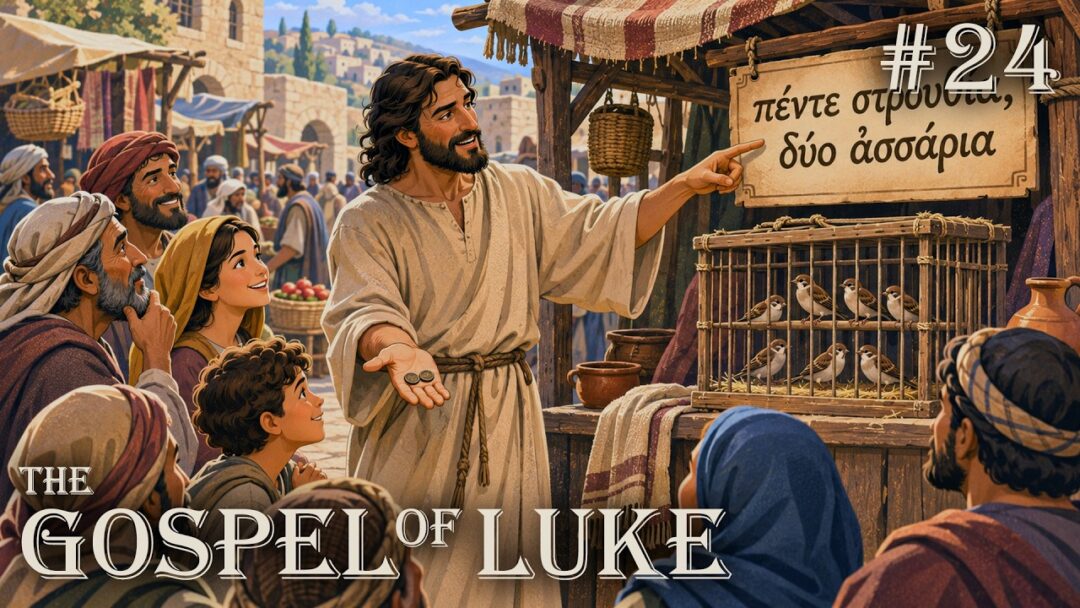
Are not five sparrows sold for two farthings, and not one of them is forgotten before God? But even the very hairs of your head are all numbered. Fear not therefore: ye are of more value than many sparrows.
Luke 12:6–7
First off, we see something very interesting here. God is cosmically aware of his creation. God is aware of even the little sparrows that fly around. God is omniscient. He can see all things, in all places, all the time. Here Jesus uses God’s omniscience over creation as an illustration for us.
He says, “Are not five sparrows sold for two farthings?” You might read that and think, “Okay, I get that a transaction is taking place, but what is that in today’s money?” The farthing in Greek is the assarion, a coin worth one-sixteenth of a day’s wage. So it’s not worth very much. If you did the math, another way you could translate this is, “Aren’t five sparrows sold for about an hour’s work?” Five sparrows for one hour’s work seems like a pretty good deal. It’s like when I go to Arby’s and get four sandwiches for about five bucks. Here’s the first-century equivalent: you go to the market and say, “I want to buy the cheapest thing you’ve got available.” It’s five sparrows for about an hour’s work. Eight bucks for five birds. They’re expendable. They’re cheap. You can just throw them out. They’re like the door buster, the pre-made chicken that Walmart or Costco sells at a loss to get you in the door. The sparrows are the loss leader.
God says five sparrows are sold cheap, but he is aware of every single sparrow on this earth. In the human mind, sparrows are expendable. You can sell them cheap; they’re pennies. But God knows each and every one of them, and he knows when a sparrow falls from a tree. It never happens without his awareness. And if God pays attention to these cheap things that are expendable to mankind, wouldn’t he pay more attention to you and have more care for you? What we consider expendable, God is aware of, and he knows every single one.
Then in verse 7 he says, “But even the very hairs of your head are all numbered. Fear not therefore: ye are of more value than many sparrows.” Compared to how God watches the sparrows, he is even more greatly aware of us. Even the hairs of our head are numbered. That is to say, God is cosmically aware of the exact number of hairs on your head. There’s no information hidden from God. He knows anything and everything there is to be known about whatever situation you’re in.
In the context of this passage, that situation is that the Pharisees are pressing the people with their rules. And God says, “Don’t worry. I understand the situation you’re in.” He understands you so well that if you asked him how many hairs are on your head, he’d be able to tell you just like that. I’m not even going to guess the number of hairs on a human head; I didn’t look that up. But God would know that perfectly. So if God knows so much about us and intentionally watches over us as believers, what do we have to worry about? God knows exactly what we need, when we need it.
Don’t Be Ashamed of Christ
Jesus builds on this in verses 8 and 9 as he tells us not to be ashamed of him.
Also I say unto you, Whosoever shall confess me before men, him shall the Son of man also confess before the angels of God: But he that denieth me before men shall be denied before the angels of God.
Luke 12:8–9
Here Jesus is saying, “In my cosmic awareness as God, I know who professes me and who denies me.” If you’re going to profess him before men and say, “I am a Christian; I put the name of Christ before my name; I am a follower of Christ,” he’s going to know. But if you deny him, he’s also going to know.
The Pharisees professed to follow God, but in their actions they didn’t. Sure, from day to day, when they were in front of the people, they could wash all their plates like we talked about last week. They could keep all the traditions, offer all the sacrifices, and pay all the tithes. But when the doors of their houses were closed, they were hypocrites. And God knew that though they professed him in the community, in private they denied him and disobeyed his commands.
You can’t trick God one way or the other. You can’t convince God that you’re for him when you’re against him, and you can’t make God think you’re against him when you’re for him. He knows everything perfectly, and so the Judge of the earth will do right by what he knows.
So Jesus says, “If you profess me before men, I am going to profess your name before the angels of God.” The angels of God are the ones that take care of things. Remember how God sent an angel to help Daniel and to give him comfort in his time of stress? God gives his angels charge to care for our needs. So if we profess God, God knows we profess him, and God will take care of us and the needs we have throughout our lives. But on the other hand, if we deny God, then the angels of God will also see that man denied before God.
The Unpardonable Sin
There’s an interesting saying in verse 10.
And whosoever shall speak a word against the Son of man, it shall be forgiven him: but unto him that blasphemeth against the Holy Ghost it shall not be forgiven.
Luke 12:10
We often refer to this as the unpardonable sin, and you see people worry about it. They ask, “Have I committed the unpardonable sin? Am I able to be forgiven?” Let’s look at Mark 3:29-30, where we’ll see how this sin is tied to a specific action in its context.
But he that shall blaspheme against the Holy Ghost hath never forgiveness, but is in danger of eternal damnation: Because they said, He hath an unclean spirit.
Mark 3:29–30
Mark gives us a clear definition of what blasphemy against the Holy Spirit is. It is saying that the acts of God are evil. It is to attribute evil to God. To commit the unpardonable sin is to say that God is not just, and if you say God is not just, you cannot be saved. Why? Because the whole concept of salvation is saying, “I am not righteous, and God is righteous, and in his perfection he sent God the Son to die on the cross for me.” If God’s Son is immoral, he can’t die for our sins. It doesn’t work. So if we say that God is evil and we want nothing to do with him, then we can’t be saved, because we have denied the very premise of the thing that saves us. And so God says you can speak blasphemy against the Son of man, but if you attribute the divinity of God to be an evil thing, there is no forgiveness for you.
To blaspheme against the Holy Spirit is to slander God by saying his convictions are wrong or evil, that the standards God teaches are bad for society. In other words, you say that his standard of justice is incorrect. People who do this end up rejecting the conviction of the Holy Spirit regarding their sins, saying, “My way is right, and God’s way is wrong.”
As Christians, we might think, “We’d never do that.” But in the world it’s very common. It’s very common for people to reject God and say, “If your God is that way, that’s not a God I want to worship.” That is blasphemy against the Holy Spirit. As long as a person remains in that state of hatred toward God, there is no grace for that person. A person in this state can never be saved, because that person has not confessed his sins and trusted God to remove them. He has in fact denied the wrongfulness of his sin and declared that God instead is wrong.
And so Jesus says, “Don’t be ashamed of me. I know which group you’re in. I know if you’re the one who is self-righteous and condemns God, or if you’re the one who admits you’re a sinner and declares God’s righteousness.”
When Persecution Comes
He continues in verses 11 and 12, telling us that if we’re on his side, persecution will come.
And when they bring you unto the synagogues, and unto magistrates, and powers, take ye no thought how or what thing ye shall answer, or what ye shall say: For the Holy Ghost shall teach you in the same hour what ye ought to say.
Luke 12:11–12
Jesus has hard truths for his friends. When you truly follow Jesus, it’s not going to be popular with the unsaved. Persecution isn’t a question of if; it’s a question of when. But Jesus gives us comfort, saying that when persecution comes, he will be right there with his Spirit to help us.
This is where Jesus begins to tell his people not to worry. He says, “Take ye no thought how or what thing ye shall answer, or what ye shall say.” Don’t worry. When persecution comes, he will be right there with you to give you the answer you need. What is he talking about? He’s talking about how his followers are going to stand before judges. When you stand before a judge, and the judge is deciding whether or not you will be condemned, it’s very important that you have a good defense attorney. Jesus is basically saying that when persecution comes, he is going to give you the greatest defense attorney of all time. God himself will come beside you and give you wisdom on how to navigate the situation ahead.
That should bring us comfort. When we find ourselves in trouble for our faith, God says, “I’ll be there. I’ll give you a defense. I will protect you. I will give you the words to say, to make you righteous before me, and to give you wisdom in your moment of need.”
Beware of Covetousness
Then, unfortunately, in the middle of this dialogue, a man chimes in and interrupts in verse 13.
And one of the company said unto him, Master, speak to my brother, that he divide the inheritance with me.
Luke 12:13
That was totally unrelated to anything Jesus was talking about. Jesus is in the middle of a very serious discussion on persecution, on how the religious leaders he just rebuked would eventually come after his followers and try to put them to death. That’s a really intense moment, and this man chimes in and says, “Hey Jesus, Teacher, talk to my brother. He hasn’t split the inheritance with me fairly.” Jesus is not interested in this man’s legal dispute with his brother over his father’s inheritance, and Jesus corrects the man immediately in verses 14 and 15.
And he said unto him, Man, who made me a judge or a divider over you? And he said unto them, Take heed, and beware of covetousness: for a man’s life consisteth not in the abundance of the things which he possesseth.
Luke 12:14–15
In verse 14 Jesus makes it clear that his mission on earth is not a legal one. The Pharisees and Sadducees might have been really invested in all these legal disputes. They used their position as religious leaders for political gain. They were not just religious; they were political. They worked with Rome, they worked with the Herodians, and they worked with all the political groups when they felt it was appropriate. So this man chimes in, thinking Jesus is just like the other religious leaders, invested in all the political disputes and all the legal disputes.
Jesus doesn’t even call him “sir.” Remember, he just called everybody “my friends.” What does he call this man? “Man.” Bro. Dude. “Who made me a judge or a divider over you?” Another way you could say it is, “Who made me an estate attorney? Does that look like what my job is here? I’m not going to represent you in a legal case. I’m here to do more important things.”
After Jesus asks the man, “Who made me an estate attorney?” he looks at the people and gives them this warning: “Take heed,” or pay attention, “and beware of covetousness: for a man’s life consisteth not in the abundance of the things which he possesseth.” Jesus openly corrects this man in front of the entire audience for his sin of greed, and he warns the crowd not to let greed overtake other parts of their lives. This man is in the wrong. His relationship with his family had fallen by the wayside because he wanted more money. He was willing to destroy his relationship with his brother for the chance to have a little bit more of a share of his father’s wealth. Jesus says, “This is evil. This is wickedness, for you to destroy your relationship with the family God gave you over the money you want to have in your pocket.”
Unfortunately, this is a very common situation that even Christians fall into today. A family member passes away, and there’s an inheritance on the table. Maybe they don’t agree with the way it was divided, or maybe it hasn’t been decided how it’s going to be divided, and suddenly a family that’s supposed to represent Christ goes to war with each other. “I want this percentage.” “No, I want this percentage.” “Well, I took care of this person for so long, and you didn’t do anything.” They butt heads and fight, and Jesus would have nothing to say to them but condemnation. That’s greed and covetousness.
My friends, why do you fight with one another over money? Isn’t your relationship with others and the love of your neighbor more important than the amount of money you can put in your pocket over this dispute? Why do you reduce your relationship with your sibling to how much money you can get out of your parent’s estate? You’re willing to throw away all those years you spent with your sibling over some wealth? Jesus says it should never be this way. We should not break fellowship with our siblings over inheritance disputes. Instead, we should let things be as they are to preserve the bond of unity in our families, even if we don’t like it.
Why? Because Jesus says a man’s life does not consist in the abundance of the things he owns. If you’re so worried about an inheritance, you think that joy in life comes from money and that security in life comes from having a high number in your bank account. But that’s not the way things are going to be in Jesus’ kingdom.
The Rich Fool
Jesus then gives an illustration, the parable of the rich fool, in verses 16 through 21.
And he spake a parable unto them, saying, The ground of a certain rich man brought forth plentifully: And he thought within himself, saying, What shall I do, because I have no room where to bestow my fruits? And he said, This will I do: I will pull down my barns, and build greater; and there will I bestow all my fruits and my goods. And I will say to my soul, Soul, thou hast much goods laid up for many years; take thine ease, eat, drink, and be merry. But God said unto him, Thou fool, this night thy soul shall be required of thee: then whose shall those things be, which thou hast provided? So is he that layeth up treasure for himself, and is not rich toward God.
Luke 12:16–21
In this parable, Jesus presents us with a rich man who owned a farm, and one year this farm performs far above expectations. It’s almost miraculous how much grain he has gotten from his wheat field. The thing about grain is that you can store it for years and it will still be good to sell. So he thinks, “I could flood the market with this grain now, or I could give it to my family or my community, because I literally don’t have room to store all of it. But if I don’t put the grain somewhere safe and it’s exposed to the elements, it’s going to be wasted.”
So he sits down and thinks, “What am I going to do with this? Do I give it away? Do I try to sell it cheaply to get rid of it?” And he decides, “No. I’m going to tear down the barns I have. I’ll use the money from this sale to build bigger and better barns so that I can store more and more for myself. I can fill my silos with grain, and I’ll never have to work another day in my life. I’ll never have anything to worry about for the rest of my life. I can live off that money, protect it for myself, and have an easy life going forward, paying everybody else to do the work for me.”
So he carries out his plan. He tears down the barns, builds up the silos, stores all the grain, and sits back to relax. And God says, “You fool, I am taking your life tonight.” How much good is all that stored grain to him now? He wanted security in his life. He did everything he could to be protected. But he forgot one thing: he didn’t maintain his relationship with God, and God says it’s time for him to come home. He didn’t live properly toward God, and so none of the things of this world could help him.
Jesus is making a comparison. You can have all the things in this world, but if you’re not right with God, there’s no safety in them. And you can have none of the things in this world, but if you’re right with God, then you have everything you need. God’s plans and this man’s plans were not aligned, and ultimately it’s God’s plans that come to pass.
The ultimate lesson Jesus gives is in verse 21: “So is he that layeth up treasure for himself, and is not rich toward God.” The one who builds up riches for himself is not rich in God’s favor. Which would you rather have: money in the bank account, or favor with the God of the universe?
Take No Thought for Your Life
Jesus takes this illustration and makes it a challenge for his disciples, whom he calls friends, in verses 22 and 23.
And he said unto his disciples, Therefore I say unto you, Take no thought for your life, what ye shall eat; neither for the body, what ye shall put on. The life is more than meat, and the body is more than raiment.
Luke 12:22–23
Rather than being like the rich fool, Jesus encourages Christians not to worry about the distant future or their basic needs. You can worry all day about things that are far down the road. You can worry today about your retirement. You can worry about your bills next week. The things to worry about never, ever end. You can worry, “What am I going to eat? What am I going to do to protect myself from the elements?” That’s what the clothing is talking about here: “How am I going to make sure I can get through the winter?” Jesus says, “Don’t waste your time worrying about food or clothes.” That is what the secular world worries about, but there are more important things than worrying about basic necessities. The life is more than food, and the body is more than clothing.
Why shouldn’t we worry about these things? In verses 24 through 26 he tells us that things will work themselves out in time if you trust God.
Consider the ravens: for they neither sow nor reap; which neither have storehouse nor barn; and God feedeth them: how much more are ye better than the fowls? And which of you with taking thought can add to his stature one cubit? If ye then be not able to do that thing which is least, why take ye thought for the rest?
Luke 12:24–26
Once again Jesus returns to birds for an illustration. Why is he so into birds in this passage? I don’t know. Maybe where he was standing was near the marketplace where the birds were being sold, and he used birds as an illustration because you could just look over and see them for sale. Maybe the farthing sign was right there and he pointed to it.
Either way, he goes back to the illustration of birds. What about the ravens? The ravens don’t run farmland. They don’t run agriculture. The ravens don’t have businesses. But God feeds them. God gets them through the tough times. If God is aware of the raven, don’t you think he’s aware of you and what you need? You don’t need to stress out so much about every single thing in life, worrying whether you can get through it, because God is there. He knows. He’s aware. He knows the number of hairs on your head.
In verse 25 he tells us how foolish our anxiety is: “Which of you with taking thought can add to his stature one cubit?” No matter how much you worry about something, your worry is not going to change anything. There are actually two different ways you could translate verse 25, because the word “stature” in Greek is used both for literal height and for the maturity of one’s life.
One way you could translate it is literally, “Who through anxiety could add one foot to his height?” Maybe you’re a kid growing up, and you’re worried: “How tall am I going to be? Am I going to be over six feet?” If you worry about that every single day of your life, how much is that worry actually going to affect how much you grow? Not at all. If anything, it’s going to make things worse, because we know through scientific studies now that anxiety is awful for you. It’s actually destructive, and it will make your life shorter.
Speaking of making your life shorter, the second way you could translate it is, “Who through anxiety can add one hour to his lifespan?” You could worry like the rich fool did: “How am I going to make sure my retirement is perfect and I never have to do anything?” You could worry every day of your life about retirement, but that worry isn’t going to help you with anything except making your lifespan shorter. So Jesus says, “Why are you so foolish, my friends, to worry, worry, worry, worry, worry?” Worry accomplishes nothing.
In verse 26 he says, “If ye then be not able to do that thing which is least, why take ye thought for the rest?” If you can worry about the small things in life and get nothing from it, why do you worry about the rest of the things? What’s the point? Is your anxiety helping you in any way? No. Your anxiety will never help. The only thing it will do is hurt your health and make you lose faith in God.
Consider the Lilies
Jesus then gives more examples in verses 27 through 29.
Consider the lilies how they grow: they toil not, they spin not; and yet I say unto you, that Solomon in all his glory was not arrayed like one of these. If then God so clothe the grass, which is to day in the field, and to morrow is cast into the oven; how much more will he clothe you, O ye of little faith? And seek not ye what ye shall eat, or what ye shall drink, neither be ye of doubtful mind.
Luke 12:27–29
Jesus once again refers to nature as an example. He says, “Consider the wild lilies that grow in the fields of Israel.” The lilies in the fields don’t have a job. They don’t spin thread to make clothing for themselves, and yet by nature they are dressed in more beauty than Solomon himself with all of his wealth. How many of you like lilies as a flower? They’re pretty. They just pop into existence in nature, displaying the beauty of God’s design, and they’re naturally taken care of in that way. If God clothes the flowers with such beauty, flowers that exist in bloom for just one day and the next day are wilted and gone and used for fuel, how much more is he going to take care of you? Don’t you think he has a design for you, just like he has a design for nature?
And if you’re worrying so much about these basic things in life, that demonstrates a lack of faith. “O ye of little faith.” God knows what you need. God can take care of you. When you doubt with anxiety, you’re not trusting in the God who created you.
Seek the Kingdom of God
Jesus nails this down again in verses 30 and 31 as he tells us that only the worldly worry about these things.
For all these things do the nations of the world seek after: and your Father knoweth that ye have need of these things. But rather seek ye the kingdom of God; and all these things shall be added unto you.
Luke 12:30–31
Jesus is saying, “You worry so much. Christian, you worry too much.” You can raise your hand today and admit, “I know I worry too much.” Come on, there should be some hands up. There are constantly things to worry about. And Jesus says, “Why are you worrying like the unsaved? Don’t you know you have a God who knows everything you need?”
You don’t even need to pray for your needs to be taken care of; God already knows. God has already promised to take care of your needs. It’s right here, and God is just naturally going to do it. So why are you doubting his promise to take care of you? If he has already promised to do it every day of your life, then you’re carrying around anxiety, a weight that God never wanted you to carry. He wants you to trust in him and to follow him. He says, “If you follow me, then you have nothing else to worry about. Your Father knoweth that ye have need of these things. Rather, instead, seek the kingdom of God.” If we seek out God’s will, everything else is going to fall into place.
Why? Go back to the parable of the rich fool. He wanted to do things in his own power, but he didn’t have God’s favor. The opposite is then demonstrated: if you have God’s favor, you will have the things you need.
Remember Joseph in Genesis? He was persecuted on every side, and he had every reason to be full of anxiety and depression. How many of you could say, “If I were Joseph, I would have a lot of anxiety”? He was falsely accused of rape, falsely accused of crimes, and almost murdered by his brothers. Joseph had something to worry about. But what happened to Joseph? No matter how hard the world tried to break him and keep him from prospering, God turned all those evil things around for Joseph’s good, and in the end Joseph was second in command of the world’s largest empire at the time.
Oh, if we had the faith of Joseph, where would we be in life? We’re sitting here worrying about the most basic things. The dishwasher is broken. My car goes up a little bit too much. Oh, that we had the faith of Joseph, and we just pursued God and said, “God, I know you’ll take care of it in your time. I’m not going to worry about it. I’m going to keep going. I’m not going to let it distract me from the goal you’ve set before me. I will continue to serve no matter how chaotic everything gets around me.”
Remember Peter walking on the water. He goes out to Jesus in faith, but he sees the storm around him, and the storm distracts him from keeping his eyes on Christ. When his eyes get distracted, he begins to sink. Peter’s concern should have been, “I need to focus on Christ and not look away.” His concern should have been where his eyes were looking, not on the waves. In our lives, the things we shouldn’t be worried about are the bills and the clothing and the food. Our concern should be, “Are we serving the Lord?” Because if we’re serving the Lord, those things aren’t anxieties anymore. They’re promised to be taken care of. God will come in and take care of those needs in ways you’ve never imagined, if you’ll trust him to do it.
Fear Not, Little Flock
Jesus then concludes with a very beautiful statement about how God loves to provide for our needs, in verses 32 through 34.
Fear not, little flock; for it is your Father’s good pleasure to give you the kingdom. Sell that ye have, and give alms; provide yourselves bags which wax not old, a treasure in the heavens that faileth not, where no thief approacheth, neither moth corrupteth. For where your treasure is, there will your heart be also.
Luke 12:32–34
I love that. “Fear not, little flock.” Little sheep, don’t worry. You’ve got a good shepherd who watches over you. And when one sheep goes astray, what good shepherd would not leave the ninety-nine and pursue the one who needs his help? Little sheep, no matter what your struggle is today, God will pursue you to help you. Why? Because it is the Father’s good pleasure to give you the kingdom. It is a blessing to the Lord to be able to take care of you as the shepherd.
And so Jesus gives this encouragement: don’t be like the rich fool, trying to take control of your life through worldly means. Stop storing up wealth for yourselves, believing, “If I just store up $2.5 million, my life will be perfect.” You can store up the $2.5 million, and you’d still be worrying, because you haven’t dealt with the root cause of the problem. No amount of money in the world is going to get rid of your anxiety. No amount of property you own is going to get rid of your anxiety.
Does that mean you can’t own a house? No, that’s not what I’m saying. I’m not saying you can’t have a positive balance in your bank account. What Jesus is saying here is, stop trying to protect your life through material means, and trust God to protect your life. These people weren’t giving to the kingdom because they were too worried about what it would cost them to invest in God, and so they were greedily holding on to things for themselves.
So Jesus says, “Sell that ye have, and give alms.” Give to the poor. Help other people instead of helping yourself. “Provide yourselves bags which wax not old.” In other words, put your treasure in a wallet that doesn’t decay. How many of you have to buy a wallet pretty regularly because wallets are weak and wear out? Jesus says that if you put things in your heavenly bank account, that wallet is not going to wear out, and you’re not going to have to replace it. You can stop hoarding for yourself and invest in God’s ministry, invest in helping the poor, invest in helping the needy, invest in loving your neighbor. And when you do those things, that fear will disappear, and you’ll have a peace that passes all understanding.
Where Is Your Treasure?
Jesus also gives us a warning: “For where your treasure is, there will your heart be also.” Wherever you choose to store the products of your labor, that’s where your heart will be focused. Another way to translate that would be, “Whatever you invest in the most is what you will give the most attention to.”
If almost everything in your life, maybe 90 percent of whatever is left over from every paycheck, goes into an investment portfolio, then if that’s where all of your work is going, you’re going to be looking at that portfolio every day. Is it up? Is it down? Is it up? Is it down? That’s where your focus is going to be. If you’ve invested every single ounce of your energy into your business, your entire life is going to be ordered around that business venture. If you’ve invested everything in your kids, in making them the most legendary, amazing, historically significant children of all time, then your attention is going to be 100 percent on your kids, all the time, in every single thing you do. And there are things you can invest other than money. You can invest your time and your attention. But whatever you invest in the most, that’s where your focus is going to be.
If you invest everything in your business, then you’re going to have anxiety that one day that business could fail. Maybe the economy takes a turn, and maybe bankruptcy is in the future. If you were investing everything into your kids’ sports, and they had a whole career ahead of them, and then they get injured, it’s all gone. Maybe you were investing in your retirement, and the economy just tanked. It’s all gone.
But if you invest in serving God, no matter what state the world is in, you’re still going to get by just fine. Because the thing you value your life on is not what benefits you. It’s not what benefits your reputation or your legacy. It’s the thing that gives glory to God. And when you sit at the end of your life and look back on all the things you’ve done, you won’t have regrets that you invested in something foolish. You’ll say, “I invested in my Father, and he took care of me through every phase of my life, and I have no regrets.” Oh, that we would all have that.
If You Fear God, You Have Nothing Else to Fear
To wrap things up today: Jesus began this passage by telling his friends not to fear those who can harm the body, and he ends by telling his little flock not to fear for the necessities of this life. Throughout this passage, Jesus reminds us that God knows us, values us, and cares for us.
When we fear people, we may become ashamed to acknowledge Christ. When we fear the future, we may become consumed with worry and lose sight of following Christ. And when we fear not having enough, we may begin to treasure earthly possessions more than our God. But Jesus calls us to live differently. Rather than allowing these fears to control what we do with our lives, we are to fear God above men, trust his provision for our needs, and seek the kingdom above earthly riches.
That brings us to the question Jesus leaves with us today: where is our treasure? Whatever we treasure most will ultimately determine where we place our trust. If our treasure is in this world, we will always have something we fear losing. But if our treasure is in God, we can face an uncertain future with confidence, knowing that our heavenly Father truly does care for us.
God wants you to know that if you fear him, you will have nothing else to fear. So what are you placing your trust in? Is it in God, or is it in the things of this world?

Recent Comments