
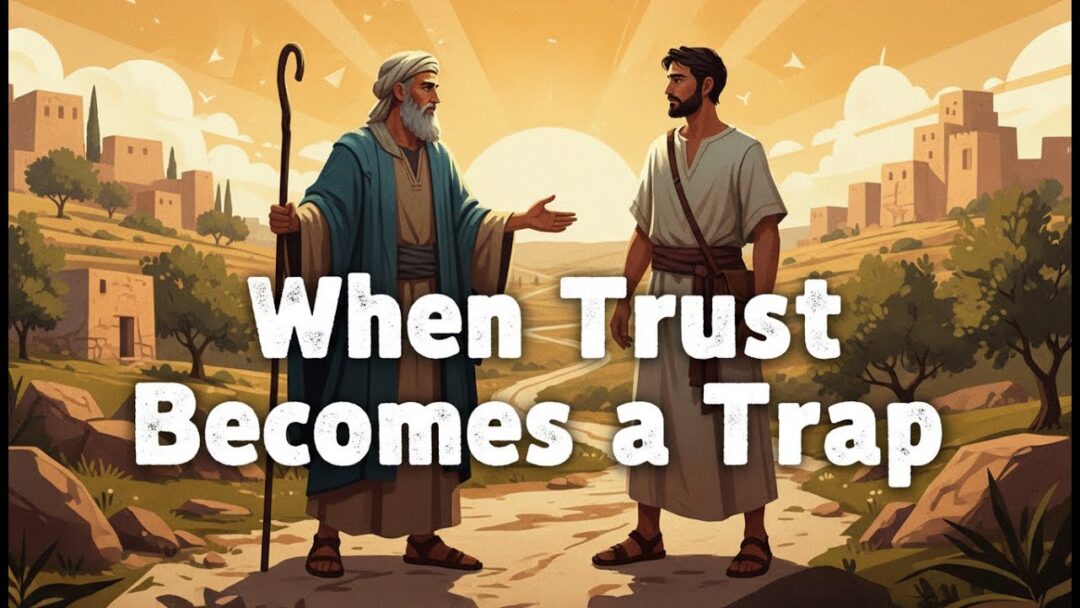
From our Sunday service on January 18, 2026, 1 Kings 13. Watch the full message: When Trust Becomes a Trap on YouTube.
1 Kings 13 is an obscure passage, not one we talk about a lot. I’ve been looking at it for the last three weeks because I find it so intriguing. It’s a very strange story. It doesn’t make a lot of sense, and it doesn’t really fit the context of what’s going on in 1 Kings. It sits in the middle of a dramatic narrative about the kings and the conflict of the kingdom, and in the middle of all this chaos we’re introduced to an unnamed prophet for a single chapter. We’ll call him the unnamed prophet throughout this message. The prophecy he gives won’t be fulfilled for over 300 years. It seems random that an unnamed prophet gives a prophecy for 300 years in the future, disconnected from the narrative about King Jeroboam. We aren’t given much explanation of anything that happens. It’s not really explained or built upon. It raises really interesting ethical questions and leaves a lot of Christians confused when they read it in their Bible study. And at the center of it is a tragedy that could have been easily avoided.
I think this message is really relevant for the time we live in. It might feel a little political by the end, but what I’m talking about is not targeted just toward our nation. It’s a trend in Christianity, not just on the left and not just on the right, not just in America but in Europe, in Asia and in all the other countries of the world. We’re going to be introduced to a prophet, a lying prophet and a corrupt king, all things that exist in every society. In every society you’ll see evil leaders from time to time, a lying prophetic teacher or pastor, and a faithful believer who trips up. This passage often gets overlooked, and the message we can learn from it is significant.
God wants you to know that obedience to him is an individual responsibility.
Jeroboam and the Calf Cult
For context, King Solomon has just died. His son Rehoboam and one of his officials, Jeroboam, have created a civil war in Israel over taxes, and Israel splits into two distinct nations: the kingdom of Israel to the north, led by Jeroboam, and the kingdom of Judah to the south, led by Solomon’s son Rehoboam. Jeroboam wants to maintain power in the north. He knows Jerusalem is the center of worship for the Jewish people and that God commanded people to go there, but Jerusalem is in Judah, not Israel. He says, “I don’t want people from my nation having to go to another nation to worship God. That’s going to ruin my authority as king. People will say, ‘How can you be God’s king if you don’t have a worship center in your nation?'” So, to maintain power, he reinstates the golden calf cult that Aaron created at the bottom of Mount Sinai. Who remembers the golden calf? Moses ground it into powder and made the people drink it. Well, the calf cult comes back under Jeroboam.
Jeroboam creates two centers of worship in Israel instead of Jerusalem. He sets one up in Bethel. The name Bethel means “the house of God,” so he thought it would be appropriate to set up a worship center in the city called the house of God. That won’t raise a lot of questions, right? Then he sets up another false worship center in Dan.
What did the calf cult teach? It stated that God truly was Yahweh, the God of Israel, but it mixed pagan idolatry and rituals into the worship of God. The Bible taught that God was an invisible God and that there shouldn’t be any idols in his worship. The calf cult says, “That’s not important. The golden calf helps me imagine God when I worship, to feel closer to God.” The philosophy of the day was that where these idols were, there was a sacred space where God and man meet, and that the idols created a way to easily connect to God through physical form. So Jeroboam says, “People like the tangible, the physical. They’ll like my religion more because it’s more physical and more accessible. I need to make it relatable to the people so they take my authority. I need to give them what they want so they don’t go to Jerusalem and worship God how they’re told to.” And they say, “It’s still Yahweh.” What did the people say at Sinai? “These be thy gods, O Israel, which brought thee up out of the land of Egypt.” “We’re still worshiping the same God here, guys. Nothing’s changed.” But in fact things had changed. When Jeroboam sets up this idol, he says:
…behold thy gods, O Israel, which brought thee up out of the land of Egypt.
1 Kings 12:28
The golden calf cult mixes paganism with worship. It was praising God while actively disobeying him. The calf cult started because the Israelites felt far from God at the bottom of Mount Sinai. They were afraid God would kill them. They were afraid God had killed Moses. They felt like God didn’t care and was distant. So Aaron thought, “If I put the idol here, God will be relatable, personal and accessible again.” Another thing about the calf cult is that it allowed anyone to become a priest. The Bible said only the Levites should be priests, but here it says:
…made priests of the lowest of the people, which were not of the sons of Levi.
1 Kings 12:31
“We’ll take the lowest of the low, the outcasts, the people who don’t ask questions, the ones who know nothing about worshiping God, the simple ones, so to speak. They’ll do what they’re told, and we’ll use them as a tool to direct the worship of God in a way that benefits me as king.” What did the calf cult ultimately do? It made the worship of God too close to the worship of non-believers. It took the standards, morals and teachings of God and made them closer to the unsaved around them. With that in mind, let’s see a prophecy declared.
A Prophecy Against the Altar
And, behold, there came a man of God out of Judah by the word of the LORD unto Bethel: and Jeroboam stood by the altar to burn incense. And he cried against the altar in the word of the LORD, and said, O altar, altar, thus saith the LORD; Behold, a child shall be born unto the house of David, Josiah by name; and upon thee shall he offer the priests of the high places that burn incense upon thee, and men’s bones shall be burnt upon thee.
1 Kings 13:1–2
Already in the first two verses we have a very strange situation, out of the norm for the Bible. The prophecy is declared not to the king himself but to the altar of the golden calf. It just so happens that Jeroboam is there, in the process of introducing a new holiday. The Jews had feast days, and Jeroboam thought, “I want my people to think our way of worship is better. I’m going to make new feast days, new holidays, new forms of worship.” So he’s there at the altar burning incense himself, which again he’s not allowed to do for God. Only Levites are allowed to do that. But as king he says, “I’ll be at the forefront of this new holiday. People will see me as a spiritual person and respect my authority as a leader in Israel.”
And this unnamed prophet, called a man of God, is sent by God’s word to Bethel not to decry the king but to speak to the altar. Why? I don’t know. That’s so bizarre. Usually the prophets go to the king. What did the altar do? Jeroboam is right there. But he says, “Altar, you false worship, I decry you, because one day Josiah is going to be king, he’ll overthrow your altar, and your corrupt priests will be put to death for their sins.” The prophecy is that the false priests would one day be put to death and burned on their own cultic altar by a future king named Josiah. And it is 300 years in the future. Why is it so far off and so disconnected? Let’s continue the story.
Remember, we’ve talked about double prophecy: if a prophet gives a prophecy about the far future, he has to give one that happens in the short term to confirm that his long-term prophecy is true. That’s what we see here. Verses 3-5:
And he gave a sign the same day, saying, This is the sign which the LORD hath spoken; Behold, the altar shall be rent, and the ashes that are upon it shall be poured out. And it came to pass, when king Jeroboam heard the saying of the man of God, which had cried against the altar in Bethel, that he put forth his hand from the altar, saying, Lay hold on him. And his hand, which he put forth against him, dried up, so that he could not pull it in again to him. The altar also was rent, and the ashes poured out from the altar, according to the sign which the man of God had given by the word of the LORD.
1 Kings 13:3–5
The man of God is a true man of God. He declares a prophecy for 300 years in the future and a short-term prophecy to confirm it: the altar will split and the ashes on it will pour out. Jeroboam, wanting to control the religious worship in his kingdom, extends his hand to tell his guards to seize him, and his hand withers in real time so he can’t move it. As he’s stuck there panicking, the altar splits in half and the ashes pour out, a picture similar to what happens with Moses and Elijah, where big miraculous events prove that the prophet is a man of God. On top of that, the man of God was divinely protected from King Jeroboam. Everything the prophet said would happen occurred just as he said, proving him a true prophet whose short-term and long-term prophecies would both come to pass. How does Jeroboam respond?
And the king answered and said unto the man of God, Intreat now the face of the LORD thy God, and pray for me, that my hand may be restored me again. And the man of God besought the LORD, and the king’s hand was restored him again, and became as it was before.
1 Kings 13:6
That’s crazy. This king just tried to kill the prophet. His arm was shriveled, and once he realizes God is on the prophet’s side, he begs, “Pray for me, please. I want my arm back. I can’t be king like this.” So the prophet prays for Jeroboam, the wicked king, and his hand is restored. Remember that God has mercy on the wicked king, because it’s going to come up later.
And the king said unto the man of God, Come home with me, and refresh thyself, and I will give thee a reward. And the man of God said unto the king, If thou wilt give me half thine house, I will not go in with thee, neither will I eat bread nor drink water in this place: For so was it charged me by the word of the LORD, saying, Eat no bread, nor drink water, nor turn again by the same way that thou camest. So he went another way, and returned not by the way that he came to Bethel.
1 Kings 13:7–10
Jeroboam invites the prophet home for a banquet: “Thank you for healing my hand. Come eat with me, spend the night, enjoy the presence of the king of Israel.” The prophet says, “You could give me half your house, and I wouldn’t do it, because God gave me a warning before I came: don’t eat, don’t drink, don’t tarry in Bethel. Go home, and don’t go the same way you came.” The prophet was given an instruction by God, and obviously it was for his protection. I genuinely don’t think Jeroboam had good intentions here. The verse doesn’t tell us what Jeroboam wanted, but I assume, based on the fact that he just tried to kill the man, that he wanted to lure him home to put him to death, because he spoke against what Jeroboam was doing in the kingdom. So God says, “You will die if you stay in Bethel, if you eat or drink. It’s not safe. Go home a different way so people don’t know where you’re going.” Considering who Jeroboam was at this point, I would assume it was most likely a trap. But the prophet does what God says. He does the right thing and leaves Bethel another way.
An Old Prophet’s Lie
Now the story takes an even more bizarre turn. Verses 11-15:
Now there dwelt an old prophet in Bethel; and his sons came and told him all the works that the man of God had done that day in Bethel: the words which he had spoken unto the king, them they told also to their father. And their father said unto them, What way went he? For his sons had seen what way the man of God went, which came from Judah. And he said unto his sons, Saddle me the ass. So they saddled him the ass: and he rode thereon, And went after the man of God, and found him sitting under an oak: and he said unto him, Art thou the man of God that camest from Judah? And he said, I am. Then he said unto him, Come home with me, and eat bread.
1 Kings 13:11–15
Now we’re introduced to another character, the old prophet, also unnamed. That he’s an old prophet implies he had been a prophet in Bethel serving God before Jeroboam took over the northern kingdom, probably from the previous era under Solomon. We’re not told anything else about his past, whether he was always good or bad. His sons happened to be around the golden calf altar at the time and saw everything. They tell their father, “Dad, there’s a prophet in town, a true man of God, and he split the altar open!” The old prophet is encouraged: “That’s so exciting. Which way did he go? Let’s catch up to him and invite him over. It’s so rare for there to be a prophet in Israel.” But there’s a problem. He invites him to come home and eat bread, the very thing the Lord had specifically told him not to do. How will the unnamed prophet respond?
And he said, I may not return with thee, nor go in with thee: neither will I eat bread nor drink water with thee in this place: For it was said to me by the word of the LORD, Thou shalt eat no bread nor drink water there, nor turn again to go by the way that thou camest.
1 Kings 13:16–17
Good job, unnamed prophet. You gave the right response. But if that were the end of the story, I don’t think it would be recorded in our Bible. Verse 18:
He said unto him, I am a prophet also as thou art; and an angel spake unto me by the word of the LORD, saying, Bring him back with thee into thine house, that he may eat bread and drink water. But he lied unto him.
1 Kings 13:18
This old prophet decided he wanted something different than what God wanted. He didn’t have an opportunity to eat with a prophet very often, and when he found out the prophet was told not to stay, he decided, “I’ll just lie. I’ll tell him God told me through an angel that what he told you was wrong, that he’s changed his mind about the standard he gave you. Those words were relevant back then, but I have a new word, an updated word from God, and it says what you were told is wrong is now okay. Come to my house and have dinner with me.” What does the prophet do? Verses 19-24:
So he went back with him, and did eat bread in his house, and drank water. And it came to pass, as they sat at the table, that the word of the LORD came unto the prophet that brought him back: And he cried unto the man of God that came from Judah, saying, Thus saith the LORD, Forasmuch as thou hast disobeyed the mouth of the LORD, and hast not kept the commandment which the LORD thy God commanded thee, But camest back, and hast eaten bread and drunk water in the place, of the which the LORD did say to thee, Eat no bread, and drink no water; thy carcase shall not come unto the sepulchre of thy fathers. And it came to pass, after he had eaten bread, and after he had drunk, that he saddled for him the ass, to wit, for the prophet whom he had brought back. And when he was gone, a lion met him by the way, and slew him: and his carcase was cast in the way, and the ass stood by it, the lion also stood by the carcase.
1 Kings 13:19–24
He decides to listen to the old prophet, and in the middle of the meal the old prophet begins to prophesy. Doesn’t that seem odd? The old prophet just lied and gave a false prophecy, and yet in the middle of the meal, while the man is disobeying God by listening to the false prophecy, the old prophet prophesies the true words of God to him: “I told you not to stay and eat. I told you to go by a different road. You knew my words. This prophet told you my words were different, but you knew my words. Because you willfully disobeyed my word based on the testimony of someone other than me, you’re not going to make it home tonight. Your life is forfeit.” All for some bread and water and some time in fellowship. Boy, does that seem harsh.
This is the most shocking and confusing part of the story. The man disobeys God by listening to a lying old prophet, and then that same lying old prophet gets a real, true message from God that the man will be killed for disobedience. Then the lion kills him on the road, but it doesn’t eat him. The lion and the donkey stand by the corpse to prove that it was truly divine judgment and not a coincidence. If the lion had just eaten him, I might say what I usually say: God stepped back and said, “You don’t want to be in my will, so I’ll take my protection away,” and if you get hit by a lion, that’s just what happens. But here the story specifically tells us that God killed him intentionally. The lion did not eat him or the donkey. The lion was not hungry. It was there to fulfill the judgment of God.
Is this story not odd? Jeroboam, the king who just tried to kill God’s prophet, was spared and his withered hand healed, but God’s prophet, who disobeys to get a meal, is put to death. Can you see why it took me three weeks to put this together? Let’s continue. Verses 25-26:
And, behold, men passed by, and saw the carcase cast in the way, and the lion standing by the carcase: and they came and told it in the city where the old prophet dwelt. And when the prophet that brought him back from the way heard thereof, he said, It is the man of God, who was disobedient unto the word of the LORD: therefore the LORD hath delivered him unto the lion, which hath torn him, and slain him, according to the word of the LORD, which he spake unto him.
1 Kings 13:25–26
The old prophet knows exactly what happened: “There’s no doubt in my mind. It’s the prophet who ate dinner with me. I know because God told me he disobeyed his word.” That’s so confusing, though. Shouldn’t the lying prophet be the one punished? He’s the one who caused him to sin. That’s not the way God sees it. It wasn’t the lying prophet that caused him to sin. It was his own willful disregard for what God had already told him. Verses 27-32:
And he spake to his sons, saying, Saddle me the ass. And they saddled him. And he went and found his carcase cast in the way, and the ass and the lion standing by the carcase: the lion had not eaten the carcase, nor torn the ass. And the prophet took up the carcase of the man of God, and laid it upon the ass, and brought it back: and the old prophet came to the city, to mourn and to bury him. And he laid his carcase in his own grave; and they mourned over him, saying, Alas, my brother! And it came to pass, after he had buried him, that he spake to his sons, saying, When I am dead, then bury me in the sepulchre wherein the man of God is buried; lay my bones beside his bones: For the saying which he cried by the word of the LORD against the altar in Bethel, and against all the houses of the high places which are in the cities of Samaria, shall surely come to pass.
1 Kings 13:27–32
What a strange situation. The old lying prophet genuinely mourns the death of the unnamed prophet whom he lied to and helped get killed. He respects the man and realizes he truly was a believer and a prophet who spoke the word of God: “Mark his words. This man spoke the truth and served the true God of Israel. When I die, bury me next to his bones.” Why? Probably because of the idea that the bones of the prophets were holy, and that if they rose in a resurrection, he might go with him: “This man was so holy, I want my bones next to his, so in the resurrection we’re the first ones going.” This man was truly a man of God, and yet he’s dead for one act of disobedience. And the story has a sad ending. Verses 33-34:
After this thing Jeroboam returned not from his evil way, but made again of the lowest of the people priests of the high places: whosoever would, he consecrated him, and he became one of the priests of the high places. And this thing became sin unto the house of Jeroboam, even to cut it off, and to destroy it from off the face of the earth.
1 Kings 13:33–34
End of story. Did Jeroboam learn his lesson? No. Did the old prophet? No. Did his sons stop helping in the golden calf worship? No. It seems like the entire story is a wasted life, where nothing changed except a prophecy for 300 years in the future. The unnamed prophet is dead, and Jeroboam continues his sinful cult, and it gets worse than before.
The Same Sin
This leaves us with quite a few questions. One you might be asking is why God had mercy on Jeroboam and the lying prophet but not on his own prophet. Jeroboam created a cult. He was trying to define the worship of God his own way and overthrow the Davidic line. Why does he get mercy? The unnamed prophet, whose name we don’t even know, was just trying to declare God’s moral standard, to declare sin as sin and righteousness as righteousness, and that the wicked will be punished. Why is he the one who doesn’t get mercy? And why was the old prophet spared? His sons served in Bethel. He may have been a good prophet in the days of Solomon, but his sons were obviously hanging around the golden calf, and they probably weren’t living for God as he had under Solomon. Why are they allowed to continue on with their lives after this tragedy?
My answer is a question: what is the difference between the calf cult and the unnamed prophet? The calf cult said Yahweh was God, the true God of Israel. They just chose not to obey his words. The unnamed prophet also said Yahweh was God, but he too chose not to obey God’s words. Do you see what’s going on in this passage? The sin of the golden calf is the same sin as the unnamed prophet’s. Both said, “I worship the true God,” and both said, “I’m not going to follow God’s instructions the way he gave them.” Jeroboam said, “That was the way God was worshiped before, but I have new instructions on how we’ll worship God here in Israel: a new word, a new priesthood, a new idol.” And the lying prophet told the same lie: “God may have told you to do this before, but now God’s instructions are different.” Just as Jeroboam lied, the old prophet lied, and the man who was sent to denounce people redefining what God said fell into the same trap he was sent to denounce.
What’s our lesson? There’s a danger in announcing God’s word to the world but not keeping it yourself. The unnamed prophet declared that God would punish them for their disobedience, but when the rubber met the road, he wasn’t afraid of disobeying God. He never stopped and said, “I know what God said, and I’m not going to take your word for what God says. I need to know what God says myself.” When the old prophet said, “God gave me a word,” the unnamed prophet should have said, “I will wait to hear a word from God, because my God said, ‘Do not stop.’ You may say you follow my God, but I need to know for sure that what you’re saying came from God. Let me stop and ask God what he thinks.”
Trusting Another Voice Today
What’s the parallel today? God has given us his Word, the Bible. He’s told us what is true and what his standard is. There will be people who say, “That’s what God said then, but this is what God told me now. That was the truth in the past. This is 2026, the modern day. We’re ready for new things. The context is different. God told you not to eat because that was a pagan king, for all intents and purposes. I’m a man of God. It’s different with me.” Unless God tells us something specifically in his Word, we can never trust somebody else’s word on it. That goes for everyone, including me. You can’t trust everything I say in the pulpit unless it’s based on the Word of God. I hope you’re checking the things I say to see if they line up with the Word of God, and if you see something you disagree with, I hope you come and talk to me about it. When we stand before God, we won’t be able to use the excuse, “This person I respected told me this is what you wanted.” It didn’t work for the unnamed prophet, and it won’t work for you and me.
I have seen so many lies put out by people who should be respected members of the church. I’ve seen clergy and Christian influencers online or on TV saying things that contradict God’s Word, and people in the comment sections saying, “Thank you for speaking this truth! Somebody’s finally saying it!” But it’s not truth. It’s not in God’s Word. It’s someone’s opinion. It’s somebody saying, “God may have said you’re supposed to go home, but I want to eat with you. God may have said that’s wrong, but that’s not what I want.” So they twist God’s Word: “That isn’t what it means. It’s different now.” And people fall into the trap. I won’t say any names, but I want to give some examples. And once again, this doesn’t just apply to the United States. It applies to all the world.
Some Christians, some people of respect, some old prophets will tell you, “It’s okay to murder unborn children in the womb.” They say, “They’re not human.” But God says, “I knew their name in the womb.”
…The LORD hath called me from the womb; from the bowels of my mother hath he made mention of my name. … For thou hast possessed my reins: thou hast covered me in my mother’s womb. … I am fearfully and wonderfully made… … Lo, children are an heritage of the LORD: and the fruit of the womb is his reward.
Isaiah 49:1; Psalm 139:13–14; Psalm 127:3
It hasn’t changed. The Word of God is written, and the standard is set. Yet there are old prophets, false teachers, who go around redefining what God’s Word says because they say things are different.
Another example: there are some Christians today, even online, saying that purposely making certain groups of sinners suffer more is moral and justified, that it’s what they deserve, that they don’t matter in the same way as you and me. But what does God say?
…He that is without sin among you, let him first cast a stone at her. … I have no pleasure in the death of the wicked; but that the wicked turn from his way and live… … Remember them that are in bonds, as bound with them… … I was in prison, and ye came unto me. … Inasmuch as ye have done it unto one of the least of these my brethren, ye have done it unto me.
John 8:7; Ezekiel 33:11; Hebrews 13:3; Matthew 25:36, 40
The world says it’s okay not to care about them because they’re sinners, because they broke the law, because they’ve done wrong. But the Bible tells us that if you see someone in prison, if you see a sinner, act as if you’re in bonds with them. God has no pleasure in the death of the wicked, but that he turn from his way.
Some Christians today are saying that racism and nationalistic supremacy are a natural and logical conclusion. But what does God say in his Word?
And hath made of one blood all nations of men for to dwell on all the face of the earth… … there is neither Greek nor Jew, circumcision nor uncircumcision, Barbarian, Scythian, bond nor free: but Christ is all, and in all. … If a man say, I love God, and hateth his brother, he is a liar: for he that loveth not his brother whom he hath seen, how can he love God whom he hath not seen?
Acts 17:26; Colossians 3:11; 1 John 4:20
And some Christians today say that gender is fluid, that marriage is subjective, and that your feelings define your morals. But what does God say?
…Have ye not read, that he which made them at the beginning made them male and female, And said, For this cause shall a man leave father and mother, and shall cleave to his wife: and they twain shall be one flesh? … for even their women did change the natural use into that which is against nature: And likewise also the men, leaving the natural use of the woman, burned in their lust one toward another; men with men working that which is unseemly, and receiving in themselves that recompence of their error which was meet. … the imagination of man’s heart is evil from his youth… … The heart is deceitful above all things, and desperately wicked: who can know it?
Matthew 19:4–5; Romans 1:26–27; Genesis 8:21; Jeremiah 17:9
Christian, it is not enough to believe what so-called Christians say. We must believe the Word of God. Today, in many nations of the world, there are preachers trying to change what the Word of God says our standards should be, shifting them to be comfortable for what they want. Just as the old prophet wanted some time with a man of God and changed the standard to get it. We need to rely on the Word and not on others.
Obedience Is Not Transferable
The story we looked at today feels unfair, and it’s meant to feel heavy. A wicked king builds a false religion, and he lives. A compromised prophet lies, and he lives. And a faithful prophet obeys God publicly but dies because of one private act of disobedience. That tension pressures us to ask the wrong question. At first we ask, “Why didn’t God show more mercy?” But Scripture is not trying to answer why God spared others. It’s answering who is responsible for what God has already spoken. Jeroboam never obeyed what he knew. The old prophet twisted what he knew. But the unnamed prophet knew exactly what God had said and chose to trust another voice anyway. That is the tragedy of our story. He decided that someone else’s spiritual authority could override God’s clear commands.
And God makes it unmistakably clear: obedience is not transferable. Convictions are not communal. Faithfulness cannot be outsourced to somebody else. One day we will all stand before God, and we will not be judged by what the government said was legal, what a respected teacher claimed was true, or what a well-meaning Christian excused in their life. We will be judged by what God has actually said to us. The calf cult tried to worship the right God in the wrong way, and the unnamed prophet preached the right truth but failed to live it consistently. Scripture places them side by side to warn us of two things: it is possible to speak for God and still disobey him, and it is possible to believe the truth and still compromise on obedience.
So the lesson today is simple. Do not ask, “Who told me this was okay?” Ask, “Has God spoken clearly on this issue in his Word?” When God has spoken, no pastor, no teacher, no tradition, no cultural pressure and no friendly voice has the authority to overrule him. The safest place a believer can ever stand is not beside a respected voice but squarely in the unchanging Word of the Lord. God wants you to know that obedience to him is an individual responsibility. Will you choose to follow only his voice today?

Recent Comments