
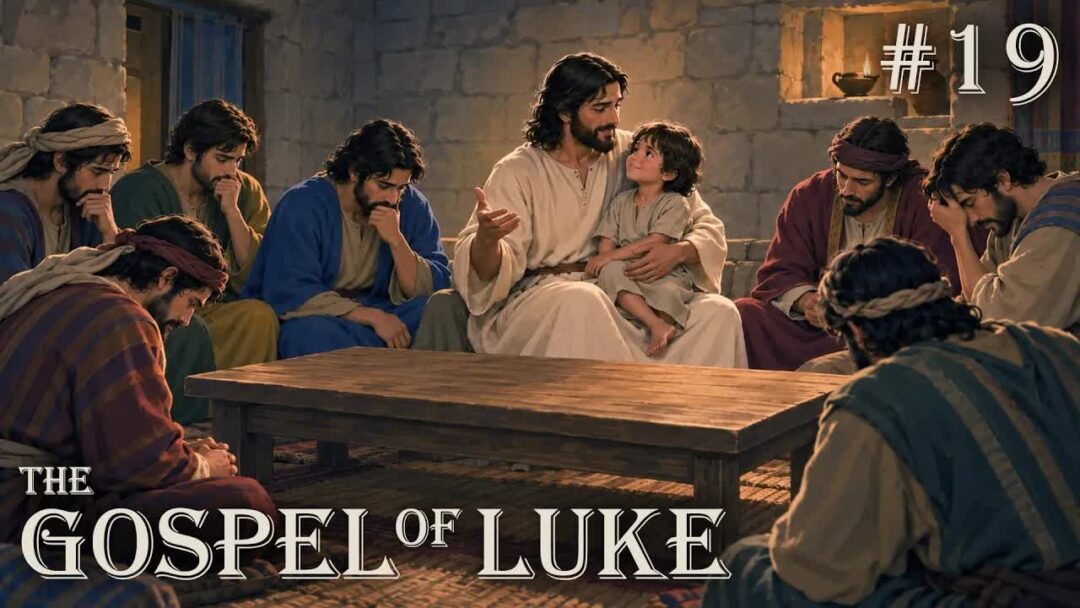
From our Sunday service on October 11, 2026, Luke 9:46-50. This is part 19 of our Gospel of Luke series. Watch the full message: Innocent Humility – The Gospel of Luke #19 on YouTube.
Today’s lesson is going to be a little bit different. We’re still in our series on the book of Luke, but today we’re going to be jumping from book to book through the synoptic Gospels. I’m pulling from the harmonized Gospel book I’m working on, to try to get a clear view of what Jesus was teaching in these passages. If you’re going to turn to any passage, I would encourage you to turn to either Matthew chapter 17 or Mark chapter 9. Those will be the main two we’ll be in.
To help you understand why we’re doing it this way, let me read the few verses we have to work with in Luke chapter 9. Luke wrote after both Matthew and Mark, so he doesn’t need to keep as many details as they do, because if you want those details, you can go there. Here in Luke, Luke summarizes everything that Matthew and Mark talk about, in Luke chapter 9 starting in verse 46.
Then there arose a reasoning among them, which of them should be greatest. And Jesus, perceiving the thought of their heart, took a child, and set him by him, And said unto them, Whosoever shall receive this child in my name receiveth me: and whosoever shall receive me receiveth him that sent me: for he that is least among you all, the same shall be great. And John answered and said, Master, we saw one casting out devils in thy name; and we forbad him, because he followeth not with us. And Jesus said unto him, Forbid him not: for he that is not against us is for us.
Luke 9:46–50
That’s all Luke records. He records a couple of other things in this chapter, but these are three totally separate lessons. So instead of doing three totally separate lessons, let’s take that chunk of Luke and look at the synoptic Gospels together and see what Jesus is really saying there.
If you remember where we left off last time, the disciples failed to cast out a demon because they were trying to do it in their own power. They weren’t praying. They weren’t fasting. They weren’t in utter dependence on God. So they failed to cast out this demon, and Jesus pulled them aside and said, “You couldn’t cast out the demon because you didn’t have faith. If you had faith as a grain of mustard seed, you could command this mountain to move, and it would move. But you did not have it.”
Today we’re picking up that narrative. Jesus was in the area around Caesarea Philippi. He has gathered his disciples together, and now they’re traveling back to Capernaum. This is going to be the last time they’re in Capernaum. After this section of the Gospel, they will set their sights on Jerusalem, and Jesus will spend the next six or so months walking to Jerusalem to go die on the cross. It’s crazy to think that in our series we’re already there. But remember, Jesus was just on the Mount of Transfiguration with Moses and Elijah, and they talked about his decease, his death on the cross, the sacrifice he would make in Jerusalem. After the transfiguration, everything is making its way towards the cross.
So Jesus is now traveling back with his disciples, and a situation is going to arise that he needs to address. From our time looking at that conversation today, God wants you to know this:
Those who serve him must do so in humility.
Who Should Be the Greatest?
First, let’s look at Luke 9:46.
Then there arose a reasoning among them, which of them should be greatest.
Luke 9:46
This verse alone sets up the entire conflict that today’s lesson comes from. Remember, just hours before this verse, they had failed to cast out a demon. And on their way back from being failures, what conversation did the disciples have? “Which one of us is going to be the best? Who do you think’s going to be the most famous?” Come on, disciples. You just whiffed it a couple of hours ago, and now you’re arguing about who’s going to be the greatest.
We’re going to see today that Jesus kind of smacks them around a little bit and wakes them up to the foolishness of this conversation. But he does not interrupt them while they’re having it. He lets them talk their foolishness and addresses it later. Their response to their failure is completely disconnected from the events. They’re prideful. They’re arrogant. They’re not thinking about what they can do for Jesus. What are they thinking about? “What can I do to make myself more noticed, more popular, more famous?”
The Temple Tax
In Matthew 17:24-27, we see an interruption in this narrative as they arrive in the city of Capernaum after being gone for a while. Verse 24 says:
And when they were come to Capernaum, they that received tribute money came to Peter, and said, Doth not your master pay tribute?
Matthew 17:24
When they arrived back in Capernaum, where Jesus’ ministry had been headquartered for its early part, they reached Peter’s home. The man responsible for collecting the temple tax for the temple in Jerusalem visits Peter’s house to collect the yearly tax. This temple tax was a once-a-year tax that only applied to male Jews from twenty years old and above. The fee was what is called a double drachma, a specific coin worth exactly two days’ wages. Every year, the tax collector for the temple would go to each Jewish family, and for every male over the age of twenty he’d take one double drachma coin for the funding of the temple, to take care of its maintenance needs and the operating costs that come with having all the Levitical priests and sacrifices. It’s something you have to do.
It appears that this man happens to be in Capernaum the day they arrive back. He sees the disciples are back. Peter’s married; he’s an older man; he has to pay his taxes. So the tax man comes knocking on the door: “Hey, Peter.” And he asks this question: “Doth not your master pay tribute?”
What appears to have happened is that he knocks on the door, and Peter gives him the coin he owes. But the tax collector says, “Doesn’t Jesus live here with you?” Remember, the Son of man hath not where to lay his head. Jesus doesn’t own his own house, but Peter does have one. So Jesus is staying at Peter’s house, and all the disciples are with him because they just got back into town. “Doesn’t your master pay the tax? One coin isn’t enough. Doesn’t he need to pay too? Does your master not follow the law of Moses? That’s kind of crazy for a rabbi, don’t you think?” So he asks Peter a simple question: “Is Jesus going to pay up on this tax, or is he doing tax evasion today?”
Were the Other Disciples Under Twenty?
What’s interesting here is that the other disciples are not mentioned at all, even though they are clearly here from the context of Scripture. Since Peter was the only disciple who was married, what’s very likely, almost definitely, happening here is that the other disciples are under the age of twenty, so they don’t have to pay the tax. You’ll see at the end that only Jesus and Peter pay the tax. The other disciples don’t, which tells us that the other disciples are under the age of twenty. They’re all teenagers.
Teens, don’t think you can’t do anything for Christ. All the disciples were teenagers when they started. Just ignore for a moment the fact that they just totally messed up and whiffed it. You don’t have to be them. But God called them when they were extremely young to start walking with him in the ministry. So the other disciples aren’t mentioned. The tax collector just needs Peter’s and Jesus’ tax money.
Then Are the Children Free
Peter gives his response to the tax collector in verse 25.
He saith, Yes. And when he was come into the house, Jesus prevented him, saying, What thinkest thou, Simon? of whom do the kings of the earth take custom or tribute? of their own children, or of strangers? Peter saith unto him, Of strangers. Jesus saith unto him, Then are the children free.
Matthew 17:25–26
Jesus says, “Peter, what are you doing? What are you thinking? Why did you just tell him that I pay the temple tax?” Remember what just happened on the Mount of Transfiguration. God just told Peter, James, and John, “This is my beloved Son: hear him.” Who is the temple for? It’s for God. And who is Jesus? The Son of God. “Do kings charge their own sons tax, Peter? No. Didn’t God just say that I’m his Son? The tax is for God, and you want me to pay a tax to myself? Peter, what are you thinking? Have you forgotten what we just learned theologically on the Mount of Transfiguration?” That was probably the biggest moment of Peter’s life, and he’s already not really thinking about it. But that’s okay.
He says the children are free. Those who are the children of God are exempt from the temple tax: “I don’t have to pay this.” Another thing in the Old Testament is that the Levites didn’t pay the temple tax, because they worked in the temple. Those who were doing the service of God in the temple didn’t pay a tax to take care of themselves. So Jesus is saying, “Why would you think we have to pay this? You’re my disciple. You are serving me here. The money is to support God and his disciples and servants.” And then he says, “You’ve made a problem for me here, Peter, but we’re going to deal with it.” In verse 27, he explains how.
Notwithstanding, lest we should offend them, go thou to the sea, and cast an hook, and take up the fish that first cometh up; and when thou hast opened his mouth, thou shalt find a piece of money: that take, and give unto them for me and thee.
Matthew 17:27
Lest We Should Offend Them
Once again, we see they’re only paying the tax for Peter and Jesus, because the other disciples don’t have to pay it, so we know they’re under twenty years old. But Jesus says, “Peter, you’ve already said something wrong. We don’t want the tax collector to go to Jerusalem,” remember, that’s where they’re going next; they’re heading towards Jerusalem, “and by the time I get there, I don’t want the rumor to be that Jesus doesn’t pay his temple tax.” Because when he goes and preaches, the only thing that’s going to come up time and time again is, “Is it true you didn’t pay your taxes this year?”
Imagine if there were a pastor famous for not paying the IRS, and every time he got up to preach, people said, “Weren’t you that guy on the news who didn’t pay his taxes this year?” It kind of distracts from the ministry. So Jesus says, “We don’t want to be a stumbling block here. We don’t want people to trip up over this. I’m going to take care of it. Peter, we don’t have to pay this, but I’m going to pay it anyway.”
“What I want you to do is go cast a hook, a fishing line, into the sea, and you’re going to find a fish.” Remember, they live in Capernaum. We know exactly where Peter’s house was from archaeology. It’s only 400 feet from the lake. So Peter is being pointed to the dock over there: cast a fishing line. The first fish you catch is going to have a silver Attic coin, which is worth four days’ wages, in its mouth. Take that coin from the fish that God provided, and pay our taxes with it. So Peter goes, casts the line, gets the fish out, and pays the taxes, and everything’s good to go.
What Was It That Ye Disputed?
Now that Jesus has this mini crisis about his reputation out of the way, he comes back to them and begins to address the problem that came up on the road. We see this in Mark 9:33-34.
And he came to Capernaum: and being in the house he asked them, What was it that ye disputed among yourselves by the way? But they held their peace: for by the way they had disputed among themselves, who should be the greatest.
Mark 9:33–34
Now that the distraction Jesus knew was coming is gone, he begins to address his disciples and their foolish behavior on the road. When they’re confronted about it, they do the wise thing and keep their mouths shut. They knew what they were talking about was not beneficial for their ministry. They knew it was something they should be ashamed of, and they’d been around Jesus long enough to know that when Jesus asks you a question, he already knows the answer. So they keep their mouths shut and prepare themselves for the lesson that is about to follow. Luke 9:47 tells us this:
And Jesus, perceiving the thought of their heart, took a child, and set him by him,
Luke 9:47
Although no one told Jesus what was going on, it tells us here that Jesus knew exactly what they thought in their hearts. So, as he often does, he grabs an illustration to teach them a lesson. This time he takes a child who’s at Peter’s home and has the child stand beside him to use for this illustration. We see him begin in Mark 9:35-36.
And he sat down, and called the twelve, and saith unto them, If any man desire to be first, the same shall be last of all, and servant of all. And he took a child, and set him in the midst of them: and when he had taken him in his arms, he said unto them,
Mark 9:35–36
I love the way this is pictured. Jesus pulls in the boy and has him standing next to him. He calls in his disciples: “Okay, everybody sit around.” He picks up the child and holds him as he talks. I just love that picture, because he’s going to use this child as an illustration of the believer, and how he cares for and upholds and runs after the believer. He holds this child in his arms as a picture of how he holds the believer in his hands. He wants to teach them a lesson by this child, and he does it in such a loving way that you just can’t help but notice.
Become as Little Children
Matthew 18:3-4 gives us the first words he says to them.
And said, Verily I say unto you, Except ye be converted, and become as little children, ye shall not enter into the kingdom of heaven. Whosoever therefore shall humble himself as this little child, the same is greatest in the kingdom of heaven.
Matthew 18:3–4
The issue here was that they were arguing about who would be the greatest and most famous one of all, and Jesus wants to take their expectations of what greatness is and flip them on their head. So he’s very straightforward with them: “Except ye be converted.” In the Greek, that literally means to turn around. Figuratively, it means, “Unless you change yourself and become humble like this little child, you will not enter the kingdom of heaven.”
Now, this little child, based on the word used, was very young. He’s at that age where you adore and trust your parents as if they are the wisest and most amazing people in the world. How many of you parents loved that phase when your kid was just in awe? “Daddy is the smartest! Daddy knows everything! Mommy knows everything!” That’s the age this child is at. They see their parent and just love them fully. There’s no restraint in that love. There are no barriers. There’s no “I know better than you.” When they become teenagers, that’s a constant problem. But here it’s this sweet adoration. They have a humility, a dependence, a teachability, and a trust that you just don’t have in any other phase of life.
Jesus says, “Unless you are converted, unless you turn around your perspective on greatness and become like this little child, you will not enter the kingdom of heaven.” These children didn’t care about being the wisest or the most important person in the room. Nothing to them was a contest. They just wanted to enjoy life with the people they loved. Luke 9:48 continues:
And said unto them, Whosoever shall receive this child in my name receiveth me: and whosoever shall receive me receiveth him that sent me: for he that is least among you all, the same shall be great.
Luke 9:48
Jesus is saying that if you can embrace the attitude of positivity and innocence of this child, then you can accept the Father and me, because by accepting me you accept the Father. This child demonstrates humility, dependence, teachability, and trust, and we need to have those same attributes when we’re dealing with our heavenly Father. So the one who has humbled himself like this little child is the one who’s going to be the greatest among you. Why? Because he emulates the characteristics of the Father in heaven.
A Real Danger
So Jesus says you need to humble yourself, because there’s a real danger that you will miss the kingdom of heaven because you’re focused on the wrong thing. Let me remind you that not all the disciples sitting in this circle are going to make it into heaven. One of them, named Judas, is going to betray Jesus, and he’s not going to make it.
So when Jesus says, “Unless you change your mind to become like this child,” he is giving them a very real danger. It’s not a hypothetical. It’s not just to get their attention. It’s just honesty: “If you can’t change your perspective and realize that you need me, and that it’s not about you, disciples, it doesn’t matter how many people you tell about me. It doesn’t matter if you go to Capernaum and to Jerusalem and to Galilee and Judea and preach to everybody about me and what I want, if you can’t get it in your own heart.” Because what is Judas going to do? He was one of those who went out two by two. He preached the gospel. People probably got saved. But God says, “Unless you do what I want you to do, it doesn’t matter, because you’re going to be in hell, because you didn’t do what was right. You just preached for others to do it.”
Forbid Him Not
He gives them this true, serious warning, and John interjects with a question in Mark 9:38. He realizes that, with these things being said, he may have slipped up.
And John answered him, saying, Master, we saw one casting out devils in thy name, and he followeth not us: and we forbad him, because he followeth not us.
Mark 9:38
John brings up an occurrence that happened while he and the other disciples traveled two by two preaching throughout Galilee. At some city on their trip, they ran into somebody who didn’t follow Jesus or the disciples but had seen Jesus do these miracles. Although he didn’t travel with the disciples, he was still preaching in the name of Jesus, and he had cast out demons in the name of Jesus, showing that he really did have the power behind him.
What’s crazy is that just a few days earlier, the disciples had failed to cast out a demon in Jesus’ name. Yet this man they saw on the road, who didn’t follow with them, did do it, because he had the faith required to do the miracle. John says, “We may have messed up, because he was preaching in your name and he did miracles. And with what you’re telling us now about faith like a child, and this illustration about not fighting over who’s best, I’ve got to admit, we kind of fought over who’s best, and we told this guy not to go because he’s not associated with us.” So he asks Jesus, “Did we do the right thing, or did we mess up?” Jesus answers that question in verses 39 through 41.
But Jesus said, Forbid him not: for there is no man which shall do a miracle in my name, that can lightly speak evil of me. For he that is not against us is on our part. For whosoever shall give you a cup of water to drink in my name, because ye belong to Christ, verily I say unto you, he shall not lose his reward.
Mark 9:39–41
“For he that is not against us is on our part.” Another way you could translate that is, “Those who are not against us are for us,” or on our behalf.
Jesus did not give John the answer he was hoping for. I’m sure John was hoping, “Lord, please tell me we didn’t mess up. Please tell me our pride didn’t get in the way in this moment and we didn’t just hurt somebody who is actually serving you.” But Jesus doesn’t give him the news he wants. He says, “Forbid him not.” There’s no one who can do miracles in the name of Jesus who can also speak evil about Jesus. If you see God working through them and doing wonderful things, then they have to be sincere followers, because God doesn’t do miracles for insincere ones. “You learned that the hard way, didn’t you? You couldn’t cast out the demon because you were insincere. Yet this one who preached in my name was sincere, and you told him to stop because he wasn’t socially associated with what’s called the twelve disciples.”
Don’t Judge by Labels
We’ve got to be careful, Christians, that we don’t pick up this same mentality: “They’re not a Baptist like us. They’re not an evangelical like us. They’re not a blank like us.” We’ve got all these labels, and we start judging people based on labels and titles. Well, I’ve got something to tell you. Not everybody who goes by a different label is all that different from you. Just because they don’t have everything in their life perfect doesn’t mean they’re not a representative of Jesus Christ. It doesn’t mean we should condemn them and call them out as frauds. What we need to look at is the fruit of their ministry, because none of us are perfect.
That’s what the disciples missed. They kept overlooking their own shortcomings and started trying to pick out all the shortcomings other people had: “We’re disciples by title. Jesus picked us. He didn’t pick him, so that makes us better.” No, we can’t judge by labels. That’s what mankind does that God doesn’t do. We’re warned time and time again not to fall into the trap of looking on the outward appearance and outward labels, but to look on the heart, because there is sincerity in places you may not expect it.
It was this foolish, competitive ideology that Jesus is speaking against. It led them to condemn a man who was doing good. Had they had the innocent humility of a child, they would have seen him as the ally he was. Jesus follows this up with an example: even someone who gives a cup of water in his name will have a reward for it. So do not condemn those doing good in the name of Jesus.
A Millstone About His Neck
We see more of a warning in Mark 9:42.
And whosoever shall offend one of these little ones that believe in me, it is better for him that a millstone were hanged about his neck, and he were cast into the sea.
Mark 9:42
Jesus compares the man they confronted to this little child, who demonstrated faithfulness. He had just said that the little child represents the believer who is faithful, the one who has accepted Jesus on the terms on which he calls you to accept him: in humility and reliance and dependence and faith and love and truth. He says the person you corrected is this little child. “Here’s something you need to be careful about. Whoever offends one of these little ones, one of my faithful followers who believes in me, it’s better for him that a millstone were hanged about his neck and he were cast into the sea and drowned.”
Why? Those who cause other genuine Christians to stumble need to be careful, because God is going to judge them harshly for it. Careful, Christian. Careful. If you cause another Christian to stumble, God does not look on that and just let it slide. If you trip up a faithful follower because of your arrogance, because you think you’re doing better than them, and you get all judgy with them, and instead of lifting them up to where they should be, you cause them to trip and fall even harder, guess what? God’s going to hold you accountable for that. God’s going to say, “Christian, it ought not to be that way.”
If Thy Hand Offend Thee
And he makes it even more severe. In Mark 9:43-48, he gives them a challenge.
And if thy hand offend thee, cut it off: it is better for thee to enter into life maimed, than having two hands to go into hell, into the fire that never shall be quenched: Where their worm dieth not, and the fire is not quenched. And if thy foot offend thee, cut it off: it is better for thee to enter halt into life, than having two feet to be cast into hell, into the fire that never shall be quenched: Where their worm dieth not, and the fire is not quenched. And if thine eye offend thee, pluck it out: it is better for thee to enter into the kingdom of God with one eye, than having two eyes to be cast into hell fire: Where their worm dieth not, and the fire is not quenched.
Mark 9:43–48
I don’t think we usually look at this passage in the context of where it’s being spoken. Jesus isn’t talking to the Pharisees here. He’s talking to his disciples. He’s telling them, “If your hand is causing you to stumble, because you want a little bit more money or something, and you want to take for yourself, and that’s what’s tripping you up in your Christian walk, and your actions are tripping up your brother, guess what? Cut it off.” Because it’s better for you not to cause other people to stumble than to be cast into hell.
These disciples haven’t accepted Jesus yet. That’s the shocking thing. Jesus is telling them, “You haven’t arrived yet. I haven’t died on the cross yet. You’re not saved yet. And the problem is, if you get too prideful, by the time the cross comes, you’re not going to have the humility to accept me.” So he says, “Get this straight. You need to humble yourself now, or you’re going to have a problem later.”
If your hand is causing you to be selfish, and it’s going to be something you can’t let go of, it’s better for you to have no hands than to end up in hell because you couldn’t control them. If your foot causes you to stumble, if you’re going places you shouldn’t go, it’s better for you to cut off your leg than to have it draw you away from Christ and keep you from getting saved. If your eye offends you, if you’re lusting after things you shouldn’t be, it’s better for you to be blind than to have those sins draw you away to the point that you won’t accept Christ because you can’t give them up.
I think it’s wild that Jesus is talking to the disciples in this moment, but he is. He says, “It’s possible for you to say you’re following me and still not have accepted me.” No matter what part of your flesh is causing you to trip up, you need to cut it off, cut it out, remove it as far from you as possible, because the things that will trip you up are a real danger to you. Here Jesus is specifically talking about that petty desire they have to lift themselves up instead of God. The real danger was that these disciples could walk with Jesus and believe he is the Messiah, but when he dies on the cross, still go to hell because they never repented of their sins and humbled themselves.
I know it’s hard to wrap our heads around the idea that the disciples could go to hell. But you’ve got to remember, one of them did. Judas did. He believed Jesus was the Messiah. He betrayed him for silver. He regretted it, and he still never repented. What did he do instead? He went and hanged himself. There’s no indication that Judas ever repented of his sins or is going to make it to heaven. There’s a real danger that you can walk in God’s name and have nothing to do with him at all. At the end of the whole journey, you could still be condemned for your actions.
Their Angels Do Always Behold the Face of My Father
Matthew 18:10-11 continues:
Take heed that ye despise not one of these little ones; for I say unto you, That in heaven their angels do always behold the face of my Father which is in heaven. For the Son of man is come to save that which was lost.
Matthew 18:10–11
A lot of times we misread this passage. We see that Jesus won’t despise these little ones, and we say, “Oh, Jesus loves the little children.” He does. But that’s not what the passage is talking about. The little children are believers. It’s you. It’s me. Jesus says, “Be careful that you don’t despise one of these faithful followers, because I say unto you that in heaven there are angels who always behold the face of my Father which is in heaven.” He’s talking about us Christians. He’s talking about our walk with God.
And what happens when somebody causes that faithful Christian to stumble? What does Jesus do? “For the Son of man is come to save that which was lost.” We’re encouraged in this section by the fact that God commands his angels to look over his believers, his little ones whom he loves. When God sees one of his faithful little ones discouraged by the sinfulness of the world or by the foolish speech of another believer, what does God do? He goes out and seeks the one who has been tripped up and has stumbled and wandered away: “I myself, Jesus, will go and find them.” Look at the verses that follow, in verses 12 through 14.
How think ye? if a man have an hundred sheep, and one of them be gone astray, doth he not leave the ninety and nine, and goeth into the mountains, and seeketh that which is gone astray? And if so be that he find it, verily I say unto you, he rejoiceth more of that sheep, than of the ninety and nine which went not astray. Even so it is not the will of your Father which is in heaven, that one of these little ones should perish.
Matthew 18:12–14
The Shepherd Goes After the One
Here’s the comfort for us today, Christian. If you are not the one who is acting like a Christian but not being one, if you’re not the one who’s a fake or a fraud, then God has comfort for you. He says, “What do you think? Let’s have an illustration.” It’s the parable of the good shepherd coming back in a different style: what man who has a hundred sheep wouldn’t leave the ones that are safe in the pen and go find the one that got out and got into danger?
Jesus says, “I’m like that shepherd. When one of my faithful followers is tripped up, I’m going to leave all those who are doing fine, and I’m going to go after that one who’s in danger, the one who’s tempted to make some mistakes, who maybe has made some mistakes, who is really playing with fire, really playing with danger in their life. I’m going to go after them, and I’m going to pursue them.”
Christian, Christ will pursue you in your moment of weakness. He will come to you in your moment of weakness and say, “I see you’ve gone astray. I see you’re in danger, my little one,” the one he holds in his arms and carries. “Let me bring you home.” That should be a comfort for us today. Verse 13 says, “And if so be that he find it, verily I say unto you, he rejoiceth more of that sheep, than of the ninety and nine which went not astray.” When that one lost follower is restored, Jesus will rejoice more over the one who has been restored from his wandering than over all those faithful followers who never struggled at all.
Christian, the Lord loves you and values you. He is seeking you and pursuing you to restore you in your time of weakness. And remember that he does the same for others as he does for you. Be careful that you don’t cause others to stumble by your actions, because God loves his little children. Christ loves his faithful ones. So love them as well.
Serve in Humility
To tie everything together today: the disciples were so concerned with being the greatest that they forgot what it really looks like to follow Jesus. They wanted the recognition. They wanted the importance. They wanted the authority. But Jesus wanted them simply to be humble servants who loved him as a little child loves his mother and father.
To address the problem, he taught them to have the humility of a child, to stop competing with others who served God, and to be careful not to cause others to stumble. Finally, he reminded them that every one of his followers is precious to him, even those who have wandered astray.
So the question we need to ask ourselves today is this: are we serving God to bring glory to him, or are we serving him to bring attention to ourselves? God wants you to know that those who serve him must do so in humility, because in God’s kingdom, greatness isn’t measured by how many people serve you, but by how willing you are to serve others. So will you choose to be a humble servant today?

Recent Comments