
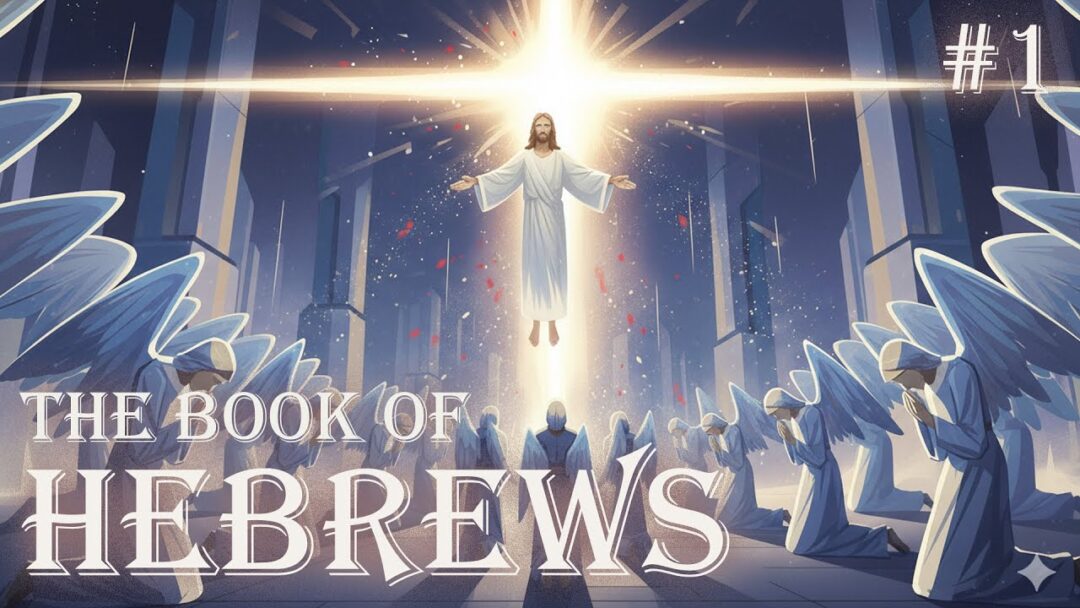
From our Sunday service on February 1, 2026, Hebrews 1:1-2:1. This is part 1 of our Hebrews series. Watch the full message: He Has Spoken – Hebrews Series #1 on YouTube.
Today we’re beginning the book of Hebrews, and we’ll continue in Hebrews over the next few weeks. Hebrews is all about how great Jesus is. It’s probably one of my favorite books in the Bible. It’s theologically rich, and it explains many of the ways Jesus fulfills the Old Testament. Because of that, it’s crucial for our walk with God and really important for us to wrap our heads around just how much Christ did for us. Before we get into the book, though, it would be good to know a little about it so we can put ourselves in the right mindset to study it.
When Was Hebrews Written?
Hebrews had to be written before AD 70, because it talks about the temple as if it still functions. For those who don’t know, the temple in Jerusalem was destroyed in AD 70, when the Romans came in and destroyed it. Since the author of Hebrews writes about persecution of the church, and also writes about temple practices as if they’re still going on, that puts us in about a two-year range: AD 64 to AD 65. Knowing that date range tells us a lot about the intentions behind the book. It gives us an insider’s perspective, which will help us draw more proper conclusions.
Who Wrote Hebrews?
There’s a lot of debate about who wrote the book of Hebrews. Some say it’s Paul. Some say you can’t know. Some say we do know and it wasn’t Paul. Here are some things we know about the author.
The author was a highly educated Jew, educated in both Greek and the Old Testament. He was highly educated not just in the Torah, the old laws and the history of Israel, but his Greek is some of the best-worded, most sophisticated Greek in all of the New Testament. That means this couldn’t be just any of the disciples. The disciples were from Galilee, and Galileans, they say, talk funny because they don’t pronounce words correctly, so to speak. The disciples didn’t have sophisticated language. So we know it wasn’t a disciple. It had to be someone educated, which would put someone like a Pharisee like Paul up for nomination, because they had this deep education.
We also know the author of Hebrews was familiar with Paul’s friend Timothy. He mentions Timothy by name in the book, which means this person had to be associated in some way with the mission work and church planting going on in early Christianity. He was friends with Timothy, which you would assume also means he knew Paul in some way. Or maybe he was Paul.
Unfortunately, he probably was not Paul. Why? If you do a linguistic study in the Greek, you’ll find that Paul and the author of Hebrews use very different wording. There’s a thing in technology called linguistic analysis. I won’t get into the details, but it can give you a match of someone’s writing style on a percentage scale. If you take all the writings of Paul and put them in to see if Paul wrote them, they all come out at 99.5% and above. If you put Hebrews in, it’s a 47% match for the writing style. Some people will say, “Well, maybe Luke wrote it down and Paul spoke it in Hebrew.” Now we’re kind of stretching. Why would Paul write one book in Hebrew but none of the other ones? It doesn’t match his writing style, so it probably wasn’t Paul.
Then who was it? We have a few other popular candidates. Some would say it’s Barnabas, who went with Paul on his missionary journeys. We have a supposed writing of Barnabas. It’s not in our Bible; it’s not Scripture. But we know his writing style, and it’s sort of similar. It can’t be Barnabas, though, because the Bible calls Barnabas an apostle, and the author of Hebrews says that he never met Jesus while Jesus was alive on the earth.
Some people would say it’s Luke, who translated it for Paul. But the way Luke writes is totally different. In Luke’s writings, he always introduces who he’s writing to, and he always has an introduction. The book of Hebrews has no introduction, nor any of the stylings of Luke.
So who was it? I would propose that it was written by Apollos. I think he is our best candidate, and Acts 18 tells us about him. We’re looking at this at the beginning so that as we go through the series, you can decide for yourself who you think wrote it. But I want to put forth what I think is right, along with my reasoning, so you can keep an open mind going through it and see whether what you see here in Acts 18 matches.
And a certain Jew named Apollos, born at Alexandria, an eloquent man, and mighty in the scriptures, came to Ephesus. This man was instructed in the way of the Lord; and being fervent in the spirit, he spake and taught diligently the things of the Lord, knowing only the baptism of John. And he began to speak boldly in the synagogue: whom when Aquila and Priscilla had heard, they took him unto them, and expounded unto him the way of God more perfectly. And when he was disposed to pass into Achaia, the brethren wrote, exhorting the disciples to receive him: who, when he was come, helped them much which had believed through grace: For he mightily convinced the Jews, and that publickly, shewing by the scriptures that Jesus was Christ.
Acts 18:24–28
What do we know about Apollos? When Aquila and Priscilla met him, he had only known the baptism of John. That means he never met Jesus. He didn’t know that the Messiah John the Baptist pointed to had come. But Aquila and Priscilla said, “Apollos, you’re waiting for the Messiah. He came. Let us tell you about him.” Apollos knew the Old Testament, and they taught him about Jesus. He converted immediately, and he began to teach the people, showing how Jesus Christ, the Messiah, fulfills the Old Testament. And he helped the whole church. Keep that in mind as we look at the book of Hebrews, because I would propose that this passage is talking about his writing of the book of Hebrews.
So I think our best guess for who wrote the book is Apollos, that disciple of Paul who was saved at the church of Aquila and Priscilla, recorded in Acts 18. And I believe this is his writing to the Jews.
Who Was It Written To?
That answers our next question. Hebrews was written to Jewish Christians who were familiar with the Old Testament and were tempted to drift back into Judaism rather than follow Christ, due to pressures and persecutions. The purpose of Hebrews is to say one specific thing: Jesus is better than what you had before, so don’t turn back. Today we’re going to look at the opening of Hebrews, at what I believe is Apollos’s opening essay explaining why the book is so important.
God wants you to know that what Christ has for you is better than anything else.
The Historical Setting
I said AD 64-65 is the only date range where this really makes sense. So put yourself in the mind of the readers. It’s been about 30 years since Jesus Christ ascended to heaven. The gospel has made it all around the Roman Empire, and Christianity is on the rise. However, you look around and realize that the persecution of Christianity is getting worse. The Jews are beginning to shun Christians, seeing them as cult members instead of fellow Jews. And the Roman leadership is getting very uncomfortable.
Your church used to receive letters from Paul while he was on his missionary journeys. But over the last year, Paul was arrested and taken to Rome, and the last you heard, he was under house arrest with no hope of release. You heard the apostle Peter might be writing a letter to encourage the church to persevere in this persecution, but you haven’t received it yet.
You begin to wonder: Is it worth it to be a Christian? Is it worth it to be shunned by my family? Is it worth it to be hated by the Roman government? The Roman government hates us, especially this emperor Nero we’ve had for the last few years. What if I just walked away from Christianity? Wouldn’t that make things easier for me? I’d have less to worry about. I’d have peace with my family. I wouldn’t have to worry about persecution from the government. What if I just walked away from it all? Then one Sunday you walk into church and you receive a letter that begins like this:
God, who at sundry times and in divers manners spake in time past unto the fathers by the prophets, Hath in these last days spoken unto us by his Son, whom he hath appointed heir of all things, by whom also he made the worlds; Who being the brightness of his glory, and the express image of his person, and upholding all things by the word of his power, when he had by himself purged our sins, sat down on the right hand of the Majesty on high; Being made so much better than the angels, as he hath by inheritance obtained a more excellent name than they.
Hebrews 1:1–4
God Has Spoken by His Son
Here we get to the introduction of Hebrews with no introduction. Like I said, Luke always writes an introduction. The author of Hebrews doesn’t. There’s no “Greetings to the church” from Paul. He goes straight into the sermon. “God, who at sundry times and in divers manners spake in time past unto the fathers by the prophets.” Sundry times and divers manners means at various times and in various ways. He says, “Jews, believers in the Old Testament: at various times and in various ways God has spoken by the prophets. You believe the Torah. You believe the law of Moses. You’ve heard the prophets and what they said, and you trust it. But don’t give up, because God has now spoken to us by his Son.” Not a prophet, not a teacher, not an angel, but his own Son, “whom he hath appointed heir of all things, by whom also he made the worlds.”
Just as God had used the prophets of old, he has now sent his Son Jesus, who inherits all the promises of the prophets and who was also the force of God that created the universe. The author is saying, “If you value the Old Testament teachings, how much more should you value the one who created the universe, and what he has to say? Sure, it might be tempting to avoid persecution and walk away from Christianity, but do you understand, believer, what you’re giving up when you walk away from the faith? God has sent a messenger, his own Son, God himself in the flesh, the one who spoke the world into existence.”
In the beginning was the Word, and the Word was with God, and the Word was God. The same was in the beginning with God. All things were made by him; and without him was not any thing made that was made.
John 1:1–3
The Word God spoke when he said, “Let there be,” was Jesus Christ. So the author says, “Christian, do you understand who you’re giving up?” The very breath of God that spoke the world into existence is the one who has taught you what you should believe.
Remember, too, that the prophets had been missing for over 400 years. He says the prophets spoke “in time past,” and the Jews know it was in time past, because for 400 years before Christ, and now 460-plus years, there had not been a prophet in Israel other than Jesus. He’s asking, “Do you want to go back to what’s old, what’s rotten, what’s dead? Do you understand that the Jewish religion as it was is gone?” Jesus says there’s not going to be any more prophecy. He says at the end of this generation everything’s sealed up, everything’s accomplished, and it will be in the last days. “Do you understand that what you’re waiting for in Judaism is empty? No more prophets are going to come. No more teachings are going to come. You’ve received it. Do you really want to go back to what’s dead and gone?”
Who Jesus Is
In verses 3 and 4 he tells us a little about who Jesus is. Let’s look at those descriptions one by one.
The Brightness of His Glory
He is the brightness of God’s glory. In other words, he is the visible light of the divine glory of God. Remember when Moses was on Mount Sinai and God’s glory passed in front of him? There’s that brightness. Moses couldn’t see God’s face, because he would die if he saw it. But God said, “I will let you see my glory.” When Jesus came, he did the same thing. He is the glory of God on earth. We never see the Father on this earth. We can’t see the Father and live. But Jesus Christ was the glory of God made flesh, who lived on this earth, whom you could see with your own eyes and touch and talk to. God came to us. He is better than the Old Testament. The best we ever got there was some light and a voice. But when Jesus came, we could touch and talk and hug and embrace him.
The Express Image of His Person
He is also “the express image of his person.” You could say he’s the exact imprint of God’s nature: the second Adam, who succeeded where Adam failed, a perfect representative. When you see the words “created in the image of God,” you need to understand the idol culture of the day. Idols, or images, were a representation of where a god’s presence dwelt. When God created man, he created man in his own image. In other words, he created him to represent God on the earth. When you look at man, you’re looking at God’s representative.
So Jesus, like Adam, was made in the image of God; he was God’s representative. But Jesus wasn’t just a partial imprint of God’s nature. Adam fell into sin. Adam and Eve both sinned; they failed as representatives. Jesus is a new image of God, the exact copy, not a knockoff, but fully God, the express image of God’s nature. He was the second Adam, the representative who didn’t fail. Hebrews will later say he was tempted as we are, yet without sin. Jesus Christ is the example of what mankind is supposed to be. When he walked on earth, he set a perfect example for us to follow.
Why would we want to follow the old teachers? Why would we want to follow human leaders like Moses, who struck the rock and fell short, or Gideon, who made a cult? Why would we worship human leaders when we have the express image of God to follow as our example?
Upholding All Things
He upholds “all things by the word of his power.” In other words, creation was created by God’s word, and it continues to exist through Christ’s will.
And he is before all things, and by him all things consist.
Colossians 1:17
Why would we want to give up Christ, when Christ is the one who upholds all of reality? If Christ wanted to let the entire universe go, it would cease to exist. Why wouldn’t you want to follow the one who holds all of existence in his hand? What could be more powerful? What could be more wise? What could be more loving than the one who upholds and cares for all things?
This is also a statement that proves Jesus Christ existed before his birth and was not created. Some people of the day said, “Jesus was just another prophet. Jesus was just another teacher.” Here the author of Hebrews says, “No, don’t be confused. Jesus wasn’t just another teacher. He is God. He is the one who upholds the universe.” That’s not something any normal teacher does.
The Purger of Our Sins
Then he says Jesus “by himself purged our sins.” Here he’s reflecting back on the temple sacrifices. Under Old Testament law, you had to give a sacrifice for your sins regularly. That sacrifice would temporarily cover your sins. It would make atonement and bring you unity with God until you sinned again, and then it was ruined. But he says Jesus purged our sins. That’s different from covering. It means to completely remove. Jesus Christ didn’t just temporarily cover our sins like the Old Testament sacrifices. He removed them. He removed them as far as the east is from the west. Why would you want to give up the only thing that can remove sins, the only thing that can free you from guilt, the only thing that can give you a second chance in your life?
Seated at the Right Hand
Then he “sat down on the right hand of the Majesty on high.” He reminds the reader that Jesus is enthroned in the place of highest honor and authority. Why would you follow the earthly teachers and what they say? The Sadducees, the Pharisees and the scribes may sit in the high seats of the synagogue or the Sanhedrin, but do you know who sits at the right hand of God? Jesus Christ. Why would you follow a politician or a preacher or a president or a group or a teacher for authority, when you’ve received the greatest authority in all of existence, God himself, the upholder of the universe, who taught us what we should be?
Better Than the Angels
Verse 4 says he was “made so much better than the angels, as he hath by inheritance obtained a more excellent name than they.” In Greek and Hebrew, the word for angels just means messengers in general. It can mean pastors and prophets, and it can also mean divine angelic beings. Probably both are meant here. Jesus’s inheritance is better than the angels’, whether that means messengers like Moses, who received the word on the mountain, or the angels speaking to certain of the patriarchs. Why would you care more about what the angels say? Gabriel may have come and talked to Daniel, but God himself came and spoke to us. Why would you want to worship an angel or a person when you have the highest authority of all, Jesus Christ?
By inheritance he has obtained a more excellent name than they have. Jesus isn’t like the other sons; we’ll talk about that in a moment. Jesus has the name and title of the Son. He is not a son or a child. He is the Son. Angels and humanity are called the sons of God, but not by nature. It’s through adoption and ownership. Only Christ is the Son of God by nature, and verses 5-12 tell us about that.
For unto which of the angels said he at any time, Thou art my Son, this day have I begotten thee? And again, I will be to him a Father, and he shall be to me a Son? And again, when he bringeth in the firstbegotten into the world, he saith, And let all the angels of God worship him. And of the angels he saith, Who maketh his angels spirits, and his ministers a flame of fire. But unto the Son he saith, Thy throne, O God, is for ever and ever: a sceptre of righteousness is the sceptre of thy kingdom. Thou hast loved righteousness, and hated iniquity; therefore God, even thy God, hath anointed thee with the oil of gladness above thy fellows. And, Thou, Lord, in the beginning hast laid the foundation of the earth; and the heavens are the works of thine hands: They shall perish; but thou remainest; and they all shall wax old as doth a garment; And as a vesture shalt thou fold them up, and they shall be changed: but thou art the same, and thy years shall not fail.
Hebrews 1:5–12
Here the author of Hebrews gives us a series of Old Testament prophecies to define what the sonship of Jesus is all about. I think most of us can agree we’re not super familiar with all the Old Testament teachings. As Christians, we focus more on the New Testament. So let’s look at them one by one and see what he’s telling us.
The Son by Nature
Verse 5 says, “For unto which of the angels said he at any time, Thou art my Son, this day have I begotten thee?” This comes from Psalm 2:7.
I will declare the decree: the LORD hath said unto me, Thou art my Son; this day have I begotten thee.
Psalm 2:7
The word begotten is used to describe a unique attribute of Christ. In the Hebrew, it refers to the process of giving birth or delivering a child, and it’s used of mothers, fathers and midwives for their role in that process. In the Greek, this verse functions the same way: “To which of the angels has God said, ‘I have delivered you; I have brought you forth’?” You may remember John 3:16: “For God so loved the world, that he gave his only begotten Son.” In Greek that word is a little different. It’s the word monogenes, which means once made, unique, one of a kind. All these words point toward the uniqueness of Christ, and how his relationship with the Father is different from anyone else’s.
Christ was begotten. That means he was brought forth purposefully. He was once made, unique, one of a kind. When God begot him, that act of begetting never happened again. When God made the angels, it wasn’t the same thing. When he made mankind, it wasn’t the same thing. It’s unique. Why? Because Jesus Christ is the exact imprint of God’s nature. He isn’t begotten in the sense that he is created. He’s begotten in the sense that he is the nature of God. He is a Son by nature, not through adoption and not through creation.
When we are called the sons of God, it says first that we are his offspring. Then, when we believe in Christ and put our faith in him, we are made sons through what is called the adoption of sons. That is to say, we weren’t sons of God by nature, but through Jesus Christ we become sons and inherit what he has. What does that mean? When we die, we’re going to get glorified bodies. As Christ was glorified, we will be glorified. We will partake of the divine nature when we are made like God in heaven. Jesus doesn’t have to go through that process of being made like God. Why? Because he is by nature the Son of God. He is fully God and fully man.
What about the angels? They were created as well. They haven’t existed forever; God created them. Do they partake fully of the divine nature? Absolutely not. Look at Satan. He rebelled and fell. Angels don’t have by nature what God has. They’re not sons by nature. But that should be an encouragement to us: God has wanted to make us sons in the same way that Jesus is the Son of God. God wants to make us like his nature, the way it was meant to be in the beginning.
Verse 5 continues, “I will be to him a Father, and he shall be to me a Son.” That comes from 2 Samuel 7.
He shall build an house for my name, and I will stablish the throne of his kingdom for ever. I will be his father, and he shall be my son.…
2 Samuel 7:13–14
This is a prophecy about the line of David. When David was anointed by Samuel, he was meant to be in the line of the Messiah. God says, “David may not live forever, but one day there’s going to be someone from the line of David.” That’s going to be Jesus Christ. He’s going to be born of a virgin. He’s going to come into the world, and God will set up a kingdom that will never end. Once again he says, “I will be his father, and he shall be my son,” defining that unique relationship.
Worshiped by the Angels
Verse 6 says, “And again, when he bringeth in the firstbegotten into the world.” Who’s the firstbegotten? And why is he the firstbegotten? He’s the firstbegotten because by nature he has always been the Son of God. God the Father, God the Son and God the Holy Spirit have always existed. How can there be a son before the one who has always existed? There can’t. Jesus is the first Son. He’s the only begotten Son.
“When he bringeth in the firstbegotten into the world, he saith, And let all the angels of God worship him.” What is this talking about? This is talking about Deuteronomy 32:43: “Rejoice ye heavens with him, and let all the angels of God worship him.” Whom do angels worship? Remember, every time in the Bible an angel appears and a man tries to worship the angel, what does the angel say? “No, I am a fellow servant. Worship God, not me.” But here, in this passage about the Messiah, it says the Messiah would be worshiped by the angels. What does that tell us about the Messiah? It means the Messiah is higher than the angels. If the angels say only God should be worshiped, then the Messiah himself is God. So the author of Hebrews is telling these people, “Do you understand that the Messiah is God? To reject the Messiah and walk away is to reject God himself and everything he has.”
The Angels Are Servants
Verse 7 says, “And of the angels he saith, Who maketh his angels spirits, and his ministers a flame of fire.” This comes from Psalm 104:4.
Who maketh his angels spirits; his ministers a flaming fire:
Psalm 104:4
He’s saying, “You’ve heard about the messengers of the Old Testament. You’ve seen the angels that came and defended Israel. You’ve seen them do miraculous things, how they could defeat armies. But do you know what angels are? They’re ministering spirits.” In other words, they’re servants.
In first-century Judaism, angels got to be this whole thing. During the intertestamental period, those 400 years of silence, people started making up fan fiction about angels. They came up with names for angels and all the cool things they did, and there became this cult of angelology. People were obsessed with angels. And the author is saying, “All those angels you want to go back and celebrate: do you know that they’re just servants? Do you understand that you’re excited about a waiter?” You think angels are so great, but Jesus is the one the angels serve. Why are you excited about the servant and not the master? Why are you excited about the creation and not the Creator? All the angels that have done all these miraculous things are just ministers God sends to help us. Why are you distracted by them?
The Eternal King
Verses 8 and 9 point us to Psalm 45:6-7.
Thy throne, O God, is for ever and ever: the sceptre of thy kingdom is a right sceptre. Thou lovest righteousness, and hatest wickedness: therefore God, thy God, hath anointed thee with the oil of gladness above thy fellows.
Psalm 45:6–7
If you look at this passage in context, we see that it’s God talking about himself. So you ask, why is God talking to God here? I’m sure people in the Old Testament were confused. How is God anointing himself? Why is God talking about how his throne is for ever and ever, and “God, thy God, hath anointed thee”? God is God’s God, and he anoints himself. That would have been very confusing in the Old Testament. But here the author of Hebrews says, “Do you understand that the Messiah, Jesus Christ, who walked among us, was God, but was also man?” And so God, as the Son and the Father, anointed the Messiah to be the King of Israel.
Do you understand that? By walking away from Christianity, you’re walking away from the King of kings and Lord of lords, the sovereign one who rules over all things, who has the final say on whether something is allowed in the believer’s life, and the final say on whether judgment will come upon a nation. Do you really want to give up the King of kings and Lord of lords just so you don’t have to have some conflict with your neighbor, your friends and your family?
The Unchanging Creator
Verse 10 brings us to Psalm 102:25-27.
Of old hast thou laid the foundation of the earth: and the heavens are the work of thy hands. They shall perish, but thou shalt endure: yea, all of them shall wax old like a garment; as a vesture shalt thou change them, and they shall be changed: But thou art the same, and thy years shall have no end.
Psalm 102:25–27
Here the author ascribes these actions to the Son, because the psalm was written about God and about when the time of the Messiah would arrive. It’s talking about the second coming. All of mankind, all the servants of God, eventually grow old like your clothes. Everybody knows clothes don’t last forever. Eventually they get holes and you have to throw them out. That’s how humans are. We only live so long. We start wearing out, things start failing, and one day, like an old garment, the body won’t be usable anymore. It will die. But it says God will fold them up and transform them into something else. “They shall be changed.” This is talking about the resurrection. If you’re a believer, you’ll be changed. You’ll be transformed in glory, and you’ll be in heaven and in the new world with the Lord.
The Messiah is the one who does this. Jesus cannot change. He was always God. He was always the Son. If you want to be one of those who are changed, you have to believe in the Son who causes the change. Believer, why would you walk away from Christianity when you know that one day you’re going to wear out and have to meet your Maker? What are you going to say when you stand before God and he says, “Why did you walk away from me? Why did you choose peace with your neighbor who hated me over following me? Why did you choose a better-functioning business over standing by my teachings? Why did you reject my Son for comfort?”
Here the author of Hebrews is begging the reader: don’t give up all that Christ has offered you. Don’t give up all that the Old Testament has promised you for a little bit of comfort right now. What God is offering is so much better.
Seated Until His Enemies Are His Footstool
Verses 13 and 14 show us that the angels are servants by nature.
But to which of the angels said he at any time, Sit on my right hand, until I make thine enemies thy footstool? Are they not all ministering spirits, sent forth to minister for them who shall be heirs of salvation?
Hebrews 1:13–14
This comes out of Psalm 110:1.
The LORD said unto my Lord, Sit thou at my right hand, until I make thine enemies thy footstool.
Psalm 110:1
Once again there’s that pattern: “The LORD said unto my Lord.” God said to my God. In the Old Testament, this would have been confusing. But here we see this prophecy about the Messiah, that Jesus would sit at the right hand of God until the time came for Christ to come and conquer. So he asks, “Which of the angels, which of the messengers, whether angelic or the prophets, has God ever told, ‘Sit on my right hand’?” Did Moses ever get invited to sit in the authority of God’s throne as his second in command? No. Did Michael the archangel sit beside God at his right hand to execute authority as God’s right-hand man? No. Only Jesus Christ, only the Son by nature, was told, “Sit thou at my right hand, until I make thine enemies thy footstool.” To give up Christ is to give up the one who wins in the end.
Then verse 14 asks, “Are they not all ministering spirits, sent forth to minister for them who shall be heirs of salvation?” This one doesn’t perfectly line up with any passage, but I think the closest is Psalm 103:20-21.
Bless the LORD, ye his angels, that excel in strength, that do his commandments, hearkening unto the voice of his word. Bless ye the LORD, all ye his hosts; ye ministers of his, that do his pleasure.
Psalm 103:20–21
Why would we focus so much on the servant when we could focus on the one who is served? Why do we focus on things that aren’t God?
Don’t Let It Slip
The author of Hebrews gives us his final thought in chapter 2, verse 1.
Therefore we ought to give the more earnest heed to the things which we have heard, lest at any time we should let them slip.
Hebrews 2:1
A lot of today’s material has been setup for the series. That’s how Hebrews is written. We have this opening essay, and I know it’s heavy, with a lot of Old Testament in it. But can you see what the author of Hebrews is saying? Jesus is so much better than anything that came before or anything that comes after. The rules and laws of the Old Testament are nothing compared to the grace of Jesus Christ. The words of the teachers are nothing compared to the words of Christ. The smartest people in the world are nothing compared to the word of God. Why wouldn’t you give up anything in pursuit of Christ?
“Therefore we ought to give the more earnest heed,” the more eager heed. We should eagerly listen to the things we have heard, “lest at any time we should let them slip.” That means it’s possible to get distracted. The author of Hebrews is saying, “You’ve been distracted.” There was so much chaos going on in the Roman Empire. Not only were the Jews shunning them, but Nero was about to blame the Christians, in just a couple of months, for burning down a city, and to start putting them to death. That’s how intense things were getting. Nero was about to blame them for burning down a city when he did it. The emperor of Rome was going to start persecuting them to death.
But the author says, “I need you to focus, because when things get hard there’s a temptation to just let things slip. More and more we start giving up what God said, until eventually we’re not following him at all.” I’m sure these words were written to prepare them for what was coming with Nero. Had they not had them, I think they would have been shaken beyond any help as they went into hiding from a persecution in which the Romans wanted to execute as many Christians as possible, in an act of revenge for something that wasn’t the Christians’ fault.
He says you need to be careful that in your day-to-day life you are fully following Jesus. If you’re not following Jesus fully, if you’re not fully devoted to him every single day, then when the hard times come it’s going to be like stepping on a banana peel. If you’ve already started down the slope of walking away from God, when persecution comes and times get hard, it’s going to be a lot harder to be where you need to be.
Closing
The author of Hebrews gets straight to the point. Before he gives any warnings or instructions, before he gives any directions or exhortation, he reminds us of who Jesus is. You will never drift away from Christ when you know who Christ is. You only drift away from Christ when you forget who he is.
The people who received this letter were tired, pressured and oppressed. They were tempted to think that turning their backs on Christ would make their lives easier, less complicated, safer and ultimately more comfortable. But Hebrews opens by reminding them of one unshakable truth: God has spoken through Jesus Christ, and what he has spoken is the final truth, fully revealed through the Son.
Jesus wasn’t just another teacher or another messenger. He isn’t just another prophet, priest or angel. He is the radiance of God’s glory, the glory of God you can see among you. He’s the exact imprint of God’s nature. He’s not flawed and doesn’t make mistakes; he fully fulfilled what God called him to do. But he’s not just a man who followed God. He’s also the Creator and Sustainer of all things, even the world in which you face persecution. He’s the one who actually removes your sins, not just covers them. You can’t find forgiveness anywhere else. There’s no other religion that can forgive your sins. There’s no other religion or teaching or practice that can make your good outweigh your bad and get you into heaven. Only through Jesus can salvation be achieved.
And Jesus isn’t just a teacher. He’s also the enthroned, eternal King who sits at the right hand of God in authority. He’s not a created being like men or angels. He’s not an adopted son. He is the Son of God by nature, worshiped by the angels and eternal in his reign.
Hebrews gives us all a warning: do not drift. Don’t loosen your grip on the truth. Don’t trade what is eternally better for what feels easier right now. There’s nothing in Judaism, nothing in Rome and nothing in the world today that is better than Christ.
That brings us to our own day. We may not be facing Nero and his persecution. We may not be facing a threat to our lives. We may not be tempted to return to the temple worship of Judaism. But we are tempted every day to drift in our personal lives: to grow more casual, more distracted, more comfortable, or silent in our faith. Hebrews reminds us that Christianity is not something you can just coast in. It’s something you have to actively cling to and hold on to, or when times get hard, it will slip out of your hands. So today I encourage you to hold on to Christ and fix your eyes on the Son of God, because what God has given you in Jesus is better than anything you could ever turn back to.
God wants you to know that what Christ has for you is better than anything else. So the question today is: will you cling to Christ?

Recent Comments