
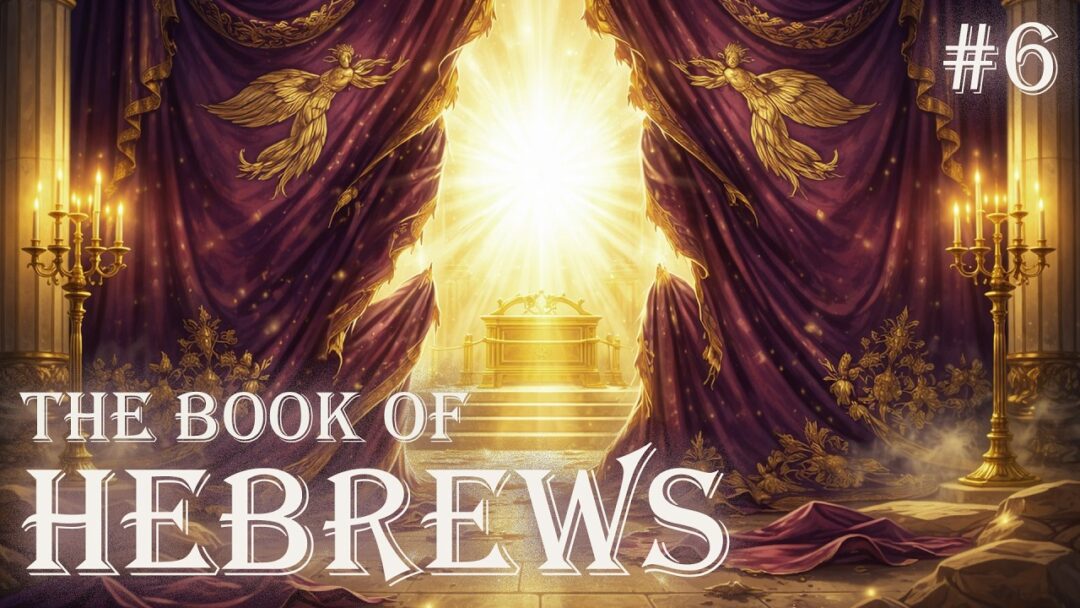
From our Sunday service on March 8, 2026, Hebrews 8:1-10:18. This is part 6 of our Hebrews series. Watch the full message: A New and Better Covenant – Hebrews Series #6 on YouTube.
Today we’re continuing our series in Hebrews, and we have a lot of ground to cover. I want to make sure that as we look at these sections of Hebrews, we keep them focused on what they’re talking about, and that we don’t drag the series out longer than we need to. So today we’re covering Hebrews 8 through the first third of Hebrews 10, as we talk about a new and better covenant.
Last week we talked about how Jesus is a better High Priest than those who came before. Rather than review that, I’ll let the beginning of today’s passage review it for us. This week we’ll see how the new covenant of the New Testament is greater than the covenant of the Mosaic law.
God wants you to know that the fulfillment of the promise is greater than the promise.
The True Tabernacle
Now of the things which we have spoken this is the sum: We have such an high priest, who is set on the right hand of the throne of the Majesty in the heavens; A minister of the sanctuary, and of the true tabernacle, which the Lord pitched, and not man.
Hebrews 8:1–2
As you can see, this reviews everything we talked about last week. The author says, “I want to summarize everything we’ve talked about.” If you know anything about the book of Hebrews, it’s a pretty heavy book. It covers a lot. So he says, “In case you missed it, this is the sum.” Literally in Greek, this is the main point: “This is what I’m trying to say. We have a great High Priest who sits at the right hand of God as our representative. He’s a minister of the true sanctuary, the true tabernacle, not one built by human hands, but the eternal tabernacle in the heavens, the one God built and not man.”
That’s partly what we’ll talk about today: the difference between the Old Testament physical law and the New Testament heavenly law. The true temple was not built by mankind. It wasn’t built by Moses. It sat in heaven. And the things of the Old Testament under the law were foreshadowing the truth of this heavenly temple, this heavenly law, all along. This temple could never be built by a man. It could only be built by God, who is perfect and sinless enough to serve inside it.
A Shadow of Heavenly Things
Verses 3-5 remind us how Jesus is a better High Priest.
For every high priest is ordained to offer gifts and sacrifices: wherefore it is of necessity that this man have somewhat also to offer. For if he were on earth, he should not be a priest, seeing that there are priests that offer gifts according to the law: Who serve unto the example and shadow of heavenly things, as Moses was admonished of God when he was about to make the tabernacle: for, See, saith he, that thou make all things according to the pattern shewed to thee in the mount.
Hebrews 8:3–5
In verse 3 he reviews what he said last week: every high priest is ordained, or appointed, because he’s from the tribe of Levi, “to offer gifts and sacrifices.” But the priest was not perfect. He was not sinless. Before he offered sacrifices for somebody else, he had to offer a sacrifice for himself, because he was sinful. Last week’s passage told us that Jesus is a great High Priest, better than those who came before, because Jesus never sinned. Jesus didn’t have to make a sacrifice for his own sins. So as a perfect, sinless man and God himself, he could make a sacrifice of himself for us, doing what the human priest could never do. A priest could never save us under the Old Testament law, because a priest could never even save himself.
Verse 5 tells us that those priests “serve unto the example and shadow of heavenly things.” In other words, it was an illustration of heavenly things. In messages we sometimes use an illustration or an analogy to make a point. Here the author of Hebrews says, “The Old Testament law was never meant to save you.” If you look at the Old Testament, you’ll see it, and he shows us throughout the book of Hebrews why that is true. The Old Testament law was a physical illustration of what God was going to do to save mankind.
That’s why God told Moses, “See, saith he, that thou make all things according to the pattern shewed to thee in the mount.” Moses was told to follow the pattern exactly. Why? So that when the Israelites followed the Mosaic law, they could see the truth of the Messiah who was to come, and when the Messiah came, they could recognize him as their salvation.
Verse 4 tells us that if Jesus served in the earthly tabernacle under the law, he wouldn’t even qualify to be a high priest, because he’s not a Levite. We talked about this last week. The Messiah was supposed to come from Judah, and he was supposed to be a priest. If the Messiah wasn’t going to come from the line of Levi and was supposed to be a priest, then it can’t be through the Mosaic law that he is a priest. Thus the law is not your salvation, but an illustration of the true salvation of Christ.
A Better Covenant
Verses 6 and 7 tell us there is a better covenant.
But now hath he obtained a more excellent ministry, by how much also he is the mediator of a better covenant, which was established upon better promises. For if that first covenant had been faultless, then should no place have been sought for the second.
Hebrews 8:6–7
“A more excellent ministry.” More excellent than what? Than the priesthood of the Levites. Here the author of Hebrews tells us that even in the Old Testament, God said a new covenant would be needed in the future. He’s talking specifically about the Mosaic covenant, the promise that Israel could be God’s representative. If they followed him faithfully, God would bless them. If they didn’t, he would send them into exile. And he says there’s a better promise, and it’s in the Old Testament. In verses 8-13 he shows us Jeremiah 31:31-34.
For finding fault with them, he saith, Behold, the days come, saith the Lord, when I will make a new covenant with the house of Israel and with the house of Judah: Not according to the covenant that I made with their fathers in the day when I took them by the hand to lead them out of the land of Egypt; because they continued not in my covenant, and I regarded them not, saith the Lord. For this is the covenant that I will make with the house of Israel after those days, saith the Lord; I will put my laws into their mind, and write them in their hearts: and I will be to them a God, and they shall be to me a people: And they shall not teach every man his neighbour, and every man his brother, saying, Know the Lord: for all shall know me, from the least to the greatest. For I will be merciful to their unrighteousness, and their sins and their iniquities will I remember no more. In that he saith, A new covenant, he hath made the first old. Now that which decayeth and waxeth old is ready to vanish away.
Hebrews 8:8–13
The Fault with the First Covenant
He says there is a fault with the old covenant. What is the problem? Verse 9: “Not according to the covenant that I made with their fathers in the day when I took them by the hand to lead them out of the land of Egypt; because they continued not in my covenant.” What was the problem with the first covenant? God could keep the covenant, but the people of Israel could not. Why did they go into exile? Because they couldn’t keep the law. God had made a covenant with Israel that they could be his people if they were faithful. But the first covenant relied on broken people, and broken people will never live up to a perfect standard.
That was the fault with the first law. It couldn’t save you, because you can never follow it perfectly. There were hundreds and hundreds of rules and regulations placed on the people to show them their need of a Savior. Paul says, “the law was our schoolmaster to bring us unto Christ.” You were never supposed to be able to keep the law. It was designed with a flaw to begin with, to point you to your need for the Messiah when he came.
We should know, by trying to follow the law, that we’re going to hell. That was the point of the law. The point of the law was for us to say, “I’m doomed. I haven’t been able to follow it. I’ve taken the Lord’s name in vain. I’ve taken something that didn’t belong to me. I’ve lied. I’ve cheated. I’ve stolen. I’ve coveted. I am convicted by the law as a transgressor.” That was the problem with the law: nobody could keep it. And because of it, the people went into exile.
What the New Covenant Fixes
So what does the new covenant fix? Verse 10: “For this is the covenant that I will make with the house of Israel after those days, saith the Lord; I will put my laws into their mind, and write them in their hearts: and I will be to them a God, and they shall be to me a people.” No longer does God only commune with his people. Before, God was present among his people in the temple. Now he doesn’t just commune with his people. He indwells his people. That’s the fix. “If you can’t be perfect and good enough to get to heaven, then I will come to you. I will be in your heart. I will be in your mind, and I will be your salvation.” There’s no longer room for a broken relationship because of sin, because under the new covenant God is going to fix the sin problem.
Verse 12 tells us how: “For I will be merciful to their unrighteousness, and their sins and their iniquities will I remember no more.” Under the old covenant, what happened? There were sacrifices, and they temporarily covered sins. They made God turn a blind eye to them for a moment. But the problem was that those sins were never gone.
If you have a kid who likes to hide from you, he hides in very obvious places. Have you ever seen a kid put a blanket over his head? “Daddy, Daddy, where am I? Do you see me?” That’s the idea with the old covenant. It’s like a kid putting a blanket over his head. You know he’s still there. Putting a blanket over something doesn’t make it disappear. How many of you, when a guest came over to the house, just threw something over your mess and pretended it was gone? In reality, you all know the mess is still there. That was the problem with the old covenant. You can put a blanket over it, but the sin’s still there.
The new covenant did something different. “Their sins and their iniquities will I remember no more.” He’s going to forgive it and cast it away. The old covenant couldn’t get rid of your sins. It could just put a blanket over them for a time.
What’s the end result? Verse 11: “And they shall not teach every man his neighbour, and every man his brother, saying, Know the Lord: for all shall know me, from the least to the greatest.” Everyone will be able to know God personally. Each believer becomes his own priest, and Christ is the High Priest over them all.
Ready to Vanish Away
So the question remains: if the old covenant is old, if it’s been replaced, how does it relate to us today? What does verse 13 say? “In that he saith, A new covenant, he hath made the first old. Now that which decayeth and waxeth old is ready to vanish away.” That phrase “decayeth and waxeth old” could also be translated “is antiquated.” What is antiquated and decaying is ready to disappear. It’s obsolete.
It’s like going to buy a new car this year and showing up at the dealership with a box full of cassette tapes: “I’ve got all these cassette tapes. I’m looking for a car with a cassette player.” What is the dealer going to say? “I’m sorry. Cassette players are antiquated. We haven’t had any of those since the ’90s.” That’s vanished away. It’s outdated. You’ve got all these cassettes, but they won’t do you any good. There’s no new car you can use them in. And so the Old Testament Mosaic law is gone. The covenant we’re talking about is the Mosaic covenant. That’s the one that is ready to vanish away.
What About the Abrahamic Covenant?
What about the Abrahamic covenant? The Abrahamic covenant was not a conditional covenant. It was an unconditional covenant. The Mosaic covenant said, “Israel will be my representatives to the world if they obey me, and I will bless them and grow them if they do.” When the New Testament came in, who became the new representative to the world? The church. That part of the covenant is gone. Israel as a nation is no longer Christ’s representative.
But what are they? They’re still children of Abraham. They still have the Abrahamic covenant, which promises them a land, a seed and a blessing. The blessing is fulfilled. That was Jesus Christ. All nations will be blessed through Jesus Christ. The land they will be able to have, but once again, they have to be faithful to God to inhabit it. God says that when you obey me, I will bring you back to the land. In Nehemiah and Ezra we see how God left a faithful remnant there, so that in their moment of obedience he could restore them. Throughout all of history there will always be a remnant to keep the promise to Abraham, so that when the people of Abraham do what God says, he can restore them and bless them as he promised Abraham.
But the truth of the matter is, God says, “If you do not bless me, I will not bless you.” So inhabiting the land depends on faithfulness to God. As you saw in AD 70, when they rejected the Messiah, Rome shunned them from the land, leaving only the remnant. And there will be a time, prophecy says, when all Israel will be saved. There will be a time of revival in the nation of Israel when they finally realize that Jesus Christ was the Messiah. When they recognize their Messiah, God will gather his elect. He will gather his people. He will fulfill the covenant of Abraham once again and restore them to the land.
But today the Mosaic covenant is gone. Israel is no longer the representative of God. We, the church, take that place. Paul tells us there is a tree, and when Israel rejected Christ, the branches that did not accept the Messiah were broken off. He says, “You Gentiles were grafted in to be part of this tree. You were not naturally under a covenant as representatives of Christ. But because you have faith in the Messiah, because you have faith in God, you have been grafted in.” You’ve become part, not of those born of Abraham or Israel, but of those who have the faith of Abraham and Israel. That’s why the Bible says, “they are not all Israel, which are of Israel.” Not all who are part of spiritual Israel are Israelites by ethnicity, but people of faith share in the promise of Abraham through their faith in the Messiah.
The Worldly Sanctuary
Hebrews 9:1-5 tells us about the worldly sanctuary.
Then verily the first covenant had also ordinances of divine service, and a worldly sanctuary. For there was a tabernacle made; the first, wherein was the candlestick, and the table, and the shewbread; which is called the sanctuary. And after the second veil, the tabernacle which is called the Holiest of all; Which had the golden censer, and the ark of the covenant overlaid round about with gold, wherein was the golden pot that had manna, and Aaron’s rod that budded, and the tables of the covenant; And over it the cherubims of glory shadowing the mercyseat; of which we cannot now speak particularly.
Hebrews 9:1–5
Once again he says that these are all things that represent Christ, but we don’t have time to deal with them today. What he wants to say is that there was a physical tabernacle in the past. It had a real candlestick. It had a real table with real bread. There was a real section called the holy place and a second section called the holiest of all. There was a real golden censer with incense, and a gold-covered ark of the covenant with cherubims. It held real manna, the real budded rod of Aaron and the Ten Commandments. All those things were real. They were historical, and they all represent truths about Christ. We don’t have time to deal with them today, but the old covenant is not pointless. It’s not something we don’t need to know about. It has a lot of truth to teach us about the new covenant.
Into the Holiest Once a Year
But there’s one picture he wants us to understand today, in verses 6 and 7: the high priest.
Now when these things were thus ordained, the priests went always into the first tabernacle, accomplishing the service of God. But into the second went the high priest alone once every year, not without blood, which he offered for himself, and for the errors of the people:
Hebrews 9:6–7
In the old system, the priests were able to enter the first room of the tabernacle, the holy place, and serve God there. According to 1 Peter 2:5 and 9, the priests of the Old Testament represent believers. In the Old Testament picture of believers, the priests could go into the holy place, but they could not enter the holiest place, the Holy of Holies. The believer could come close to God, but could never get to God. That was the picture. The Old Testament believer had no direct access to God or heaven. Only the high priest went in, once a year. And the high priest obviously represents the Messiah, the Savior, God himself.
In the Old Testament the priests couldn’t get through, because there was a literal wall between those two places, a veil that separated them. What happened when Christ died on the cross? The veil of the temple was torn in two from top to bottom, showing that the believer, the priest, no longer lacks access to God. That dividing wall is gone, and the believer can go into the holiest place, the Holy of Holies, where God dwells, and have direct access to the Father.
Only the high priest could enter the holiest place, once a year, with the blood of atonement on the Day of Atonement, to offer blood for the sins of all the people. We can see how the high priest represents Christ. He was the one who offered the blood once for the people. This high priest foreshadows Christ, who would offer himself once for all sins.
A Figure for the Time Then Present
The Holy Ghost this signifying, that the way into the holiest of all was not yet made manifest, while as the first tabernacle was yet standing: Which was a figure for the time then present, in which were offered both gifts and sacrifices, that could not make him that did the service perfect, as pertaining to the conscience; Which stood only in meats and drinks, and divers washings, and carnal ordinances, imposed on them until the time of reformation.
Hebrews 9:8–10
What’s he saying? The illustration was supposed to make it clear that following the law did not give the believer the right of direct access to God. There were a lot of things in the temple, but one thing it had many layers of was walls, multiple dividing lines. The temple was to show God’s presence in the nation of Israel, but it wasn’t to show God’s presence near the people. There were many times they couldn’t get close to God. Nobody in Israel saw the ark of the covenant except one person. Sure, they heard stories about it, but nobody ever saw it. They were never close to it. There was a wall separating them. The people were supposed to realize that they weren’t good enough to be in the presence of God because of their sin. There was a literal wall separating them from it.
As I said, the offerings covered sin, like throwing a blanket over it, but they did not wash it away. And the people were to remain aware of that. Why? So they would know their guilt still stood. It says they could not be made “perfect, as pertaining to the conscience.” Even if they gave the sacrifices, there was no freedom from the guilt of sin: “Sure, you’ve covered my sin, but it’s still there.” Go back to the illustration of a guest coming over and throwing a blanket over the mess. The guilt of your disaster of a home still stands if you cover it up. If someone pulls that blanket off at the wrong time, all that shame comes rushing back. That’s how it was in the Old Testament. The shame of guilt could never be removed. The rituals “stood only in meats and drinks, and divers washings,” habits you could do that would never actually change your guilt.
The Blood of Christ
Verse 11 tells us about the greater covenant.
But Christ being come an high priest of good things to come, by a greater and more perfect tabernacle, not made with hands, that is to say, not of this building; Neither by the blood of goats and calves, but by his own blood he entered in once into the holy place, having obtained eternal redemption for us. For if the blood of bulls and of goats, and the ashes of an heifer sprinkling the unclean, sanctifieth to the purifying of the flesh: How much more shall the blood of Christ, who through the eternal Spirit offered himself without spot to God, purge your conscience from dead works to serve the living God? And for this cause he is the mediator of the new testament, that by means of death, for the redemption of the transgressions that were under the first testament, they which are called might receive the promise of eternal inheritance.
Hebrews 9:11–15
Verse 11 tells us that Christ does not serve in a physical temple. It’s a “greater and more perfect tabernacle, not made with hands, that is to say, not of this building.” It’s a spiritual temple, the one the physical temple represented. It represented God’s kingdom in heaven. That temple in heaven is the real deal, not an illustration. And when Christ offered himself, he wasn’t making an illustration. Some people today will teach you that Christ’s death on the cross was just a metaphor. It’s not a metaphor. The Bible teaches clearly that the death of Christ was not a metaphor. It was an actual saving, transforming sacrifice on behalf of all humanity. Christ’s sacrifice means something, and it changes everything.
Verse 12 tells us that Christ’s sacrifice is better. It’s not the blood of animals, but his own perfect and sinless blood, which could do more than temporarily cover our sins. It could remove them. With the removal of our sins comes freedom for our conscience from the guilt of sin. And then it allows us to access the holiest place, the place of eternal inheritance. That’s what verse 15 says. It’s only through Christ that you receive the eternal inheritance of heaven and enter the holiest place.
But we don’t have to wait until we die and go to heaven to receive the benefits of this sacrifice. Why? Because verse 14 says the blood of Christ will “purge your conscience from dead works” for a reason. What’s that reason? “To serve the living God.” Just as the Old Testament rituals purified the priests for service, the blood of Christ purifies the believer to serve the Lord. We’re not just people who believe in God and say, “Well, I guess I’ll wait to die now.” No, that’s not what God wants from us. God wants us to serve him here as a kingdom of priests.
God’s Last Will and Testament
Let’s read verses 16 and 17 and see how God’s covenant is his last will and testament.
For where a testament is, there must also of necessity be the death of the testator. For a testament is of force after men are dead: otherwise it is of no strength at all while the testator liveth.
Hebrews 9:16–17
What is this talking about? We have the phrase “last will and testament.” He’s saying that the covenant God made wasn’t just a promise. We often think of covenants as a promise or a deal or a contract. That’s not what it was. He’s saying it was God’s last will and testament, and a will and testament doesn’t go into effect until the person whose will it is dies. So he says Christ had to die, because the covenant God made was his will.
If you look at the Greek translation of the Old Testament, you’ll see that the word used for all of the covenants made in the Old Testament is the Greek word for a will and testament. So this was obviously understood by the Jews even before the time of Christ: God’s covenant was his will, and it was always meant that God would fulfill the promises through his death. So the author of Hebrews says that if it’s true, which it is, that God’s will is brought into effect by his death, then it is necessary that God die.
Sealed with Blood
“Whereupon neither the first testament was dedicated without blood.” Even in the Old Testament, when the Mosaic covenant was made, blood sealed the covenant. There had to be death.
For when Moses had spoken every precept to all the people according to the law, he took the blood of calves and of goats, with water, and scarlet wool, and hyssop, and sprinkled both the book, and all the people, Saying, This is the blood of the testament which God hath enjoined unto you.
Hebrews 9:19–20
Even the first covenant, the Mosaic covenant that gave the people the right to be God’s representative, was sealed with blood, because there had to be a death for the covenant to go into effect. The covenant was ratified through blood. What’s the point? If any covenant needs a blood sacrifice to ratify it, then the New Testament is ratified through Christ’s blood. And his blood doesn’t just ratify the covenant. The blood purifies us.
Moreover he sprinkled with blood both the tabernacle, and all the vessels of the ministry. And almost all things are by the law purged with blood; and without shedding of blood is no remission. It was therefore necessary that the patterns of things in the heavens should be purified with these; but the heavenly things themselves with better sacrifices than these.
Hebrews 9:21–23
He says that if that was an illustration, then we can assume everything else was an illustration too. How did they dedicate items to be used in the tabernacle? They would offer a sacrifice and sprinkle the blood on the item to purify it. If everything in the Old Testament is an example for the New Testament, what is that teaching us? That the ratifying blood of the new covenant also purifies, but it doesn’t purify drinking cups and eating bowls. It purifies the believer.
The Old Testament told us that “almost all things are by the law purged with blood,” purified by blood. It also taught us that “without shedding of blood is no remission,” no forgiveness of sins. Every time you sinned, you had to go make a sacrifice for your sins to be covered. The Old Testament was teaching us that without the shedding of blood there was no forgiveness. It wasn’t those sacrifices that forgave, but those sacrifices pointed forward to Christ, to show us that one day our sins would be purified by the blood of Jesus.
So we see that the rituals of the Old Testament law illustrate the truth of the gospel. They point forward to Jesus, because if we want to be dedicated to God, we too need to be purified through the blood of Christ. Without Christ’s blood there is no forgiveness of sins and no service to him.
Once for All
For Christ is not entered into the holy places made with hands, which are the figures of the true; but into heaven itself, now to appear in the presence of God for us: Nor yet that he should offer himself often, as the high priest entereth into the holy place every year with blood of others; For then must he often have suffered since the foundation of the world: but now once in the end of the world hath he appeared to put away sin by the sacrifice of himself. And as it is appointed unto men once to die, but after this the judgment: So Christ was once offered to bear the sins of many; and unto them that look for him shall he appear the second time without sin unto salvation.
Hebrews 9:24–28
So what is it saying? Everything points to Christ. The sacrifices were done repeatedly and constantly to illustrate the point. They didn’t fix the problem. But Jesus isn’t like the Old Testament sacrifices. The high priest had to go every single year to offer a sacrifice for the sins of the people. But Christ did it once and for all by offering himself for all people, providing the true blood of purification for all of humanity. The blood of sheep and goats never purified. It just covered. It just delayed. It just made an illustration. But Jesus Christ is not like that. He’s not just there to teach us a truth. He’s there to change our world.
The Law Could Never Fix Anything
In Hebrews 10:1-4 he doubles down on the point that the Old Testament is an illustration.
For the law having a shadow of good things to come, and not the very image of the things, can never with those sacrifices which they offered year by year continually make the comers thereunto perfect. For then would they not have ceased to be offered? because that the worshippers once purged should have had no more conscience of sins. But in those sacrifices there is a remembrance again made of sins every year. For it is not possible that the blood of bulls and of goats should take away sins.
Hebrews 10:1–4
The author of Hebrews does not want us to misunderstand him. Remember, Hebrews was written to Jews who were tempted to go back to the old Levitical system, give up Christ and just follow the Torah. He says, “I don’t want you to miss how serious this is. The law could never fix anything.” We know this because the law was written in a way that reminds us how sinful we are all the time. How often do we have to offer a sacrifice? Every single time we sin. How often does the high priest have to make the offering for the sins of the people? Once every single year. He says, “If it was supposed to make us feel good about ourselves, wouldn’t it have been done once and been finished?” But no, God wanted to remind us of our sins every year, so we would know we needed a Savior, so we would know we couldn’t save ourselves.
He says it’s not possible for the blood of bulls and goats to take away sins. “Jew, don’t go back to the Old Testament. Don’t go back to works for salvation. It was never possible for works to save you. Only a sinless man can save you.” And there was only one sinless man, Jesus Christ, God in the flesh. Without him, you are hopeless. There is never any hope outside of him. You must be saved through Jesus Christ.
Lo, I Come to Do Thy Will
He doesn’t just state it. He wants to prove it from the Old Testament, so in verses 5-8 he quotes Psalm 40:6-7.
Wherefore when he cometh into the world, he saith, Sacrifice and offering thou wouldest not, but a body hast thou prepared me: In burnt offerings and sacrifices for sin thou hast had no pleasure. Then said I, Lo, I come (in the volume of the book it is written of me,) to do thy will, O God. Above when he said, Sacrifice and offering and burnt offerings and offering for sin thou wouldest not, neither hadst pleasure therein; which are offered by the law;
Hebrews 10:5–8
“Thou wouldest not” means you would not desire. The author of Hebrews is saying David knew the truth. David preached the truth in his day that God never really cared about offerings and sacrifices. “Jews, you cared about the offerings and sacrifices. You put a lot of value on them, but God didn’t care.”
When God speaks in Malachi, he rebukes them because they would follow parts of the law, but in their day-to-day lives they wouldn’t follow any of the laws on moral standards. He says, “Your sacrifices disgust me. You offer sacrifices, but you don’t obey me. I ask you to do things, and I also ask you not to do things. The things I ask you not to do, you’re doing, and the things I ask you to do, you’re not doing.” Why? Because it’s a lot easier to hide the things you’re not supposed to do than to hide the things you should be doing but aren’t. The things you should be doing are out in the open. The things you shouldn’t be doing are hidden in secret.
So he says, “I don’t care about the sacrifices. I never have.” Why? Because the sacrifices are an illustration of the Messiah. They weren’t about saving you. If you skip a sacrifice, it’s just an illustration. It’s there to teach you a lesson. If you skip a sacrifice, that’s actually better for me, because you’re going to realize you’re not perfect. The law is there to show you that you deserve to be condemned. If you mess up on the law, that’s the whole point. That’s why I gave it: to show you that you can’t be perfect.
So David realized that God is not pleased by sacrifices. He’s pleased by obedience. The sacrifices are an outward sign of an inward change. If the inward change isn’t there, the sacrifice is meaningless. God didn’t enjoy them at times. He says, “Your sacrifices disgust me, because they’re hypocrisy.” Once again, if the inward change isn’t there, the outward doesn’t count. The sacrifices never changed anything about the believer. They were just an illustration to teach people about God, and a tool to keep them obeying the covenant so God could bless them. But now the new covenant is here. The new covenant is needed, and the old covenant is not.
Then said he, Lo, I come to do thy will, O God. He taketh away the first, that he may establish the second. By the which will we are sanctified through the offering of the body of Jesus Christ once for all. And every priest standeth daily ministering and offering oftentimes the same sacrifices, which can never take away sins: But this man, after he had offered one sacrifice for sins for ever, sat down on the right hand of God; From henceforth expecting till his enemies be made his footstool.
Hebrews 10:9–13
When he says, “Lo, I come to do thy will, O God,” that was a messianic prophecy: “I’m not satisfied with your sacrifices, but the Messiah is coming to do God’s will.” And when it was said in the Psalms, it was said to take away the first covenant, the Mosaic covenant, and to introduce the new covenant of salvation through Jesus Christ.
Now we know we are sanctified “through the offering of the body of Jesus Christ once for all.” What does sanctified mean? It means made holy, set apart, dedicated to Christ. Just as the tabernacle items were dedicated by the sprinkling of blood, the blood of Jesus dedicates us to Christ and purifies us from our sins. Once again he makes the same point. The priests offered sacrifices every day, and yet the people’s sin was still there. But Jesus is not like this. He was perfect, so when he made a sacrifice, he did it once and for all, and now everything is complete.
Remembered No More
He concludes in verses 14-18.
For by one offering he hath perfected for ever them that are sanctified. Whereof the Holy Ghost also is a witness to us: for after that he had said before, This is the covenant that I will make with them after those days, saith the Lord, I will put my laws into their hearts, and in their minds will I write them; And their sins and iniquities will I remember no more. Now where remission of these is, there is no more offering for sin.
Hebrews 10:14–18
He brings it back to Jeremiah. The Holy Ghost testified to us through Jeremiah about his role in the future: “I’m going to make a covenant with Israel in those days. I’m going to bring my Messiah. He’s going to die, and I’m going to put my Holy Spirit in them. I will indwell them.” We don’t need the physical temple anymore. Why? Because the body of believers is a spiritual building. The temple is all believers together, the church. We don’t need a physical temple to offer physical sacrifices in. It was all an illustration to point us to Christ.
He says, “You don’t need to offer any more sacrifices in Jerusalem.” Remember, at this time the temple was still there, and the Jews were still offering sacrifices. He’s saying, “You don’t need to go there and offer a sacrifice anymore, because we have a sacrifice that’s greater.” When Christ died on the cross, the veil of the temple was torn in two to make it clear that we can walk straight to the throne of God through Jesus Christ, our great High Priest and the Mediator of the covenant.
“Their sins and iniquities will I remember no more.” If those sins are gone, “where remission of these is, there is no more offering for sin.” There’s no more reason to say, “I need a sacrifice to say I’m sorry.” Instead of saying, “I’m sorry,” we can say, “God, thank you. I celebrate the work you’ve done for me on the cross. You’ve forgiven me. I don’t need to live under the guilt anymore. I don’t need to make sacrifices daily for my sin, because Christ has completed it for me.” And now, as he said before, I can come boldly before the throne of grace, so that when I’m struggling with sin, I can get help in my time of need.
We now inherit the promise given all those years ago, that we would have the law in our hearts, and the Holy Spirit now indwells the believer. And because we are truly forgiven, there are no more works needed for salvation.
Conclusion
So what’s the conclusion of the matter? The point is clear. Everything under the old Mosaic covenant was an illustration that pointed forward to Christ. The priests, the sacrifices, the tabernacle and the rituals were never meant to save anyone. They were illustrations preparing the world for the real solution to sin.
Jesus is the true High Priest who serves in the real heavenly temple. By offering his own perfect blood, he accomplished what the law never could: the complete removal of sin. Because of Christ, the old covenant is obsolete. It’s antiquated, and our forgiveness can now be final. Believers now have direct access to God.
Today we can rest in the finished work of Christ. There’s no need for further sacrifices for sin, because Jesus has offered himself once and for all. God wants you to know that the fulfillment of the promise is greater than the promise. So will you rest in the fulfillment of his promises today?

Recent Comments