
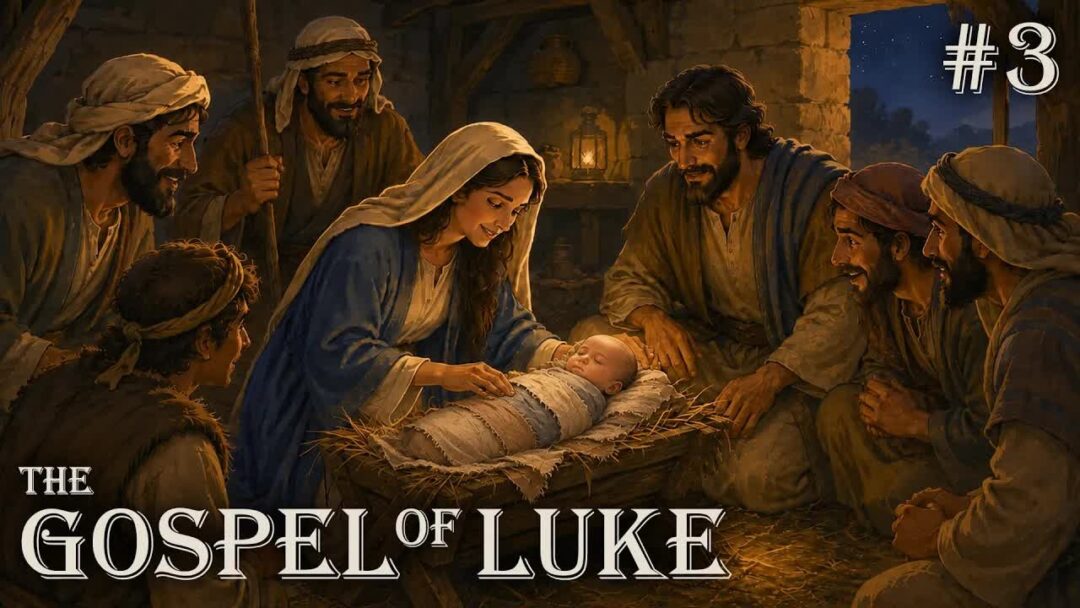
From our Sunday service on June 7, 2026, Matthew 1:18-25 and Luke 1:57-2:20. This is part 3 of our Gospel of Luke series. Watch the full message: The Birth of Two Blessings – The Gospel of Luke #3 on YouTube.
Today we’re continuing our series on the book of Luke, but we’re going to start in Matthew 1:18. There’s some material in Matthew that isn’t talked about in the book of Luke, because Luke is adding context to what’s already covered.
Last time, we covered the angel Gabriel visiting Mary in the little town of Nazareth to tell her she was chosen to give birth to the Messiah. We were shown how Mary demonstrated her faith and obeyed God exactly as he had asked her to. And when we left off, Mary had stayed with Elizabeth for three months before she returned to Nazareth. Today we pick up as Mary returns to Nazareth and encounters Joseph again, who is just now being informed about what is going on.
Mary had not yet told Joseph she was pregnant, so there’s going to be a bit of a challenge here. She had accepted God’s call to make her the mother of the Messiah, and with that came a lot of problems. She wasn’t yet married; she was only betrothed. She was legally married, but she was not allowed to consummate her marriage. So if she and Joseph had a baby, people would be asking questions about where that baby came from. And Joseph, who had not yet been informed, was going to have some questions about where that baby came from. After being gone three months, she comes home, and Joseph finds out, “My espoused, my betrothed, is now pregnant with a baby I know nothing about.” And as we look at today’s lesson, God wants you to know he fulfills what he promises.
Joseph Finds Out
Now the birth of Jesus Christ was on this wise: When as his mother Mary was espoused to Joseph, before they came together, she was found with child of the Holy Ghost. Then Joseph her husband, being a just man, and not willing to make her a publick example, was minded to put her away privily.
Matthew 1:18–19
“On this wise” is another way of saying “it occurred in this way.” Mary comes back from three months with Elizabeth, and we’re told in Matthew that Joseph finds out about this pregnancy. We’re not told whether Joseph was told by Mary, or if he just noticed that she was showing a bump and asked about it one day, but one way or another, Joseph finds out. And Mary tells him that this is a miraculous conception: “I haven’t cheated on you, Joseph. There’s not been any unfaithfulness. The Holy Spirit came over me, and through a miracle of God, I have been chosen to give birth to the Messiah.”
I think any man whose wife or girlfriend came and said that this had happened would not believe her. The Gospel is very honest. What you think would happen is exactly what happened. Joseph does not believe the story. “Oh, Mary, you want me to believe this baby just appeared from the Holy Spirit? That you’re so righteous before God that God gave you a miraculous baby? Okay, Mary.”
A Just Man
But Joseph was a just and righteous man. He wasn’t petty. He wanted to do what was right. And so he concluded, “I don’t want to make a public example out of her.” What would that have included? As I told you before, the punishment for this kind of sin was death by stoning. Joseph, genuinely loving Mary, did not want her to be put to death for this sin. So he said, “If I just divorce her, since we’re legally bound already and haven’t consummated the marriage, she will not be put to death for this. The punishment would be less severe. It wouldn’t make her a public example. There’d be no death penalty. We could go our separate ways, and I can just move on with my life and she can move on with hers. This doesn’t need to be a big problem. This doesn’t need to have any major consequences for her.” So Joseph is struggling with this situation. Fortunately, God steps in and helps solve it.
An Angel in a Dream
But while he thought on these things, behold, the angel of the Lord appeared unto him in a dream, saying, Joseph, thou son of David, fear not to take unto thee Mary thy wife: for that which is conceived in her is of the Holy Ghost. And she shall bring forth a son, and thou shalt call his name JESUS: for he shall save his people from their sins. Now all this was done, that it might be fulfilled which was spoken of the Lord by the prophet, saying, Behold, a virgin shall be with child, and shall bring forth a son, and they shall call his name Emmanuel, which being interpreted is, God with us.
Matthew 1:20–23
Before, we saw that the angel Gabriel came and visited Zacharias and Mary. In this case, Joseph is not visited physically by an angel. But one night, as he’s probably thinking about the whole situation and how to solve this conflict, where he loves this woman but believes she’s unfaithful, he falls asleep, and an angel appears to him in a dream and explains why things happened the way they did.
The angel says, “What Mary said is true. The Holy Spirit did come upon her and cause a miraculous conception. This was not a lie from your betrothed wife. She’s going to bring forth a son, and his name will be called Jesus,” which means Yahweh is salvation, by the way, “and he will save his people from their sins.”
“And Joseph, the reason this happened is because we need to fulfill the prophecy spoken in Isaiah, that a virgin shall be with child and bring forth a son, and they shall call his name Emmanuel, which being interpreted is God with us.” The angel explains that the reason Mary is pregnant is because the prophecy says that a virgin must conceive. “I don’t know if you know this, Joseph. Maybe you didn’t have as much access to the Torah scrolls as other people. You live in the hill country, in the middle of nowhere. You probably don’t have a synagogue. But go look at the scroll of Isaiah, and you’ll see that what Mary is saying is backed up by Scripture: the Messiah will come from a virgin. So, Joseph, Mary really is telling the truth. Do not be afraid to marry her.”
Joseph Obeys
Then Joseph being raised from sleep did as the angel of the Lord had bidden him, and took unto him his wife: And knew her not till she had brought forth her firstborn son: and he called his name JESUS.
Matthew 1:24–25
After Joseph fully understands the situation, he hurries to wed Mary. He doesn’t delay. The angel says, “Don’t fear it.” He says, “Okay. We’re going to get married as soon as possible. We’re going to do a pop-up wedding, and I’m going to get married before I planned.”
He decides he’s going to take on the same risk that Mary did. Mary had taken on the risk of punishment for being unfaithful, and the shame that came with being a young unmarried woman conceiving. And Joseph says, “You know what? I’m going to dive in headfirst into that situation as well. I don’t care what people are going to say about me and Mary, or about the context of this marriage. I’m going to go marry her right now. I’m going to do what the angel says, and we’ll worry about the details later.” So he now risks his reputation, as people see him and say, “Don’t you think you’re jumping the gun a little here? Don’t you want to wait and see how this turns out first?” He says, “No.”
It also tells us that, despite being married to her and being fully allowed legally to consummate the marriage, Joseph refrains from doing so, so that the prophecy of a virgin giving birth could be entirely fulfilled. Joseph saw the mission and said, “I’ve got this. Whatever it takes, I’m going to do it. I’ll marry her. I won’t sleep with her. I’ll do whatever the angel said. I don’t care about the consequences. I don’t care about the reputation. I don’t care about the details. We’ll just do what God says and worry about the rest later.” I didn’t want to skip over Joseph here. We talked a lot about how Mary risked everything. I also want to give Joseph his credit as he jumps into this situation as well.
The Birth of John the Baptist
Now let’s go back over to Luke chapter 1, verse 57, to look at the birth of John the Baptist.
Now Elisabeth’s full time came that she should be delivered; and she brought forth a son. And her neighbours and her cousins heard how the Lord had shewed great mercy upon her; and they rejoiced with her.
Luke 1:57–58
If you remember from last time, Elizabeth had decided to keep the pregnancy of John the Baptist a secret. She was too old to give birth, so nobody would have suspected anything, and she secluded herself for five months. Here the full time comes; the due date arrives. She gives birth to a healthy baby, John the Baptist. And she finally, for the first time, tells her neighbors about it, and they, having no idea, are shocked and surprised at what’s going on. They celebrate the miracle of this old woman giving birth: this barren woman who had no legacy and no future now had a child.
“His Name Is John”
And as is natural, the Jews continue with their traditions. Eight days after birth, there is a circumcision ceremony, where the child is officially made a Jew and given a name. We see that in the naming of John.
And it came to pass, that on the eighth day they came to circumcise the child; and they called him Zacharias, after the name of his father. And his mother answered and said, Not so; but he shall be called John. And they said unto her, There is none of thy kindred that is called by this name. And they made signs to his father, how he would have him called. And he asked for a writing table, and wrote, saying, His name is John. And they marvelled all.
Luke 1:59–63
The angel Gabriel had visited Zacharias and told him, “You’re naming the child John. He’s going to have that name.” So Zacharias knew that, and he told Elizabeth. But Zacharias is also mute at this point, because he didn’t believe God when God said, “I’m going to give you a child in your old age.” Since he doubted God, God said, “You’re not going to speak until the child is delivered.” He gets a curse for nine months, and he can’t speak.
So when this whole party’s going on, Zacharias is still unable to speak. Everybody’s around celebrating. It’s time to name the child, and the family says, “Well, since Zacharias can’t talk, we’ll just name him. We’ll name him after his father.” It was a tradition in the Jewish culture to name the newborn child after someone in the family, often somebody who had already passed. But they decided to name him after his father. His father was a priest, a very well-respected individual. That would be a very natural thing to do.
But his mother says, “Not so.” In other words, “No. His name is going to be John.” And the people are confused. “John? Who’s John? There’s no one in this family who’s ever been called by that name. We need to talk to the father and get his opinion on this. This is really weird.” So they gesture to him, “Come over here, Zacharias. We need your take on this,” and they give him a writing table. This would have been a specially treated piece of wood with wax on it, often used by Greek scholars or doctors to take down temporary notes. Since he couldn’t speak, he wrote. They give him the writing tablet, and with no doubt left, he writes: his name is John. Underlined.
And they marvel. They’re amazed and confused. “What? You want his name to be John? This is so weird. In our culture, that’s not what you do. But whatever, it’s your kid. You can name him whatever you want.” And so John gets his name and becomes John the Baptist.
Zacharias Speaks
We see that God blesses Zacharias for doing as he was told.
And his mouth was opened immediately, and his tongue loosed, and he spake, and praised God. And fear came on all that dwelt round about them: and all these sayings were noised abroad throughout all the hill country of Judaea. And all they that heard them laid them up in their hearts, saying, What manner of child shall this be! And the hand of the Lord was with him.
Luke 1:64–66
Zacharias was told he wouldn’t speak until his wife gave birth to a baby named John. So when Zacharias makes the decision that his name is John, the curse immediately stops. For nine months, Zacharias had been internalizing all the things he wanted to say about what God was going to do in his life. He had a lot of time to think about it and no time at all to talk. So when he finally fulfills his duty and the curse is lifted, he immediately jumps into praise. The man who was silent sure had a lot to say. And we see what he had to say in Zacharias’s psalm.
And his father Zacharias was filled with the Holy Ghost, and prophesied, saying, Blessed be the Lord God of Israel; for he hath visited and redeemed his people, And hath raised up an horn of salvation for us in the house of his servant David; As he spake by the mouth of his holy prophets, which have been since the world began: That we should be saved from our enemies, and from the hand of all that hate us; To perform the mercy promised to our fathers, and to remember his holy covenant; The oath which he sware to our father Abraham, That he would grant unto us, that we being delivered out of the hand of our enemies might serve him without fear, In holiness and righteousness before him, all the days of our life.
Luke 1:67–75
You might have expected that when Zacharias talks, it would be about his own son. But instead of praising his own son and the mission his son faces, he talks about Mary’s son, Jesus, the Messiah. He’s filled with the Holy Spirit, and he praises God because the Messiah is coming and all the promises to Israel will be fulfilled in only a short time. “God, thank you for keeping your promise to Israel by bringing the Messiah into the world. The Messiah is in the womb of Mary now, and it’s only a matter of time until he is born and the promises to your people are fulfilled. God has remembered his covenant with us, and he’s granting us deliverance from those that hate us.”
A Blessing over His Son
Only after he’s praised Jesus does he give a blessing over his son.
And thou, child, shalt be called the prophet of the Highest: for thou shalt go before the face of the Lord to prepare his ways; To give knowledge of salvation unto his people by the remission of their sins, Through the tender mercy of our God; whereby the dayspring from on high hath visited us, To give light to them that sit in darkness and in the shadow of death, to guide our feet into the way of peace.
Luke 1:76–79
Here he gives a blessing over his son, who has just been committed as a Jew through the circumcision ceremony. He says, “You will be the prophet of the Highest.” Remember how significant this is. There hasn’t been a prophet in Israel for over 400 years, and John is now being anointed the first prophet in 400 years. His dad gets to be the proud father, knowing that the prophets left off 400 years earlier saying God wasn’t going to do anything until the prophet came to prepare the way for the Messiah. And now John the Baptist is being anointed to be that prophet. He’s going to go before Jesus to prepare disciples for him. His son will be the one who prepares the way for God in the flesh, who will prepare the Israelite people to repent from their sins and prepare themselves to be disciples who follow Jesus.
Here he mentions Jesus’s two goals in his ministry. Number one, “to give light to them that sit in darkness.” In other words, he was going to give hope to the nation of Israel for the first time in a long time. Number two, “to guide our feet into the way of peace.” In other words, to teach us how to live life well. John the Baptist’s job was to prepare the people to accept Jesus, and we know he did well, because some of Jesus’s disciples came directly from John and his disciples. Some of them went on to spend the rest of their lives working in the name of Jesus Christ.
In the Deserts
And the child grew, and waxed strong in spirit, and was in the deserts till the day of his shewing unto Israel.
Luke 1:80
Unfortunately, we don’t know a ton about John the Baptist’s life. From the time of his circumcision to the time that he announced the Messiah, we know shockingly little. But what we do know is that he never lived in the big cities. He lived as a nomad. He lived as a Nazarite. And he lived in the wilderness. That word, wilderness or desert depending on your translation, doesn’t mean something like the Navajo desert. It means a place that isn’t built up with settlements. There was no town, no city, no local group of people. He lived in places that were uninhabited. He lived in a tent in uninhabited places, and he taught, gathered followers, and prepared them for the Messiah.
The Journey to Bethlehem
Now that we’ve seen John the Baptist born, it’s only natural that we move to the birth of Jesus Christ, as Joseph and Mary travel to Bethlehem.
And it came to pass in those days, that there went out a decree from Caesar Augustus, that all the world should be taxed. (And this taxing was first made when Cyrenius was governor of Syria.) And all went to be taxed, every one into his own city. And Joseph also went up from Galilee, out of the city of Nazareth, into Judaea, unto the city of David, which is called Bethlehem; (because he was of the house and lineage of David:) To be taxed with Mary his espoused wife, being great with child.
Luke 2:1–5
“All the world” there means the Roman Empire. Now we see how God is going to put together the steps of prophecy. There was a prophecy about the Messiah, that he would be born in the city of Bethlehem. But Mary and Joseph didn’t live in Bethlehem. They lived in Nazareth, a no-name town in the middle of nowhere. So God needed to move the world, so to speak, to get them where they needed to be for prophecy.
But thou, Bethlehem Ephratah, though thou be little among the thousands of Judah, yet out of thee shall he come forth unto me that is to be ruler in Israel; whose goings forth have been from of old, from everlasting.
Micah 5:2
Micah 5:2 says that he “whose goings forth have been from of old, from everlasting” would come to be ruler in Israel. Do people exist everlastingly? No. That’s God himself. He who is from of old, from everlasting, will come to be the ruler of Israel, and he’ll come from Bethlehem. To get Mary and Joseph to Bethlehem, God moved the entirety of the Roman Empire to create a census.
Why They Traveled
So Joseph had to go back to his hometown. It wouldn’t usually be normal in the Roman Empire for this to happen, but the world was in a very specific place. It wouldn’t be until shortly after the birth of Jesus that the Roman Empire would take full control of Judea. At this point, they were just under Roman taxation. They weren’t actually run 100% by the Roman government; they were run by the Herodians. So the taxing was done a little differently in Israel than in the rest of the Roman Empire. In the rest of the empire, you wouldn’t travel home. But under Herod the Great, it was still done under the Jewish system, where those who needed their census data taken would have to go to their hometown to record it. So Joseph had to go.
Why did Mary go with Joseph? There could be quite a few reasons. One might be that she was so far along in her pregnancy. Joseph was worried that she’d give birth and wanted her to be with him. But that also raises a question: it’s an 80-mile trip, and that’s a pretty hard trip for a pregnant woman to take. Wouldn’t it have been easier for her to stay in her hometown? Other people propose that maybe the hometown wasn’t looking so good these days, as Mary was visibly pregnant and the circumstances of her pregnancy were clearly going to be gossiped about. It seems that possibly Mary and Joseph decided to go to Bethlehem a little early just to get away from the chatter going on in their hometown. Mary had no reason to go with Joseph other than the fact that Joseph wanted her to be there.
So we see God working through the situation. He moved the pieces in a way to get Mary where she needed to be to fulfill the prophecy of Micah. I don’t think Joseph was aware of the prophecy in Micah. Joseph didn’t grow up in a town where Torah teaching was available. He wouldn’t have been familiar with all these obscure prophecies about the Messiah. He wasn’t a studied scholar of the Bible. He was just a regular guy who worked in a stone quarry making stones and doing woodwork. And yet God moved him where he needed to be and brought his wife where she needed to be.
What About the Census?
If you watch the History Channel, you might see that many historians reject the existence of this specific census, because Cyrenius, or Quirinius as we say in modern English, was not the governor of Syria in 6 BC, when this took place. However, there are many ways to solve this problem.
The first thing to mention is that this is an argument from silence. Just because we don’t have a piece of rock that records that the census happened doesn’t mean the census didn’t happen. We do know that Quirinius was constantly making censuses left and right. The fact we haven’t found the specific rock buried in the specific place underground doesn’t mean it didn’t happen. There’s a good chance that in the future we dig it up and find it. But even if there’s no evidence for it, that doesn’t mean it didn’t happen.
A lot of people will say that Luke was confused with the AD 6 census under Quirinius. But this can’t be the case, because Luke specifically writes about that census in Acts 5:37, telling us he definitely knew about the AD 6 census, and he’s not talking about the same one, because they happened in two different time periods.
The Greek word used here for governor is also used for Pilate, who in the Bible was not actually a governor in the sense we would usually think of; he was a prefect at the time. So maybe this term refers to a position other than a literal governor, maybe a sub-ruler in the empire. And we do know from history that Quirinius had political roles in the area during this time. We know that Sentius Saturninus was considered the governor of Syria during this period, but Quirinius served as the commander-in-chief of Syria’s military at this time. So it’s possible that this census fell under the military leadership role rather than Saturninus’s role as governor, and that it was a census done in order to fund the Roman military.
In fact, if we look at some of the historical documents we have from the 100s AD, not too long after this happened, both Tertullian of Carthage and Justin Martyr say that this census data still existed in their time. Tertullian writes that the census was conducted under Sentius, but Justin Martyr says it was conducted under Cyrenius. So they disagree on who ordered the census, but they both agree that the record existed, and that if you really wanted to, you could travel to Bethlehem or Rome or wherever they stored the census and read it in their time. So early Christians say the census existed and that you could see the birth of Jesus recorded in it. Wherever it’s buried now, who knows? But if you went in the year 100, you could actually go look and see Jesus’s name, born in Bethlehem, written down there.
Alternatively, another explanation says that the word “first” should be understood in the sense that it occurred first, as in it happened before Cyrenius was governor of Syria. One way or another, we know the Bible’s accurate, and we know the people who lived in that time period believed this account and said they had evidence to prove its accuracy.
The Birth of Jesus
Now, with that covered, just so we have our faith proven by evidence, let’s look at the birth of Jesus.
And so it was, that, while they were there, the days were accomplished that she should be delivered. And she brought forth her firstborn son, and wrapped him in swaddling clothes, and laid him in a manger; because there was no room for them in the inn.
Luke 2:6–7
It says “while they were there, the days were accomplished.” This implies it was a longer period than what was normal for the census. You didn’t need to live in the city for a long period for the census; you just needed to go, sign, and leave. But it appears that Mary and Joseph intentionally stayed in Bethlehem for a longer period than normal. I would assume it’s probably because back home people were talking, and they thought it would be better to have the baby away from all that. Plus, there was probably better childcare in Bethlehem than in the middle of nowhere. Maybe they were hoping to get a midwife. We don’t know. But for whatever reason, they decided to spend more time in Bethlehem. Of course, ultimately the reason was that God ordained it to be that way.
No Room for Them
Unfortunately, when she gets there, there are a lot of people traveling for the census and a lot of family in the home they wanted to stay in. So the family told Mary and Joseph to stay outside in the area meant for the animals. I wouldn’t assume this was a normal choice. I don’t think you would normally make the pregnant woman sleep outside. But in this case, that’s what the family did. And I can only assume that’s because of the circumstances of her pregnancy. “No, no, no. You had this baby out of marriage. We don’t want you in our home. You need to be punished for what you did, Mary. You need to go stay with the animals. We’re going to give the space to other people who are more deserving of it.” So we see them shunned from the home, not cared for like you normally would care for a pregnant woman who’s about to give birth. She’s placed outside in the cold, in a humble position.
Swaddling Clothes and a Manger
It tells us that she brought forth her firstborn son, which implies there were others, and wrapped him in what’s called swaddling clothes and laid him in a manger. We probably don’t realize what swaddling clothes means. The root of the word used in the Greek is the word for torn. Swaddling clothes are wrappings made from cloth ripped off of other garments.
When Jesus was born, Mary and Joseph came from such a humble position. Remember, Mary in her song talks about how she’s poor and humble. She was so poor that she couldn’t afford a blanket for her newborn baby. Instead of having a blanket for this imminent birth, Mary rips up some of the clothes she has and wraps baby Jesus in little shreds of garments. And with no place to put him, she lays him inside the feeding trough where the animals would be tied and fed. What a humble beginning for the birth of our Savior: not a blanket, not a cradle, nothing but scraps of cloth and a feeding trough meant for donkeys.
Shepherds in the Field
And when this miraculous birth takes place, the angels give notice.
And there were in the same country shepherds abiding in the field, keeping watch over their flock by night.
Luke 2:8
This gives us a specific timeline for Jesus’s birth during the year. Shepherds were only in the fields from April to early autumn. Most early Christian sources project that Jesus was born early in the spring. It was the period of the year the shepherds would target for their sheep to give birth to lambs. It was likely April for other reasons, and we’ll get into those reasons in the next part of this series.
In fact, Bethlehem was a place where the sheep for the temple sacrifices were birthed. So it’s appropriate that here, during the lamb-birthing season for temple sacrifices, Mary gives birth to the Lamb of God, which taketh away the sin of the world. We saw how Nazareth was a location that was prophetic in its role. Here, Bethlehem is also prophetic, in that the shepherds need to be told about a lamb that’s just been born in their city. We see the prophecy fulfilled, and the coincidences begin to stack up to prove to us that Jesus is the Messiah.
The Angels Speak
And if that wasn’t enough, suddenly angels begin to speak.
And, lo, the angel of the Lord came upon them, and the glory of the Lord shone round about them: and they were sore afraid. And the angel said unto them, Fear not: for, behold, I bring you good tidings of great joy, which shall be to all people. For unto you is born this day in the city of David a Saviour, which is Christ the Lord. And this shall be a sign unto you; Ye shall find the babe wrapped in swaddling clothes, lying in a manger. And suddenly there was with the angel a multitude of the heavenly host praising God, and saying, Glory to God in the highest, and on earth peace, good will toward men.
Luke 2:9–14
The angels come, and they want to notify somebody about the birth of the Messiah. Somebody needs to go and tell the world that Jesus is here. But the angels don’t choose a king. They don’t choose a prince. They don’t choose a powerful, rich person. They choose a bunch of outcasts. Shepherds in this society were looked down upon legally. They couldn’t even give witness testimony in court. And yet the angels go to the shepherds and say, “You need to go see your lamb. You need to go see the Lamb of God, which taketh away the sin of the world.”
But the shepherds are terrified. Remember, angels haven’t shown up for 400 years. Suddenly the angel of the Lord comes, the same one that came to Joseph, and tells them what has happened. And the second he finishes, not just one angel, but a whole army, a host of angels, appears and starts singing. If one wasn’t overwhelming, it would have been overwhelming when hundreds and hundreds of angels lit up the sky with the glory of God for a bunch of lowly shepherds sitting in a field on an average day in the middle of the night. I don’t know what they thought, but I’m sure it was overwhelming. But they were given a task and a mission, and when you see something like that, you don’t delay.
They’re told to go see the baby and see what God has done, and so they do. They go look for the sign, and the sign is that humble birth of Jesus: you’ll find a baby wrapped in tattered cloths, lying in a feeding trough. When you see that, you’ll know it’s Jesus. And they say, “Well, you don’t see that anywhere else. So that’s what we’ll look for.”
The Shepherds Go and Tell
And it came to pass, as the angels were gone away from them into heaven, the shepherds said one to another, Let us now go even unto Bethlehem, and see this thing which is come to pass, which the Lord hath made known unto us. And they came with haste, and found Mary, and Joseph, and the babe lying in a manger. And when they had seen it, they made known abroad the saying which was told them concerning this child.
Luke 2:15–17
The shepherds didn’t waste any time. Just like Joseph, they got right to the task. God knew that although the world didn’t value the shepherds, those shepherds were exactly what he needed for the task at hand. So the shepherds said, “Let’s go find that baby in a feeding trough and see what God is talking about.” And they find him there. When they see it, they say, “What’s been said is true. We need to tell the world the Messiah is here.” And so they go throughout Bethlehem telling everyone.
And all they that heard it wondered at those things which were told them by the shepherds. But Mary kept all these things, and pondered them in her heart. And the shepherds returned, glorifying and praising God for all the things that they had heard and seen, as it was told unto them.
Luke 2:18–20
The shepherds go through the countryside and the city, telling each and every person they can: “The Messiah is here. The Lamb is here. The prophecies are fulfilled. Jesus is here in Bethlehem. We saw angels. Angels haven’t been seen for 400 years. What else could it be? Malachi told us this was coming. You’ve been waiting, but the time is up. He’s here.” And the people are amazed. “Is it true? Is it possible?” “The angel said we’d find a baby in a manger wrapped in tattered clothes. We went to the place he said, and there he was. The Messiah is here.” And so the people wonder, and the chatter begins: “Is it really the Messiah? Is he really here?”
Mary Pondered Them in Her Heart
Mary, seeing all these wonderful things happening around her, had every reason to talk about what was going on. She could have shared her side of the story: “Yes, the angel came to me and told me this. I wrote this psalm. Do you want to read it?” But we’re reminded of Mary’s humility time and time again. In her humility, she doesn’t say a word. What does verse 19 say she did? “But Mary kept all these things, and pondered them in her heart.” She sees the excitement of the people around her. She sees that the angels have announced the birth of her baby. But instead of making it about her, she takes it all in. She remembers what she had already said: all generations will call me blessed. “I am so blessed.” And instead of lifting herself up in it, in her humility she keeps it inside, between her and God.
And the shepherds return, glorifying and praising God for everything they’ve heard and seen. Mary ponders it inside, but the shepherds can’t help but rejoice that their Messiah has finally arrived and the time has come for salvation.
Conclusion
When we step back and look at this account, we see that God did not improvise his plan to bring salvation to the world. Every detail was being guided by his hand. Mary’s pregnancy, Joseph’s dream, John’s birth, Zacharias’s restored speech, the census, the trip to Bethlehem, and the shepherds in the field were all part of God’s fulfillment of what he promised.
For hundreds of years, Israel had waited for their Messiah. God had promised that a virgin would conceive. He had promised that the ruler of Israel would come from Bethlehem. He had promised that a messenger would prepare the way. He had promised mercy, redemption, salvation, light, and peace. And at the birth of Jesus Christ, God brought all these promises together as he began to bring them to their conclusion.
The message we need to carry with us is that God does not forget what he promises. He may not fulfill his promises in our timing or the way we expected, but he always fulfills what he says. The birth of Christ reminds us that God is faithful and trustworthy, and that his plans always move forward even when we cannot see how all the pieces fit together.
Consider it for a moment. Sometimes God’s plan seems confusing, like we saw with Joseph and his concerns about Mary’s conception. Sometimes the waiting feels long, like it did for Zacharias as he sat mute for nine whole months. And sometimes circumstances seem humble and difficult, like Mary having to lay her newborn child in a manger with only scraps of cloth for comfort. However, when we face difficulties like these, we can still trust God, because God’s plan is always bigger than life’s circumstances. The same God who moved Rome, guided Joseph, opened Zacharias’s mouth, sent an army of angels to shepherds, and brought his Son into the world at the appointed time is still faithful and working today. And he’s always ready to do great things with you as well.
God wants you to know that he fulfills what he promises. So, will you follow his plan for your life today?

Recent Comments