
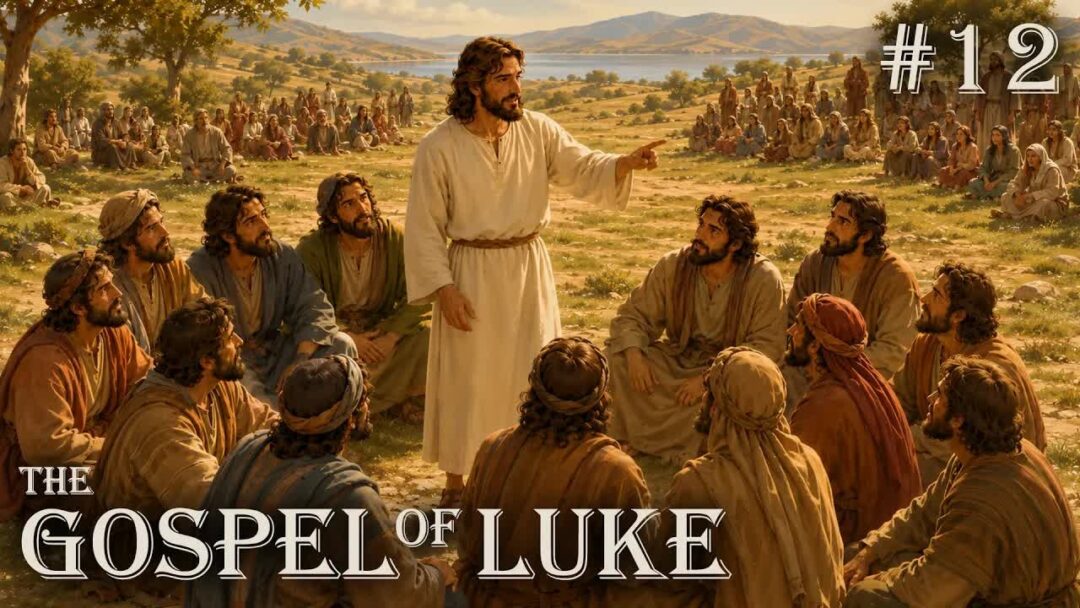
From our Sunday service on August 16, 2026, Luke 6:37-7:10. This is part 12 of our Gospel of Luke series. Watch the full message: Training the Twelve: Part II – The Gospel of Luke #12 on YouTube.
This is part two of a message Jesus is teaching to his disciples. Last time, Jesus went up and prayed in a mountain, then came down from the mountain and chose his twelve apostles. These twelve would be those specially called to be sent by Jesus into the world after his death. Before they got to the part where they’re missionaries throughout all the known world, they had a lot to learn. Immediately after Jesus picked the twelve, he sat them down in front of him and began to speak about what it means to be a disciple or apostle of Christ. Before they went out into the world and were challenged by the powers of Satan and by the powers of the culture and the society, they needed to know what being a follower of Christ was all about.
In the first half, Jesus began by emphasizing the importance mercy would play in their Christianity. Mercy needed to be a core part of their lives, always carried alongside their mission. Why? Because to represent God to the world, they must first be like God, and God is merciful to everyone, even the sinners and the atheists. Now Jesus continues to build up his disciples.
God wants you to obey his authority.
Giving and Receiving
Judge not, and ye shall not be judged: condemn not, and ye shall not be condemned: forgive, and ye shall be forgiven: Give, and it shall be given unto you; good measure, pressed down, and shaken together, and running over, shall men give into your bosom. For with the same measure that ye mete withal it shall be measured to you again.
Luke 6:37–38
Jesus is building on what he said in verse 31: “as ye would that men should do to you, do ye also to them likewise.” You should do to others what you want them to do to you, because when you treat others the way you want to be treated, you will often be treated the same way you treat others. As we noticed last time, Jesus in this sermon always brings things out in sets of four, and here is no different. He gives four examples.
Judge Not
First: “Judge not, and ye shall not be judged.” If you are a judgmental person, people will treat you judgmentally. If you are not, people will tend not to be judgmental toward you. Say you’re at work and you just focus on all the mistakes your coworkers make: “They messed this up, and it gave me extra work, or gave my boss extra work. They’re always complaining about this,” yada, yada, yada. You’re judgmental and you start gossiping about everybody around you. Then don’t be surprised when you mess up and people start yapping, tattling, and gossiping about you. Why? Because you already did it to them. Naturally, their response is, “I’m going to lean it back on them. I’m going to treat them the same way they treated me.” So Jesus says, “If you don’t want to be judged, don’t judge others.”
This doesn’t just have a physical, community sense. It also has a spiritual sense. The Bible tells us that if we judge others, God is going to judge us more harshly as well. If we’re always condemning and ragging on other people about all their mistakes, God is going to hold us accountable for our mistakes doubly so. Why? Because God hates a hypocrite. If you sit there and point out all the mistakes everybody else makes, God is going to say, “Okay, you want to play it that way? When you make a mistake, it’s not going to be as easy on you anymore. You’re going to find out the hard way what it’s like to hold other people to a standard you don’t measure up to.” That’s what Jesus is talking about this whole time: making sure the standard you hold other people to is the same standard you hold yourself to. If not, what do we call that? Hypocrisy. And Jesus was never a fan or supporter of the hypocrite.
Condemn Not
Number two: “condemn not, and ye shall not be condemned.” He’s talking about having mercy. Condemnation is when you have a judgment and a penalty given to you. When you are condemned, you’re found guilty in a court of law and sentenced to a punishment. If every time somebody in your business messes up you’re constantly punishing and punishing them for their mistakes, don’t be surprised when they are your boss and you make a mistake and they punish you. On the other hand, if when somebody makes a mistake you forgive them and choose to do what Jesus said in the first half, to have mercy because God is merciful, don’t be surprised when you mess up later and that person, who has the opportunity to punish you, is merciful to you as you were to them. Do unto others as you would have them do unto you, and you will receive it back.
Forgive
Number three: “forgive, and ye shall be forgiven.” Here we’re not talking about the punishment but about the emotion: not holding a grudge. If you’re somebody who always holds a grudge, don’t be surprised if somebody else holds a grudge against you. That’s the kind of person you are, so that’s the way they’re going to treat you. But if you’re somebody who always forgives, who always lets go of wrongs done against you, don’t be surprised when other people forgive you as well. Nobody wants to be mean to somebody who’s always kind. How many of you can say, “I hate nice people. I wish bad things would happen to them”? No one’s going to say that. If you are kind and merciful in your day-to-day life, people will be kind and merciful to you. What you give to others is, more often than not, what you will receive.
Give
Number four goes even further: “Give, and it shall be given unto you.” This one is a bit different. If you give to those in the most need, let’s be honest, it’s not likely they’ll get to a position where they’re able to pay you back. The Bible says not to expect anything in return when you give to someone in need, because it’s just not reasonable to expect it. And if you’re helping others just to help yourself, that’s vain and selfish. But give to those in need, and although they might not get back to you, guess what’s going to happen? If you’re quick to help others in their time of need, your community is going to notice. When you find yourself in a tough place, don’t be surprised when your community steps up and says, “This person has helped people for decades. Now they’ve fallen on hard times. Let’s go help them.”
How many times have we seen on a news channel a business that’s been in the community for 30 years? “I was hungry, and he gave me food from his restaurant.” Then COVID hit and they’re struggling, and the community says, “They’ve been with us for 30 years. They’ve been helping our community. I don’t care if COVID is out there. I’m going to send all the money and do all the business, and I’m going to bring my friends, and we’re going to support this business, because it’s supported those in need.” That’s what Jesus is talking about. Give unto others, and it’ll be given back to you. If you invest in others, others will be happy to invest in you. The community will rally around you if you are somebody who gives. Once again, this has a secular sense and a spiritual sense. Even if your community doesn’t, God will bless you just the same.
Good Measure
He doesn’t stop there: “good measure, pressed down, and shaken together, and running over, shall men give into your bosom. For with the same measure that ye mete withal it shall be measured to you again.” Jesus doesn’t say you’re going to get exactly the same amount you gave away, and he doesn’t say you’ll receive less. He says you will have a good measure. The image is like a spice or flour. You go to the market and get exactly a measurement of flour. What would often happen is that sellers would try to save as much money as possible. They’d fill it to the top, but they wouldn’t press it down or sift it a little to get as much in the measurement as possible. You got what you paid for, but it was loosely packed. How many of you open a cereal box and see, “Wow, I got a whole box of cereal, but most of the box is air”? That’s the idea. They’re going to give you a cereal box with all the air removed. It’s going to be full of cereal. That’s not the expectation. That’s extra. It’s filled to the brim, pressed down, shaken to make sure there are no air pockets, so you’re getting everything you deserve. And it doesn’t even stop there: it’s running over. They give to you, press it down, make sure there’s no air, and give you extra on top of it. Everything you pay for, you get plus more. When you invest in others, God will multiply that gift back to you.
“With the same measure that ye mete withal it shall be measured to you again.” That measure is the tool you use to measure what you sell. If you’re the person who, when you help and give to others, might fill the box but won’t press it down or shake it, who says, “I’ll go through the motions, but I’m not going to be all in, not all invested in this,” then that’s your measure. Chick-fil-A says that for two cans I get a free sandwich, so I’ll give the two cans for the sandwich, but the third, I’m done, because I don’t get a reward for that. If that’s the measurement you use, that’s a fair trade, and no one’s going to hold it against you. But don’t expect to be patted on the back and blessed by God if all you do is the bare minimum of what is expected of you. If you want to be blessed by God, you need to go over and above what people expect. You have the choice before you today. How will you treat other people? Because the way you treat other people is how they’re going to treat you as well.
The Beam in Thine Own Eye
He continues the topic of hypocrisy as he challenges us to observe ourselves.
And he spake a parable unto them, Can the blind lead the blind? shall they not both fall into the ditch? The disciple is not above his master: but every one that is perfect shall be as his master. And why beholdest thou the mote that is in thy brother’s eye, but perceivest not the beam that is in thine own eye? Either how canst thou say to thy brother, Brother, let me pull out the mote that is in thine eye, when thou thyself beholdest not the beam that is in thine own eye? Thou hypocrite, cast out first the beam out of thine own eye, and then shalt thou see clearly to pull out the mote that is in thy brother’s eye.
Luke 6:39–42
First Jesus told them: do not judge, do not condemn, do not resent others, give to others. Now he redirects those attributes. Instead of focusing on other people’s problems, Jesus challenges the disciples to focus inward on their own problems and how they can improve themselves.
Can the Blind Lead the Blind?
“Can the blind lead the blind? shall they not both fall into the ditch?” These men were meant to become leaders. They were disciples and apostles, meant to teach what Jesus said and take the gospel all over the known world. Could they really teach these sayings if they themselves did not follow them? The answer is no. Nobody’s going to care what the disciples say about love if, right before they get up to preach, they start yelling at someone for wasting their time. Thus saith the Lord, no one’s going to care. Hypocrisy destroys ministry. You need to stop being focused on everybody else and everybody else’s problems. If you’re going to be a disciple of Jesus, you need to stop looking outward and start looking inward at yourself. If you’re blind and you don’t know what you’re doing, how are you going to tell other people what to do? The first thing you need to do is get yourself right. Then you’ll be able to help other people.
As His Master
Verse 40: “The disciple is not above his master: but every one that is perfect shall be as his master.” The student is never above his teacher in authority. The teacher knew everything and passed it down to his student. In this case, the disciples would never have the same authority as Christ. However, if they truly learned the teachings of Christ and applied them, they would be like Christ. The word perfect in the Greek could also be translated complete: someone who has completed their training, who has perfected their craft. They’ll be like their master.
Say you’re a carpenter, and you have a son you want to train in the art of carpentry. That son may never be exactly as good as his father, but if he has completed his training in everything his father has done, he’s going to be a lot like his father, because he sat under his teaching. No one’s going to be better than Jesus. He was perfect and sinless, so the standard we’re going toward is one we will never achieve perfectly. So he says, “You’re not going to be fully like me, but if you complete your discipleship, if you really understand what it means to be a follower of me, when people look at you they’re going to say, ‘You’re just like your teacher.'” It’s like the people around that carpenter’s son saying, “Man, you’re a carpenter just like your dad.” That’s the goal of discipleship: for people to look at you and say, “I didn’t know Jesus in my life for real, but if Jesus were in this world and he were real, I think he’d look a lot like you.” If that’s what people say about you, I’ve got good news. You’ve got a good hold of discipleship and what it means to follow Christ. If the disciples wanted to teach Christ, first they must learn to live like him. Then, and only then, could they teach others how to be like him.
The Mote and the Beam
In verses 41 and 42 he tells them once again: don’t focus on other people’s problems. It’s easy to see the problems in other people and hard to see the problems in ourselves. Why are you looking at the speck in your brother’s eye, in the eye of a person in your community? Why are you looking at their tiny little flaws, and you don’t recognize the beam, literally a cedar beam, that is in your own eye? You’re walking around with this big beam in your head. You’ve got a deadly wound in your own character, and yet you’re looking at the tiny character flaws of other people. It seems humorous to us. You can just imagine people ducking underneath the beam as he turns his head. But it’s not meant to be funny. It’s meant to be serious. Some of these disciples sitting there, outside the twelve, were saying they were followers of Christ, and they weren’t. We’ll get to that in a bit. They had damning character flaws. They were not saved. That’s the idea here. You have a mortal wound in your character that you are ignoring. This beam in your eye is lethal. You’re not going to recover unless you get the beam out and seek help. You are bleeding out and you’re worried about other people. First you need to stabilize yourself; then you can help someone else with their inconveniences.
That’s how seriously Jesus wants us to understand that we need to look at ourselves. If we’re not looking at ourselves, we may not realize just how much of a situation we’re in, just how flawed we are, and how badly we’re jumping the gun, trying to tell people about Christ before we’re even like him at all. So, examine yourself. If you want to help people, “cast out first the beam out of thine own eye, and then shalt thou see clearly to pull out the mote that is in thy brother’s eye.” If you don’t look in the mirror, you’re not going to notice the beam. If you don’t take time to look at yourself and see what you look like from somebody else’s perspective, it’s going to be pretty easy to overlook. Jesus says you need to stop and check yourself first. Then you’ll be equipped to serve the Lord.
Known by His Fruit
He tells us why, as he shows that we are defined by our actions.
For a good tree bringeth not forth corrupt fruit; neither doth a corrupt tree bring forth good fruit. For every tree is known by his own fruit. For of thorns men do not gather figs, nor of a bramble bush gather they grapes. A good man out of the good treasure of his heart bringeth forth that which is good; and an evil man out of the evil treasure of his heart bringeth forth that which is evil: for of the abundance of the heart his mouth speaketh.
Luke 6:43–45
In verse 43 Jesus says the health of a tree determines the quality of its fruit. An unhealthy tree will produce bad fruit, or no fruit at all. This is the nightmare of the farmer: to plant his field and find the soil isn’t fertile, without enough nutrients for the plant to become healthy. If the plant doesn’t get enough nutrients, it’s not going to produce usable fruit. Once again, this is drawing from the parable of the sower. The soil is our hearts, and our hearts need to be prepared for the word of God so it can grow. If we have bad soil, we’re going to have bad plants. If we have bad plants, we’re going to have bad fruit, and our fruits are our actions and our salvation. If we have an unhealthy life and we’re trying to produce fruits of righteousness, that fruit is not going to be useful. It’s not going to be produced. A good tree brings forth good fruit, not bad fruit. So if your life is corrupt, how are you going to produce what is good?
Of Thorns Men Do Not Gather Figs
“For every tree is known by his own fruit. For of thorns men do not gather figs, nor of a bramble bush gather they grapes.” Here he goes in a slightly different direction. The true type of tree is identified by what it produces. A vine that grows grapes is called a grapevine. A tree that grows figs is called a fig tree. In a similar way, bad plants are named: a thorn bush is identified by its thorns, and a bramble is called a bramble bush, which literally means a prickly shrub. The truth of this statement is emphasized by the fact that if you translate it into English, the same rules apply. This was written in Greek, but even the Greek words represented the fruit or product the plant was known for. Grapevines were named in Hebrew and Greek after grapes. The fig tree in Hebrew and Greek was named after figs. Bramble still works in English, because no matter which country you live in, the bush is named after the thorns if it has thorns, not after the fruit it produces.
So what Jesus is saying is that if you have those thorns in your life, it doesn’t matter what fruit you produce. You’re not going to be known for producing nice fruit if you have thorns. You’re going to be known as a thorn bush, not for the good fruit you have. All these are named based on how you generally interact with them. Fruit trees are named positively because they give you fruit, and your main interaction with them is that you get produce and sustenance from them. The thorn and the bramble are named negatively for the harm they do you, because that’s the general experience people have with them. So the question is, do you want to be known by your positive or your negative actions? Because you will be known by your actions one way or another.
I think a lot of us overlook this fact. It doesn’t matter how much we try to shape what we look like. At the end of the day, we are not going to be defined by how we want to present ourselves, but by what we do. We judge ourselves by our intentions, but other people judge us by our actions. People have no choice but to judge us by our actions. So Jesus is saying, “If you want to be my disciple, you’ve got to be really aware of the actions you’re putting into the world.” If you have bad actions, you’re going to be a little thorny. If you’re harming people, that’s what you’re going to be known for. All your other good attributes will be overlooked, and they’ll call you Mr. or Mrs. Thorn instead of Mr. or Mrs. Beautiful, Pleasant Person to Be Around. So, who do you want to be?
The Treasure of His Heart
Verse 45: “A good man out of the good treasure of his heart bringeth forth that which is good; and an evil man out of the evil treasure of his heart bringeth forth that which is evil: for of the abundance of the heart his mouth speaketh.” This gets back to the idea of the soil. It’s the source. Our hearts are either the fertile soil or the soil that can’t produce good fruit. Maybe your soil can only sustain weeds. I’ve got bad news for you: you’re going to need to work on your soil. You’re going to need to work on your heart. If all you do is build up resentment and anger and frustration, your soil needs some work. Your heart needs some work. You need to put some nutrients into that soil: some of the word of God, some of the Spirit, some prayer, some renewal, if you want it to produce things that are good and healthy, because the state of your heart is going to come out in your actions.
Jesus doesn’t present this as an “if, possibly” statement. It’s not “if your soil’s bad, you might produce bad actions.” It’s a matter of fact: if your heart has problems, you’re going to produce bad actions. The cause and effect are perfectly correlated. There is no exception. All of your actions come from your heart. Whether you like it or not, your heart’s attitude will ultimately be revealed to others through the actions you choose to take, and whatever is in your heart will eventually come out through your mouth.
Why Call Ye Me, Lord, Lord?
So Jesus continues: don’t be a hypocrite.
And why call ye me, Lord, Lord, and do not the things which I say? Whosoever cometh to me, and heareth my sayings, and doeth them, I will shew you to whom he is like: He is like a man which built an house, and digged deep, and laid the foundation on a rock: and when the flood arose, the stream beat vehemently upon that house, and could not shake it: for it was founded upon a rock. But he that heareth, and doeth not, is like a man that without a foundation built an house upon the earth; against which the stream did beat vehemently, and immediately it fell; and the ruin of that house was great.
Luke 6:46–49
It’s clear from verse 46 that some of the people who came to this discipleship meeting publicly identified themselves with Christ’s teaching but did not follow his teachings in their lives. “Why do you call me Lord, Lord? You call me master. You call me the authority. But you don’t obey my orders. I’ve given you teachings, and those aren’t recommendations. Those are orders. So why do you come to my discipleship meeting to learn what I say if at the end of the day you’re not going to do it?” You’re not taking seriously the things God has told us to do. “I will show you what your so-called wisdom is like.”
Founded Upon a Rock
He draws out a parable, as he so often does. Those who hear his teachings, and don’t just listen but do them, are like somebody who builds his house’s foundation by drilling into bedrock and building the house on top of that bedrock. When the storms of life come and it rains and the ground beneath the house gives way, the house is structurally secured into the bedrock, so though the ground beneath gives out, that house will still stand. Why? Because it’s built on a solid foundation. Jesus is saying, “My teachings, and I myself, am the foundation on which you need to build your life.” That means following what he says, not just liking it or approving of it, but actually doing it, actually acting on the things you have learned.
“But I’ll tell you what you are like, disciple who calls me Lord but doesn’t treat me like one. You’re like a house built on the dirt, on the ground. You have a house that’s beautiful on the outside, but it’s just sitting on the dirt.” If you know anything about rivers, they meander and move over the centuries. They don’t stay in the same place. They erode and shift. When the storms of life come and that river starts to erode and gets underneath your house, your house no longer has a foundation. It’s going to fall into the river and be destroyed. “Everything you try to work for for me, what you’re trying to build up in my name, is worthless, because you didn’t build it on the foundation. You didn’t live by the words you spoke. You said nice things. It looked good on the outside, but your actions didn’t support it.” When people came to view the house, it was gone, washed away.
He doesn’t just say it washed away. He says “the ruin of that house was great.” It wasn’t just that it was gone. Looking at its destruction was amazing in and of itself, and it was disturbing to look upon. “The ruin of you disciples who call me Lord but don’t obey me is going to be a moment of awe and wonder.” Not in a positive light, but a negative one. It’ll be shocking, disturbing, and overwhelming to watch you fall after all you’ve built up. In so many words, he’s saying, “Don’t be a hypocrite, because hypocrites don’t build anything up for me or for themselves.”
The lesson is this: learning about Jesus only has an effect if you actually put it into practice. Have you ever wondered why Christianity isn’t working for you? If you’ve ever felt that way, it’s probably because you were like those disciples that day who listened to Christ’s teaching session but never followed his instructions. You aren’t actually trying to be like Christ. You’re just trying to associate with his wisdom from a distance, and it will not work. Great will be the fall of the one who listens to and approves of Jesus, yet rejects actually listening to him.
A Man Set Under Authority
Usually this is where this passage would end, but I want you to see what happens right after this. It’s amazing how God orchestrates events to teach a lesson. In Luke 7 an interesting event appears that creates a great object lesson for the topic Jesus just taught his disciples.
Now when he had ended all his sayings in the audience of the people, he entered into Capernaum. And a certain centurion’s servant, who was dear unto him, was sick, and ready to die. And when he heard of Jesus, he sent unto him the elders of the Jews, beseeching him that he would come and heal his servant. And when they came to Jesus, they besought him instantly, saying, That he was worthy for whom he should do this: For he loveth our nation, and he hath built us a synagogue.
Luke 7:1–5
After Jesus concludes his teaching, a group of Jewish elders approaches him and asks Jesus to do a favor for their community. A certain centurion’s servant, his son (in the Greek, pais, which can mean boy or servant), who was dear unto him, was sick and ready to die, and this centurion was a big pillar of the community, so to speak. They said he is worthy for whom Jesus should do this. Why? Because he loves their nation and has built them a synagogue.
Here we have an object lesson. Jesus just taught that if you’re good to others, people will be good to you, and here is an example out of left field. It’s a Roman centurion, somebody who worked for the Roman Empire as a police force to oppress the Jewish people. He worked in the Roman army. This is not usually somebody the Jewish people would like. Remember when soldiers showed up at John’s messages at the beginning of our series? I said that usually the people’s response would be that they should quit their job and go do something else. Apparently this Roman had been such a pillar of his community in helping those in need that they overlooked the fact that he was a centurion who worked for Rome, and they embraced him in their community. This man was so generous that we’re told the Capernaum synagogue was actually built by his donations, because he loved the Jewish people so much. Though technically, in terms of Israel’s culture, he was an enemy, to the people of Capernaum he was a friend. Why? Because he did good unto others, and others did good unto him.
So these Jewish elders, probably people of wisdom in teaching the Torah, are the ones who go to Jesus and say, “Jesus, this man’s servant is dying. We need him healed. Come heal him. We’re coming on his behalf. He deserves it, because he’s helped us so much, and we want to help him.” Unfortunately, we don’t know too much about him outside of this. We do know he built the synagogue, but when we excavated that synagogue, another one had been built on top of it, so we don’t know too much about the synagogue he built.
Then Jesus went with them. And when he was now not far from the house, the centurion sent friends to him, saying unto him, Lord, trouble not thyself: for I am not worthy that thou shouldest enter under my roof: Wherefore neither thought I myself worthy to come unto thee: but say in a word, and my servant shall be healed. For I also am a man set under authority, having under me soldiers, and I say unto one, Go, and he goeth; and to another, Come, and he cometh; and to my servant, Do this, and he doeth it.
Luke 7:6–8
Jesus agrees and goes with them to heal the centurion’s servant. The centurion himself had sent the elders, and now, as Jesus comes near the house, he sends friends to stop Jesus from coming: “I am not worthy that thou shouldest enter under my roof.” And he says there’s another way this can work: “Say in a word, and my servant shall be healed. I know you, Jesus. I know you are the Word of God, the divine Logos, the one who created the world through speech, and I know that if you just say the word, my son can be healed. So don’t bother taking time out of your healing ministry and preaching ministry to come to my home. Just speak, and my son will be healed.”
Listen again to verse 8: “For I also am a man set under authority, having under me soldiers, and I say unto one, Go, and he goeth; and to another, Come, and he cometh; and to my servant, Do this, and he doeth it.” What was Jesus just talking about? People saying, “Lord, Lord, master, master,” but not doing the things he commands. Who is this man? The centurion is the master of the servant. This Roman, completely distant, not at Jesus’ teaching, not tied to the Jewish people, not learning the Jewish culture or reading the Torah, understood what it meant to be a disciple. “I know that you’re the master, and what you say will be done.” He has such a high view of Jesus that he didn’t even consider that Jesus’ disciples might not do what he says. Jesus had just sat and told his disciples, “You say I’m master, but you don’t obey.” The centurion says, “I know that you’re a master, and whatever you say will be obeyed.” Boy, what a contrast. While others praised this centurion as worthy, the centurion himself didn’t see it that way: “I am unworthy to have you in my home. Just speak the word and he’ll be healed.” So we have this lesson on authority right after this passage.
When Jesus heard these things, he marvelled at him, and turned him about, and said unto the people that followed him, I say unto you, I have not found so great faith, no, not in Israel. And they that were sent, returning to the house, found the servant whole that had been sick.
Luke 7:9–10
He marvelled. He was amazed. He was in wonder at him. What a shame it would be if we stopped where the chapter division stopped and didn’t tie this all together to see what was going on. Jesus had just told his disciples that in Israel those disciples, those followers, liked Jesus. They were fans of Jesus. They publicly identified with Jesus. But when it came to following the things he preached, they agreed with them but didn’t implement them. So Jesus turns around to the people he just spoke to and says, in effect, “I have not seen anybody like this in your group. You call yourselves disciples, but you don’t understand authority. When God speaks, you listen. When God teaches, you implement. Whatever God says, do, because that is the sign of true faith.” If you believe God is who he says he is, you will do the things he says to do. There’s no other way to look at it.
The irony here is striking. A Roman centurion understood what some of Jesus’ own followers had failed to understand. Some of Jesus’ followers verbally acknowledged Jesus’ authority but resisted his commands. The centurion, on the other hand, believed Jesus’ authority was so absolute that merely speaking a word was enough to accomplish what was known to be impossible.
If You Call Him Lord
Jesus’ teaching in this passage ultimately comes down to one question: what does it actually look like to call Jesus our Lord, our master? It is not enough to listen to his words, agree with his wisdom, or publicly call yourself one of his followers. The sign of a true disciple is that he allows Jesus’ teachings to shape the way he treats others, the way he examines himself, and the choices he makes when no one else is watching. Our actions always reveal what is truly in our hearts, and our obedience reveals whether we truly recognize Christ’s authority as our Lord.
That is what makes the centurion’s appearance such a powerful addition to this lesson. He understood authority. When a commander speaks, those under him respond. So when he looked at Jesus, he did not merely see a wise teacher. He saw someone whose words carried absolute authority. Ironically, this Roman soldier understood something Jesus’ own followers and disciples had missed. If Jesus is truly Lord, then his words are meant to be truly obeyed. The question, then, is not simply whether you believe what Jesus says. The question is whether his words will actually change the way you live. If you call him Lord, will you let him be Lord?
God wants you to obey his authority. So, will you obey his authority by following his commands today?

Recent Comments