
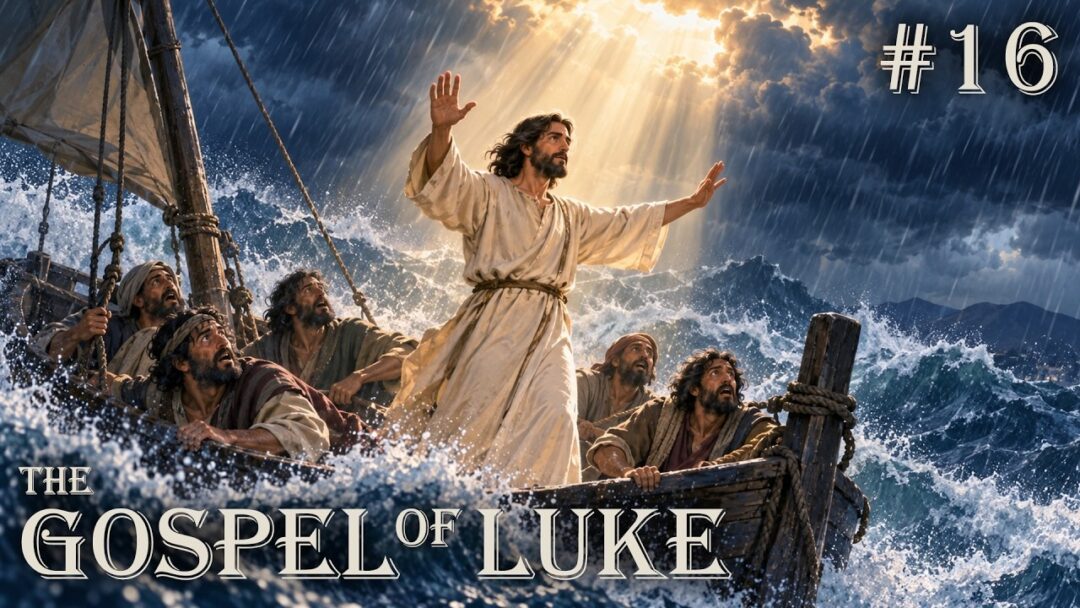
From our Sunday service on September 20, 2026, Luke 8:22-56. This is part 16 of our Gospel of Luke series. Watch the full message: Power and Provision – The Gospel of Luke #16 on YouTube.
Last time, we saw Jesus preach about the kingdom of heaven and what it looks like to truly follow Christ. We talked about the idea of true followers versus those who just got excited about the gospel, who liked the idea of Christ but never decided to follow him in obedience.
Today we’re picking up in Luke where we left off, but something we need to understand is that the passage we’re looking at doesn’t take place chronologically where we are in the book of Luke. We talked about people who faithfully committed to the cause of Christ, and the way Luke decides to build on that is with a flashback. Remember, near the beginning of our series, we talked about how Andrew, Peter, James, and John forsook their fishing business and followed Christ. And I said there was some stuff that happens that’s not mentioned. Today we’re going to go back to that section and talk about the things Luke didn’t talk about then.
Why are we going back in time? Isn’t Luke an orderly narrative? Yes, this is an orderly narrative. Luke has just talked about what it looks like to become a faithful follower of Christ, so instead of dealing with it after this passage, he jumps us back in time to show us what it looked like when those faithful disciples forsook all and followed Jesus. We’re building on what we talked about last time, but it doesn’t chronologically take place at the same time. So just remember today that what we’re talking about happens immediately after Peter, Andrew, James, and John leave their fishing nets and choose to follow Christ. From our time in Scripture today:
God wants you to know that he has the power and authority to protect and provide for those who follow him.
Power over the Storm
For context, we are at the point where Peter was in his fishing boat. Jesus told him to cast the net, and Peter got snippy with the Lord, right? He said, “Well, we fished all night. Nevertheless, Lord, at your word, I will cast the net.” When he pulled that net in, it was full of fish, and he couldn’t even get it all into his boat. Peter called Andrew, James, and John to help him get all the fish. They filled all their boats, and their boats began to sink. Peter falls to his knees and says, “Depart from me; for I am a sinful man.” It’s in this moment that Peter stopped being a fan and became a follower. Andrew and James and John make the same move Peter makes. They leave their fishing business and go with Jesus. We’re told they get in the boat and go across the sea, and that is where we’re picking up in verse 22.
Now it came to pass on a certain day, that he went into a ship with his disciples: and he said unto them, Let us go over unto the other side of the lake. And they launched forth.
Luke 8:22
“Now it came to pass on a certain day.” Luke is differentiating this from the narrative he was just telling. He makes it clear that this isn’t a chronological section. It happened on a certain day. I’m not saying it happened before, and I’m not saying it happened after, but on a certain day Jesus and his disciples got in a boat. And today we know exactly when that was: it was after Peter, James, John, and Andrew all followed Christ. Here Jesus is going to show them, after they became faithful followers, just how powerful he was.
But as they sailed he fell asleep: and there came down a storm of wind on the lake; and they were filled with water, and were in jeopardy. And they came to him, and awoke him, saying, Master, master, we perish. Then he arose, and rebuked the wind and the raging of the water: and they ceased, and there was a calm. And he said unto them, Where is your faith? And they being afraid wondered, saying one to another, What manner of man is this! for he commandeth even the winds and water, and they obey him.
Luke 8:23–25
“In jeopardy”: we’re not talking about the game show here. We’re talking about how they were in trouble.
The disciples forsook everything and followed Jesus, right? They made the commitment. They left their fishing business behind. Peter is taking what seems to be his own fishing boat in this event. Like I said, it sounds like they didn’t even take the time to sell the fish before they forsook everything and followed Jesus. The narrative doesn’t give a gap in the other accounts. It seems like Peter just dumped the fish out and they went across to the other side. You would think these are people full of faith. They just gave up their entire livelihood to follow Jesus. But here we learn their faith isn’t as solid as maybe they think.
Immediately once they decide to devote everything to Christ, they begin to fall into tumultuous times. They’re going across the Sea of Galilee, which I’m sure they’ve done a thousand times. They’re experienced fishermen. They know what the Sea of Galilee is like. They know well and good that at any moment the humidity levels can rise, and suddenly there can be a storm on the sea, and it becomes very dangerous to be in a tiny boat in the middle of that sea with all the water pouring down. They’re experienced in it. I’m sure they’ve been caught in a storm before. But as Satan does, when you decide to devote yourself to something for the cause of Christ, he’s going to try to shake you up a little.
Asleep in the Storm
So suddenly, as they’re going across to begin their ministry with Christ, Jesus is sleeping. He’s just been teaching. Remember, he was teaching out of Peter’s boat that whole day. I’m sure Jesus, being in the flesh, was exhausted in this moment, so he decided to take a nap. What do you usually do on a Sunday? I’m pretty regularly that person: after a good long message, I go take a nap. Guess what? When you do that, you’re like Jesus. Jesus preached, and then he took a nap.
So he’s taking a nap in the boat when the storm comes, and the disciples have not seen a storm quite like this before. They don’t wake Jesus up. He’s the master. He’s in charge. He’s their teacher, their rabbi. They let him sleep. But as the storm goes on and they’re trying to bail the water out of the boat, the boat just keeps getting fuller, and they’re thinking, “Okay, we’re past the point where this is reasonable. Our boat is filling with water. Our lives are in jeopardy. Everything’s falling apart. If something doesn’t change, we’re going to die. How is Jesus still asleep during all this?” This is not a huge boat where you can go down into the bottom and be protected from the elements. Jesus is being rained on this whole time and sleeping all the way through it. So they wake him up. “Okay, we’ve got to stop messing around. Let’s wake up Jesus. Jesus! Master, Master, wake up! Don’t you care about what’s going on? Don’t you see the storm? Don’t you care that we’re going to die here?”
Where Is Your Faith?
What does he say to them in verse 24? It says he arose. He didn’t even reply to them. He just rebuked the wind and the raging of the water, and they ceased, as he says, “Peace, be still.” The literal translation of the Greek of that phrase is “Silence. Be quiet.” Jesus doesn’t even talk to the disciples. He just says, “Shut it. Can it. This is nap time. Be quiet.” And the disciples are shocked, because he just solved the whole problem by telling the storm, “Be quiet. You’re too noisy.”
What does Jesus say to them after he solves the problem? He looks at them and says, “Where is your faith? Guys, didn’t you just forsake everything to follow me? Wasn’t the whole point of what happened before I took my nap that you trust me? I just taught you the lesson that you don’t need your livelihoods to take care of you. You can follow me, and I will take care of you. If you choose to forsake your comfort or your business, you’ll never need to fish another day in your life. I showed you that through the miracle of the fishes. That was the whole illustration: at a moment’s notice I could give you all the money you need, all the fish you need to eat. And now, between the beginning of my nap and the end, you’ve completely lost your faith. Where is your faith? Don’t you know my power?”
Apparently they hadn’t quite grasped Jesus’ power yet, because verse 25 says they, being afraid, wondered. They were amazed, saying to one another, “What manner of man is this? What kind of person is this, who wakes up from a nap and says, ‘Silence, be quiet,’ and the universe listens?” It was no big deal to Jesus. The biggest crisis they had ever had in their lives, when they were closer to death than they ever thought they could be, was not a crisis for Jesus. It was just a matter of saying one command, and the solution presents itself immediately. They say, “He commandeth even the winds and water, and they obey him.” The question was, were the disciples going to obey him? Because creation does.
Here Jesus is once again showing this lesson to his disciples: “If you are a follower, if you’re going to forsake all and follow me, guess what? I’m going to take care of you. I’m going to protect you, and I’m going to provide for you.” Through this miracle they see the power of Christ and realize once again that when we’re with Jesus where he wants us to be, we’re in the safest place we can ever be.
Power over the Demons
Moving on to the next story, a demon-possessed man shows up as they arrive across from Galilee, and quite the fiasco happens. Let’s first look at verses 26 and 27.
And they arrived at the country of the Gadarenes, which is over against Galilee. And when he went forth to land, there met him out of the city a certain man, which had devils long time, and ware no clothes, neither abode in any house, but in the tombs.
Luke 8:26–27
“Over against Galilee” means across from Galilee. Immediately they get out of the frying pan of the storm and go into a new fire, right? This is what it’s going to look like to follow God sometimes, just so you know. Immediately they’re met by a man, and we’re told this man is very, very scary. The Synoptic Gospels talk about him in different lights, and they all emphasize different things. Matthew in his account emphasizes that there wasn’t just one man there. There were actually two men who appeared who were demon-possessed, but Luke only focuses on one of the two.
And when he was come to the other side into the country of the Gergesenes, there met him two possessed with devils, coming out of the tombs, exceeding fierce, so that no man might pass by that way.
Matthew 8:28
Matthew tells us a little more. This wasn’t just one man. This was more of a systemic problem: the demon possession in this area was bad. There were two men demon-possessed. They were fierce, meaning they were violent. It was so bad that people would avoid traveling on this road so they didn’t have to interact with these men, because they were afraid these demon-possessed men would come out at them and attack them, and they’d be harmed or killed. And of course, what does Jesus do? He goes right into that situation.
We’re told this man had suffered from demon possession for a long time, and because of his oppression, based on the words there, he ran around at best in tattered old clothes. It says he wore no clothes. That word in the Greek doesn’t always mean literally fully naked. It could mean just wearing your undergarments. At best he’s wearing old, tattered undergarments; at worst he’s completely naked. He’s been running around like this for a long time, living in empty tombs carved out of the cliff walls, sitting in the middle of the wilderness.
Imagine the terror you would have of a man who lives in tombs and attacks people at random at night while you’re walking through the dark. It’s a very scary situation, not a situation you want to be in. As you walk by the whole row of tombs carved into the mountainside, at any moment two deranged men could hop out and attack you. Usually people run away from this situation. But Jesus, being the Son of God, says, “You know what? That’s a ministry opportunity.” So they go there, and he interacts with these men.
We’re also told in another passage that the demons caused the man to cut himself. So these men were not just a harm to others; they were also a harm to themselves. The demons were forcing them not just to harm others but also to hurt themselves, and they were just as tortured as the community that had to live around them. Jesus, seeing this situation, wants to do something about it. So he approaches the demon-possessed man and begins to speak to the demons.
Torment Me Not
In verses 28 and 29, the demons speak first.
When he saw Jesus, he cried out, and fell down before him, and with a loud voice said, What have I to do with thee, Jesus, thou Son of God most high? I beseech thee, torment me not. (For he had commanded the unclean spirit to come out of the man. For oftentimes it had caught him: and he was kept bound with chains and in fetters; and he brake the bands, and was driven of the devil into the wilderness.)
Luke 8:28–29
Here we see a situation that’s far worse than any other story we’ve encountered so far in the Gospel of Luke. This is an unprecedented level of demonic possession. Last time we were introduced to Mary Magdalene and the seven demons that possessed her. This man was far beyond that situation.
When Jesus talks to the man, we’re told the man speaks to him, but it’s not the man who’s speaking. If you notice the way he’s speaking, it’s the demon. He responds the same way as the demon in the synagogue did, with the possessed man, when Jesus was preaching. It’s not the man who can speak. The man has lost complete and utter control of himself because of the severity of the demonic possession. He has no control over his body. When Jesus speaks to him, he’s not the one who answers. The demons cry out, “What have I to do with thee, Jesus, thou Son of God most high?” If you notice, every time the demons talk about Jesus, they call him the Son of God. They recognize him for who he is. “What do we have to do with thee? Jesus, why are you here? What is your plan? What do you plan to do with us?”
Then they make this request: “I beseech thee, torment me not.” Here they’re talking about the ultimate destination for all the demonic, fallen-angel forces. In the end they will all be cast into the lake of fire; we’ll talk about that a little in a second. “Don’t torment me. I beg you, Jesus. I’m a demon, yes, but don’t torment me.”
It says he fell down before him. If you read the other Gospel accounts, you might see that translated with the word “worship,” and you might be tempted to think the demon-possessed man is worshiping Jesus in a spiritual sense. But the word “worship” literally means to fall on the knees. So the word there is “worship” in its literal sense, not its figurative sense, and Luke renders it more clearly as “he fell down.” The demon makes the man fall into an act of submission, not an act of praise. The demon is not praising Jesus as the Son of God. He’s submitting to the authority of God so as not to bring eternal punishment on himself through his actions. The demon immediately knows who Jesus is. They refer to him as the Son of God, as the demons always do, and the demon begs Jesus not to torment him.
My Name Is Legion
So Jesus begins to speak with him, in verses 30 through 32.
And Jesus asked him, saying, What is thy name? And he said, Legion: because many devils were entered into him. And they besought him that he would not command them to go out into the deep. And there was there an herd of many swine feeding on the mountain: and they besought him that he would suffer them to enter into them. And he suffered them.
Luke 8:30–32
That word “suffer” means allowed. So Jesus is talking to this demon: “Demon, what is your name?” And the demon replies, “My name is Legion,” and it says they are called this because many devils were entered into him. The word “legion” refers to a Roman regiment that consisted of 6,826 soldiers. It was a very large military group in the Roman military. A centurion had a hundred; this had 6,826 soldiers in it. So Legion refers to himself as this series of demons, which we’re going to find out is beyond 2,000 demons. These over 2,000 demons refer to themselves as one collective, Legion, and Jesus is speaking with this collective.
How do we know it was over 2,000? Mark tells us the pigs the demons are about to go into were about 2,000. So you have to say, if one demon went into each pig, that’s at least 2,000 demons in this one man. This is a horrible, horrific situation. This man is completely lost, and to everybody in the community around him, he’s a lost cause that you don’t even approach or go near.
The Deep
You may have noticed in verse 31 that they besought him that he would not command them to go out into the deep. That word in the Greek is abyssos, or as we would say in English, the abyss. The abyss is the place God has prepared as a holding cell for demons that cross the line God said they should never cross in their rebellion. We see it in the book of Revelation as the location where Satan will be bound for a thousand years during the millennial reign of Christ. We’re told that in the abyss there are demons held in chains of eternal darkness that won’t be released until Judgment Day.
Why? It seems it’s because these demons didn’t obey God in the sense that God says, “In your rebellion you can only go so far. If you go beyond this line I’ve set for you, I’m going to throw you into the abyss until the day of judgment. You’re not going to see the light of day until the day of judgment, and then you’re going straight into the lake of fire for all eternity.” So these demons see Jesus come, and they say, “Okay, we are staying within the lines you’ve set. You said if we pass over this line, we’re going to be in hell until the day of judgment. But we’ve not crossed that line. Jesus, what do we have to do with you? We’ve only rebelled to the extent you allow. Please do not send us into the abyss until the day of judgment.” That is what the demons are requesting. We don’t know much about the abyss, but I can tell you it’s a place of torment, based on what they said, and it’s definitely a place the demons don’t want to be.
Another thing we notice about demons in this passage is that they prefer to inhabit some kind of body. They know what Jesus is there to do. They know Jesus is going to liberate this man from the over 2,000 demons in him. Because they know they’re going to lose this body, they beg Jesus, “Please let us have another body. Let us go enter into these pigs at this farmer’s homestead over here, and we’ll take those bodies. Please just allow us to do that.” And Jesus does allow it. It seems demons do prefer to inhabit something rather than exist on their own. We’re not told why Jesus allows them to enter the pigs, but one way or another, Jesus allows them.
Into the Swine
We see the results of that in verses 33 and 34, as the demons enter the pigs.
Then went the devils out of the man, and entered into the swine: and the herd ran violently down a steep place into the lake, and were choked. When they that fed them saw what was done, they fled, and went and told it in the city and in the country.
Luke 8:33–34
“Choked,” or another way you could translate that, drowned. When the demons enter the pigs, the situation doesn’t get any less chaotic. I don’t know if it’s an act of lesser rebellion or what, but the demons decide, “Let’s take all these 2,000 pigs, run them straight into the Sea of Galilee, and drown them.” And that’s what they do. Suddenly all the pigs go crazy. They jump the fence, break the fence, whatever they do, and they go straight off a cliff into the Sea of Galilee and drown. The people tending the pigs are saying, “What in the world is going on? 2,000 pigs just went crazy and killed themselves!” So they run into the city and tell everybody what’s going on. Suddenly things are getting very chaotic in this region. Like I said, Mark tells us about 2,000 pigs are killed here, so it’s at least 2,000 demons that went out here, and the people begin to gossip and talk.
In His Right Mind
In verses 35 and 36, we see people come to see what in the world is going on.
Then they went out to see what was done; and came to Jesus, and found the man, out of whom the devils were departed, sitting at the feet of Jesus, clothed, and in his right mind: and they were afraid. They also which saw it told them by what means he that was possessed of the devils was healed.
Luke 8:35–36
I think the way this is worded is really interesting. The people in the community hear about the pigs. They hear about something crazy going on at this farm. They show up, and they see this crazy, deranged man, who used to jump out of tombs, maybe with a knife, I don’t know, attacking people, cutting and harming himself, and they see him fully clothed at Jesus’ feet. And their response is fear. They’re afraid. What? Weren’t you afraid of the man who was coming out and attacking you? No. What’s really scary is the fact that this man is sitting at the feet of Jesus in his right mind. They saw the severity of this man’s possession. They saw the severity of his hopelessness. And when they saw that Jesus gave him hope, they were afraid, because they knew that the man who can put this man in his right mind is more powerful than over 2,000 demons, someone who can speak a word and change the spiritual realm.
What Luke is doing here is showing us the power Jesus has over all aspects of the world. First he shows us God’s control over nature and creation. Now he’s showing us Jesus’ ability to control what is spiritual in our lives. And these people are terrified because this man is now in his right mind.
Two Responses
So what do the people do? How do they respond to such a miraculous occurrence? We see their response in verses 37 through 39, as they send Jesus away from the country of the Gadarenes.
Then the whole multitude of the country of the Gadarenes round about besought him to depart from them; for they were taken with great fear: and he went up into the ship, and returned back again. Now the man out of whom the devils were departed besought him that he might be with him: but Jesus sent him away, saying, Return to thine own house, and shew how great things God hath done unto thee. And he went his way, and published throughout the whole city how great things Jesus had done unto him.
Luke 8:37–39
We see two interesting reactions to this event. The first is that those who saw such a miraculous thing wanted nothing to do with it. They saw Jesus as somebody too powerful to control, so they said, “If he’s that powerful, if he’s got that much authority, I don’t want him around here. Somebody with the power you have can cause us nothing but trouble. We want nothing to do with you. Go.” That’s the first response. That’s crazy. You’ve seen this man heal the unhealable. You’ve seen this man control the uncontrollable, and you say, “Go away.”
Then we see the second response, which I think is just as interesting. The man who has finally been freed from over 2,000 demons goes to Jesus, falls at his feet, and begs him, “Lord, let me follow you like these disciples on this boat. Let me go with you. Let me be a disciple. Let me teach with you.” And Jesus tells him, “No. Don’t come follow me with the disciples. What I need you to do is go to your own friends, your own family, your own household, and show them what great things God has done in your life.”
Not everybody is called to go and be a preacher. Not everybody’s ministry in life is to stand before everyone and preach the gospel. Sometimes our calling isn’t so public. It’s more private and personal. This man says, “I want to follow you, Jesus.” Jesus says, “You don’t understand what following me looks like for you. For you, following me isn’t going city to city and preaching. For you, following me is going to your friends and your family and telling them what God has done in your life.” That’s true for us today. Not every one of us is called to go out and stand in front of everybody and preach the gospel. Sometimes we need to say, “Let me show you what Christ has done in my life,” and you show them the gospel of how your life has been changed by God. Sometimes our ministry roles look different, but that doesn’t mean we’re not following. It just means God has called us to a different purpose. This man wasn’t rejected. He wasn’t told, “No, you can’t serve me.” Jesus just says, “Serve me here in your city, in your town, with your friends and your family.”
And what does he do? Verse 39 says he “went his way, and published throughout the whole city how great things Jesus had done unto him.” Why is this so important? Because Jesus was just sent away from this region. The disciples and Jesus were not allowed to come back. But who could preach there? This man whose life was changed by Jesus. This was more of a Greek area. They probably didn’t know the Scriptures very well, and they’d never hear the Scriptures again. Though the Scriptures wouldn’t be preached, they’d still read the life of that man. I believe it was D. L. Moody who said that out of 100 people, maybe one will go out of their way to read the Bible; the other 99 will read your life. This is an example of that in action in Scripture. They were never going to get another chance to read the Scripture, but the testimony of that man was something he would preach his entire life.
Notice also a bit of the divinity of Jesus put into this passage. In verse 39 Jesus says, “Return to thine own house, and shew how great things God hath done unto thee,” and he went and published throughout the whole city how great things Jesus had done unto him. Notice the divinity of Christ displayed there: God’s actions and Jesus’ actions are one and the same.
Power over Sickness
Now we see Jesus return home, in verses 40 through 42.
And it came to pass, that, when Jesus was returned, the people gladly received him: for they were all waiting for him. And, behold, there came a man named Jairus, and he was a ruler of the synagogue: and he fell down at Jesus’ feet, and besought him that he would come into his house: For he had one only daughter, about twelve years of age, and she lay a dying. But as he went the people thronged him.
Luke 8:40–42
Jesus returns to Capernaum, the center of his ministry, where Simon Peter, Andrew, and John all lived. Here we meet Jairus for the first time, the head of the Capernaum synagogue. We’ve heard about the Capernaum synagogue a couple of times, and here we meet the man in charge of it. He meets Jesus as he arrives, bows down in front of him, and invites him to his house, because his 12-year-old daughter was dying and he knew Jesus could heal her. However, it has been a while since Jesus returned to his home base of operations in Capernaum, and naturally, everybody misses him and wants to see him. In no time at all a crowd grows, and it becomes difficult to travel to Jairus’s house, let alone move a few feet.
The Border of His Garment
In this situation we see another person arrive, in verses 43 and 44.
And a woman having an issue of blood twelve years, which had spent all her living upon physicians, neither could be healed of any, Came behind him, and touched the border of his garment: and immediately her issue of blood stanched.
Luke 8:43–44
Among this crowd of hundreds of people is a woman who has been bleeding for 12 years straight. She spent every coin she had in her Roman purse trying to find a solution, but she found none. In fact, Mark tells us that the doctors she sought for help had actually made her situation worse. But she did know about Jesus, who worked out of Capernaum. So she went there and waited for him, and she latched on to a prophecy about the Messiah from Malachi 4:2, which says, “But unto you that fear my name shall the Sun of righteousness arise with healing in his wings.”
The word “wing” in Hebrew is the word they would use for the edge of a cloak. If you needed a seam done on the edge of your cloak, you would say, “I need a seam done on the wing of my coat.” So she saw this prophecy in Malachi that there was healing in the wings of the Messiah, and she concluded, “If I touch the edge of his garment, then I can be healed by the Messiah. I believe Jesus is the Messiah, and if that’s true, Malachi says I can be healed by him.” So she goes to get this healing, and she does in fact touch the edge of his garment, and she is immediately healed.
Who Touched Me?
We see Jesus question the woman in verses 45 and 46.
And Jesus said, Who touched me? When all denied, Peter and they that were with him said, Master, the multitude throng thee and press thee, and sayest thou, Who touched me? And Jesus said, Somebody hath touched me: for I perceive that virtue is gone out of me.
Luke 8:45–46
Immediately Jesus knows he was touched and that a miracle had occurred, because virtue had gone out of him. That word “virtue” should be understood as power. It’s the word dunamis, which is where we get the word “dynamite” in English. The disciples think this whole situation is kind of absurd, because everybody is pushing on Jesus, pressing him from every side. They say, “Are you kidding? ‘Who touched me?’ Everybody’s touching you, Jesus. It’s a crowd, and we can’t get through it, and we’re trying to get to Jairus’s house before his daughter dies.” But Jesus says, “No, I know somebody has been healed here. My power left me, and I need to see them.”
The woman confesses in verses 47 and 48.
And when the woman saw that she was not hid, she came trembling, and falling down before him, she declared unto him before all the people for what cause she had touched him and how she was healed immediately. And he said unto her, Daughter, be of good comfort: thy faith hath made thee whole; go in peace.
Luke 8:47–48
So the woman comes out and makes public what she did. Because of fear, she realizes she’s not going to get away with it. She needs to come clean. She admits, “Yes, I touched you, and I know what I planned to do worked. I can tell that this issue of blood, this bleeding that has been going on for 12 years, has stopped, and I’m healed.” And Jesus says, “Now that I have you, I want to clarify what just happened.” He clarifies for her what saved her. It wasn’t Jesus’ clothing that she touched that healed her. It was her faith in the Messiah that saved her. Then he calls her daughter and sends her home in peace.
Power over Death
But while she has peace, Jairus is about to have another experience, in verses 49 and 50.
While he yet spake, there cometh one from the ruler of the synagogue’s house, saying to him, Thy daughter is dead; trouble not the Master. But when Jesus heard it, he answered him, saying, Fear not: believe only, and she shall be made whole.
Luke 8:49–50
Because of the crowd and the interruption of the woman with the issue of blood, Jesus does not make it to Jairus’s house in time. The daughter dies, and a servant comes and says, “It’s over. It’s done. She’s dead. Don’t bother the teacher. Don’t bother the rabbi. She’s gone. It’s too late.” And Jesus rebukes the man delivering that message. He says, “Don’t be afraid. Just believe, and she will be made whole.” That word for belief is the same word he just used with the woman: it’s your faith that healed you. It’s pistis in Greek. Your faith, your belief, healed you. And he turns and says, “Just believe. Have faith. That woman was just healed by faith. Have faith, and your daughter will still be healed.”
So Jesus enters the house, in verses 51 through 53.
And when he came into the house, he suffered no man to go in, save Peter, and James, and John, and the father and the mother of the maiden. And all wept, and bewailed her: but he said, Weep not; she is not dead, but sleepeth. And they laughed him to scorn, knowing that she was dead.
Luke 8:51–53
“Suffered” means allowed. Jesus meets the family and the professional mourners hired to mourn her at her funeral service. When Jesus says the girl is not dead, they mock Jesus to his face, because they know she is very much dead. She is not breathing, there is no pulse, she’s gone. In so many words they say, “If she’s not dead, then why are we here? Why are we mourning her? Are you crazy?”
Maid, Arise
So what does Jesus do? He kicks all of them out, in verses 54 through 56.
And he put them all out, and took her by the hand, and called, saying, Maid, arise. And her spirit came again, and she arose straightway: and he commanded to give her meat. And her parents were astonished: but he charged them that they should tell no man what was done.
Luke 8:54–56
The first thing Jesus does is tell those people who had no faith, “Get out of this building right now. You mocked me to my face about my ability to heal. Get out. You don’t get to see the miracle.” If you want to see God’s miracle in your life, don’t question God. If you want to see God do miraculous things, don’t get angry with him. Don’t challenge him, because guess what? He’s going to say, “Get out. You’re not going to see the miracle.” The only people who saw this miracle were the people who believed Jesus could do it. So he says, “Okay, get out of the house.” He also tells the people about this miracle, “Don’t tell anybody else about it. When they want to know what happened, when they want to know what they missed out on, don’t tell them, because they rejected me. This is going to stay between you and me.”
So Jesus kicks them all out, takes the girl by the hand, and says, “Maid, arise.” Mark tells us a little more detail about this. He gives us the Aramaic words Jesus actually spoke to her, talitha cumi, which in Aramaic means “Get up, little lamb.” Talitha is an Aramaic word that works like our English word “kid.” In English, “kid” means a young goat, but we also use it to refer to young children. Similarly, talitha means a young sheep, but Aramaic speakers used it as a cutesy name for young children. So Jesus, as the Good Shepherd, goes to this little girl and says, in so many words, “Get up, my little lamb,” because he loves her and cares for her. Jesus is the Good Shepherd, he does care for his sheep, and he loves the little children. So he tells his little lamb to wake up, and the girl is immediately healed and awakes, and the miracle is done. And once again he tells everybody, “Don’t tell anybody outside this room what happened, because they doubted me in their faith.”
Here we see the third aspect of Jesus’ power. First, he has power over creation in this world. Then he has power over the demons and the enemies we face spiritually. And third, he has power over life and death. Jesus has the power to do anything and everything you need. If Jesus can raise this girl from the dead, then let me tell you, he can raise you from the dead at the last day. He can give you a new life in the new heaven and the new earth in the age to come.
He Can Still Be Trusted
Through so many miracles we’re taught that if we become faithful followers, if we are the person who takes the pearl of great price, who takes the hidden treasure, sells everything, and devotes ourselves to Christ, he can take care of all our needs, no matter what area of life they are in. And our ministry isn’t going to look the same. Those disciples forsook everything and followed Jesus, going town to town preaching. But the man who was possessed by demons had a ministry that was more personal, more day to day. He still worked a regular job. Maybe he became a fisherman. What was important wasn’t specifically what God called him to, but that he did what God called him to do in his life. And because of that, Jesus can take care of anything we need.
Throughout today’s passage, Jesus repeatedly proves to us that no situation is beyond his power. He has authority over the storm, power over the demons, and healing for sickness, and he even has control over death itself. We saw that not everyone understood what Jesus was doing. The disciples didn’t always understand. Jairus was told it was already too late. Though they didn’t understand exactly what Jesus was doing, let me tell you, Jesus took care of their problem. In the end, Jesus continually showed that no matter what situation you’re in, he can still be trusted. So whatever we face:
God wants us to know that he has the power and authority to protect us, provide for us, and carry us through it. So the question today is, will you trust him to provide for you?

Recent Comments