
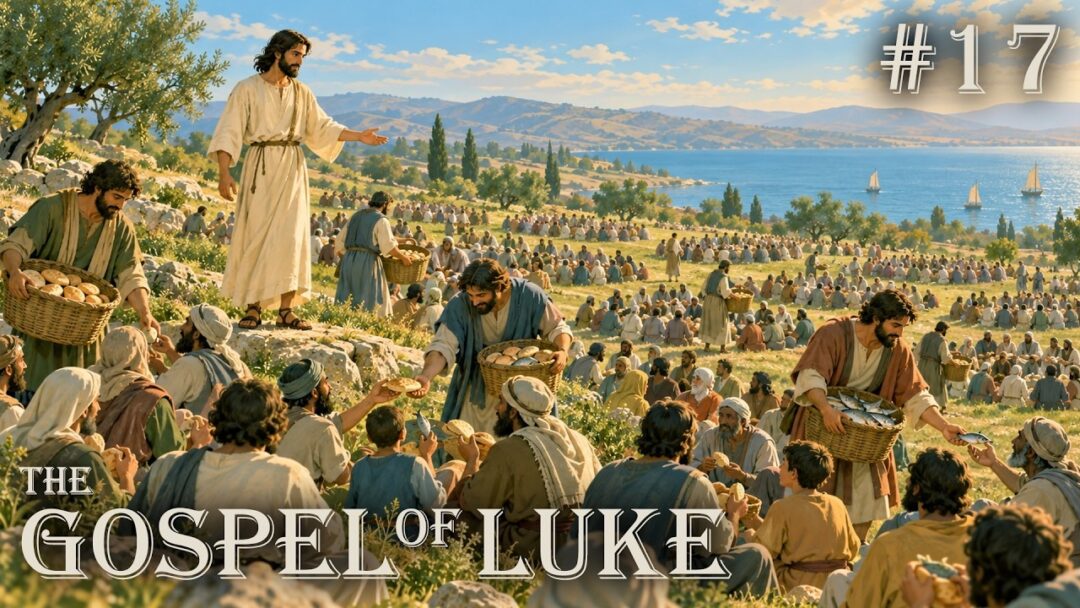
From our Sunday service on September 27, 2026, Luke 9:1-26. This is part 17 of our Gospel of Luke series. Watch the full message: Serious Servanthood – The Gospel of Luke #17 on YouTube.
Last time in our Luke series, we had a flashback to when the disciples first followed Jesus. As Jesus taught the parable of the sower and all about the kingdom of heaven, Luke talked about how important it is to dedicate your life to Christ and to forsake everything in pursuit of him. To tie in with that thought, Luke took us through a flashback to right when the disciples Andrew, Peter, James, and John decided to leave their fishing business behind and follow Jesus.
Today we’re jumping back into the chronology of events in Luke, to the moment when Jesus finished telling the parable of the sower alongside those other parables about the kingdom of heaven, such as the parable of the hidden treasure and the pearl of great price. Now that Jesus has trained his disciples through his teaching and given them many parables about what it looks like to spread the word of God, he is going to send his twelve disciples to go do the things he taught them. This is where we pick up today. From our time in the Word, what God wants you to know is this:
Although he does promise to take care of you, being a faithful follower will still come at a great cost.
Sent with Power and Authority
We’ll start right off in verses 1 through 6.
Then he called his twelve disciples together, and gave them power and authority over all devils, and to cure diseases. And he sent them to preach the kingdom of God, and to heal the sick. And he said unto them, Take nothing for your journey, neither staves, nor scrip, neither bread, neither money; neither have two coats apiece. And whatsoever house ye enter into, there abide, and thence depart. And whosoever will not receive you, when ye go out of that city, shake off the very dust from your feet for a testimony against them. And they departed, and went through the towns, preaching the gospel, and healing every where.
Luke 9:1–6
Here we see that Jesus didn’t just teach to teach. He taught with a purpose: that one day those who listened to his teachings would go out and do the things he said. We saw Jesus take his disciples multiple times and sit them down and preach to them about what it looks like to follow him. What would have been the point of preaching and teaching that if Jesus didn’t then say, “Okay, I’ve taught you what to do. Now go do it”? For the first time we see Jesus step away from the teaching role and dedicate his disciples to do the same thing.
Not only does he allow them to teach, but he also says, “Remember what happened when you first decided to follow me, how there was that demon-possessed man with 2,000-plus demons in him, and I cast out the demons? Guess what? I’m giving you the same authority to go and do miracles. If you see a man possessed with demons on your ministry, liberate him and teach him about the kingdom of heaven. If you see someone sick and dying, liberate them and teach them about the kingdom of heaven. All the power and authority I have to preach and teach and heal, I give to you.” So the twelve disciples are now dedicated to go around the region and preach to everyone.
To the Lost Sheep of Israel
Matthew 10:5-7 gives us some additional details that Luke does not.
Go not into the way of the Gentiles, and into any city of the Samaritans enter ye not: But go rather to the lost sheep of the house of Israel. And as ye go, preach, saying, The kingdom of heaven is at hand.
Matthew 10:5–7
Matthew tells us that the purpose of this ministry was to go to the Israelites and preach, “Your Messiah is here. The time of repentance is now.” It’s basically the same message John the Baptist was preaching before he was put to death. Now the disciples are going to go in the authority of Jesus, as Jesus’ representatives, to every city in the region.
It’s not clear exactly how much of the region this meant. It’s possible it could have meant all of Judaea, but most scholars would agree that it’s at least the entire region of Galilee. In the messages we’ve had in this series so far, everything Jesus has taught has been not too far from his headquarters in Capernaum. He’s been going town to town, maybe a couple of days’ journey. So far Jesus’ ministry has been popular in the local area, but the word of Jesus hadn’t yet spread to all of Israel. That’s a problem, because in the prophecies all of Israel needs an opportunity to respond to the Messiah. So Jesus says, “This is a big job for one person. I’m God. I could do it all myself, but you know what? I want to use each and every one of you. I’m going to send you to all of Israel. Make sure that when the time comes for prophecy to be fulfilled, not one person in Israel can say, ‘Well, I never heard about it.'” So they’re going to go through at least the entire Galilee region and travel city to city.
Take Nothing for Your Journey
Jesus gives them some very specific instructions. They’re not supposed to bring anything for their journey except a few things: an inner garment, which meant no outer cloak, no walking staff, and no food or money. That sounds kind of dangerous. How many of you would say that sounds like a sketchy situation to be in? Why would Jesus not want them to bring money? Why would he not want them to have an outer garment for protection?
Jesus wants to make sure that when they preach, nothing distracts from their preaching. In that day, in the Greek culture, there were Cynic philosophers who would travel around. They would have their inner coat and their outer cloak, they’d walk with a staff, and they’d have a money purse at their side. They would give philosophical wisdom to people and hope people would give them money in return. As these traveling preachers go town to town, Jesus doesn’t want them to be confused with Greek philosophers. “I don’t want people to think this is just philosophy. I want them to know that this is ministry, that this is the truth of God. I want you to be more like the prophets of old than the Cynic philosophers of the day.”
Posidonius says the Cynics were known for one thing: their provision bag, where they took donations, their staff, and their big mouth. So Jesus says, “They’ve got a bad reputation. We don’t want you to look like them.” They wear two tunics, so you go and wear one, so you look different. And don’t ask for money at all, because if you ask for any money, they’re going to accuse you of being a Cynic philosopher, and because that’s Greek, the Jews aren’t going to listen to you. “We need to be distinct. We need to remove any stumbling block we can from this ministry.” Because of this, they can only take shelter and assistance from those who directly offer it to them without their asking.
Shake Off the Dust
In verse 5 Jesus says that if a city doesn’t listen to them and provide them shelter, then they have preached that one time in that city, and that is enough. Move on to the next city, where people want you to preach. Matthew and Mark tell us some additional details about the cities that rejected the disciples’ teaching.
And whosoever shall not receive you, nor hear you, when ye depart thence, shake off the dust under your feet for a testimony against them. Verily I say unto you, It shall be more tolerable for Sodom and Gomorrha in the day of judgment, than for that city.
Mark 6:11
If you remember, earlier in this series Jesus talked about how Capernaum would have a harder day in the day of judgment than Sodom, because Jesus lived in their city. Here Jesus is extending the same thing to these disciples: “If you go to their town and preach in my name and they reject you, it’s exactly the same judgment as if I went to their town and preached in my name and they rejected me.” Isn’t that wild? When a follower of Christ is given an order by God to spread the word, if they reject you giving the word, it’s the same as if Christ came to them and they rejected him to his face.
Jesus doesn’t look at us as useless creatures. Jesus wants us to be his representatives, and he sends us with the same authority he has. He says, “When I send you into the world, I’m not sending you empty-handed. I’m sending you with the same authority. When you spread the gospel to your neighbor, it’s as if I went there myself and told them.” Why are we so afraid to spread the gospel? Why are we so afraid to tell people about Christ? The authority Christ gives us is so great.
A Long and Dangerous Trip
How long would this trip have taken? That’s a big question. It says they’re going to go to all these cities. Josephus records that just in the region of Galilee there were 204 settlements. If everybody had to know about Jesus, boy, that’s going to take a long time. We have twelve disciples going two by two, so we have six groups going to about 200 cities. That would have taken quite a long time. We know at least that this ministry trip would have taken at least a month, maybe a couple of months, before they got back.
It was a scary and dangerous trip. These disciples were going to unknown cities with an unknown response, where they had to rely on strangers to take care of them, and not just for a few days, but for a few months. Jesus didn’t ask Christians to do something easy, but he says, “I’m going to give you the power and authority to do what I’ve called you to do. And don’t worry, my presence is with you wherever you go. If they reject you, it’s as if they reject me, because where you are, I am as well.” So he sends these six teams out to preach city to city.
Herod Takes Notice
We see something crazy happen in verses 7 through 9, as Herod becomes interested in Jesus.
Now Herod the tetrarch heard of all that was done by him: and he was perplexed, because that it was said of some, that John was risen from the dead; And of some, that Elias had appeared; and of others, that one of the old prophets was risen again. And Herod said, John have I beheaded: but who is this, of whom I hear such things? And he desired to see him.
Luke 9:7–9
We know from this that the preaching was a success. No longer was Jesus just somebody known in the local region. The news got to Herod the tetrarch, who ruled Galilee from his capital at Tiberias. He began to hear about this traveling preacher whose disciples were going city to city proclaiming his teachings. When Herod hears this, he starts to wonder, “I just killed John the Baptist for preaching that the kingdom of heaven is at hand and to repent. Who’s this? Who’s this new group of preachers?” And he becomes very interested, because his own people have said, “You killed John the Baptist, and he’s resurrected!” I could see how they might have been confused. Jesus and John the Baptist were cousins. They may have had some resemblance, and it could be easy to think that Jesus was John the Baptist. So Herod now knows about Jesus. He’s intrigued, because he’s probably thinking to himself, “I beheaded John the Baptist. Do I have to do something about these ones too?”
With Jesus’ mission came a very real danger. The sending of the twelve disciples is the core catalyst for the main point of today’s passage: following Jesus can come at a cost. Jesus sending the twelve was a moment of crossing the threshold. Once the disciples preach to all the region of Galilee, their activities are no longer hidden from Herod. They’re no longer hidden from the Roman Empire. They’re no longer hidden from the Sanhedrin in Jerusalem, who had called their teachings blasphemy. The political center would be on full alert, and soon everyone would know what they stood for. The truth is, not everybody who hears the teachings of Jesus is going to like what they hear. But the disciples go out, they do their mission, and it’s a success. People are talking about repentance. People are talking about the Messiah. People are talking about the kingdom of heaven.
Five Loaves and Two Fishes
In verse 10 we see the disciples report back to Jesus.
And the apostles, when they were returned, told him all that they had done. And he took them, and went aside privately into a desert place belonging to the city called Bethsaida.
Luke 9:10
Once the disciples returned, Jesus sat down with them and listened to each and every disciple report back on all the things that happened on their travels: how they preached, how they healed, how this city responded positively and how that city responded negatively. Then Jesus takes them away to a solitary place outside the city of Bethsaida, where Andrew, Peter, and Philip all grew up as kids.
The solitude doesn’t last long, as crowds appear in verses 11 and 12.
And the people, when they knew it, followed him: and he received them, and spake unto them of the kingdom of God, and healed them that had need of healing. And when the day began to wear away, then came the twelve, and said unto him, Send the multitude away, that they may go into the towns and country round about, and lodge, and get victuals: for we are here in a desert place.
Luke 9:11–12
“Victuals” means meals. Because the word of Jesus had spread so much, people were really interested to hear him. When the disciples were in Bethsaida, some of them were in their hometown, and their families were there. People had heard Jesus, because it’s clear from the context that Jesus had traveled with Andrew and Philip to their hometown a couple of times. So they hear Jesus is back. They want to hear his preaching, so they go out. They want to be healed, so they go out. A crowd begins to assemble, and it’s quite a big one. The disciples say, “We need to send people away. The sun’s going to set soon. It’s not going to be safe to travel. They’ve been here for hours, and they haven’t eaten anything, because they didn’t have time to prepare or cook any food for their trip.”
An Undesigned Coincidence
Here we see a pretty interesting detail. This is what we refer to as an undesigned coincidence, and it helps us understand the authority of the Scriptures. John’s Gospel account tells us that Jesus specifically asks Philip an interesting question: “Where can we buy bread in Bethsaida?” Why would he ask Philip that? Because Philip grew up there, and out of all the disciples, Philip was the only one still living in Bethsaida when Jesus called them. One Gospel tells us that Philip was a native there and lived there when Jesus called him. Another Gospel says Jesus asked Philip where to buy bread. If you put them together, you can see that the Gospel accounts agree on who Philip was, even though neither of them intended to tell us those details. They just mentioned them in passing.
When Philip is asked this question, he says, “Two hundred pennyworth of bread is not sufficient for them, that every one of them may take a little.” Two hundred pennyworth is 200 days’ wages. Philip says, “We have a problem, Jesus. 200 days’ wages is not enough to feed this entire crowd. That’s what we’ve got. We’re broke. We can’t afford this. And I figure it would be pretty hard to bring all that bread out here anyway with only twelve people.”
John also gives us the detail that Andrew brings up a small boy, someone under the age of 13, who offers Jesus his five barley loaves and two small fishes as a donation to help feed the people. But Andrew says, “But what are they among so many?” The disciples are panicking. “We’ve got a crowd of hungry people. We’ve just alerted the Roman government to our presence. What if people start dying on the way home? What if they pass out from exhaustion and heatstroke? They haven’t had any water. They haven’t had any food. What do we do?”
Give Ye Them to Eat
So Jesus does what he does best. He takes care of the problem. We see that in verses 13 and 14.
But he said unto them, Give ye them to eat. And they said, We have no more but five loaves and two fishes; except we should go and buy meat for all this people. For they were about five thousand men. And he said to his disciples, Make them sit down by fifties in a company.
Luke 9:13–14
That doesn’t include women and children: 5,000 men. Notice that Jesus doesn’t explain to the disciples what he’s going to do. He doesn’t explain what’s going on. He just says, “Start breaking the people down into groups of 50.” If you do your math, that’s 100 groups of people, and since women and children weren’t included, who knows how many people were actually there that day. To me it seems pretty obvious why Jesus wanted them to break the people down into groups of 50: so that when the day was over, they’d know exactly how many people they fed. There’s a reason the Gospels agree on the high number of people. Jesus wanted to make sure they had an official number for attendance that day, just so that we all could know today how big the miracle he was about to do would be.
In verses 16 and 17 we see Jesus do something miraculous.
Then he took the five loaves and the two fishes, and looking up to heaven, he blessed them, and brake, and gave to the disciples to set before the multitude. And they did eat, and were all filled: and there was taken up of fragments that remained to them twelve baskets.
Luke 9:16–17
As Jesus began to break the bread and the fish, piece by piece by piece, he gave it to the disciples to fill up twelve baskets, and then he gave it to the disciples to distribute. You might ask me, “Well, Zach, how is it possible that he broke the bread and it kept filling up twelve full baskets of food?” And the answer is, “I have no idea, but he’s Jesus.” Clearly it happened. It’s recorded in all the accounts. Everybody agrees on it.
It’s part of the reason the people became huge fans of Jesus. Not followers: huge fans. It’s because he broke the bread, and they saw it as a fulfillment of the prophet like unto Moses, who gave the manna in the wilderness. The manna came from heaven, and they said, “There’s a prophet like unto Moses who’s going to be the Messiah. Jesus broke the bread, and he gave us bread from heaven. This bread can’t come out of nowhere except from one person, and that’s God. This must be the Messiah.” In this, the crowd knew what it meant. The bread of heaven is here. The prophet like unto Moses is here. The one who can provide for us in the wilderness is here.
Notice they’re in a solitary place, a desert place. They’re in the wilderness, just like the Israelites were. There’s a picture there. But unlike the Israelites, who just got bread, manna (remember, they complained they didn’t have meat, they didn’t have quail?), guess what? Jesus gave more than Moses. Manna came from heaven, but with Jesus it was bread and meat. The things the ancient people longed for, that they complained they didn’t have, Jesus freely gave them, above what they needed. So we see this miracle fulfilled. The disciples go and pass it all out, and when they come back to Jesus, their baskets are still full. They have twelve baskets of food left over.
Whom Say Ye That I Am?
Having done this miracle, Jesus asks them a very important question: “Who do you think I am?” We see this in verses 18 through 22.
And it came to pass, as he was alone praying, his disciples were with him: and he asked them, saying, Whom say the people that I am? They answering said, John the Baptist; but some say, Elias; and others say, that one of the old prophets is risen again. He said unto them, But whom say ye that I am? Peter answering said, The Christ of God. And he straitly charged them, and commanded them to tell no man that thing; Saying, The Son of man must suffer many things, and be rejected of the elders and chief priests and scribes, and be slain, and be raised the third day.
Luke 9:18–22
Jesus had just done a miracle to show that he was the Messiah, and he asks the disciples whether they got it, and whether the crowd got it. A lot of the crowd didn’t quite get it. They understood that Jesus was a prophet like unto Moses. They realized he was a prophet. Some thought he was a prophet risen from the dead. Some thought he was John the Baptist resurrected from his death. Some thought he was the one like unto Elijah, which was actually John the Baptist. They were split. So Jesus says, “The crowd is split on who I am. You, my disciples, my students, whom I’ve sent with my authority, who do you say that I am?”
That’s the most important question for us today. Who do you say that Jesus is? Is he a teacher? Is he a prophet? Is he a priest? Or is he our Savior? Who is he to you?
The Gates of Hell
Matthew and Mark tell us this takes place next to Caesarea Philippi, next to a place called the gates of hell, a place where the Greeks would come to allow spirits from the underworld to come and commune with them. It’s a very metaphorical place, where Jesus is juxtaposing his kingdom of heaven with the gates of hell. This is the same place where Jesus says, “Upon this rock I will build my church; and the gates of hell shall not prevail against it.” Jesus is showing them the battle that’s about to begin. He asks them a very important question because the battle that is coming is going to be a hard one. He warns them very clearly that he will be slain and raised again the third day. “The gates of hell are coming, disciples. You need to know who I am, because one day someone’s going to ask you who I am, and the cost of that answer is going to be severe.”
Peter is the first to jump in and give the right answer. He says Jesus is “the Christ of God.” We see that in Luke. In other Gospels you’ll see it rendered as “the Christ, the Son of the living God.” The phrase “Christ of God” in Luke should be understood as Christ the Son of God, just like in the book of John, “Judas Iscariot of Simon” is understood as Judas Iscariot the son of Simon. So Peter says, “You are the Messiah. You are the Son of the living God. You are the Son of the God of Israel. You are divine.”
Take Up Your Cross
So what does Jesus say to him then? Peter has given the right answer. Verse 23 continues.
And he said to them all, If any man will come after me, let him deny himself, and take up his cross daily, and follow me.
Luke 9:23
It’s a very serious thing. Notice that Peter’s answer is the same answer the demons had been crying out in the passages we’ve studied. Every time he cast out demons, the demons knew who Jesus was: “You are the Christ, the Son of God.” And he told the demons, “Don’t say it yet. Don’t say it yet.” Why? Because when that was said, things were going to get dangerous. The Sanhedrin was going to come after him. Rome was going to come after him. So he tells the disciples the same thing, if you notice: “Don’t tell anybody yet that I am the Son of God, because I need to do my ministry and accomplish my prophecy before I die on the cross.” Yes, that is the right answer, but don’t tell anyone, because “If any man will come after me, let him deny himself, and take up his cross daily, and follow me.”
“When people know who I am, everything’s going to change. When I’m just a teacher, when I’m just a prophet, that’s one thing. People can handle that. But when I tell them I’m the Son of God and you’re accountable to me for what you do in your life, that one day you’ll stand before me at the judgment seat of Christ, they don’t like that part. So if you’re going to actually follow me for real, if you’re going to be a serious servant, you’re going to need to deny yourself and take up your cross and follow me.”
At this moment Jesus is extremely honest with his disciples about what it’s going to cost to follow him. We often see the phrase “take up your cross and follow me” as a metaphor, but to them it was a very literal statement. Jesus’ movement was countercultural in their day, and it’s countercultural even today. To the Greeks, Christ’s teaching was foolishness, as Paul says, and it was a danger to the Roman power systems that be. To the Jews, what Jesus preached was blasphemy and highly offensive. Following Jesus meant you carried the very real threat of being put to death, and the most common way you were put to death for the things Jesus was teaching was to be nailed on a cross. For the last few hundred years, those who claimed to be Messiahs were killed. So why would the followers of Jesus be any different? “Take up your cross and follow me” was not a metaphor but a very literal statement, because if you’re going to preach that Jesus is the Son of God, you might as well have your cross ready, because they’re going to be ready to nail you on it.
The Cost Today
Even today, following Jesus carries the very real threat of being put to death. This threat is not gone. We might think it’s gone because we live in America, where we’re free to worship, and we should never stop being grateful for that freedom. I’m sure none of you are aware of what’s going on in the world of Christianity today, but let me tell you about some things that happened just in the month before this message.
On September 20, 2026, in Nigeria, a Baptist pastor along with seven other Christians was killed by Muslim Fulani terrorists. As of 2026 in Nigeria, one Christian is killed every hour and a half for their faith. In Nigeria today, every hour and a half, in the time it takes you to come to this church and leave, a Christian in Nigeria will have been put to death. They picked up their cross, and they carried it to death.
On September 14, 2026, a Baptist pastor was assassinated by the Myanmar military, making him the third Baptist pastor assassinated in the last three and a half months in Myanmar. Just like in the day of the Israelites, when the Sanhedrin was crucifying for blasphemy, guess what? In Nigeria, they crucify you for blasphemy against Allah. In the first century it was offensive to the political powers that be, and guess what? In Myanmar today, it’s offensive to the political powers that be, and they’ll put you to death by assassination, by firing squad, as you’re driving down the road, crossing your bridge to go to work. There is a real threat even today.
Another pastor, John Cao, is a Chinese missionary married to a US citizen and a lawful resident of the United States, who has helped move aid into Myanmar for the poor and needy. He was accused by China of illegal smuggling because he was a Christian. This man has a wife who’s a US citizen. Don’t think this can’t touch us. He was smuggling aid, they said. He was going to Myanmar bringing food out of China to people who were starving. He bought food in China and brought it to the needy in Myanmar, because their government won’t take care of them. Their government won’t help them. He was feeding them, and China, after detaining him in 2017, sentenced him in 2018 to seven years in prison, to be released in 2024. And guess where he is today? He’s still in a prison cell in China in 2026, even right now, dying of stage four cancer, because he did what Christ said: he went to the needy, he fed them, and he gave them the gospel. And he lived in America. But America doesn’t go to rescue him. No one’s coming to free him. He saw the cost, he picked up his cross, and he went, and he says, “I know what it’s going to cost.”
The truth is, when you really follow Jesus, there is a very real chance you’ll be carrying your own death sentence, because the world is not going to like what you believe, and they will see it as either offensive or a threat. Just because we live in America doesn’t mean that one day it won’t be the same way. We have to understand that what we say, no matter what culture we’re in, is going to be countercultural. It’s going to be against the political powers that be. It’s going to be against the other religions that are here. And one day we too may be asked, “Is your cross ready? Are you carrying it? Are you ready to give everything to preach the truth to those around you?”
Risk and Reward
But Jesus doesn’t leave us with that heavy burden to carry. He says that although there is risk, there will be reward. Let’s read verses 24 through 26.
For whosoever will save his life shall lose it: but whosoever will lose his life for my sake, the same shall save it. For what is a man advantaged, if he gain the whole world, and lose himself, or be cast away? For whosoever shall be ashamed of me and of my words, of him shall the Son of man be ashamed, when he shall come in his own glory, and in his Father’s, and of the holy angels.
Luke 9:24–26
Jesus says that whoever is fixated on preserving their own life here will find one day that they lose everything in the end. Those people who persecute you are trying to do one and only one thing: they’re trying to preserve their life the way they want it to be. They’re going to spend their entire life serving themselves, what they believe, and how they think the world should work. Let me tell you, when those people who live for themselves die, guess what? They’re going to lose everything, including themselves, because they’re going to go into eternal punishment, because they never repented of their sins. They never came to Jesus for help.
He says, “You who take up your cross and carry it, who have surrendered yourself and your thinking and what you think is best, who have trusted the word of God and trusted my teachings, who have decided that your works aren’t good enough and your way isn’t good enough, who have surrendered to my way and my teaching and said, ‘Jesus is the Son of God, the Messiah, the Lord, and my Savior’: guess what? Even if they take that cross you’re carrying on your back and nail you to it, in the end you will be infinitely better off than them, because whoever will lose their life for my sake, the same shall inherit eternal life.” He says, “What benefit would it be for you to do everything you want to do in this life and in the end lose everything, be cast away yourself, and waste the very thing that is most precious to you?”
He says, “Whosoever shall be ashamed of me and of my words, of him shall the Son of man be ashamed.” If we are ashamed that we believe in Christ, well, guess what? We don’t really believe in Christ. We ought not be ashamed of the truth of God’s word. We ought to preach the truth and say the truth. When we stand before God, God forbid any of us hear Jesus say, “Why were you ashamed of me? I taught you what to do. I was ready to send you in my power, like those disciples. Wherever you went, it would have been as if I went and reached my hand out to them and said, ‘Please, grab on. I want to save your soul from being cast away forever.’ Why were you ashamed? I could have sent you with my power. I could have sent you with my authority to do impossible things.”
You know, Jesus, on the night before his crucifixion, said in John 14:12 that we would do greater things than he has ever done. God wants to use us, but it costs something. We have to be willing to give up everything in pursuit of him.
Is Jesus Worth the Cost?
To conclude, following Jesus is not always easy. Jesus never promised it would be. Faithfully following Jesus comes with a real cost. It may cost us our comfort. It may cost us our relationships. It may cost us opportunities. And depending on where we live and the culture and world around us, it could even cost us our lives, even today. But Jesus reminds us that whatever we give up for him is nothing compared to what we gain in him. So the question is not whether following Jesus will cost us something. It will at some point. The question is whether we believe Jesus is worth the cost.
God wants you to know that being a faithful follower comes at a great cost. So, if it is needed, are you willing to pay that cost today?

Recent Comments