
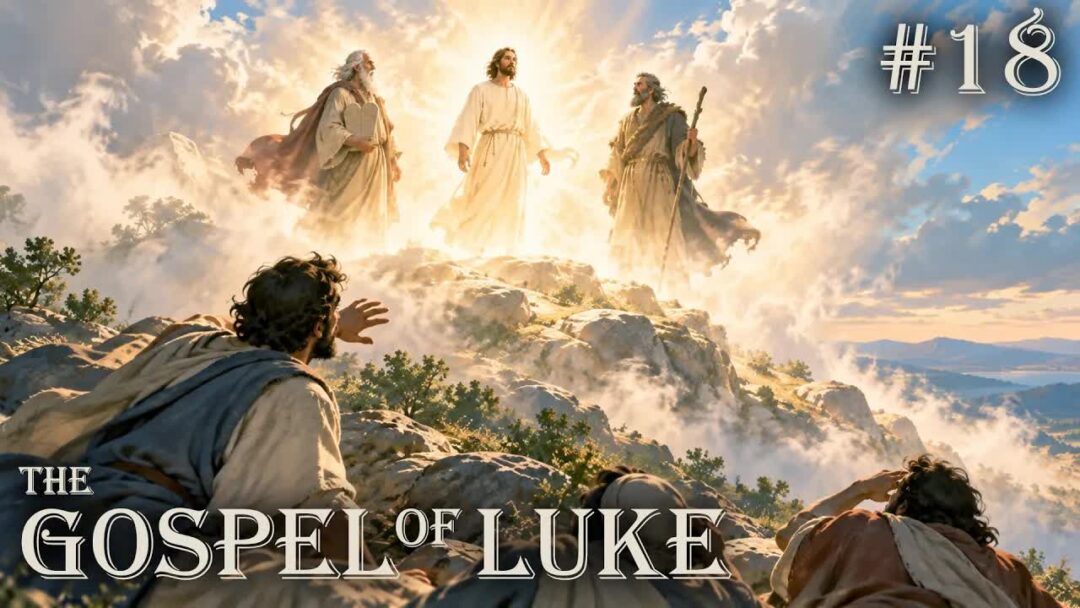
From our Sunday service on October 4, 2026, Luke 9:27-45. This is part 18 of our Gospel of Luke series. Watch the full message: Glory and Death Foretold – The Gospel of Luke #18 on YouTube.
Today we’re returning to the book of Luke, chapter 9. We have a really interesting passage to look at: a great promise from God and a great foreshadowing of the glory that awaits us in heaven.
Last time, as we left off, Jesus warned his disciples about the dangers they would face for being faithful followers. Probably the most famous line from that passage is Jesus saying, “You need to take up your cross and follow me.” That wasn’t a metaphor. That was a quite literal statement, because if they were going to be faithful followers of Christ, there was a very real risk that they would be crucified for their beliefs. Today we continue right on from that narrative, as Jesus continues to prepare his disciples for the days when he must return to the Father. From our time in the Word today, God wants you to learn this:
You need to depend on Christ and his power.
A Promise of the Kingdom
Let’s skim through where we left off, in verses 23 through 26.
And he said to them all, If any man will come after me, let him deny himself, and take up his cross daily, and follow me. For whosoever will save his life shall lose it: but whosoever will lose his life for my sake, the same shall save it. For what is a man advantaged, if he gain the whole world, and lose himself, or be cast away? For whosoever shall be ashamed of me and of my words, of him shall the Son of man be ashamed, when he shall come in his own glory, and in his Father’s, and of the holy angels.
Luke 9:23–26
This is where we left off, with Jesus telling his disciples that if they really, truly wanted to follow him, they needed to carry their own cross and be ready to pay the price of being his disciple if it came to it. Now, last time I left off one verse from that passage, because it sets up the events we look at today. Look at verse 27 as Jesus gives a promise.
But I tell you of a truth, there be some standing here, which shall not taste of death, till they see the kingdom of God.
Luke 9:27
Jesus was telling them, “You’re going to need to be faithful to me, even if it means the point of death.” But he added a promise at the end of that: “I promise you that there are some of you here today who will see the glory of my kingdom before your death.”
This passage is misunderstood by some, but the Bible actually tells us exactly what it’s talking about. Peter tells us in 2 Peter 1:16-18:
For we have not followed cunningly devised fables, when we made known unto you the power and coming of our Lord Jesus Christ, but were eyewitnesses of his majesty. For he received from God the Father honour and glory, when there came such a voice to him from the excellent glory, This is my beloved Son, in whom I am well pleased. And this voice which came from heaven we heard, when we were with him in the holy mount.
2 Peter 1:16–18
Here Peter tells us that we have the evidence of Christ and his return in his full glory in the kingdom of heaven, because Peter, James, and John were allowed to see his power and glory on the Mount of Transfiguration.
There was a real danger: “If you follow me, there is a chance that you’re going to have to give up your life for my sake.” Last time, we looked at some examples of people around the world today who are actively giving up their lives for the sake of Jesus. We ought not forget that that’s a real threat, even here in America. Things could change overnight. But Jesus didn’t leave them without hope. There was a specific moment, which we’re looking at today, called the Mount of Transfiguration, where Jesus gave Peter, James, and John a glimpse of what it looks like to live in a glorified body.
And Peter tells the church the reason they can be so confident about what Jesus taught. It’s not because they just heard a myth or a legend. It wasn’t just words. Jesus took them up on this mountain and provided them indisputable evidence that could not be debated or denied, because he showed them the full glory of his kingdom there. That is the main passage we will be looking at today.
The Mount of Transfiguration
Looking at verse 28, we see the first verse on the transfiguration.
And it came to pass about an eight days after these sayings, he took Peter and John and James, and went up into a mountain to pray.
Luke 9:28
Jesus said there would be some who wouldn’t taste death till they saw the kingdom of God and its glory. Well, about eight days after he says that (Mark and Matthew say specifically six days after Jesus says, “Take up your cross”), they go up into this mountain. Matthew also tells us that this mountain is “an high mountain apart.”
You might be wondering, well, what is that mountain? Since the mountain was pretty high, scholars agree it’s probably Mount Hermon, a mountain that is 9,000 feet above sea level and wasn’t far from the gates of hell in Caesarea Philippi that we mentioned last time. We know from the context they were in Caesarea Philippi. Some also believe it’s Mount Tabor that they went to, but it’s really impossible from this passage for us to know exactly which mountain it was. I don’t think the significance is where they went. The significance is what happened on that mountain. In verses 29 through 31, we see the transfiguration.
And as he prayed, the fashion of his countenance was altered, and his raiment was white and glistering. And, behold, there talked with him two men, which were Moses and Elias: Who appeared in glory, and spake of his decease which he should accomplish at Jerusalem.
Luke 9:29–31
A Parallel to Sinai
Here we see a clear parallel to Mount Sinai in the Old Testament, where Moses went up to receive the law of God. If you put those two passages together, you will see some similarities. Moses goes up to the top of Mount Sinai to talk with God in Exodus 34, and verse 29 of that passage tells us about Moses that “the skin of his face shone while he talked with him.” Here we see Jesus’ appearance is also altered as he talks with Moses and Elijah.
Another interesting fact is that Elijah is also recorded as going to Mount Horeb, the same mountain as Sinai (it’s a different name for it), where he hears God speak to him in a still small voice. So we have Moses go up to the mountain, and Moses represents the law. We have Elijah go up to the mountain, and he represents the prophets. And now we have Jesus going up into a mountain, who is the forerunner of the new covenant, the law of grace.
Now, this has led some to believe that Jesus traveled all the way to Mount Sinai and spoke with Elijah and Moses across time. I’ve seen that going around more and more over the last maybe two years: “Jesus and his disciples traveled to Mount Sinai, and God traveled across time and space to have one conversation between the three.” I’ve got some bad news. Only six days passed between Jesus’ sayings and this moment, and Sinai is way too far to walk in that time. If they were teleported there, I’m pretty sure the passage would have said they were whisked off their feet and knew not how they got there. But we don’t have any of that. Whatever travel they did had to fit within those six days. Mount Sinai is 446 miles from Caesarea Philippi. 446 miles in six days is a little bit unbelievable. So we’re not talking about some kind of miraculous across-time-and-space thing. We’re talking about a picture being made. As Moses and Elijah ushered in their eras, Jesus now ushers in a new one.
The Law and the Prophets Point to Jesus
This passage clearly ties Moses and Elijah to Jesus. As I said, Moses represents the law and Elijah represents the prophets, and their presence with Jesus shows how the law and the prophets both agree and serve to point us towards Jesus and the work he would accomplish. The law and the prophets existed as a schoolmaster to bring us to Christ. They all taught us about what Jesus was going to do.
What did they talk about? Verse 31 says they “appeared in glory.” That’s their glorified bodies. When a Christian dies, he is glorified. He begins a new body, a glorified, sinless body. Here we see Moses and Elijah in their glorified state in the kingdom of heaven, transformed, and Jesus shines before them. We see the kingdom of God fulfilled in them.
And what do they talk about? Verse 31 says they “spake of his decease which he should accomplish at Jerusalem.” The law and the prophets both talk with Jesus about the prophecy that, not long from then, he would begin to fulfill. Jesus said, “Take up your cross,” and he wasn’t excluding himself when he said that, because Jesus was going to be the first and most significant cross of all of Christianity. So Moses and Elijah talk about how Jesus is going to have to die on the cross in fulfillment of prophecy, to fulfill what both Moses and Elijah started by prophesying about him.
Peter Speaks Up
This is a very shocking and unique situation. How did the disciples respond? We see Peter speak up in verses 32 through 33.
But Peter and they that were with him were heavy with sleep: and when they were awake, they saw his glory, and the two men that stood with him. And it came to pass, as they departed from him, Peter said unto Jesus, Master, it is good for us to be here: and let us make three tabernacles; one for thee, and one for Moses, and one for Elias: not knowing what he said.
Luke 9:32–33
Matthew gives us a little more detail about this situation. Matthew tells us that Peter, James, and John were absolutely terrified. They fell on their faces with fear. They were panicking. What would you do if you saw the full glory of the kingdom of God standing in front of you, with Moses and Elijah and Jesus all standing in front of you? And who are you amongst this crowd? These disciples were basically asleep on the ground, and suddenly they wake up to see something miraculous. Maybe they don’t know if they’re awake yet. Maybe they’re confused and don’t know what to do. “Did we die and go to heaven? The prophets are here. I know who that is. This is not how I remember Jesus looking when I fell asleep.” They’re terrified, and they fall on their faces in fear. And Jesus says, “It’s okay. Stand up. Don’t be afraid. This is for you. This is good.” So they stand up.
Verse 33 tells us that as Elijah and Moses are preparing to leave Jesus, Peter steps in. Peter, being that bold man who has some thoughts that maybe he shouldn’t say out loud, says them anyway: “It’s good that Elijah and Moses are here. It’s good that the law and the prophets are here. We should keep them here. They’re leaving. Let’s let them stay. We should build them tents, tabernacles. You can have a tent, and Moses and Elijah can have a tent, and we can commune here forever.” Because this is just a beautiful moment. It’s the fullness of the kingdom of God displayed, and the only thing Peter can say is, “I don’t really want this to end.”
But for Peter, it’s just a taste, just a glimpse of what is awaiting the Christian at the end of all this. Jesus said, “Some of you are going to taste the kingdom of heaven before you die.” These three were granted this, and when they see it, they say, “Let me hold on a little bit longer, just a little bit more.” Mark tells us, very humorously, that Peter blurts this out because he’s scared and doesn’t really know what to say. All he knew is that he liked what was there, and he didn’t want it to end.
This Is My Beloved Son: Hear Him
So what happens? We see a response in verses 34 through 36.
While he thus spake, there came a cloud, and overshadowed them: and they feared as they entered into the cloud. And there came a voice out of the cloud, saying, This is my beloved Son: hear him. And when the voice was past, Jesus was found alone. And they kept it close, and told no man in those days any of those things which they had seen.
Luke 9:34–36
As I said, this picture mirrors Sinai. When Moses went to the mountain, what appeared around the mountain? There was a cloud, and thundering, and lightning. Here Jesus is on the Mount of Transfiguration, being the prophet like unto Moses, and the smoke overcomes the mountain just as it did at Mount Sinai. The disciples are afraid, because there wasn’t a cloud here a second ago, and suddenly it’s getting dark, and Peter just said something he wasn’t so sure about. He wasn’t really thinking. He just blurted it out, and suddenly it’s getting dark and cloudy, and we see the presence of God pictured in the cloud just as it was at Mount Sinai.
Out of this cloud comes the voice of God: “This is my beloved Son: hear him.” God’s speech to the disciples references the prophecy in Deuteronomy 18:15 about Jesus being a prophet like unto Moses: “The LORD thy God will raise up unto thee a Prophet from the midst of thee, of thy brethren, like unto me; unto him ye shall hearken.” To him you shall listen. So God, here on the Mount of Transfiguration, confirms to the disciples without any doubt that Jesus is the prophet like unto Moses, the Messiah prophesied all those thousand-plus years earlier. “This is my beloved Son,” giving him divinity. “Hear him.”
This is a twofold confirmation. First, it proves that he was the Messiah, the prophet like unto Moses whom you should listen to, and one who is better than the law. Listen to him. Don’t listen to Moses. Don’t listen to Elijah. They were just there to make you do one thing: listen to Jesus. Their goal is accomplished. Their work is done. Jesus alone remains. Listen to him.
Second, it confirms that Jesus truly is the Son of God. Remember, every time the demons are cast out, they call Jesus the Son of God. There could be some debate there: were the demons telling the truth? They are demons, after all. Don’t demons lie? Here that whole question is completely silenced, because God himself says, “This is my beloved Son.” He is the Son of God. He is divine. Any questions the disciples had were met here.
That is why Peter, when he writes to his people in his letter, says, “We didn’t follow cunningly devised fables, but we heard the truth on that mount of transfiguration.” Just as Moses was given the law, the cloud came around them and God spoke to them: “I want you to know two things for sure: this is my Son, and this is the Messiah. With those things in mind, listen to him.” In other words, everything Jesus is going to teach you is true. Everything Jesus is going to teach you is valuable. So listen, obey, and follow. When you take up that cross, you can have confidence in what you’re carrying it for.
When God finishes speaking, he removes Moses’ and Elijah’s presence, and only Jesus is found where they were standing. This is a clear message from God that the old ways are gone. The law and the prophets have accomplished their purpose. Christ is the only way. He’s the only one left standing on the mountain. The law and the prophets were there to lead Israel to their Messiah. And Peter, James, and John, guess what? That’s now your job as well: lead Israel to Christ.
Coming Down the Mountain
Mark and Matthew give some additional details. Turn to Mark chapter 9, keeping your spot in Luke. Mark records the details of them coming down the mountain, in verses 9 and 10.
And as they came down from the mountain, he charged them that they should tell no man what things they had seen, till the Son of man were risen from the dead. And they kept that saying with themselves, questioning one with another what the rising from the dead should mean.
Mark 9:9–10
Just as he told the demons to be quiet about him being the Son of God, Jesus tells Peter, James, and John the same thing. “I have shown you my glory. I’ve revealed the glory of the kingdom. Remember, you wanted it not to end, but I’ve got good news: one day you’re going to enter that kingdom, and it’s going to be forever, and you’re going to be able to enjoy it. And yes, I am the Son of God, and yes, it’s confirmed, but I don’t want you to tell people yet.” Why? For the same reason he didn’t want the demons to do it. It made the Roman Empire and the Sanhedrin, the Jewish council of Pharisees and Sadducees, his enemy, because once they started claiming that, he’d face charges of blasphemy, and it would be only a matter of time till he ended up on that cross. So he says, “It’s not time for me to reveal that yet. That’s just for you. Don’t tell anyone what you’ve seen until after I have risen from the dead.”
Peter, James, and John got the idea of “don’t tell anybody.” What they didn’t understand is what his rising from the dead means. Is this a metaphor? Jesus uses parables all the time. Is this another one of his parables about death and resurrection? They just didn’t get it. This is the second time now that he’s told anyone about his death, and the disciples didn’t know enough about Old Testament prophecy to know that the Messiah was going to die for his people. So they continue to ponder it, but they’re too ashamed to ask, “What’s going on here?”
Elijah Must Come First
We do see them ask for clarification on something else, in verses 11 through 13 of Mark chapter 9.
And they asked him, saying, Why say the scribes that Elias must first come? And he answered and told them, Elias verily cometh first, and restoreth all things; and how it is written of the Son of man, that he must suffer many things, and be set at nought. But I say unto you, That Elias is indeed come, and they have done unto him whatsoever they listed, as it is written of him.
Mark 9:11–13
Peter, James, and John don’t ask for clarification on his death, but they had just seen Elijah in the flesh. They had known from when they were little boys in Torah school that when the Messiah came, Elijah was going to prepare the way. “I just saw Elijah. Why did the scribes say that Elijah needed to come first? The religious teachers of our childhood said it was the other way around.”
Jesus says that the scribes were right to teach that Elijah does come first and restores all things. But then Jesus clarifies in verse 12: “and how it is written of the Son of man, that he must suffer many things, and be set at nought.” Another way you could translate that is, “Why does Scripture say, then, that the Messiah must suffer and be considered a no one?” He says, “You’re missing the point. I just told you about my death. You’re asking the wrong question. Why did the Scriptures say that the Messiah must suffer? Why aren’t you asking me that question?” But they just don’t understand yet.
Jesus tells them, “It’s true, Elijah did come. And guess what? They did unto him whatsoever they listed,” or whatever they wanted, “as it is written of him.” Here we’re told that the disciples realized immediately that he was talking about John the Baptist. John the Baptist came not as the literal Elijah, but in the spirit and power of Elijah. He dressed like Elijah. He was in the wilderness like Elijah. He preached the truth like Elijah. And Jesus says, “Guess what they did to him, just as they wanted. And as they did to Elijah, they will do the same to me.”
A Demon the Disciples Could Not Cast Out
Back in Luke:
And it came to pass, that on the next day, when they were come down from the hill, much people met him. And, behold, a man of the company cried out, saying, Master, I beseech thee, look upon my son: for he is mine only child. And, lo, a spirit taketh him, and he suddenly crieth out; and it teareth him that he foameth again, and bruising him hardly departeth from him. And I besought thy disciples to cast him out; and they could not.
Luke 9:37–40
Mark tells us a little more about the context of them coming down the mountain. When they get to the bottom of the mountain, the disciples and the scribes are in a debate. The disciples say one thing, and the scribes say another, because the disciples tried to cast out a demon and couldn’t do it. Now, this isn’t something normal for them. Remember, Jesus had just sent the twelve city to city, and they preached, they did miracles, and they cast out demons, and everything went well. The lame walked, the deaf heard, the demons were cast out. But then they get back and there’s this demon-possessed boy, and they’ve tried to cast out the demon, and it’s just not working.
So the scribes use this as an opportunity to rebuke the disciples. They don’t like what the disciples are teaching, so they get into a debate: “Ha! You can’t cast out a demon, and you say you work in the power of God?” “No, we do work in the power of God. We’ve been casting out demons for like a month and a half.” “Well, why can’t you do it now?” Back and forth, back and forth. And Jesus walks in on his disciples: what in the world is going on? Everything is a mess.
As this debate is going on, the father of the demon-possessed son goes to Jesus and begs him for help: “I came to your disciples to cast this demon out of my son. It’s hurting him. It’s harming him. It’s causing him to have seizures and foam at the mouth, and it bruises him. And the disciples can’t do anything to help. They’ve tried, and it’s nothing. Jesus, can you take care of it for me?” This demon is a little bit different from the other ones we have seen, and today we’re going to see why.
A Demon Bent on Destruction
Switch back to Mark chapter 9, where Mark gives us additional details in verses 19 through 22.
He answereth him, and saith, O faithless generation, how long shall I be with you? how long shall I suffer you? bring him unto me. And they brought him unto him: and when he saw him, straightway the spirit tare him; and he fell on the ground, and wallowed foaming. And he asked his father, How long is it ago since this came unto him? And he said, Of a child. And ofttimes it hath cast him into the fire, and into the waters, to destroy him: but if thou canst do any thing, have compassion on us, and help us.
Mark 9:19–22
The situation here is not like the other demons. We saw Legion not long ago: over 2,000 demons in one person. And the situation with Legion was nothing compared to how bad this is. Sure, Legion hurt the man, but this demon doesn’t approach Christ like the other ones. Remember that the demons before approached Christ first and begged for mercy first. This demon doesn’t do that. This demon, when approached by Christ, doubles down on its intention to hurt this young boy.
As Jesus draws near, the spirit takes the child and causes him great pain. The child screams, and it tears him. It gives him a seizure, his mouth is foaming, and it’s bruising him and hurting him. This child is in pain. If you remember all the way back to the first demon Jesus cast out, in the synagogue, the demon cried out and made a scene, but it says it didn’t hurt the man. In this passage, though, we’re told that this demon fights and actively harms the child as it is being cast out.
This demon isn’t like the other ones. Legion said, “Don’t send us into the abyss. I will obey. Allow me to go into the pigs. I don’t want to go into the abyss.” This one is willing to disobey God to the point of eternal judgment in the abyss early. This demon isn’t like the other ones that, if you ask nicely, will leave. That is why the disciples couldn’t cast it out. This one had no intention of obeying God even if God told it to listen. So when Jesus comes to save this child, the demon does the opposite in rebellion, knowing what Jesus is going to do.
Jesus asked how long he had been this way, and the father said since he was a young boy. This child has been tormented by this demon all that time. And what does it do? Verse 22 says, “And ofttimes it hath cast him into the fire, and into the waters, to destroy him.” This demon’s one and only goal is to kill this child. Every time this child is near fire, it tries to make him dive into the fire and kill himself. When he’s near a big body of water, it tries to drive the boy into the lake so he drowns. The other one, Legion, had 2,000 demons in one person, and it wasn’t going to kill that person. It wanted to keep that person alive and suffering. But this one wants to end life, and it’s an act of horrible rebellion.
And the father just doesn’t know what to do. It’s his son, his only son, and everywhere he goes, this demon tries to end his life. He says, “Help us.”
Lord, I Believe; Help Thou Mine Unbelief
What does Jesus do? In verses 23 and 24, he encourages the man to have faith.
Jesus said unto him, If thou canst believe, all things are possible to him that believeth. And straightway the father of the child cried out, and said with tears, Lord, I believe; help thou mine unbelief.
Mark 9:23–24
Jesus tells him the truth: it’s going to be his faith that determines whether or not this miracle happens. “If you believe, it’s possible. Just have faith.” It’s faith that enables the miracle of casting this horrific demon out of this young child. The father says, “I believe you can do it, Jesus,” yet he still humbly asks Jesus to help him with any doubts he may have.
How many of you can say that you would be confident if your child were in this situation? If you saw your child having these seizures and foaming at the mouth and having self-destructive tendencies because of demon possession, would you have this confidence? The man has to be honest with Jesus: “I believe in you, but this is a lot. Help me.” This is what sets him and the disciples apart, as we’ll see in a little bit. And Jesus takes the faith that he has and does something with it, in verses 25 through 27.
When Jesus saw that the people came running together, he rebuked the foul spirit, saying unto him, Thou dumb and deaf spirit, I charge thee, come out of him, and enter no more into him. And the spirit cried, and rent him sore, and came out of him: and he was as one dead; insomuch that many said, He is dead. But Jesus took him by the hand, and lifted him up; and he arose.
Mark 9:25–27
As you can see, this demon’s removal is much more violent than any other we’ve seen. The demon in the synagogue put up a fight, but it was all a show. It didn’t hurt the man. This demon knows that it cannot directly disobey the order of God. If God wants to take this demon out, he’s going to take it out. But in one final act of rebellion, the demon tries again to kill the child. As it is being pulled out, it makes the boy scream, gives him a seizure once again, and comes out of him, and the boy is lying on the ground as if he’s dead.
If the Bible gave us a little more detail, I could tell you whether or not Jesus raises him from the dead here. But everybody around him says that boy is dead. This was the final strike, because this demon did not want to obey Jesus. But Jesus casts it out anyway, because God’s power is greater than that of the demons, even when they are in rebellion. The people think he’s dead, but Jesus takes him by the hand and lifts him up, and the boy is healed.
What Made This Demon Different
So what is really going on in this story? What is happening with this demon that’s different from the others? All demons know that eventually they’re going to have to obey God. One way or another, God’s will will occur. So they can either listen to Jesus’ command and leave the person they possess, or they can resist. And what happens to the demons that resist? We’re told multiple times throughout Scripture that they’re cast into eternal darkness, into the abyss, until the day of judgment. If God tells a demon to do something, and says it can only do this much, and it goes beyond that, it gets stuck in eternal chains.
Well, this demon was willing to be put in eternal chains. When God said to come out, it didn’t want to listen. So it was removed by force, and it was violent. This demon may have ended up in the abyss after this, because it stepped out of line and directly attempted to disobey Jesus’ order to leave the child alone.
Notice what Jesus calls the spirit: “Thou dumb and deaf spirit.” What is he saying? This demon wasn’t listening. “You dumb and unlistening spirit, guess what? Even though you’re not willing to obey God, I’m going to make you.” So he rips this demon out of the boy as the disciples couldn’t, and casts it out against its will.
Why Could Not We Cast Him Out?
Naturally, the disciples have some questions about what just happened, because it’s unlike anything they’ve seen before. We see that question in Matthew 17:19-21.
Then came the disciples to Jesus apart, and said, Why could not we cast him out? And Jesus said unto them, Because of your unbelief: for verily I say unto you, If ye have faith as a grain of mustard seed, ye shall say unto this mountain, Remove hence to yonder place; and it shall remove; and nothing shall be impossible unto you. Howbeit this kind goeth not out but by prayer and fasting.
Matthew 17:19–21
The disciples wanted to know the difference between what Jesus had just done and what they had attempted to do. “We did the same thing, but nothing happened. We ordered the demon to come out, and nothing happened.” Jesus tells them, “It’s because you had no faith.”
Sure, some demons might be cast out by an order. Some demons aren’t willing to put up a fight. Demons are like us in that way. All of us are different, and some of us are more apt to listen than others. Demons are the same way. Some demons, when you tell them to come out, are just going to go. They don’t want the trouble. They don’t want to risk it. They’ll just leave. So when the disciples went around casting out demons in their ministry, city to city, those demons listened. They heard that Jesus was involved: “I don’t want to go to the abyss. I don’t want to deal with eternal judgment early, so I’ll just go before Jesus gets involved, and I’ll go on my way.” In Acts 19:15, the evil spirit says, “Jesus I know, and Paul I know; but who are ye?” When they know that someone’s tied to Jesus, they just kind of listen and go along with it.
But this one wasn’t like the others. It didn’t care if it had to deal with God. It was still going to disobey. This demon wasn’t just going to listen, which meant you actually needed God’s power to remove it. And if you want God’s power, what do you need? You need faith.
Prayer and Fasting
Here Jesus says the solution to this faith problem is prayer and fasting. If you look at every passage in the Bible that carries that phrase, prayer and fasting, you’ll find one thing in common in each and every one. Prayer and fasting is a state of utter dependence upon God for the outcome. When you’re praying and fasting, it’s oftentimes because you’re in a situation where you don’t know what to do. You’re out of options, and you’ve got to go before God and say, “God, there is nothing I can do about this situation. It is fully in your hands. I’m praying to you to take care of it. I’m fasting to show that there’s nothing I can do, and I’m going to stop doing anything until you take care of it.” That’s the state of prayer and fasting.
The reason the disciples couldn’t cast out this demon was that they were trying to do it in their own power, by their own command, rather than in the power of Jesus. So he says, “If you want to cast out a demon like this, you need the power of God. You need to get yourself out of the way. You need to not believe in yourself, but in the power of God,” who is able to do exceeding abundantly above all that we ask or think. You cannot do it alone. So pray and seek God’s help, and then cast the demon out in his power, not your own.
Let These Sayings Sink Down into Your Ears
Once again, Jesus closes this section by reminding them of his death, in Luke 9:43-45.
And they were all amazed at the mighty power of God. But while they wondered every one at all things which Jesus did, he said unto his disciples, Let these sayings sink down into your ears: for the Son of man shall be delivered into the hands of men. But they understood not this saying, and it was hid from them, that they perceived it not: and they feared to ask him of that saying.
Luke 9:43–45
Jesus finally tells the rest of his disciples what he talked about with Elijah and Moses on the Mount of Transfiguration, namely, that he would die at the hands of humanity. But with everything crazy going on, the disciples just didn’t understand what he was saying, and they were afraid to ask for clarification. They were likely still too ashamed that they couldn’t cast out the demon to ask for any more answers.
What Jesus was saying is, “You need to pay attention, because I will be given over to humanity, and I will return to my God and your God. After that, you need to get this faith thing figured out, because if you want the power of God in your life, you have to have faith. You can’t rely on your own power as a believer, or you’re not going to get results.”
You would think these disciples would have it all together. They had just gone city to city preaching about the kingdom of God, and they had the power to heal the sick. And yet, because they didn’t rely on Christ in that moment, they were powerless to do anything. Jesus says, “This is the challenge: I’m going to return to my Father. And if you’re not careful, you’re going to forget that Moses and Elijah were removed and I was the only one left standing on that mountain, and that the only thing that has power anymore is my name. If you’re going to do anything, it’s going to be in my power and not your own.”
Depend on Christ
To tie everything together today: as Jesus prepared his disciples for what lay ahead, he gave them every evidence to depend on him. On the mountain, they saw his glory and heard the Father say, “This is my beloved Son: hear him.” At the foot of the mountain, they faced a need they could not meet, and Jesus demonstrated that he had the power they lacked.
We need to learn the same lesson as the disciples. We can know Jesus, we can have experiences of serving him, and we can still find ourselves trying to handle things in our own strength. True dependence on Christ requires listening to him, seeking his help in prayer, and acting in faith even when the challenge ahead seems insurmountable.
The father’s prayer that we saw in this passage gives us a place to start: “Lord, I believe; help thou mine unbelief.” We can do the same thing by bringing both our needs and our struggles of faith to God in prayer. What are you facing that you’ve been trying to handle without seeking the Lord’s help? Where do you need to listen to his Word and trust what he has said? The one who invites you to take up your cross and follow him is the gracious Son of God, so you can trust him with whatever challenges lie on the road ahead.
God wants you to depend on Christ and his power. So bring him your weakness, ask for his help, and trust him to follow where he leads.

Recent Comments