
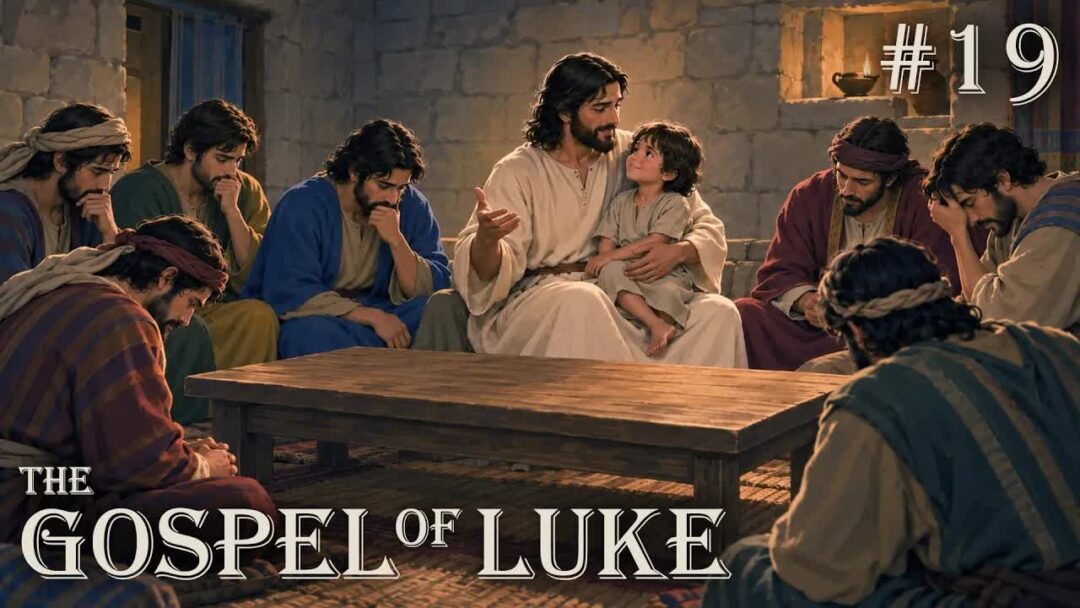
From our Sunday service on October 11, 2026, Luke 9:46-50. This is part 19 of our Gospel of Luke series. Watch the full message: Innocent Humility – The Gospel of Luke #19 on YouTube.
The disciples had failed to cast out a demon because they were not depending on God. Yet on their way back to Capernaum, their conversation turned to which of them would be the greatest. Instead of asking how they could serve Jesus, they were wondering who would become the most important. I want you to notice how easily pride can survive even a failure that ought to humble us. Their problem was not simply an unfortunate conversation on the road. It was a way of thinking that could keep them from receiving Christ on His terms. Those who serve Him must do so in humility.
Greatness Begins with Dependence
When they reach the house, Jesus asks what they were disputing about. They keep quiet, because they know the conversation was nothing to be proud of. Their silence does not hide anything from Him; He knows the thoughts of their hearts. Rather than leaving greatness to mean whatever they have imagined, He tells them what it means in His kingdom:
And he sat down, and called the twelve, and saith unto them, If any man desire to be first, the same shall be last of all, and servant of all.
Mark 9:35
Then Jesus takes a young child and holds him in His arms. I love that picture. He is going to use the child to show them what a believer should be like, and He does it while holding and caring for him. The disciples have been trying to establish their importance, but the child gives them a different picture altogether. At that young age, a child adores and trusts his parents, looking to them with dependence and teachability rather than insisting that he knows better. Jesus tells these men that they must turn around and become like that:
And said, Verily I say unto you, Except ye be converted, and become as little children, ye shall not enter into the kingdom of heaven. Whosoever therefore shall humble himself as this little child, the same is greatest in the kingdom of heaven.
Matthew 18:3–4
This is not merely advice about becoming a nicer person to work with. Jesus warns them that unless they change, they will not enter the kingdom of heaven. They need to realize that they need Him, and that following Him is not about making themselves important. A child is not trying to win a contest over who is the wisest person in the room. He wants to enjoy life with the people he loves. We need that humility, dependence, teachability, and trust when we come to our heavenly Father, because the one who makes himself least is the one Jesus calls great.
There is a real danger here, not a hypothetical warning meant only to get their attention. Judas is sitting among these disciples, and he will betray Jesus. He has gone out with them and preached, but that does not mean he has accepted Christ in his own heart. It is possible to tell other people what Jesus wants while refusing it ourselves. The disciples need more than the title of disciple or the reputation of belonging to the twelve. They need to humble themselves and recognize their own need before they concern themselves with anyone else’s shortcomings.
An Ally Is Not a Rival
John begins to see where their pride has led them. He tells Jesus that they met a man casting out demons in His name and told him to stop because he did not follow with them. Think about that. The disciples themselves had failed to cast out a demon, yet when they saw someone doing it in Jesus’ name, their concern was that he did not belong to their group. Their own failure had not kept them from acting as though their title made them better than this man. Jesus answers:
But Jesus said, Forbid him not: for there is no man which shall do a miracle in my name, that can lightly speak evil of me. For he that is not against us is on our part. For whosoever shall give you a cup of water to drink in my name, because ye belong to Christ, verily I say unto you, he shall not lose his reward.
Mark 9:39–41
The man was not their rival; he was their ally. He was serving in Jesus’ name, and the power of his ministry showed that he was sincere. The disciples had overlooked their own shortcomings while finding fault with someone who lacked their social association. Had they approached him with the innocent humility of a child, they would have recognized the good he was doing instead of trying to stop him. Even a cup of water given because someone belongs to Christ matters to God. The work does not have to make the worker famous to be worthy of a reward.
We need to be careful that we do not fall into the same competitive way of thinking. A person may not use our Baptist label or another label we recognize, but that alone does not make him a fraud or mean he cannot represent Jesus Christ. None of us has everything in his life perfect. We need to look at the fruit of a person’s ministry rather than deciding from titles and outward associations that we are better. There is sincerity in places we may not expect it, and pride can make us condemn someone we ought to encourage.
Do Not Trip Up Those He Loves
That competitive spirit does more than make us unpleasant. It can hurt a faithful follower of Christ, and Jesus wants the disciples to understand how seriously He takes that danger. The child He holds represents the believer who trusts Him in humility and dependence. When the disciples discourage someone like the man John describes, they are dealing with one of His little ones:
And whosoever shall offend one of these little ones that believe in me, it is better for him that a millstone were hanged about his neck, and he were cast into the sea.
Mark 9:42
If you cause another Christian to stumble, God does not look on that and just let it slide. We may think we are correcting someone because we are doing better than he is, but if our arrogance trips him up rather than helping him, God will hold us accountable. Jesus goes on to speak with the same severity about whatever causes us to stumble ourselves. We need to remove the selfish actions, the places we should not go, and the things we lust after that can draw us away from Christ. The disciples’ desire to lift themselves up was not a harmless weakness. It could keep them from humbling themselves and accepting Him.
I know it is hard to think that men walking with Jesus could still refuse Him, but Judas shows that the danger is real. He believed Jesus was the Messiah, betrayed Him for silver, and regretted what he had done, yet there is no indication that he ever repented of his sins. Walking in God’s name is not the same as belonging to Him. So before we use our religious standing to judge another person, we need to ask whether we have accepted what Jesus is saying to us. Pride is dangerous both to the person we discourage and to our own hearts.
Love the Ones the Shepherd Pursues
For the faithful believer who has been discouraged or has wandered, however, this passage also brings comfort. Jesus tells us not to despise His little ones, and then He describes a shepherd whose sheep has gone astray. The shepherd does not forget the one in danger merely because the others are safe:
How think ye? if a man have an hundred sheep, and one of them be gone astray, doth he not leave the ninety and nine, and goeth into the mountains, and seeketh that which is gone astray? And if so be that he find it, verily I say unto you, he rejoiceth more of that sheep, than of the ninety and nine which went not astray. Even so it is not the will of your Father which is in heaven, that one of these little ones should perish.
Matthew 18:12–14
Christian, Christ will pursue you in your moment of weakness. He sees when you have gone astray and are in danger, and He seeks to restore you. The child held in His arms gives us a picture of how He cares for His faithful followers, not how eager He is to cast them aside. When the wandering one is restored, He rejoices. That should comfort us, but it should also change how we treat one another. The person we are tempted to dismiss is precious to the same Lord who loves and pursues us. Christ loves His faithful ones. So love them as well.
The disciples wanted recognition, importance, and authority, while Jesus wanted humble servants who loved Him as a child loves his parents. He taught them to depend on Him, recognize others who served Him, and take care not to make those followers stumble. All of it brings us back to the question of why we serve. Are we seeking to bring glory to God, or attention to ourselves? Those who serve Him must do so in humility, because in God’s kingdom, greatness isn’t measured by how many people serve you, but by how willing you are to serve others. Will you choose to be a humble servant?
Recent Comments