
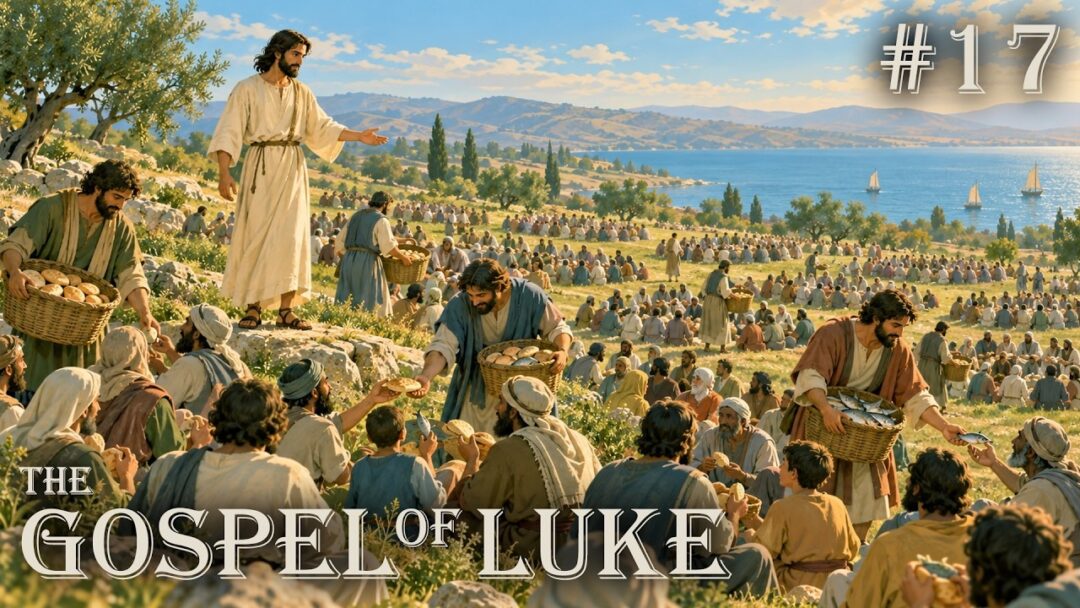
From our Sunday service on September 27, 2026, Luke 9:1-26. This is part 17 of our Gospel of Luke series. Watch the full message: Serious Servanthood – The Gospel of Luke #17 on YouTube.
Jesus does not teach His disciples merely so that they can listen. He prepares them to go out and do what He has taught them. In Luke 9:1-26, they begin that work with His authority, see His ability to provide, and then hear what following Him will cost. We need to keep all three things together. His promise to take care of us is real, but it is not a promise that serving Him will be easy. Although He does promise to take care of you, being a faithful follower will still come at a great cost.
Sent to Do What He Taught
The disciples have heard Jesus explain the kingdom of God and what it means to follow Him. Now He sends them to preach that kingdom and heal the sick. Teaching has brought them to the point of action, and He does not send them empty-handed. They are going as His representatives, doing the work He has given them to do:
Then he called his twelve disciples together, and gave them power and authority over all devils, and to cure diseases. And he sent them to preach the kingdom of God, and to heal the sick. And he said unto them, Take nothing for your journey, neither staves, nor scrip, neither bread, neither money; neither have two coats apiece.
Luke 9:1–3
Matthew adds that this particular mission is to the lost sheep of Israel. They are to announce that the kingdom of heaven is at hand, bringing the message of repentance and the Messiah to people who need to hear it. The purpose of hearing His Word is not simply to know what He says. We are meant to do it, and He wants to use us to bring the gospel to others.
The instructions for the journey make that work an exercise in trust. The disciples are not to take food or money, and they must rely on those who receive them for shelter and assistance. Jesus wants nothing to distract from their preaching or make it appear that they are traveling for profit. This is not an easy assignment, but it is an assignment given by the one whose authority goes with them.
Where a city rejects them, they are to shake its dust from their feet as a testimony and move on. Jesus treats rejection of the message they carry with the seriousness of rejecting Him. They are not merely offering their own opinions; they are representing Christ. I want us to consider how much that means when we are afraid to speak of Him. Jesus does not look at us as useless creatures. He wants us to be His representatives, and when we bring the gospel to our neighbor, we go in His authority rather than our own.
The mission succeeds, but success does not mean the danger disappears. Word of Jesus spreads until even the ruler who had John the Baptist beheaded hears about Him and wants to know who He is. Their ministry can no longer remain a local matter unnoticed by those in power. Some people welcome the message, while others see it as a threat. The disciples need to understand both sides of that result: Jesus has empowered their work, and the very work He has empowered can bring them into danger. His provision and the cost of following Him are not opposites.
The One Who Provides in the Wilderness
When the apostles return, they tell Jesus what they have done, and He takes them aside near Bethsaida. Their time alone does not last. A crowd follows, and Jesus welcomes the people, teaches them about the kingdom, and heals those who need healing. As the day wears on, the disciples see another problem. These people need food and somewhere to stay, and they are in a solitary place. Sending them away seems the practical answer. Yet Jesus tells the disciples to give them something to eat, bringing them face to face with a need far beyond their resources.
They have five loaves and two fish for about five thousand men, without counting women and children. Philip recognizes that even two hundred days’ wages would not buy enough bread for everyone to have a little, and Andrew asks what so little food can accomplish among so many. Jesus does not explain the miracle beforehand. He tells the disciples to seat the people in groups of fifty, and they do what He says. They cannot see how the need will be met, but they can obey the instruction in front of them:
Then he took the five loaves and the two fishes, and looking up to heaven, he blessed them, and brake, and gave to the disciples to set before the multitude. And they did eat, and were all filled: and there was taken up of fragments that remained to them twelve baskets.
Luke 9:16–17
Everyone eats and is filled, and twelve baskets remain. I cannot explain how Jesus broke the bread and kept supplying food, but He is Jesus. The disciples have seen that the problem they could not solve was not beyond Him. The crowd recognizes a connection with Moses and the bread given in the wilderness. Here is the one who can provide for them where they cannot provide for themselves. But being impressed by what Jesus gives is not the same as following Him. People can become enthusiastic fans of the miracle without yet understanding who He is or what He will ask of them.
Who Do You Say That He Is?
Jesus brings that question directly to the disciples. He asks who the people say He is, and they repeat the divided answers: John the Baptist, Elijah, or one of the old prophets risen again. They have seen Him provide, heard Him teach, and gone out in His authority, but He wants their answer, not a report of what everybody else thinks. This is the most important question for us too. Is Jesus simply a teacher or a prophet to us, or is He our Savior? Peter gives the right answer, and Jesus immediately explains where that truth will lead:
He said unto them, But whom say ye that I am? Peter answering said, The Christ of God. And he straitly charged them, and commanded them to tell no man that thing; Saying, The Son of man must suffer many things, and be rejected of the elders and chief priests and scribes, and be slain, and be raised the third day. And he said to them all, If any man will come after me, let him deny himself, and take up his cross daily, and follow me.
Luke 9:20–23
Knowing who Jesus is does not lead the disciples away from the cross. It prepares them to face it. Jesus tells them that He will suffer, be rejected, be killed, and rise again. He also makes clear that those who follow Him must deny themselves. We often treat taking up a cross as a metaphor, but for these disciples it carried a literal threat. To preach Jesus as the Son of God could mean being put to death. He is not hiding that cost while asking them to follow. He wants serious servants who understand what they are committing themselves to.
The same message can offend those who want life to remain on their own terms. It is one thing to admire a teacher and another to acknowledge the Son of God to whom we are accountable. Following Him means surrendering our own ideas of what is best and trusting His Word instead. That can cost comfort, relationships, opportunities, and even life itself. We should be grateful for freedom to worship where we have it, but we must not assume that freedom means following Christ can never become dangerous. The question is whether we are ready to give everything rather than stop speaking the truth about Him.
What Would You Gain by Turning Back?
Jesus does not leave His followers with the cost alone. He asks them to weigh it against the loss of living entirely for themselves. We can devote ourselves to preserving the life we want, protecting our own desires and refusing to surrender, yet lose the very thing we were trying to save. Or we can trust Christ, knowing that even death cannot take away what He gives:
For whosoever will save his life shall lose it: but whosoever will lose his life for my sake, the same shall save it. For what is a man advantaged, if he gain the whole world, and lose himself, or be cast away? For whosoever shall be ashamed of me and of my words, of him shall the Son of man be ashamed, when he shall come in his own glory, and in his Father’s, and of the holy angels.
Luke 9:24–26
What benefit is there in getting everything you want here if, in the end, you are cast away yourself? Those who live for themselves and never repent or come to Him for help will lose everything, including themselves, in eternal punishment. Those who surrender to Him, trusting Him as Messiah, Lord, and Savior, are better off even if following Him costs their lives. Their own works and their own way cannot save them. Christ can, and what they receive in Him is worth more than everything they might keep by refusing Him.
If we are ashamed that we believe in Christ, well, guess what? We don’t really believe in Christ. We ought not be ashamed of the truth of God’s word. He has taught us what to do and is ready to send us in His power, so we should not shrink from saying what He has said. Following Him will cost something at some point. The question is not whether there will be a cost, but whether we believe Jesus is worth it. Although He promises to take care of you, being a faithful follower will still come at a great cost. If it is needed, are you willing to pay that cost?
Recent Comments