
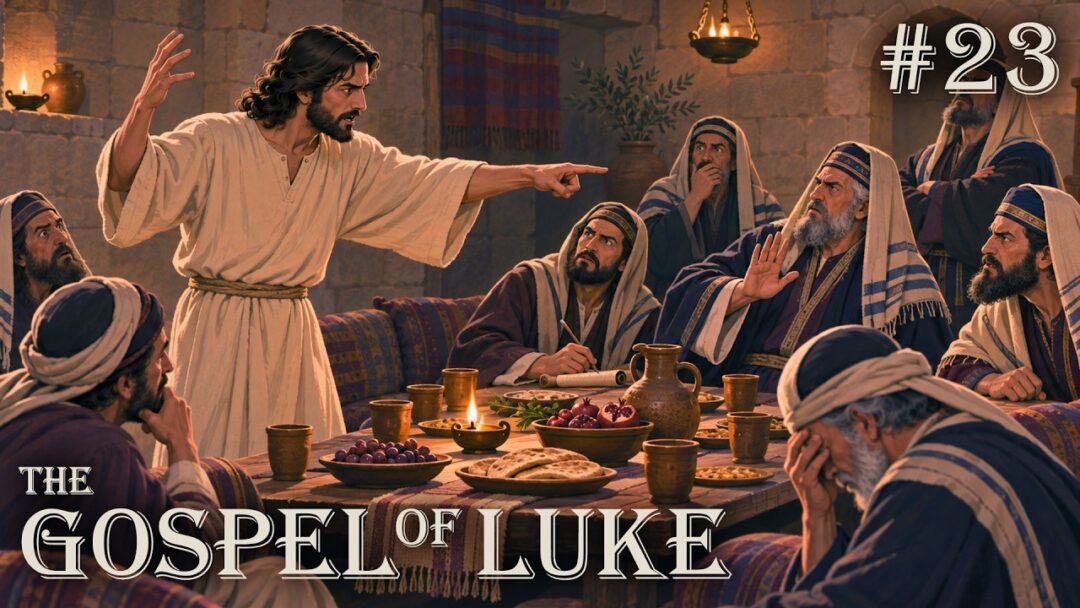
From our Sunday service on November 8, 2026, Luke 11:37-12:3. This is part 23 of our Gospel of Luke series. Watch the full message: Hidden Hypocrisy – The Gospel of Luke #23 on YouTube.
We’re continuing our sermon series in Luke, in Luke chapter 11 starting in verse 37. Last week, we left off by seeing how Jesus taught the crowds that there was no neutral ground when it came to following Christ. There were only two realities: either you were on the side of Christ and helping the kingdom grow, or you were against Christ and hindering the growth of the kingdom.
Today we’re going to continue that passage, and we’re going to see a story about a Pharisee and the dangers of hypocrisy. Hypocrisy isn’t just a small thing in the Christian faith. It’s a dangerous and contagious thing, and just a little bit of hypocrisy in the body can lead many people to become hypocrites as well. Jesus is going to use this Pharisee to teach an important lesson. From our time in Scripture today, here is what God wants you to know:
God wants you to know that hypocrisy is dangerously contagious.
An Invitation to Dinner
We’ll start by reading verse 37.
And as he spake, a certain Pharisee besought him to dine with him: and he went in, and sat down to meat.
Luke 11:37
This is the context of today’s lesson. After the teaching we looked at last week, it became time to eat. Whether that’s lunch or dinner, we don’t know. But a Pharisee who was in the crowd said, “Hey, Jesus, it’s time to eat. Why don’t you come to my house today, sit down with me, and we’ll share a meal together?”
Now clearly, this Pharisee hadn’t heard about the other meals Jesus had shared with Pharisees. Had he known what happened at those meals, he may not have wanted to invite Jesus to his home. Because when you invite Jesus to your home for dinner, he’s going to be honest with you about the state you are in. And so this Pharisee is going to have a very interesting meal as he sits down with Jesus.
Unwashed Hands
It continues in verse 38.
And when the Pharisee saw it, he marvelled that he had not first washed before dinner.
Luke 11:38
Right off the bat, the meal gets off to a bad start. The Pharisee was the religious, traditional man he was, and in some areas of his life he elevated the culture of the Jews above Scripture. Jesus and the disciples didn’t follow those traditions of the culture of the day, and one of the things that drove the Pharisees nuts was that Jesus and the disciples didn’t wash their hands before meals.
How many of you have this tradition in your household? Do you make your kids wash their hands before they eat? Some of you have this rule. Well, guess what? Some of you don’t, and you just sit down and eat. When some people go to a Burger King, they send their kids into the bathroom: “Go wash your hands.” Other kids are just told, “Go eat your burger.” The culture is different.
Here Jesus and the Pharisee differed. The Pharisees said, “You have to wash your hands before every meal. If you don’t, that’s disgusting and shameful, and you’re impure.” Jesus and the disciples didn’t always have the liberty of washing their hands before every meal. Where did they live? Oftentimes it was in the wilderness or at somebody else’s house. So they just didn’t have the routine of washing their hands before they ate. The Pharisee invites Jesus in, and instead of going to the basin to wash his hands, Jesus sits down and starts eating. And the Pharisee thinks, “What’s wrong with this Jesus guy? He doesn’t wash his hands. He just eats the food.”
Mark records another incident like this, and he tells us why the Pharisees felt this way.
And when they saw some of his disciples eat bread with defiled, that is to say, with unwashen, hands, they found fault. For the Pharisees, and all the Jews, except they wash their hands oft, eat not, holding the tradition of the elders. And when they come from the market, except they wash, they eat not. And many other things there be, which they have received to hold, as the washing of cups, and pots, brasen vessels, and of tables.
Mark 7:2–4
So in the culture of this day, among the religious, conservative Jews, sanitation was expected to be a top priority. You make sure all the dishes are washed before you use them; you don’t just take them out of the cupboard. If you haven’t washed your hands within the last couple of minutes, you’re going to wash them again. This was a constant stumbling block. The disciples would come to eat, having come from the wilderness and not washing their hands all the time, and the Pharisees would say, “This is gross.” This Pharisee is clearly, visibly disgusted with Jesus as he eats. And Jesus is going to use this discomfort as an object lesson.
Clean on the Outside
Jesus speaks up in verses 39 and 40.
And the Lord said unto him, Now do ye Pharisees make clean the outside of the cup and the platter; but your inward part is full of ravening and wickedness. Ye fools, did not he that made that which is without make that which is within also?
Luke 11:39–40
Jesus clearly sees the disgusted look on the Pharisee’s face, and he uses it as an opportunity to call out the Pharisee for his hypocrisy. Like I said, this man obviously didn’t know what it was like to have Jesus as a dinner guest. If you’re a hypocrite and you invite Jesus over for dinner, he’s going to do the same thing he did when he sat down with the publicans and sinners. He’s going to call out sin for what sin is. He doesn’t care if you’re the fanciest, most elevated person in society or the lowest and most destitute of society. When you’re sitting at dinner with Jesus, he’s going to tell you the truth.
Jesus says, “It’s funny that me not washing my hands bothers you. You Pharisees will rigorously clean the plates and the platters and wash your hands before every meal. But you know what you won’t do? You won’t fix the hypocrisy that lives inside your heart. You’ll make sure those plates are clean when your dinner guests come, because if they’re not washed, people are going to look at you like you’re dirty. But the truth is, you are dirty inside, because you only care about the external things people judge you on, and not the internal things that go unseen by others.”
And he calls them fools: “Ye fools, did not he that made that which is without make that which is within also?” In other words, isn’t it important not just for the outside to be clean, but for the inside to be clean as well?
The Pharisees had been extremely concerned about their religious tradition and culture, but they cared very little about what their religious walk was like when nobody was looking. When people were watching, they meticulously ensured they did every single thing right, because if they didn’t, people would be quick to look at them the wrong way and judge them, just like this Pharisee judged Jesus. But when the eyes were turned away, they lived completely differently, in a greedy and selfish way.
Full of Ravening
Jesus says they are “full of ravening and wickedness.” That word ravening could also be translated with the modern word extortion. These Pharisees were extorting the people. They were telling the people to be religiously pious while they themselves were not. They were telling them, “Give tithe, give tithe. Pay into our pockets, pay into our pockets.” But when it came to giving out money to help others, they kept their pockets closed. In one situation the Bible talks about, they were telling people to stop giving money to take care of their parents and instead to give it to the temple, so that the Pharisees could receive the money themselves instead of the parents. They were extorting the people for their money.
And they were disgusted by Jesus not washing his hands, because to them it meant, “You’re ritually impure.” Jesus says, “There’s a bigger issue. You’re not just ritually impure. You are actually spiritually impure, because you teach people to do something, but you yourself do not do it.” The Pharisees were taking advantage of people for their own profit. Jesus tells them, “Do you not understand that the God who demands righteousness in public also demands righteousness in private? You can’t separate them. Don’t you think God wants you to have sincerity on both sides of your life?”
Give Alms of Such Things as Ye Have
Jesus could have left it there and just said they were hypocrites, but Jesus really wants to hit the nail on the head. He goes right at the people at this dinner and points out one area where they are lacking, in verse 41.
But rather give alms of such things as ye have; and, behold, all things are clean unto you.
Luke 11:41
Jesus tells them to give alms. Literally, he’s telling them to give the money they were hoarding for themselves to the poor: “Give alms of such things as ye have. Stop telling the Jews to give to the poor, and give yourselves.” Guess what? The Pharisees were wealthy. The religious leaders had more money than anybody else, and they lived in comfort every day. Jesus is saying, “You go town to town to town, going to widows and saying, ‘Widow, you need to give more to the poor.’ Well, why don’t you give money to the poor widow? You’re rolling around in cash. You hypocrites. Stop preaching down to others and start preaching to yourselves.”
He says that if they gave to the poor, everything would be clean to them. Their whole life would be pure. They need to give from what is inside them, “such things as ye have.” In other words, you need to give to the poor from your heart. Then you will be fully clean, not just on the outside through your actions, but on the inside in your heart; not just in your external life, but in your internal life as well.
Three Woes to the Pharisees
Once again, Jesus could have left it there and he would have hit the nail on the head. But Jesus wants to make sure the Pharisees know exactly what they are doing wrong. So in verses 42 through 44, he gives three woes to the Pharisees: three warnings about their coming destruction. We’ll look at them one by one.
Woe One: Passing Over Judgment and the Love of God
But woe unto you, Pharisees! for ye tithe mint and rue and all manner of herbs, and pass over judgment and the love of God: these ought ye to have done, and not to leave the other undone.
Luke 11:42
You see, the Pharisees followed the law of tithing perfectly. When it came to tithing mint, rue, and all manner of herbs from their crops, they did one hundred percent of what the Bible said. Praise the Lord, right? They did what the Bible said. But why did they do that part accurately and not the other? Because there was a little docket that could tell the people in the community whether they were tithing the right percentage. When there was accountability for the tithes, they said, “We’ll make sure we do everything perfectly, to a T. If anybody audits our works, we want it to come back that we’ve done everything God has told us.” So when it came to the public tithe from a percentage of their goods, they gave exactly what they were supposed to give, because the law said specifically what you should do in that situation.
But it says they skipped something else. They “pass over,” or pass by (just like the Levite who passes by the wounded man in the parable of the good Samaritan), judgment, or justice, and the love of God. When it came to things that weren’t so set in stone, they didn’t uphold the standard, because they could argue through semantics or the wording of the Scripture: “Well, maybe it doesn’t mean that. Maybe the standard isn’t that high.”
A good example is the good Samaritan, which we just saw. The Bible says to love your neighbor. What did the Pharisees do? They said, “My neighbor is literally those who belong to my nation and live in my community. That’s literally the definition of neighbor. They can’t be my neighbor if they don’t live here.” So when it came to giving love and justice to those who weren’t from Israel, they said, “We have no obligation, because that’s not literally what neighbor means.” If a foreigner in their land faced abuse from one of their own people, they would reason, “When I sit down at the judgment seat before the Sanhedrin and we hand out our sentence, we’re just going to let that slide, because the one in our community who committed the crime is a neighbor, and that Samaritan is not.” They would not hold the law perfectly in the matters they could excuse away. When the law was specific on a percentage, mathematical and precise, they would always follow it. But in any area where they had a little bit of leeway, somehow it always fell in their favor.
Going back to the example of tithing: a man was supposed to take care of his elderly parents. He went to the Pharisees and asked, “What should I do? I’m supposed to tithe, but the Bible also says I’m supposed to take care of my mother and my father.” And the Pharisee said, “Give us the money, and God will forgive you for not taking care of your mother.” Why is it that whenever there was a choice, it always fell in the Pharisees’ benefit? They had the option to choose one or the other, and somehow it was always what helped them and not what helped someone else.
So Jesus says, “Woe unto you, because you’re hypocrites. When there’s an easy way to measure it, you make sure you do it right. But any time there’s leeway, everything’s for you, and no one else.” He says, “These ought ye to have done, and not to leave the other undone.” You should have done both. You should have stuck to the tithing to a T and brought justice and love to those around you.
We need to be careful that we’re not hypocrites like the Pharisees, where, when it comes to following God’s tithing command, we say, “Ten percent, I’m good,” but when it comes to loving our neighbor, we excuse ourselves and redefine it to our benefit to give us a day off from doing what God says.
Woe Two: The Uppermost Seats
Woe unto you, Pharisees! for ye love the uppermost seats in the synagogues, and greetings in the markets.
Luke 11:43
The second woe is that the Pharisees loved to be recognized. Why were they Pharisees? Was it really to show God to others? No. The only reason they got into ministry, the only reason they served people, was to elevate themselves. In the nation of Israel, the Pharisees were elevated as people of respect. They were highly educated, skilled and knowledgeable in the Torah, and because of that they were honored. They didn’t choose to serve the Lord because they wanted to serve God. They chose to serve the Lord so that others would serve them.
They wanted the seats of honor, the uppermost seats in the synagogues. In the place of worship, they wanted the seat that their culture reserved for recognized people of importance. In today’s church, that would be these seats up here on the platform, to my left and my right. They would say, “I serve the Lord so I can be up there on the platform next to the preacher, so that people know my name and recognize me as a spiritual person.” Jesus calls them out for their hypocrisy. If you didn’t get noticed, you wouldn’t serve. If it was stacking chairs downstairs for the fellowship, you wouldn’t show up, because no one would notice you.
He also says they love “greetings in the markets.” They loved to be recognized. Matthew tells us that when they were greeted in the marketplace, they loved to be called “Rabbi, Rabbi.” People would be so excited just to run into them. They’d see the rabbi out shopping and say, “How are you doing? How’s it going? It’s so good to see you. I loved your lesson last Sabbath.” They would lift them up, and their ego would just be massive.
Jesus says, “You’re only in this for the title and the recognition and the ego boost. You care nothing about actually honoring God.” We ought to make sure in our own lives that we aren’t serving God for the recognition of being a good Christian, but that we’re serving the Lord so that honor and glory go to God alone and not to us.
Woe Three: Graves Which Appear Not
Woe unto you, scribes and Pharisees, hypocrites! for ye are as graves which appear not, and the men that walk over them are not aware of them.
Luke 11:44
It’s like a metaphorical slap in the face as he calls them hypocrites. This is the one we probably don’t understand right off the bat, but it is the most severe, and it carries the idea of the dangerous spread of hypocrisy. Jesus is saying that the Pharisees and the scribes are in reality a hidden pollution in their society.
Jesus calls them “graves which appear not.” Another way you could translate that is hidden graves. Numbers 19:16 says that anybody who touches a grave is ceremonially unclean. You would be defiled by walking over a grave. Why? What were the purity laws in the Old Testament? They were sanitation laws. If you got near a dead body, you needed to go away from everybody else, go into isolation for a little while, wash yourself, and make sure you didn’t spread germs. That was the whole point of it.
So Jesus says, “You are like hidden graves. When people walk over you, they’re polluted by you. By spending time with you, they themselves are polluted and defiled by your hypocrisy. When they interact with you and sit under your teachings, they don’t know it, but as they listen to your words, they’re taking in a poison for their souls.” Because they presented a form of following God that was not following God. When people looked up to them and recognized them, what they were recognizing was not the love of God, but godless hypocrisy. And by sitting down and spending time with them, people polluted themselves with poisonous teachings that damned their souls.
So we need to make sure that we are good Christians, and that when people hang around us, we aren’t polluting them with hypocrisy.
“Thou Reproachest Us Also”
You may have noticed something different in that third woe. He says, “Woe unto you, scribes and Pharisees.” Someone is offended by this, because he happens to be a scribe. In verse 45, a teacher of the law responds.
Then answered one of the lawyers, and said unto him, Master, thus saying thou reproachest us also.
Luke 11:45
Another way you could say that is, “Teacher, by saying this, you’re also insulting us.” So he interjects: “Jesus, I hope you realize that by saying scribes, you’re also insulting me and my group of religious leaders. Surely this wasn’t intentional. If you would just stop for a moment and clarify, I’m sure you’d make it clear that you’re not calling us out.”
Oh boy. Clearly, this man has never sat down to dinner with Jesus before, because that’s not what happens.
Three Woes to the Lawyers
What does Jesus do? Let’s look at verse 46. Jesus essentially says, “I’m glad you spoke up. While we’re on the topic of you, I’m going to throw you under the bus as well.” The lawyers are also going to get three woes, three warnings about coming destruction for their hypocrisy. The man’s attempt to minimize the condemnation of his group has backfired. Jesus clarifies, “Oh no, I absolutely meant to include you in this. And while we’re talking about it, I have some woes for you as well.”
Woe One: Heavy Burdens
And he said, Woe unto you also, ye lawyers! for ye lade men with burdens grievous to be borne, and ye yourselves touch not the burdens with one of your fingers.
Luke 11:46
Another way you could translate that is, “You load men up with seriously heavy burdens that are hard to carry, but you yourselves will not lift them with even a single finger.” Jesus is telling these lawyers, “You love to oppress people with standards, but those standards you lay on other people, in secret you don’t live up to them yourselves. You tell them all these things they need to do every Sabbath day when they come and sit under you, and when you’re at home, you’re breaking them all the time. You’ve made the law of God more difficult than it needs to be, and you don’t even do what the real law of God says. You wouldn’t even lift it with your pinky finger, because it’s too much work.”
These lawyers had spent their entire lives studying the Torah. They knew the Old Testament inside and out. They wanted to be spiritual and religious, so they wrote down all the things God says you need to do, interpreted them their way, and made sure everybody knew what those 613 laws were. Whenever they saw somebody breaking one, they’d call them out in public and rebuke them for it. But when it came to judging themselves, they let everything slide. They would publicly humiliate and discourage other people while they themselves were sinners too. Jesus says this is hypocrisy, because you are pressing others with standards you don’t even hold. They were quick to forgive themselves and get themselves out of responsibilities, and quick to throw others into serving them.
Woe Two: The Tombs of the Prophets
The second woe, in verses 47 through 51, is a long one, so hold on.
Woe unto you! for ye build the sepulchres of the prophets, and your fathers killed them. Truly ye bear witness that ye allow the deeds of your fathers: for they indeed killed them, and ye build their sepulchres. Therefore also said the wisdom of God, I will send them prophets and apostles, and some of them they shall slay and persecute: That the blood of all the prophets, which was shed from the foundation of the world, may be required of this generation; From the blood of Abel unto the blood of Zacharias, which perished between the altar and the temple: verily I say unto you, It shall be required of this generation.
Luke 11:47–51
When it says “ye allow the deeds of your fathers,” in other words, you approve of them. The second woe is that the lawyers reject God’s messengers, persecute them, and kill them. Jesus now confronts the teachers of the law on their unbroken track record of putting God’s prophets to death.
Jesus mentions that they build the sepulchres of the prophets. What was going on in that day was that the prophets’ tombs were known. People knew where they were, and in reverence for the prophets of old who were put to death by the religious leaders of their day, they would redo the tombs. They would decorate them, put flowers outside them, and recarve them. They would do all these things to honor the deaths of the prophets.
But when you go back in time and look at the circumstances of the prophets’ deaths, how did they die? It was these lawyers’ own fathers and grandfathers who murdered them. They decorated the tombs of the prophets and gave them reverence, but it was their own family line, their own scribes, Pharisees, and teachers of the law, who killed the prophets to begin with. And they would go around saying, “Oh, we would not make the same mistake as our fathers. We have learned the lesson. We are more spiritual than they were.”
And Jesus says, “Look at the track record, from the blood of Abel to the blood of Zacharias. They’ve all been put to death. None of you have learned your lesson. You’re all hypocrites. And you’re going to be given the same opportunity soon.” Because who is the newest prophet? It’s Jesus Christ: prophet, priest, and king. “And guess what you’re going to do with him? You’re going to do the same thing your fathers did. You’re going to kill me and put me in a tomb. You act like you’re so spiritual, but every time somebody rebukes you for your hypocrisy, you say, ‘All right, time to dig another tomb and put them inside.'”
Their hypocrisy was relentless. They were just like their fathers, and Jesus would be proven right when they colluded with Rome to put him to death. The apple doesn’t fall far from the tree, flaws and all.
Jesus says the blood of the prophets would be required of this generation. In other words, this generation was going to have the final opportunity to decide whether or not they would reject the Messiah: a final opportunity for Israel to embrace their role as God’s chosen people, or to oppose God’s purposes and exclude themselves from being part of the kingdom of God. Unfortunately, they would choose the second. They excluded themselves from the kingdom of God because they could not give up their hypocrisy.
Woe Three: The Key of Knowledge
Woe unto you, lawyers! for ye have taken away the key of knowledge: ye entered not in yourselves, and them that were entering in ye hindered.
Luke 11:52
Woe number three is that the lawyers blocked people from heaven, and they weren’t even going in themselves. They had the Scriptures in front of them. They knew what God said about salvation. They knew that Abraham got in through faith; they knew it wasn’t works. But what did they do? They took that knowledge, the key that was the truth to the pathway to heaven, locked the door, threw away the key, and didn’t even go inside themselves. They said, “We’re not going to heaven, and we’re not telling anybody else how to get there either.” Why? Because in this world, the truth didn’t benefit them. It made them lose a little bit, and they would rather have comfort and praise than actually preach the truth to their society.
The lawyers had hindered the people’s knowledge. They were really the only ones who could read the law. Sure, there were some Aramaic translations, but the average person in that day could not read Hebrew. They could not read the Scriptures for themselves. They didn’t have the privilege we have today of having the Bible in our own language in an easily accessible way. If they were hearing the Word, it was through the teachers of the law, and the teachers of the law lied. They locked the door and blocked people from entering, because they taught the Scriptures inaccurately.
So when Jesus came to preach, the people didn’t have the base knowledge they needed to understand what he was speaking on. They didn’t understand Jesus’ teachings, because they were so confused about what the prophecies were about. The Pharisees taught that the Messiah was going to be a warrior who would overthrow Rome, a mighty man of war, with no peace, bloody and violent. When Jesus came preaching something else, the people couldn’t wrap their heads around it. The lawyers had locked the doors to salvation, not just for themselves, but for everyone around them. Why? Because they were hypocrites and would not do what was right.
Seeking to Catch Something Out of His Mouth
With all this going on, the scribes and Pharisees say, “We need to do something.” We see that something in verses 53 and 54.
And as he said these things unto them, the scribes and the Pharisees began to urge him vehemently, and to provoke him to speak of many things: Laying wait for him, and seeking to catch something out of his mouth, that they might accuse him.
Luke 11:53–54
These woes hit close to home. The Pharisees, the scribes, and the teachers of the law were all very uncomfortable. They could not allow Jesus to continue speaking about all the hypocrisy in their lives, because Jesus bringing these things up would deny them their credibility in the community. So they tried time and time again to make Jesus talk about controversial issues, to turn the people against him and make them think he was a false prophet. Because what happens if the people believe he’s a true prophet? Then everyone is going to know the Pharisees aren’t all they’re cracked up to be: that the religious leaders aren’t as honest as they present themselves, and that what’s truly going on is that these Pharisees want nothing that’s good for the people and everything that’s good for themselves.
So they try to entrap Jesus. But fortunately, Jesus is wiser than they are. He never says anything that angers the people, his words are never twisted, and he escapes them.
The Leaven of the Pharisees
We’ll close with the first three verses of chapter 12, as Jesus continues to teach.
In the mean time, when there were gathered together an innumerable multitude of people, insomuch that they trode one upon another, he began to say unto his disciples first of all, Beware ye of the leaven of the Pharisees, which is hypocrisy. For there is nothing covered, that shall not be revealed; neither hid, that shall not be known. Therefore whatsoever ye have spoken in darkness shall be heard in the light; and that which ye have spoken in the ear in closets shall be proclaimed upon the housetops.
Luke 12:1–3
The Pharisees had attempted to stop Jesus from speaking out to the community. They intended to discredit him before he came out with the truth about their character. But we see in chapter 12 that it didn’t work. Their secrets could not be kept forever. Jesus goes before a crowd so full that people are stepping on each other just to get closer to him. People are being trampled. And in this massive crowd, Jesus calls out the Pharisees: “Beware ye of the leaven of the Pharisees, which is hypocrisy.”
A Little Leaven
He warns them that the Pharisees are a dangerous poison that spreads quickly. He compares them to leaven, like yeast in a dough. Once you put a little bit of yeast in that dough and mix it in, it’s only a matter of time until the entire dough is fermented. A little leaven leaveneth the whole lump. Jesus is saying, “This hypocrisy of the Pharisees, you need to get away from it. You need to get away from hypocrites and from the ideas hypocrites have.” Because when you hang around hypocrites, their hypocrisy begins to wear off on you. You begin to become like them.
It’s like a pandemic of hypocrisy. You need to isolate yourself from it, because just a little bit getting in is absolutely going to decimate everything. Once the yeast is in the dough, it’s just a matter of time until the whole dough is fermented. And guess what? You can take a part of that dough and use it as a starter for the next batch. And the hypocrisy multiplies, and multiplies, and multiplies.
Nothing Covered That Shall Not Be Revealed
Jesus warns them, “You won’t get away with hypocrisy forever. Your insincerity will one day come to light.” For the Pharisees, their hypocrisy was quite literally coming to light in that moment. Jesus says, “Whatsoever ye have spoken in darkness shall be heard in the light; and that which ye have spoken in the ear in closets shall be proclaimed upon the housetops.”
You might be able to hide your insincerity for a while. You might be able to hide for a while that you’ve got double standards, that you judge other people differently than you judge yourself. You may be able to hide for a while that you’re just doing things for your own benefit and not the benefit of others. But eventually the truth is going to come out. Eventually people are going to see you for who you are. And the only thing that will have happened is that you will have caused other people to stumble by your hypocrisy, and you will have benefited nothing in the end.
One day we’re all going to have to stand before Christ. And let me tell you, Christ is not going to be deceived by the secret things we hid from everybody else. He’s going to know if we were sincere. He’s going to know if we meant what we said. He knows if we’ve done the things we said we’d do.
Don’t Be a Carrier
To conclude today: our lesson started with something as simple as washing your hands. But Jesus used this small issue to expose a much greater underlying problem. These religious leaders were so concerned with appearing righteous to others that they had neglected what it actually meant to be righteous at all. They carefully followed the commands that brought them recognition while neglecting the ones that required personal sacrifice. They demanded obedience from others while excusing their own disobedience. And worst of all, their hypocrisy was leading others away from the very God they claimed to represent.
This is why Jesus warned his disciples, “Beware ye of the leaven of the Pharisees, which is hypocrisy.” Hypocrisy is dangerous because it does not remain isolated. When we begin making excuses for our own sins, we eventually begin influencing others to do the same. And as Jesus reminds us, nothing remains hidden forever. We may be able to conceal our true character from the people around us, but we can never hide it from God.
We often ask ourselves, “Do other people see me as a good Christian?” But more importantly, we should be asking, “Am I living a life that professes what I claim to believe?” Are we holding ourselves to the same standards we expect from others? Are we faithfully obeying God even when no one is watching us? And are we helping others draw closer to Christ by following our example?
Ultimately, God is not looking for people who appear righteous. He desires people who are sincere in their faith and obedient in their hearts. God wants you to know that hypocrisy is dangerously contagious. Will you ensure you aren’t a carrier of hypocrisy today?

Recent Comments