
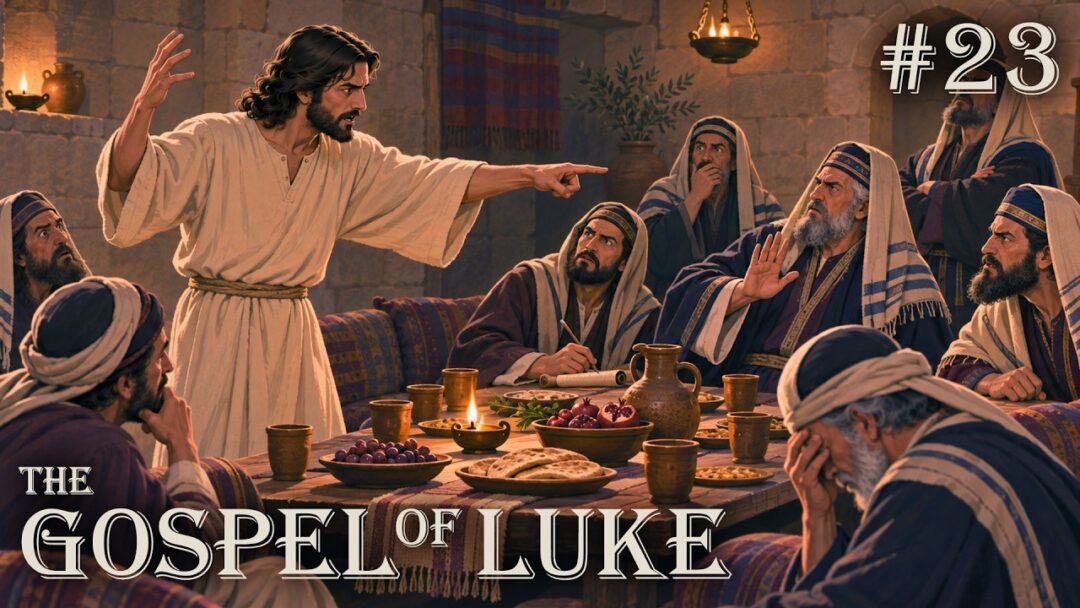
From our Sunday service on November 8, 2026, Luke 11:37-12:3. This is part 23 of our Gospel of Luke series. Watch the full message: Hidden Hypocrisy – The Gospel of Luke #23 on YouTube.
Last time we saw Jesus teach that there is no neutral ground when it comes to following Him: either we are on His side, helping the kingdom grow, or we are against Him, hindering it. This passage carries that teaching to a dinner table, where a Pharisee’s quiet disgust opens the way for a serious warning from Jesus. Hypocrisy is not a small thing in the Christian faith. It does not stay in one corner of a life, and a little of it in the body can lead many others to become hypocrites as well. God wants you to know that hypocrisy is dangerously contagious.
Clean Cups and Unclean Hearts
A Pharisee in the crowd invites Jesus home for a meal. This man clearly has not heard what happened at the other meals Jesus shared with Pharisees, because when you invite Jesus to dinner, He is going to be honest with you about the state you are in. Jesus sits down and eats without first washing, and the Pharisee marvels at it. Mark tells us the Pharisees, “except they wash their hands oft, eat not, holding the tradition of the elders,” and this man had raised that culture above Scripture. Jesus and the disciples often lived in the wilderness or in other people’s houses and simply did not keep that routine. Jesus turns the Pharisee’s discomfort into an object lesson:
And the Lord said unto him, Now do ye Pharisees make clean the outside of the cup and the platter; but your inward part is full of ravening and wickedness. Ye fools, did not he that made that which is without make that which is within also?
Luke 11:39–40
The Pharisees scrubbed their plates and platters because guests would notice a dirty dish and think less of them. What they would not clean was the hypocrisy in their hearts. When eyes were on them they did everything right, and when eyes were turned away they lived greedily and selfishly. That word ravening could be rendered extortion. They told the people to tithe into their pockets while keeping those pockets closed to others, and even told people to give to the temple the money that should have cared for their own parents. The Pharisee worried that Jesus was ritually impure, but Jesus tells him he is spiritually impure, because he teaches others to do what he does not do himself. The God who demands righteousness in public demands it in private as well, and Jesus goes straight to the place where these wealthy men were lacking:
But rather give alms of such things as ye have; and, behold, all things are clean unto you.
Luke 11:41
They told widows to give more to the poor while they themselves rolled around in cash. If they would give from the heart, out of such things as they had, they would be clean not only on the outside but within.
Three Woes to the Pharisees
Then Jesus pronounces three woes, three warnings of coming destruction. The first concerns how they kept the law:
But woe unto you, Pharisees! for ye tithe mint and rue and all manner of herbs, and pass over judgment and the love of God: these ought ye to have done, and not to leave the other undone.
Luke 11:42
They tithed their mint and rue to the last leaf, exactly as the Bible said, because tithing was measured, and anyone who audited them would find it done to a T. Justice and the love of God are not so easily measured, and there they passed by, arguing through semantics that the standard surely was not that high. They decided a neighbor was only someone of their own nation, so a wronged foreigner could be left without justice. When a man asked whether to tithe or care for his aging parents, they told him to give them the money and God would forgive him for neglecting his mother. Where the law was precise they followed it, and where there was leeway it always fell in their favor. Jesus says they ought to have done both, and we must be careful not to say “Ten percent, I’m good” while redefining love for our neighbor to give ourselves a day off from what God says.
The second woe exposes why they served at all. They loved the uppermost seats in the synagogues, and they loved greetings in the markets and being called “Rabbi, Rabbi.” They served the Lord so that others would serve them, and if no one would notice, as with stacking chairs downstairs for the fellowship, they would not have come. We ought to serve not for the recognition of being a good Christian, but so that honor and glory go to God alone. The third woe is the most severe, and it carries the whole danger of hypocrisy:
Woe unto you, scribes and Pharisees, hypocrites! for ye are as graves which appear not, and the men that walk over them are not aware of them.
Luke 11:44
Numbers 19:16 says that whoever touches a grave is unclean. A hidden grave defiles people who never know they walked over it, and that is what these men were to their society. People sat under their teaching and took in poison for their souls without realizing it, because the Pharisees presented a form of following God that was not following God. What people admired in them was not the love of God but godless hypocrisy, and we need to make sure that those who spend time with us are not polluted in the same way.
Three Woes to the Lawyers
Because Jesus named the scribes, one of the lawyers speaks up: “Master, thus saying thou reproachest us also.” The lawyer’s attempt to soften the condemnation backfires, and Jesus has three woes for the lawyers too. They laded men with burdens grievous to be borne and would not touch those burdens with one of their fingers, publicly rebuking anyone they caught breaking one of the 613 laws while breaking them all the time at home. They built and decorated the sepulchres of the prophets their own fathers had killed, claiming they would never make the same mistake, and Jesus tells them that by this they approve their fathers’ deeds. The blood of the prophets from Abel to Zacharias would be required of this generation, because the newest prophet was standing in front of them, and they would kill Him and put Him in a tomb too. The third woe is the saddest:
Woe unto you, lawyers! for ye have taken away the key of knowledge: ye entered not in yourselves, and them that were entering in ye hindered.
Luke 11:52
The lawyers had the Scriptures in front of them and knew that Abraham was saved through faith and not works. Yet they took the key to the pathway of heaven, locked the door, and did not go in themselves, because the truth did not benefit them and they preferred comfort and praise. The ordinary person could not read Hebrew and heard the Word only through these teachers, who taught it inaccurately. Hypocrisy had locked the doors of salvation, not only for the hypocrites, but for everyone around them.
Beware the Leaven
The scribes and Pharisees could not let Jesus go on exposing them. They began to urge Him vehemently, seeking to catch something out of His mouth that would turn the people against Him, because if the people believed Him, everyone would see what the religious leaders really were. But Jesus is wiser than they are, and their effort to silence Him fails. A crowd gathers so large that people trample one another to get close to Him, and before them all He says:
In the mean time, when there were gathered together an innumerable multitude of people, insomuch that they trode one upon another, he began to say unto his disciples first of all, Beware ye of the leaven of the Pharisees, which is hypocrisy.
Luke 12:1
Leaven works like yeast in dough. Once a little is mixed in, it is only a matter of time until the whole lump is fermented, and a piece of that dough can start the next batch, so the hypocrisy multiplies again and again. That is why we need to get away from hypocrites and the ideas they hold, because hypocrisy wears off on you until you become like the people who carry it. And it will not stay hidden, for “there is nothing covered, that shall not be revealed.” You may hide your double standards and self-serving motives for a while, but eventually the truth comes out, and all you will have done is cause others to stumble and gain nothing in the end. One day we will all stand before Christ, and He will not be deceived by the secret things we hid from everyone else. He will know whether we were sincere and whether we meant what we said.
So a lesson that began with something as simple as washing your hands exposes a much greater problem. These leaders were so concerned with appearing righteous that they neglected what it means to be righteous at all. They kept the commands that brought recognition and neglected the ones that required sacrifice, demanded obedience from others while excusing their own disobedience, and worst of all, led others away from the very God they claimed to represent. We often ask whether other people see us as good Christians, but the better question is whether we are living what we claim to believe, holding ourselves to the standards we expect from others, obeying God when no one is watching, and helping others draw closer to Christ by our example. God is not looking for people who appear righteous; He desires people who are sincere in their faith and obedient in their hearts. God wants you to know that hypocrisy is dangerously contagious. Will you ensure you aren’t a carrier of hypocrisy today?
Recent Comments