
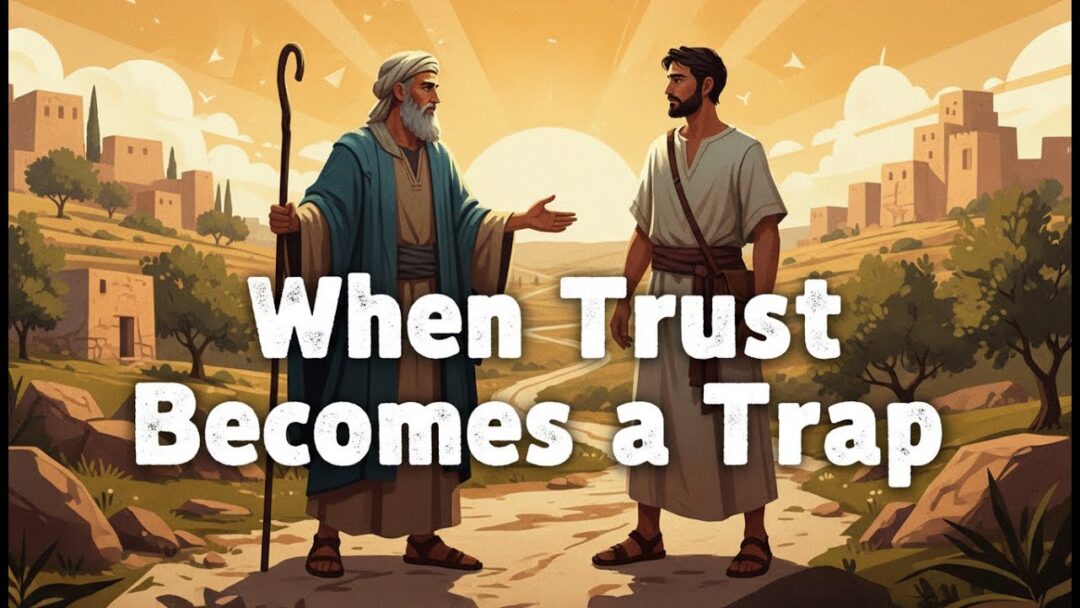
From our Sunday service on January 18, 2026, 1 Kings 13. Watch the full message: When Trust Becomes a Trap on YouTube.
First Kings 13 is an obscure chapter, and a strange one. It sits in the middle of the conflict of the kingdoms, and for a single chapter we meet a man we will simply call the unnamed prophet. His prophecy will not be fulfilled for more than three hundred years. At the center is a tragedy that could have been avoided. The warning is not aimed at one nation or one side. In every society you will find an evil leader from time to time, a lying teacher, and a faithful believer who trips up. God wants you to know that obedience to Him is an individual responsibility.
A True Word Against a False Altar
After Solomon’s death the kingdom split. Jeroboam took the north, and he feared that if his people kept going down to Jerusalem to worship, his authority would not last. So, to keep power, he brought back the golden calf cult Aaron had made at Sinai. He set up worship at Bethel, a name that means “the house of God,” and at Dan. The cult still named Yahweh, but it mixed idolatry into His worship. The calf, they said, helped them imagine God and feel closer to Him. It was still the Lord, they claimed. Nothing had changed. In fact everything had changed.
Whereupon the king took counsel, and made two calves of gold, and said unto them, It is too much for you to go up to Jerusalem: behold thy gods, O Israel, which brought thee up out of the land of Egypt.
1 Kings 12:28
They were praising God while disobeying Him. Jeroboam also made priests of the lowest of the people, men who were not sons of Levi. The system pulled the worship of God closer to the unsaved around them, and made it more useful to the king. Then, while Jeroboam stood by the altar to burn incense, a man of God came out of Judah, not first to scold the king, but to cry against the altar itself.
And, behold, there came a man of God out of Judah by the word of the LORD unto Bethel: and Jeroboam stood by the altar to burn incense. And he cried against the altar in the word of the LORD, and said, O altar, altar, thus saith the LORD; Behold, a child shall be born unto the house of David, Josiah by name; and upon thee shall he offer the priests of the high places that burn incense upon thee, and men’s bones shall be burnt upon thee.
1 Kings 13:1–2
He named a future king, Josiah, who would burn the false priests’ bones on that altar, three hundred years later. A prophet who speaks of the far future also gives a sign near at hand to confirm it. That same day the altar was rent and the ashes poured out. When Jeroboam put forth his hand to seize the man, the hand dried up. The man of God was a true prophet, and he was divinely protected. Then the king begged him to pray, and the withered hand was restored. God had mercy on a wicked king. Jeroboam then invited him home for a reward.
And the king said unto the man of God, Come home with me, and refresh thyself, and I will give thee a reward. And the man of God said unto the king, If thou wilt give me half thine house, I will not go in with thee, neither will I eat bread nor drink water in this place: For so was it charged me by the word of the LORD, saying, Eat no bread, nor drink water, nor turn again by the same way that thou camest. So he went another way, and returned not by the way that he came to Bethel.
1 Kings 13:7–10
The man of God refused. God had charged him: eat no bread, drink no water, and do not return by the way you came. The invitation was not safe. So the prophet did what God said and left another way.
The Lie, and the Same Sin
Then the story turns. An old prophet in Bethel, a man who had likely served in earlier days, heard from his sons what had happened and rode after the man of God. He found him under an oak and invited him home to eat bread, the very thing the Lord had forbidden. The unnamed prophet gave the right answer: he may not return, nor eat, nor drink, because of the word of the Lord.
He said unto him, I am a prophet also as thou art; and an angel spake unto me by the word of the LORD, saying, Bring him back with thee into thine house, that he may eat bread and drink water. But he lied unto him.
1 Kings 13:18
The old prophet claimed a new word. An angel had spoken, he said, and the old command no longer stood. He lied. And the man of God went back, and ate, and drank. While they sat at the table, the word of the Lord came to the very man who had lied, and he cried out that because this man had disobeyed, his carcass would not come to the sepulchre of his fathers. On the road a lion met him and slew him, and then stood by the body with the ass. The lion did not eat him. This was not a hungry animal and a lapse of protection. It was judgment. Jeroboam, who had tried to kill the prophet, had been healed. God’s prophet, for a meal, was put to death.
Why was the liar not the one struck down? Because the unnamed prophet was not destroyed by someone else’s lie so much as by his own willful disregard for what God had already told him. He knew the word. He chose another voice anyway. The old prophet later buried him and asked to be laid beside his bones, confessing that the word against the altar would surely come to pass. And Jeroboam did not turn.
After this thing Jeroboam returned not from his evil way, but made again of the lowest of the people priests of the high places: whosoever would, he consecrated him, and he became one of the priests of the high places. And this thing became sin unto the house of Jeroboam, even to cut it off, and to destroy it from off the face of the earth.
1 Kings 13:33–34
Nothing in the immediate scene seemed to change, except a prophecy still waiting three hundred years. That is what makes the story feel so heavy. So why did God show mercy to Jeroboam and to the lying prophet, and not to His own messenger? The answer is a question: what is the difference between the calf cult and the unnamed prophet? The cult said Yahweh was the true God, and then would not obey His words. The unnamed prophet said the same, and then would not obey. Jeroboam offered a new word, a new priesthood, a new way. The old prophet told the same kind of lie: God may have said this before, but now the standard has changed. The man sent to denounce that very thing fell into the trap he was sent to expose. There is a danger in announcing God’s word and not keeping it. He should have said, “I will wait to hear from God. You may claim His name, but I already have His command.”
Obedience Cannot Be Handed Off
The parallel today is plain. God has given us His Word. People will still say that was then, and this is now, and the context has changed. Unless God has spoken in His Word, we cannot take another person’s word as if it were His. That includes what you hear from this pulpit. Check it. When we stand before God, we will not be able to say, “Someone I respected told me this is what You wanted.” It did not work for the unnamed prophet, and it will not work for us.
I have seen respected voices say things that contradict Scripture, and people thank them as if it were truth when it was only an opinion. I will not name names, and the pattern is not limited to one country or one party. Some will tell you it is acceptable to murder unborn children in the womb, as if they were not human. But God says He knew a name in the womb, and that children are His heritage. Some will say it is moral to make certain groups of sinners suffer more, as if they mattered less. But God has no pleasure in the death of the wicked, and He tells us to remember them that are in bonds as bound with them. Some will treat racism and nationalistic supremacy as a natural conclusion. But God has made of one blood all nations, and he who says he loves God and hates his brother is a liar. Some will say that gender is fluid, that marriage is subjective, and that feelings define morals. But from the beginning He made them male and female, and a man is to cleave to his wife. The heart is deceitful, and it is not a safe rule. It is not enough to believe what so-called Christians say. We must believe the Word of God.
The story is meant to feel heavy, because it presses us toward the right question. Scripture is not mainly explaining why others were spared. It is showing who is responsible for what God has already spoken. Jeroboam never obeyed what he knew. The old prophet twisted what he knew. The unnamed prophet knew exactly what God had said and trusted another voice anyway. Obedience is not transferable. Faithfulness cannot be outsourced. We will not be judged by what a government called legal, what a respected teacher claimed, or what a well-meaning Christian excused, but by what God has actually said. It is possible to speak for God and still disobey Him, and to believe the truth and still compromise. When God has spoken, no pastor, no tradition, and no friendly voice has the authority to overrule Him. The safest place to stand is in the unchanging Word of the Lord. God wants you to know that obedience to Him is an individual responsibility. Will you choose to follow only His voice today?
Recent Comments