
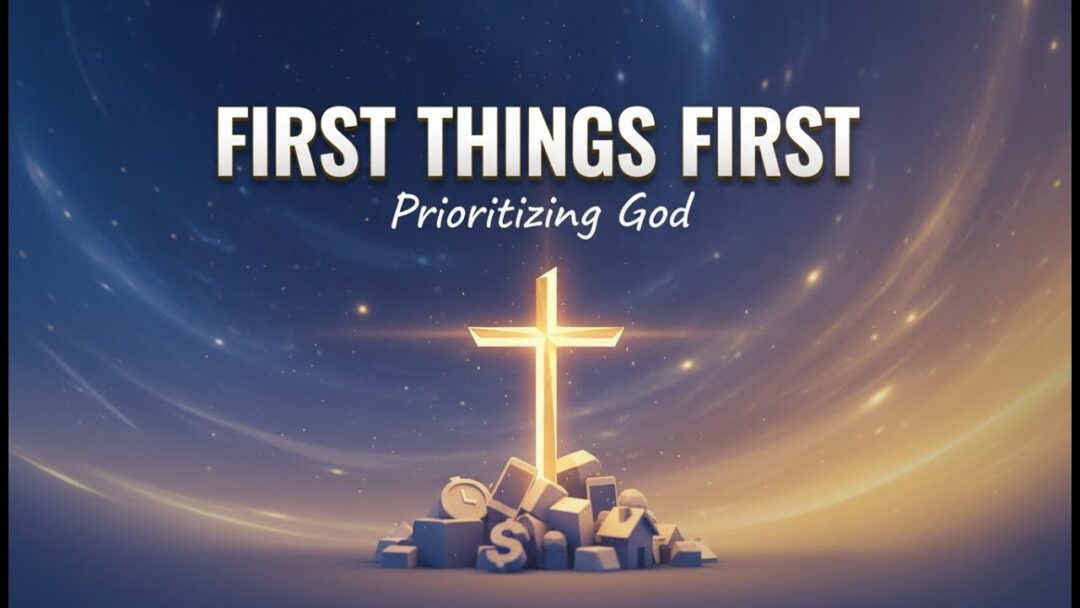
From our Sunday service on January 11, 2026, Matthew 6:31-34 and Proverbs 3:1-13. Watch the full message: First Things First on YouTube.
We may not know what the months ahead will bring, but we can know how we should live. Scripture still gives us foundational principles for that. If we set our priorities right, we will be set up to live well, because God has already told us where those priorities belong, and He has promised to take care of us when we put Him first. Jesus shows us the promise. Then Solomon, in Proverbs 3, gives four instructions, and each one has a living example in Scripture. When you put God first, you will prosper.
Seek Ye First
Therefore take no thought, saying, What shall we eat? or, What shall we drink? or, Wherewithal shall we be clothed? (For after all these things do the Gentiles seek:) for your heavenly Father knoweth that ye have need of all these things. But seek ye first the kingdom of God, and his righteousness; and all these things shall be added unto you. Take therefore no thought for the morrow: for the morrow shall take thought for the things of itself. Sufficient unto the day is the evil thereof.
Matthew 6:31–34
Jesus rebukes anxious disciples. Why let fear drive your decisions? Your Father knows what you need. Seek first the kingdom of God and His righteousness, and all these things shall be added unto you. If you give yourself to every headline and every worry, you will take a lot of thought about food, drink, and clothing. You do not have to freeze in front of the chaos. True prosperity is only possible when God is first.
And when I say prosper, I do not mean a number in a bank account. You can have income and still be unprosperous in the rest of your life. In modern speech, prosperity often sounds like money. I mean the older, wider sense: a life that is generally well, able to walk through trouble without coming apart. Money is not the solution by itself. You can be rich and still want more, and you can be poor and still not be well. Prosperity is not merely wealth, and it is not merely an idea of wisdom. It is not simply equal to saying you have faith, either. You can claim to follow God and still live in chaos. Faith must be joined to a faithful walk. When we actively seek God, the meeting of our needs is promised as a result. That is not a promise of riches. It is a promise of provision and peace.
My son, forget not my law; but let thine heart keep my commandments: For length of days, and long life, and peace, shall they add to thee.
Proverbs 3:1–2
Solomon speaks as wisdom to his son: do not forget the Lord’s law. Length of days, long life, and peace shall they add to thee. Again, the prize is not first a fortune. I would rather have peace than money. If you follow the wisdom God has given, He adds a peaceful, well-ordered life.
Mercy and Truth, and God's Wisdom
Let not mercy and truth forsake thee: bind them about thy neck; write them upon the table of thine heart: So shalt thou find favour and good understanding in the sight of God and man.
Proverbs 3:3–4
Keep mercy and truth close. Bind them about your neck. Write them on your heart. So shall you find favour in the sight of God and man. You need both. Truth is God’s truth, which gives you a standard. If there is no absolute truth, there is no stable morality, and peace will not last. But you can have truth and no mercy, and then you will confront sin in a way that only sounds like pride. Mercy is the readiness to forgive people who do not meet the standard. Every person you meet is fallen, just as you are. Without mercy and truth together, those relationships break, and so does a life of peace.
Eli is the warning. He kept mercy close and neglected truth. He loved his sons, priests in the temple, more than he loved the honor of God. They stole the best of the offerings and sinned with the women who came to the house of the Lord, and he let it slide. A man of God told him that he had honored his sons above the Lord, and that those who honor God will be honored, and those who despise Him will be lightly esteemed. The house that might have served forever was cut off. The sons died terribly, and Eli died of a broken heart. Mercy without truth is not love.
Trust in the LORD with all thine heart; and lean not unto thine own understanding. In all thy ways acknowledge him, and he shall direct thy paths. Be not wise in thine own eyes: fear the LORD, and depart from evil. It shall be health to thy navel, and marrow to thy bones.
Proverbs 3:5–8
Trust in the Lord with all thine heart, and lean not unto thine own understanding. In all thy ways acknowledge Him, and He shall direct thy paths. We are not wise enough, and our lives are not long enough, to invent a moral system that will hold. History keeps repeating the same collapses because generations forget. The law of God is not a bare legal code. It is His instruction for His people. We do not close our minds when we read it. We think, and we also recognize that His Word has already been proved.
Saul shows what happens when a man trusts his own wisdom instead. God told him to smite Amalek and utterly destroy all they had, because of an old, unrepentant wickedness. Saul and the people spared Agag and kept the best of the spoil. Saul even greeted Samuel with a blessing and said he had performed the commandment of the Lord. Samuel asked what the bleating of the sheep meant. Saul still would not admit the fault. He dressed it up as a better plan, even as a sacrifice. Samuel told him that to obey is better than sacrifice, that rebellion is as the sin of witchcraft, and that because he had rejected the word of the Lord, the Lord had rejected him from being king. What looks beneficial is not always moral. When we acknowledge God, He directs our paths. That is health. That is how a life prospers.
Give First, and Take Correction
Honour the LORD with thy substance, and with the firstfruits of all thine increase: So shall thy barns be filled with plenty, and thy presses shall burst out with new wine.
Proverbs 3:9–10
Honour the Lord with thy substance, and with the firstfruits of all thine increase. If we hoard everything for ourselves, we make a great mistake. If we give last, we often find that little is left. Giving first is also a sign of faith that God will provide. Hope that is seen is not hope. You do not wait to see whether the month ends well and then offer God the leftovers. You honour Him first.
Haggai faced people who had come back to the land, rebuilt their own paneled houses, and said the time had not come to build the Lord’s house. God told them to consider their ways. They had sown much and brought in little. They earned wages to put into a bag with holes. They thought they lacked the resources to put God first, and God said the lack was the fruit of that choice. If they would give Him the firstfruits, He could bless what remained. If God is not first, He cannot grow you the way He intends.
My son, despise not the chastening of the LORD; neither be weary of his correction: For whom the LORD loveth he correcteth; even as a father the son in whom he delighteth. Happy is the man that findeth wisdom, and the man that getteth understanding.
Proverbs 3:11–13
Despise not the chastening of the Lord, neither be weary of His correction. Whom the Lord loves, He corrects, as a father the son in whom he delights. You should be more troubled if God never corrects you than if He does. The temptation is to be angry when consequences come, and to tell God to let it slide. He corrects early so that we are spared worse later. When He corrects us, He is giving wisdom.
Hezekiah was a righteous king with a moment of pride. After God had healed him and blessed him with treasure from many victories, he showed the Babylonian messengers everything in his house. Isaiah told him that the days would come when all of it would be carried to Babylon, and that some of his sons would be eunuchs in that palace. Saul made excuses. Hezekiah did not. He said, “Good is the word of the LORD.” He humbled himself, and the wrath did not fall in his days. The later fall of the kingdom came in another generation’s sin. Because he accepted correction, his people had more years of peace than they would have had if he had argued with God.
The question is not whether we want God’s blessing. The question is whether we will order our lives around His priorities in order to receive it. Solomon does not promise a life without trouble, and Jesus does not promise unlimited comfort. What is promised is better: direction, peace, provision, and wisdom for those who put Him first. Keep mercy and truth close. Trust God’s wisdom rather than your own. Give back to God first. Accept His correction. Our prosperity is tied to our priorities. God is not asking to be added to a full list. He is asking to be placed first in everything we do. Then the words of Jesus prove true: all these things shall be added unto you. Do not seek comfort, control, or success first. Seek God first, and trust Him with the rest. When you put God first, you will prosper. Will you choose to put Him first today?
Recent Comments