
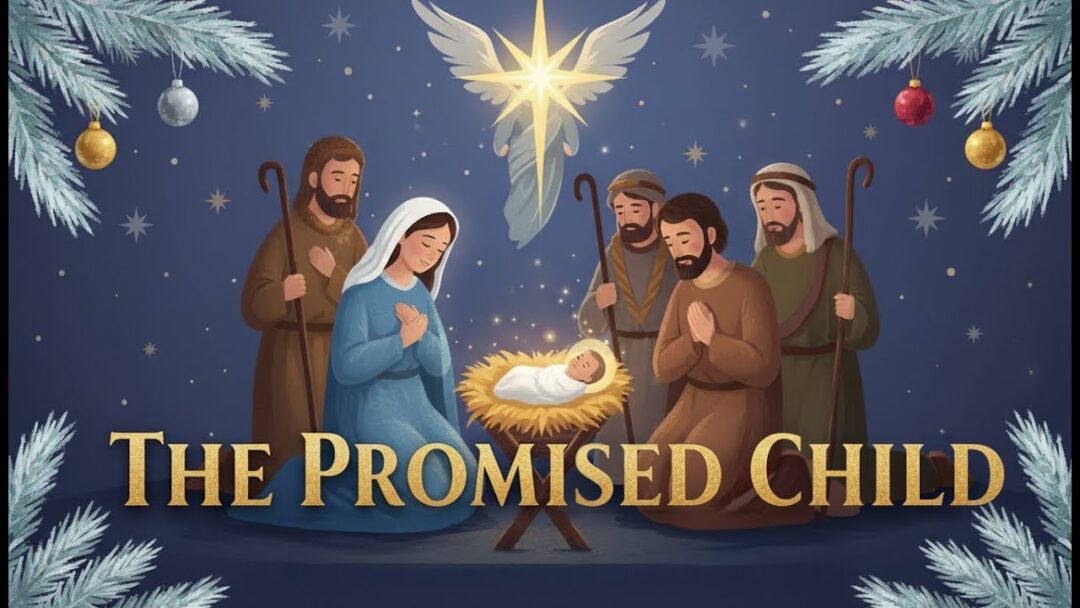
From our Sunday service on December 21, 2025, Malachi 2-4, Luke 1 and Luke 2. Watch the full message: The Promised Child on YouTube.
Christmas is about a promise God made to humanity that was fulfilled in Bethlehem on that Christmas morning. In a message called “A Time Foretold,” we looked at the prophecies of Christmas. It is natural, then, to look at those prophecies fulfilled. God always keeps His promises.
Four Hundred Silent Years
Between the Old and New Testaments there were four hundred years of silence. God did not speak to Israel, send prophets, or raise up deliverers by the power of the Holy Spirit. The promises to Abraham, Isaac, Jacob, Moses, and David were still there, but everything was silent. After Israel was restored to the land, and the temple and the walls were rebuilt, the spiritual leadership became corrupt and unjust. Because of that apathy and injustice, God stopped speaking until the Messiah arrived. But before He went silent, He left a final warning through Malachi, His last Old Testament prophet.
The Levites had failed as God’s representatives. They favored some over others, offered diseased animals and kept the best for themselves, and abandoned their wives through divorce. The people only partially paid the tithes, and they blamed God for the injustices they saw. Rather than saying, this is our fault, they said God is unjust and serving Him is useless. So God says, in effect, I promised to send the Messiah, and I will keep that promise. Even the blessings you have now, I have already cursed. But He did not leave Israel with only bad news.
Behold, I will send my messenger, and he shall prepare the way before me: and the Lord, whom ye seek, shall suddenly come to his temple, even the messenger of the covenant, whom ye delight in: behold, he shall come, saith the LORD of hosts.
Malachi 3:1
The Messiah will come and repair the damage they have caused. Who proclaimed the first covenant with Israel? Not an angel and not a prophet. God Himself made the covenant, so the messenger of the covenant is the same One who gave it. The Messiah is Yahweh Himself, and He is coming to purify, like a refiner’s fire. Malachi 4 adds that Elijah would return in some way to prepare the hearts of the people.
Malachi walks away as the last prophet of the Old Testament, and for four hundred years God leaves Israel to learn their lesson. Shortly after, the Greeks conquered them and oppressed them for around a hundred and seventy years. Eventually God set the world in motion for the arrival of the Messiah, the arrival of Himself. He allowed Israel to be conquered by Rome in 64 BC, which opened a way for the gospel to spread through the language of the Romans and their road networks. Then, sometime around 6 BC, everything was set for the Messiah to come.
The Messenger and the Child
In the days of Herod there was a priest named Zacharias, and his wife Elisabeth, both righteous before God, walking in all the commandments. They had no child, because Elisabeth was barren, and they were well stricken in years, like Abraham and Sarah. Unlike Abraham, Zacharias was faithful to his wife. He served faithfully in the temple, unlike many of the corrupt leaders in Malachi’s time. Zacharias will have the son he thought he would never have, a son who will go before the Lord in the spirit and power of Elias, to make ready a people prepared for the Lord.
His name, John, means “Yahweh is gracious.” God had cut off contact with Israel because of their sin, and when He rejoins them He names this child to say, I am being gracious to you. And John was a Nazarite. He would never have wine or strong drink, so that no one could accuse him of being an alcoholic. Some also believe Elijah himself was a Nazarite.
Then comes the Messiah Himself. In the sixth month the angel Gabriel is sent to a virgin in Nazareth named Mary, espoused to Joseph of the house of David. Gabriel looked to Daniel like any other man, and Mary does not realize at first that he is an angel. He greets her in a strange way: she is highly favoured, the Lord is with her, blessed among women. Usually when angels come, people are afraid because they think they are going to die. Here Mary is troubled at his saying, and she might be worried that this visitor is up to no good. But Gabriel does not stop there.
And the angel said unto her, Fear not, Mary: for thou hast found favour with God. And, behold, thou shalt conceive in thy womb, and bring forth a son, and shalt call his name JESUS. He shall be great, and shall be called the Son of the Highest: and the Lord God shall give unto him the throne of his father David: And he shall reign over the house of Jacob for ever; and of his kingdom there shall be no end.
Luke 1:30–33
Mary has been chosen to bring the Messiah into the world, the Son of the Highest. God is coming. The child’s name is Jesus, which means “Yahweh saves.” Mary wonders how this is even possible, seeing she has not been with a man. Gabriel answers that the Holy Ghost shall come upon her, and that holy thing shall be called the Son of God. A lot of people say the Gospels give no indication that Jesus was God. But what does God say about Jesus? That He will be the Son of the Highest, the Son of God. The Bible clearly tells us that Jesus is God in the flesh.
And God did not rely on Mary to believe without evidence. He gave her a sign. Her cousin Elisabeth, who was called barren, has conceived in her old age, and this is the sixth month with her. For with God nothing shall be impossible. Mary did not know Elisabeth was pregnant, but this stranger did. When Mary arrives, Elisabeth, filled with the Holy Spirit, echoes the exact words Gabriel had said, before Mary has told her anything. That proves this was not a coincidence. With all this evidence, Mary could not help but believe the promise, and she rejoices and praises God.
The Promise Arrives
A decree went out from Caesar Augustus that all the world should be taxed, when Cyrenius was governor of Syria, and everyone had to return to their own city. For Mary this was a thirty-five-hour walk from Nazareth to Bethlehem, and the time of her delivery was near. In Jewish culture, engagement was already legal marriage, and being married, she had no choice but to go. What she probably did not realize was that this was part of the prophecy that Christ would be born in Bethlehem.
While they were there, she brought forth her firstborn son, wrapped Him in swaddling clothes, and laid Him in a manger, because there was no room for them in the inn. The “inn” was not a modern inn but the family house, already full. I do not have any way to prove it, but it is also possible they did not let her in because she had been pregnant before the marriage was joined. For whatever reason, they did not prioritize the pregnant woman, and Mary and Joseph stayed outside with the animals. That is where the promised child Israel had waited four hundred years for was left.
But out in the fields, some shepherds hear the silence break. It does not break to speak to a king, a prophet, a priest, or a religious leader, but to shepherds who are not in Bethlehem, are not in the census, and whom nobody cares about.
And the angel said unto them, Fear not: for, behold, I bring you good tidings of great joy, which shall be to all people. For unto you is born this day in the city of David a Saviour, which is Christ the Lord. And this shall be a sign unto you; Ye shall find the babe wrapped in swaddling clothes, lying in a manger.
Luke 2:10–12
The good tidings are to all people. You might think of the wise men, but the magi were not told by God that Jesus was there. They figured it out on their own when the new star appeared. God told the lowly, poor shepherds. “Christ” is Messiah, the anointed one. And “the Lord” is Yahweh. In the Greek they wrote “the Lord” in its place as a sign of respect. So your Savior, who is the Messiah, is Yahweh Himself. And why was lying in a manger a sign? It is not a normal thing to see.
Why did God choose shepherds? You might think they were respected, since Abraham, Isaac, Jacob, Moses, and David were shepherds. But shepherds were actually despised: poor, uneducated, seen as unreliable and shady. In a court of law a shepherd was not allowed to give witness. And yet God chose them to give testimony that He had arrived. They were also despised because they did not keep the Pharisees’ purity laws and could not observe the Sabbath like everybody else, because the flock still needed care. People said they did not love God. So when God Himself shows up, who does He tell? In effect, I care about your heart. They left their flocks, came with haste, and made known abroad what had been told them. The promise God made, though it seemed silent for four hundred years, was kept.
Sometimes in our own lives it can feel like God is silent. Why has He not done anything? Why has He not replied? Even when God has not replied, His promises still stand. That silence should not be confused with absence. What seems slow to us is what God calls His perfect timing. If God can use shepherds, God can use you. Remember three things. First, God does not forget what He has spoken. When times are silent, that does not mean He is not working. It means He is working in an unseen way. Second, God does not abandon His people in the silence. If He has not responded, it is not because He does not care. It is because His timing has not arrived yet. Third, God never fails to do exactly what He promises. Christ came exactly as foretold, and the God who was faithful then has not changed. God always keeps His promises.
Recent Comments