
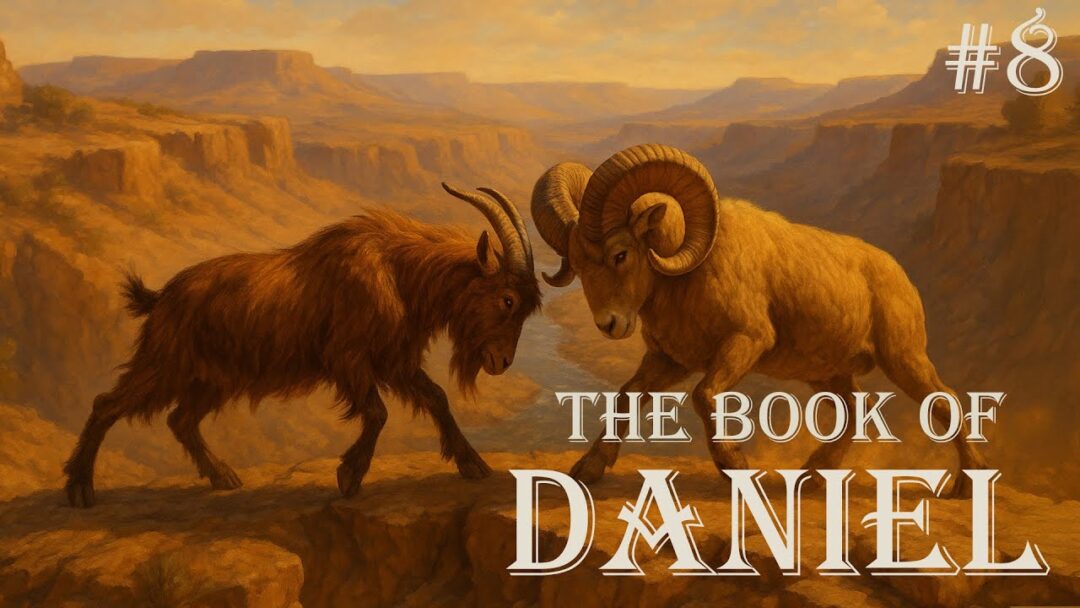
From our Sunday service on June 29, 2025, Daniel 8. This is part 8 of our Daniel series. Watch the full message: Desolation and Renewal – Daniel Series #8 on YouTube.
We return to the book of Daniel, now in the Hebrew portion of the book. The last section we looked at was the last Aramaic section, and it was also the first section of prophecy. Today is vision number two, and it is pretty significant, because this passage relates to the religious holiday of Hanukkah. It is one of only two passages in the Bible that deal with the topic. The other is in John 10, where Jesus is in Jerusalem to celebrate the feast of dedication. That is what Hanukkah means, dedication. It is there that He says, I and My Father are one. Daniel prophesies the conflict that would eventually bring about Hanukkah as a religious observance. This chapter also foreshadows the antichrist. Our enemy to Israel here is a glimpse of the character traits the antichrist will have. God wants you to beware of deception.
A Vision at Susa
In the third year of the reign of king Belshazzar a vision appeared unto Daniel, after that which appeared unto him at the first. He is at Shushan in the palace, in the province of Elam, by the river of Ulai. This takes place around 550 BC, before the fall of Babylon and before the Medes and the Persians come to power. Daniel is not going to understand a lot of this, and we can compare that to ourselves and the antichrist. The antichrist is coming in the future. We know character traits and rough details about him, and we know what his personality will be like. But we do not know exactly when he is coming. Once again we are introduced to animals. Why are kingdoms pictured as animals and not as people? Because the kingdoms of this earth are driven by animal instinct and fleshly desires.
He sees a ram with two horns, and the two horns were high, but one was higher than the other, and the higher came up last. The ram pushed westward, and northward, and southward, so that no beasts might stand before him. These two horns represent the combined empire of the Medes and the Persians. With Susa as the setting, that should be pretty clear. Persia was the smaller kingdom at first, relatively weak and outpaced by the Medes, until the second horn surpassed the first. Remember Darius the Mede, who conquered Babylon and kept his power for only two years before Cyrus quickly overtook him. Through this ram God would start to restore His people, sending them back to restore the temple and rebuild the walls under Ezra and Nehemiah. Why a ram? Rams are territorial and aggressive. They butt heads and knock rivals off the mountain. The Medes and Persians pushed west, north, and south, but not from the east, because that is where the empire comes from.
The Goat
And as I was considering, behold, an he goat came from the west on the face of the whole earth, and touched not the ground: and the goat had a notable horn between his eyes. And he came to the ram that had two horns, which I had seen standing before the river, and ran unto him in the fury of his power. And I saw him come close unto the ram, and he was moved with choler against him, and smote the ram, and brake his two horns: and there was no power in the ram to stand before him, but he cast him down to the ground, and stamped upon him: and there was none that could deliver the ram out of his hand.
Daniel 8:5–7
He ran unto the ram in the fury of his power, smote him, and brake his two horns, and there was no power in the ram to stand before him. Touched not the ground does not mean the goat hovered. It means this animal ran so fast you could not see its legs. This kingdom comes from the west out of nowhere. The goat represents Macedon under Alexander the Great. There was a legend that Caranus, the first king of Macedon, was led by goats to the location of their capital. They named that city Aegae, which meant goat in their language. It is a bit on the nose, but it is much like Babylon being the lion: the culture was so focused on the goat as its national identity that the prophecy represents it as a goat. The ram and the goat meet beside the river. When Alexander the Great eventually came into conflict with Persia and won his first battle against the Medes and the Persians, it happened at a river.
The Little Horn
The he goat waxed very great, and when he was strong, the great horn was broken, and for it came up four notable ones toward the four winds of heaven. The great horn being broken is Alexander himself, cut down when he was strong. Alexander did not die from war. He died from sickness. This great man of war, who conquered many nations in his young life, was way younger than most conquerors. Four notable ones rise toward the four winds: Seleucus, Cassander, Ptolemy, and Lysimachus, the generals who took his empire and divided it among themselves. Out of one of them came forth a little horn, which waxed exceeding great, toward the south, and toward the east, and toward the pleasant land. He magnified himself even to the prince of the host, and by him the daily sacrifice was taken away, and the place of his sanctuary was cast down. It cast down the truth to the ground, and it practised, and prospered. Gabriel later names this plainly: the ram is Media and Persia, the rough goat is Grecia, the great horn is the first king, and a king of fierce countenance shall stand up in the latter time of their kingdom. His power shall be mighty, but not by his own power. Through his policy he shall cause craft to prosper, and by peace shall destroy many. He shall also stand up against the Prince of princes, but he shall be broken without hand.
The Prophetic Timeline
One saint asks how long the vision concerning the daily sacrifice and the transgression of desolation shall be, and the answer is, Unto two thousand and three hundred days; then shall the sanctuary be cleansed. Why does God give us prophecy? So that when it happens, we know He did it. He was going to allow Israel a new form of captivity, where their worship was taken away, but only for a time, and He did not want them to think they freed themselves.
It is 2,300 days in our King James. In the Hebrew, the word days is evening-morning. Another way to translate this is 2,300 morning and evening sacrifices, or 2,300 daily sacrifices. So the number is not 2,300 literal days but 2,300 evenings and mornings. Because it is talking about sacrifices, you cut it in half, and that would be 1,150 days. There are multiple conflicting calendars in this period, so these are estimates, but it is very close. In 169 BC, Antiochus stormed into Jerusalem and looted the temple. But that is not when the countdown starts. On December 6, roughly 167 BC, he returned and committed the abomination of desolation. He erected a pagan altar inside the Jewish temple, an altar to Zeus, and offered a pig on it, an unclean animal. In this act he defiled the entire sanctuary. Then the faithful form a revolt, called the Maccabean revolt, which you can read about outside your Bible, and they eventually overthrow Antiochus. When they rededicated themselves to God, they reopened the temple and dedicated not only the temple but themselves to God. Based on my estimated dates, you get 1,111 days, not 1,150, so my dates are obviously a little off. Maybe if I had three months to figure this out, I could get exact dates. But that gives you enough idea of what happened. For years they suffered without a temple because they did not dedicate themselves to God. That cleansing is what Hanukkah remembers.
His craftiness will allow him to prosper. He will lift himself up and be proud and boastful. But by peace shall destroy many. When an antichrist or the antichrist comes, he does not come to destroy believers by force. That is the one thing I think we forget when we project in the future who the antichrist may be. The antichrist is not going to force believers to give in. Christians are going to go peacefully to the side of the antichrist, because their standards were so slowly eroded that they do not even know they are switching sides. The Israelites faced this under Antiochus. Satan got into Antiochus’s military strategy and successfully weakened the Israelite people until he could walk in and peacefully turn them over.
Daniel fainted, and was sick certain days, then rose up and did the king’s business, astonished at the vision, but none understood it. The vision of the evening and the morning is true, and it was to be shut up for many days. It is history now, and it is also a warning about what will be. Many antichrists will come. Antiochus did not just one day march into Jerusalem and conquer all the cities. He started by craft, by policy, by peace that destroyed many. God wants you to beware of deception. Will you watch, and refuse to be taken in by a peace that is not peace, and a power that is not from God?
Recent Comments