
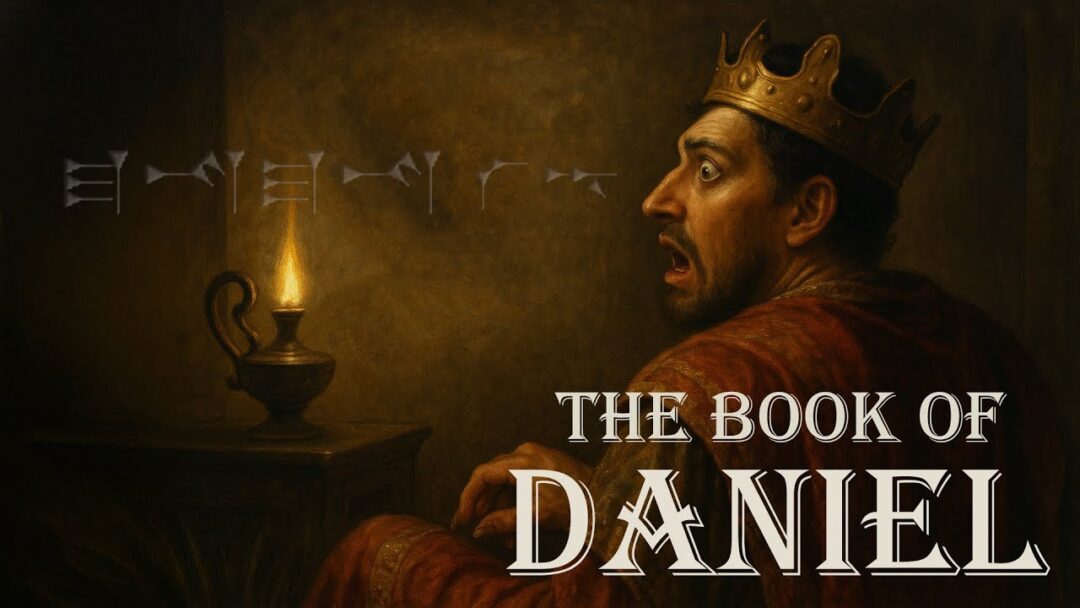
From our Sunday service on June 1, 2025, Daniel 5. This is part 5 of our Daniel series. Watch the full message: Writing on the Wall – Daniel Series #5 on YouTube.
This story jumps two decades from where we left off, to the year 539 BC. Today we will look at the life of Belshazzar to learn this lesson: God wants you to reverence Him.
What Happened in the Gap
A lot of time has passed between those two chapters. In 562 BC King Nebuchadnezzar II died, and his son, Evil-Merodach, took the throne. The Bible tells us that this new king released Jehoiachin, the king of Judah, in his thirty-seventh year of captivity, in the first year of his reign. We have Babylonian tablets that record his release happening at the same time the Bible says. Some things we take by faith, but other things are backed up by archaeology, and that is one of them. Evil-Merodach did not last long. Two years into his rule he was murdered. In 560 BC Neriglissar killed him and took the throne, then married Nebuchadnezzar II’s daughter to solidify his right to it. His kingship lasted only four years, and his son, Labashi-Marduk, took over in 556. Within weeks or months, he too was overthrown and murdered. In 556 Nabonidus, another outsider to the royal family, came quickly to the throne. A stele of Nabonidus has him saying he is the real executor of the wills of Nebuchadnezzar and Neriglissar, his royal predecessors, so he does claim some kind of political continuation from Nebuchadnezzar. In my studies I am almost 100 percent certain that the king in the last chapter was Nebuchadnezzar II, based on the way Nabonidus talks in his own writings. He does not sound like the king in the Bible at all, but Nebuchadnezzar II sounds a lot like how he wrote in his own writings.
So who is Belshazzar? He was the acting king of Babylon, the son of Nabonidus and the grandson of Nebuchadnezzar. Very shortly after his reign began, Nabonidus went into a self-imposed exile at Tayma, an Arabian oasis, from at least the fourth year to the thirteenth year of his reign. He originally went to start a war against Arabia, but when he conquered the city of Tayma, he never came back. From the Babylonian Chronicles we see that Nabonidus left the kingship to Belshazzar. Once again, archaeology had not found it out yet, and the Bible was right. Belshazzar was the acting king of Babylon. For a long time critics said Belshazzar was not a real king, because the records they had named Nabonidus. Then the chronicles showed that the father had left the throne in the son’s hands, and the Scripture already had him right where he was, ruling in the city the night it fell.
The Feast
Belshazzar the king made a great feast to a thousand of his lords, and drank wine before the thousand. The city has walls too big to assault head-on, food to last for years, and a river running through the center, so there is no shortage of fresh water. Regardless, this is a weird time to throw a party. Your people are fighting and dying on the battlefield, and you are sitting in your castle drinking wine. “Whiles he tasted the wine” implies he was not in his right mind. In his drunken state a bad idea sounded good to him. He says he wants the gold and silver vessels that his father took. The word for grandfather and father is the same in Aramaic, which does not have separate words for them. They bring the golden vessels that were taken out of the temple in Jerusalem, and the king, his princes, his wives, and his concubines drink in them. They drink wine, and praise the gods of gold, and of silver, of brass, of iron, of wood, and of stone. That is the opposite of reverence. He takes what was dedicated to the living God and uses it to honor idols, as if the Most High were just another name on a list.
The Hand Appears
As quickly as Belshazzar blasphemed, God showed up to set him straight. “In the same hour” is an idiom meaning at that very moment. Fingers of a man’s hand write over against the candlestick upon the plaister of the wall. In artistic recreations we usually see a giant hand, but I do not think that is what happens. If it were a giant hand, the text would have said so. It implies a normal, human-sized hand floating there and writing. The king’s countenance is changed, his thoughts trouble him, the joints of his loins are loosed, and his knees smite one against another. He cries for the astrologers, the Chaldeans, and the soothsayers, and offers scarlet, a chain of gold, and that the interpreter be the third ruler in the kingdom. The word “scarlet” should be understood as purple. The language uses the same word for purple and red. He is talking about a purple garment, a royal one, with a gold chain, a necklace. We are going to make you look royal, and we are going to give you the power to go with it. But they cannot read the writing, nor make known the interpretation.
The Queen Speaks
The queen comes into the banquet house. She is not one of the wives already at the feast. She has to come in, and she remembers what the frightened court has forgotten. She tells him not to let his thoughts trouble him. There is a man in the kingdom in whom is the spirit of the holy gods, whom Nebuchadnezzar made master of the magicians, a man named Daniel, whom the king named Belteshazzar. Let Daniel be called. So Daniel is brought in. Then Daniel answered and said before the king, Let thy gifts be to thyself, and give thy rewards to another. He will not be bought with gifts. He is saying, You can offer me the third position in the kingdom, but by tonight it will be lost, because things are about to get messy. Someone is coming to take the authority he is offering. He reminds Belshazzar of what happened to Nebuchadnezzar, how his heart was lifted up, how he was deposed and driven from men, until he knew that the most high God ruled in the kingdom of men. And thou his son, O Belshazzar, hast not humbled thine heart, though thou knewest all this. Belshazzar has not learned from another man’s discipline. The warning is simple: when you ignore learning from God’s discipline in the lives of others, you set yourself up to learn it the hard way. Nebuchadnezzar had been driven out like a beast and then restored when he looked up. Belshazzar knew that story and still used the temple vessels as party cups. Knowledge without reverence only adds to the guilt.
The Writing Explained
And this is the writing that was written, MENE, MENE, TEKEL, UPHARSIN. This is the interpretation of the thing: MENE; God hath numbered thy kingdom, and finished it. TEKEL; Thou art weighed in the balances, and art found wanting. PERES; Thy kingdom is divided, and given to the Medes and Persians.
Daniel 5:25–28
The writing would have been in Aramaic, the formal language Belshazzar spoke and wrote. So why could nobody understand it? For one thing, it was written in incomplete grammar. All the words are nouns: mene, mene, tekel, upharsin. Translated literally, they mean “number, number, weight, divide.” People were unsure what that meant. Daniel explains it as a direct response to the king. God has numbered the kingdom and finished it. Belshazzar has been weighed in the balances and found wanting. The kingdom is divided and given to the Medes and Persians. The warning had already been lived out in his grandfather’s lifetime, and Belshazzar knew it and still would not humble his heart. That is why the writing comes as a finished sentence, not a second chance.
In that night was Belshazzar the king of the Chaldeans slain. And Darius the Median took the kingdom, being about threescore and two years old.
Daniel 5:30–31
We are told all of this in only two verses, so let us look at history. Daniel read the writing, was rewarded, and was given his kingly coat and necklace. But as Daniel walked away, the Euphrates River was slowly getting lower and lower. The walls of Babylon were too big to assault head-on, and the city had food and water that could last for years. But the water supply would become the city’s weakness. The Euphrates divided the city into two parts. To invade, the Persians began digging trenches to divert the river, and that very night they came in under the walls. Babylon falls, and the kingdom passes to the Medes and Persians. Belshazzar had more light than he used. He had his grandfather’s story, the temple vessels in his own treasuries, a city that still stood only because God had not yet finished the sentence, and a prophet still living in the kingdom who could have been asked before the feast ever started. He waited until the hand was on the wall, and by then the kingdom was already numbered, weighed, and divided. Reverence would have looked like humility while there was still time. God wants you to reverence Him. The hand does not have to reach your wall if the warning has already reached your ears. Will you learn from the warnings He has already given, or will you wait until the writing is on the wall?
Recent Comments