
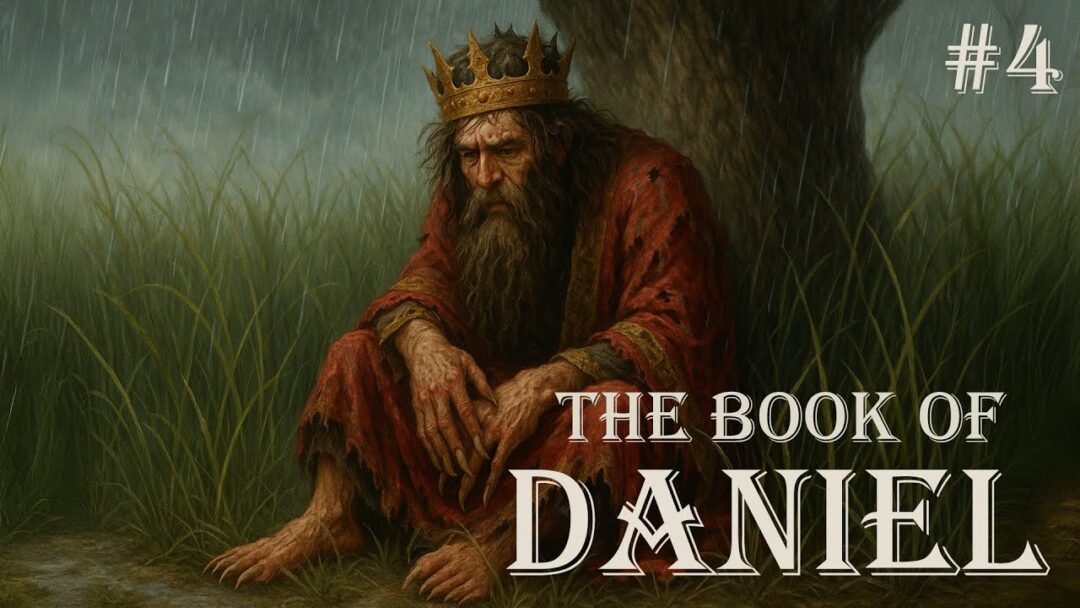
From our Sunday service on May 25, 2025, Daniel 4. This is part 4 of our Daniel series. Watch the full message: Nebuchadnezzar Speaks – Daniel Series #4 on YouTube.
Today we are in Daniel chapter 4, the vision of the great tree. I really wish I could come up with a better title for this lesson, because that one tells you nothing about it. Alternatively, I entitled this message “Nebuchadnezzar Speaks.” We left off with Daniel’s three friends facing the dangers of the fiery furnace. This week we pick up Daniel’s story in a very unique passage of Scripture. The lesson we want to take away is that God wants you to be humble so He can lift you up in His time.
A Pagan King Writes Scripture
What is really unique is that this passage was not recorded by a prophet, a priest, or even someone who believes God is the true God. It was written by the pagan king Nebuchadnezzar himself. That sets it apart from most of Scripture, which is usually written by a believer. Today we get someone who does not believe God is the one God writing inspired Scripture. I believe the Bible is the inspired word of God. I believe Daniel 4 is inspired, and that if God wants to work through a pagan king to write inspired Scripture, He can do so. But we have to be careful, because inspired does not always mean factually correct. God inspired Nebuchadnezzar to record an accurate account of the events that happened. That does not mean God endorses all the events that occur, or that everything Nebuchadnezzar says about God is right.
What Do History and Archaeology Say?
If you talk with an atheist, they may bring up an accusation against the Bible: that it gets wrong who this king is, because the events of Daniel 4 did not happen to Nebuchadnezzar. Historians argue about two understandings. Either the king was Nabonidus, or he was Nebuchadnezzar II. Among the Dead Sea Scrolls, alongside the Hebrew Scriptures, there were also some other fragments of stories. One of those separate accounts records a king of Babylon named Nabonidus, the last king of Babylon, who had a very similar experience. He received an ailment from God, Daniel was there to help him, and there was a seven-year period when Nabonidus was insane. Nabonidus and Nebuchadnezzar have very similar names in Aramaic and may have been transliterated the same way at certain points in history. Herodotus, a Greek historian who traveled to Babylon about 90 years after Nebuchadnezzar’s reign, referred to both Nebuchadnezzar II and Nabonidus by the same name, Labynetus. Nabonidus’s son was named Belshazzar. Nabonidus also married Nebuchadnezzar II’s daughter, and there is an archaeological record that says Nabonidus suffered a mental illness in the wilderness of Teima for seven years. Even so, this chapter presents the testimony as Nebuchadnezzar’s, and that is how we will take it.
The Great Tree
The king has a dream that terrifies him, and the magicians cannot make it known. At last Daniel comes in. The king has seen a tree in the midst of the earth, whose height reaches unto heaven. The leaves are fair, the fruit much, and all flesh is fed of it. Then a watcher, a holy one, comes down from heaven and cries, Hew down the tree, cut off his branches, shake off his leaves, and scatter his fruit. Leave the stump of his roots in the earth, in the tender grass, and let his portion be with the beasts, and let his heart be changed from a man’s, and let a beast’s heart be given unto him, and let seven times pass over him. Based on how the word is used in Ezekiel, it is probably a cedar tree. The intent is that the living may know that the most High ruleth in the kingdom of men, and giveth it to whomsoever He will.
The book of Enoch is not Scripture and should not be taken as Scripture. In the 400 years of silence after Malachi, people started writing books trying to fill in the gaps of the old stories. They took this unexplained term “watcher” from Daniel and wrote a story about what the watchers were. We do not need that. We need what the text says.
"It Is Thou, O King"
Then Daniel, whose name was Belteshazzar, was astonied for one hour, and his thoughts troubled him. The king tells him not to let the dream trouble him. Daniel answers, My lord, the dream be to them that hate thee, and the interpretation thereof to thine enemies. Then he says, The tree that thou sawest, it is thou, O king. The king has grown great, but he is going to be driven from men, and his dwelling will be with the beasts, until he knows that the most High rules. But the stump is left. The kingdom will be sure unto him after he has learned that the heavens do rule. God is not done with him. The tree is cut down, but the roots remain, because the goal is not merely to destroy a proud king. The goal is that he would know that the most High rules, and that after he knows it, the kingdom can be restored. Mercy is already built into the judgment. Daniel begs him to learn the lesson the easy way: break off thy sins by righteousness, and thine iniquities by shewing mercy to the poor. This gives us a little glimpse into what God was so angry about. It seems Nebuchadnezzar was hoarding wealth for himself. Remember that in Babylon they coated so much in gold and built so much. Nebuchadnezzar was putting all this money into making his kingdom fancier, more spectacular, and more magnificent. It is said that his rooftop walking place was like six miles long, six miles of walls to walk on at night. Daniel is saying, Replace your injustice. Take all this money you are hoarding to make yourself look good and take care of the people in your nation who are suffering. And if he does, maybe God will have mercy on him and this judgment will not come upon him.
A Year to Repent, and the King Looks Up
Twelve months later, the king is walking in the palace.
The king spake, and said, Is not this great Babylon, that I have built for the house of the kingdom by the might of my power, and for the honour of my majesty? While the word was in the king’s mouth, there fell a voice from heaven, saying, O king Nebuchadnezzar, to thee it is spoken; The kingdom is departed from thee. And they shall drive thee from men, and thy dwelling shall be with the beasts of the field: they shall make thee to eat grass as oxen, and seven times shall pass over thee, until thou know that the most High ruleth in the kingdom of men, and giveth it to whomsoever he will.
Daniel 4:30–32
I built it all by my power, my authority, and my strength, for my glory and my majesty. What he did not know is that the year had passed and his time was up. He tripped the switch. While the word is in the king’s mouth, a voice from heaven falls, and the thing is fulfilled. As time passed his hair would grow matted and interwoven, like feathers on an eagle. His fingernails would go uncut and grow long and curl. Because people were so afraid to be around him, he was left out in the wilderness, in the cold and the wet, as a mad, insane individual. At the end of the days, Nebuchadnezzar lifts up his eyes unto heaven, and his understanding returns, and he blesses the most High. The turning point is not that he got his throne back first. The turning point is that he looked up. He finally acknowledged that heaven rules, and only then did his understanding return. His reason came back when his pride went down. Looking up is the first sane act in the whole collapse. The most powerful man in the world got his mind back only when he finally admitted he was not the most high. He is established in his kingdom again. Christians are called to walk in humility before God, knowing that all authority, opportunity, and ability comes from Him. When we understand our place before God, our hearts will be moved to worship Him, and our lives will become testimonies of His goodness and grace. In the end, Nebuchadnezzar learned the hard way that what Daniel tried to tell him from the beginning was true. God is the only one who rules over the kingdom of men. God is patient with us, but He is also just. He will give us warnings and offer opportunities to humble ourselves and repent, but He does not allow arrogance to go unchecked forever. The stump was left, and the kingdom was returned, but only after the king looked up. That is the pattern. God can empty a proud life all the way to the ground, and He can also restore what He has cut down, but He will not share His glory with a man who says, I built this by the might of my power. Humble yourself under His hand, and in due time He can lift you up. God wants you to be humble so He can lift you up in His time. Will you humble yourself now, or will you wait until God has to bring you low?
Recent Comments