
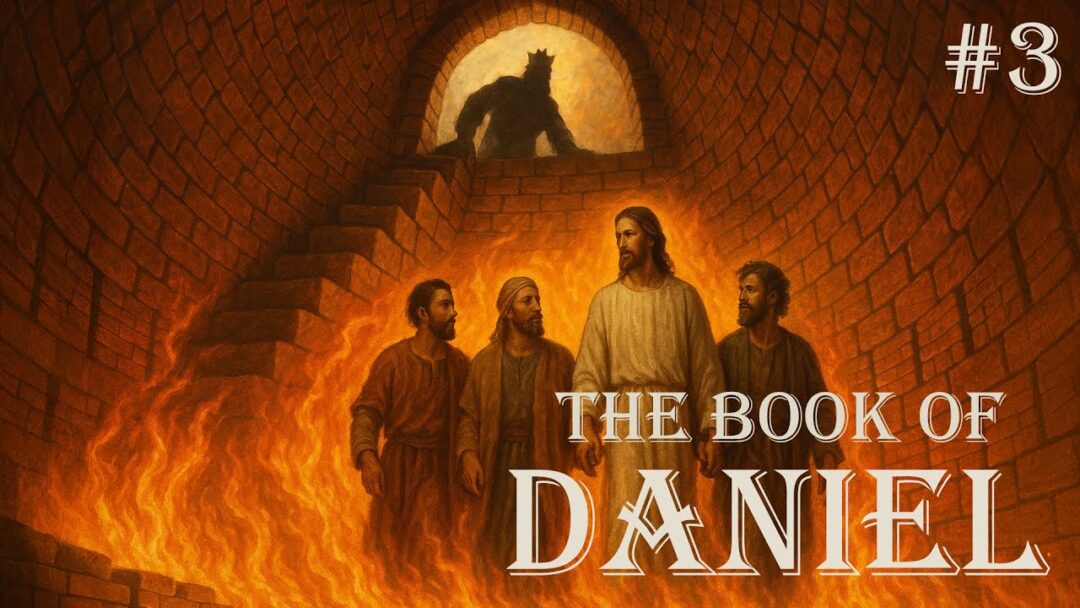
From our Sunday service on May 18, 2025, Daniel 3. This is part 3 of our Daniel series. Watch the full message: Faith in the Fire – Daniel Series #3 on YouTube.
Last time Daniel had just saved the wise men of Babylon and been promoted to overseer of the whole province, with Shadrach, Meshach and Abednego promoted to lesser positions alongside him. Through prayer they had interpreted King Nebuchadnezzar’s dream. This passage, though, is not about Daniel. It is about those three friends as they face their next challenge in this pagan city. In our first lesson Jeremiah encouraged the people in exile to remain faithful to God no matter what. The main lesson we want to take from this story is that God wants you to keep your faith even through the difficulties of life.
A Giant Golden Image
Nebuchadnezzar has made a golden statue about 90 feet tall and 9 feet wide, roughly the height of a nine-story building. Those measurements are a 10 to 1 aspect ratio, so a humanoid figure is very unlikely. What we are more likely looking at is something like an Egyptian obelisk coated in gold. A document in the British Museum tells of him making many gold-covered statues, including a statue of the god Nabu and a giant bronze bull, and even trees coated in gold for pillars. Here he makes a pillar-shaped statue, covers it in gold, and probably puts inscriptions on it to Marduk or Nabu or Aku. This statue was too big to roll through the streets, so he sets it up and calls his officials to dedicate it.
The Command and the Furnace
A herald cries that this command applies to people, nations and languages, whether you are a Jew, a Persian, a Babylonian or a Chaldean. Every single person is required to worship this statue when the music sounds, from horns and lyres even to bagpipes. Whoever does not fall down and worship will at that hour, literally at that moment in the Aramaic, be thrown into a burning fiery furnace. Throughout Babylon he had many brick-burning kilns, not a furnace that heats a house. He was repairing Etemenanki, a giant ziggurat, and it is estimated that during his reign he produced over 15 million bricks, so these furnaces ran at full power. They burned at roughly 1,832 degrees Fahrenheit, hot enough to melt aluminum and silver, though not quite hot enough to melt iron or gold.
"But If Not"
Some of those Chaldean rulers had been displaced by familiar Jews. Upon Daniel’s recommendation, these three had taken positions the Chaldeans held, and the Chaldeans knew they were faithful followers of Yahweh who had refused meat from the king’s table. In the Aramaic, “accused the Jews” literally means “ate pieces of them.” These three are not going to bow to a pagan idol, but most of the other Jews who were there likely did, because their lives were not worth risking. Daniel is not mentioned here. Somebody proposed that the statue was erected in Daniel’s honor, which would explain why he was not asked to bow to it, but I do not know if there is credence to that. These three were the third in command under Daniel, and the king is going to be angry at that insubordination.
Yet he is not unreasonable. He does not just believe the accusation. He asks them whether it is true, and he gives them a chance to make it right. He will play the music again, and if they worship this time, he will forget the whole thing happened. But if they do not, he will throw them in one of his brick kilns. Then he makes a slam at their God, and it is the real theme of the chapter: “Who is that God that shall deliver you out of my hands?” The word in Aramaic carries the idea of liberating or freeing you.
Shadrach, Meshach, and Abed-nego, answered and said to the king, O Nebuchadnezzar, we are not careful to answer thee in this matter. If it be so, our God whom we serve is able to deliver us from the burning fiery furnace, and he will deliver us out of thine hand, O king. But if not, be it known unto thee, O king, that we will not serve thy gods, nor worship the golden image which thou hast set up.
Daniel 3:16–18
They respond pretty bluntly. “We do not need to answer you, king.” But they explain why: even if you throw us in the furnace, our God can save us. If you do it, you will see it for yourself. They do not presume God is going to do it. “But if not, we want you to know that even if our God does not save us, we will not worship your gods. Take out your cuneiform tablet and write it down.” They were saying, “I do not need to answer, because God will answer.” This reminds me of Job, who said:
Though he slay me, yet will I trust in him: but I will maintain mine own ways before him.
Job 13:15
It is the importance of saying that even if God decides to let me be a martyr for His sake, I will still be okay with that. It also reminds me of Hebrews 11. We see that hall of faith of successful people, but then at the end of that list it talks about those who were sawn asunder. Not all of them got a happy ending, and yet they were faithful to God. A lot of times we like to say God’s going to save Shadrach, Meshach and Abednego. But God does not always save. Sometimes He allows His servants to die for a greater cause. Here the three surrender to that fact: He can save us, and if He does not, we have still done our part.
The Fourth Man
Nebuchadnezzar’s attitude changed when they said, in effect, my God is bigger than you, king. “Seven times hotter” does not mean they measured temperature. They had no way to. It means seven times more charcoal or wood, as hot and torturous as humanly possible. He has his strongest men tie them up as tightly as possible, and he does not even take their clothes off, because he wants them to burn and feel pain as quickly as possible. Because the furnace was exceedingly hot, the flame slew the men who took them up. The guards climb to the opening at the top, but they die immediately from the heat, and instead of throwing the three in, they kind of tumble in as the guards die.
Then Nebuchadnezzar the king was astonied, and rose up in haste, and spake, and said unto his counsellors, Did not we cast three men bound into the midst of the fire? They answered and said unto the king, True, O king. He answered and said, Lo, I see four men loose, walking in the midst of the fire, and they have no hurt; and the form of the fourth is like the Son of God.
Daniel 3:24–25
Notice that key word “loose.” When they go into the fire, the things that bound them burn off, and they walk freely in their time of trial. In modern translations you will see “a son of the gods.” That is because this is an Aramaic passage, and “a son of the gods” is supposed to be understood as a reference to Jesus Christ, God the Son. You see a similar idiom in Judges, where “the sons of Benjamin” is understood as meaning he is a Benjamite. Knowing that the God of Israel has a Son, we know that is Jesus Christ. In their trial, Jesus Christ comes before His birth, as God the Son, and walks with them in the fire. The angel of the Lord is with them. The fire did not harm them. It only freed them from the bonds that held them, and they walk out. What was meant as a punishment to destroy them was used to liberate them.
What the Fire Does
God can use the difficulties of our lives to liberate us from the things that restrain us and hold us back. Sometimes God will allow us to go through hardship so He can burn away the sinful habits that tie us down and stop our spiritual growth. God could have told Nebuchadnezzar not to throw His people into the furnace, or had the angel of the Lord come before him with a flaming sword. But that is not what God did. God allowed them to walk slowly toward that kiln. God does not free us from every difficulty of life, but He will use those difficulties, and as we saw with Jesus in the fire, He will be with us through them.
Even at a thousand-plus degrees their God was still able to save them. He is a polytheist who believes in hundreds of gods, and at this point he is not going to say that Adonai, Yahweh, the Most High, is the only God. But he does say this God is definitely superior to the gods he worships, because his gods were not able to challenge him in this impossible task. His new decree is that anyone who speaks against their God will be cut in pieces and have their house made a dunghill, a trademark Nebuchadnezzar punishment. In the previous chapter the advisers said that the gods do not interact with man. For Nebuchadnezzar this would have been groundbreaking. There is a God in Israel who does not just talk through the stars but actually walked in the fire with His people. He announces God’s ability to deliver, and they are promoted for their faith.
Every trial we face in this life is an opportunity to grow in the Lord. When we go through trials, there are things we lose, and we find that God is really what we need. When that next trial comes, will you choose to be faithful like Shadrach, Meshach and Abednego? Will you say, “Whether or not God spares me from this hardship, I will trust Him”? Next time you face hardship, choose to say, “No matter what happens, I will trust my God.” God wants you to keep your faith even through the difficulties of life. So will you choose to keep that faith today?
Recent Comments