
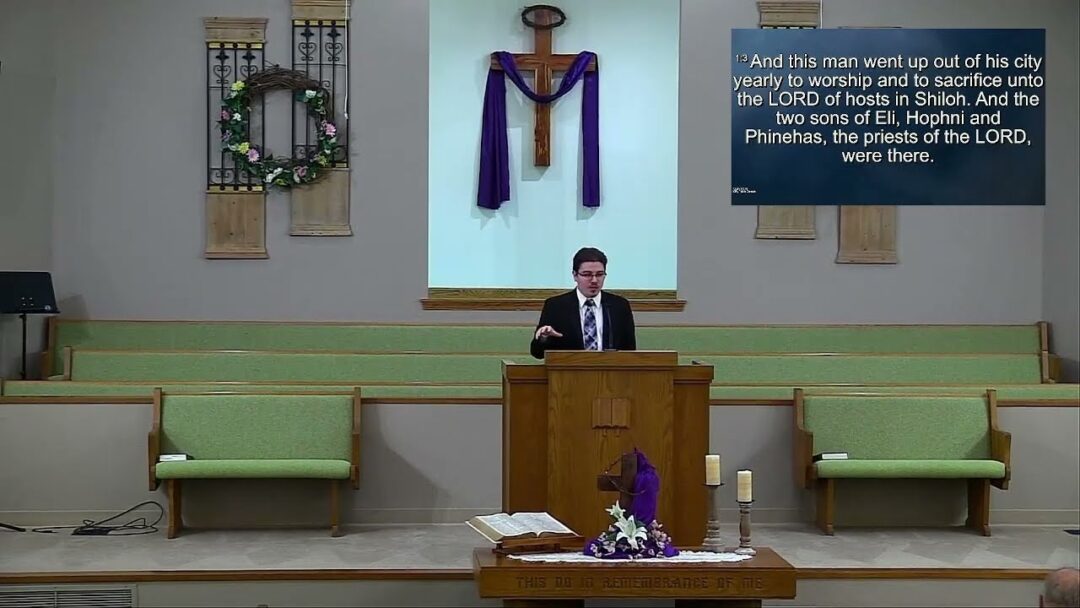
From our Mother’s Day service on May 11, 2025, 1 Samuel 1. Watch the full message: A Mother’s Prayer – 1 Samuel 1 on YouTube.
On Mother’s Day we thank the Lord for the mothers and grandmothers in our lives. This story takes place at the end of the book of Judges, right before King David, where we meet the origin of the prophet and judge Samuel. The religious leadership at the tabernacle was corrupt. Eli was the high priest, but he is not really engaged with his ministry. We meet a young woman who is barren. She goes to prayer and uses her relationship with God to get close to Him and pray for a child. Our proposition is that God wants spiritual leaders who will pour out their hearts to Him in faith.
A Faithful Man With a Broken Family
We meet our three main characters in the city of Ramah. Elkanah’s name means “purchased by God.” If you are given that name, your parents took God pretty seriously. It talks about how He forgives our sin and buys us back. During the time of the Judges there was a lot of idolatry, and you could not assume that the average person grew up in a God-honoring home. But Elkanah did. He lived in Mount Ephraim, but he came from the Levite line. He himself was not a priest, but that came with a responsibility to be loyal to God, and he followed the law.
Unfortunately, this man so dedicated to God made the mistake of taking two wives. You will never find a place in Scripture that praises polygamy. It always points out the tension, conflict and heartache. Hannah’s name means “grace.” Peninnah’s name means “jewel,” which is appropriate for the way she sees herself. Hannah is supposedly the first wife, and it seems Elkanah took a second wife because she was unable to conceive. Wanting to follow God’s will, he ignored God’s design for marriage, the same mistake Abraham made with Sarah and Hagar.
Elkanah went every year to Shiloh to offer sacrifices, about a half day’s journey, like three times a year. Who is in charge of worship at Shiloh? Eli, and his two sons, Hophni and Phinehas. They were running amok in the tabernacle. They are known for stealing sacrifices and for improper relationships with the women who served at the front of the tabernacle. Part of an offering was burned to God, and part was given back to the family as a picture of communion with God. Hophni and Phinehas, under threat, took the food that belonged to the family. Elkanah makes a faithful pilgrimage despite the leadership. God never fails.
"Am I Not Enough?"
In my wife’s culture in Brazil, when you cut a cake, you give the first piece to the person who means the most to you. In Jewish culture you give the largest portion to the person who means the most to you. So Elkanah gives Peninnah and her children a portion, but to Hannah he gives the largest. He’s saying he loves her the most, and that’s going to make people jealous. Peninnah, “her adversary,” harassed her and provoked her sore, because the Lord had shut up her womb. Hannah wept, and she did not eat. This was supposed to be communion with God, and Peninnah ruins it for Hannah.
The husband speaks up, and man, does he not have the right thing to say. “Why are you crying, Hannah? Am I not better to you than ten sons? Am I not enough?” Men, never use the phrase “Am I not enough?” as an attempt to encourage your wife. A loving marriage does not negate the hardship of infertility, or the loss of a child or a family member. Be compassionate. Listen, but don’t pretend to have the solution. Even the most loving marriage cannot fulfill every longing of the soul alone. He means well, but he misses the point of her sorrow.
Hannah Pours Out Her Heart
The other wife is abusive, and her husband is disengaged from the problem. After the meal Hannah runs to the temple. She walks past Eli, sitting by the post, and prays a promise: “God, if you will see me in my suffering and give me a child, then I will give that child back to you.” She makes a Nazarite vow by saying no razor shall come upon his head. A Nazarite was not allowed to drink wine or grape juice, never to cut their hair and never to touch a dead body. So she says the child will be dedicated to God for all the days of his life.
Eli is a very passive, hands-off kind of person. The reason his sons are such a mess is that he was clearly a passive parent. He didn’t deal with the rampant corruption of his own sons. He just said, “God will deal with it.” Instead of having the discernment of a judge and high priest and realizing she’s praying to God, he assumes she’s a drunken babbler. So he says, “Woman, what are you doing? Put your wine away.” He lashes out in a judgmental tone, with a condescending attitude full of prejudice, and talks down to her like everybody else.
And Hannah answered and said, No, my lord, I am a woman of a sorrowful spirit: I have drunken neither wine nor strong drink, but have poured out my soul before the LORD. Count not thine handmaid for a daughter of Belial: for out of the abundance of my complaint and grief have I spoken hitherto.
1 Samuel 1:15–16
She answers respectfully: “No, my lord. I’m not drunk. I’m sorrowful. I’m pouring out my spirit before the Lord.” “A daughter of Belial” means a child of worthlessness. Prayer is not a flowery public show. Hannah doesn’t even pray out loud. She prays silently, weeping, because what God values is a sincere heart. Jesus Himself was accused of being crazy, a drunk and demon-possessed because of the way He interacted with God. Despite Eli’s lack of spiritual discernment, God still uses him as His messenger. We don’t have to be perfect to be used by God. Hannah still doesn’t have a child, but she has faith in the promises of God, so she eats and leaves in joy.
Keeping the Vow
In God’s perfect time, He opens Hannah’s womb and she conceives and delivers a child whom she calls Samuel. The name Samuel means “God has listened.” She wants Samuel’s testimony to be so clear that it’s the very name he holds.
And they rose up in the morning early, and worshipped before the LORD, and returned, and came to their house to Ramah: and Elkanah knew Hannah his wife; and the LORD remembered her. Wherefore it came to pass, when the time was come about after Hannah had conceived, that she bare a son, and called his name Samuel, saying, Because I have asked him of the LORD.
1 Samuel 1:19–20
Year after year Elkanah continues to go to Shiloh, but Hannah stays back to take care of Samuel. It was only required that the man of the household go to offer sacrifices. Now she chooses to stay home because she doesn’t want to offer anything to the Lord until she has fulfilled her promise to Him. We should make sure we aren’t worshiping God with our lips while avoiding surrendering our lives to His purposes. Elkanah agrees and adds, “The Lord establish his word.” So she stays and raises this child, probably until the age of about four.
When the child is old enough to live without his mother, she goes to fulfill her promise. Samuel is not going to learn about following God from Eli, or from Hophni and Phinehas. He is the most faithful judge of all the judges, the last judge before King David, and he will anoint King David against the will of the king of Israel. I imagine he learned those traits from those four years with his mother. When the time came, she brought three bullocks, for a burnt offering, a sin offering, and a peace offering that was not required, along with flour and wine. “Lent” here is the idea of surrendering something.
Give your children over to God. When I was growing up, I heard parents say, “I’ll never give my children to the mission field. I need to keep them near me.” Hannah had the same dilemma. She knew what those priests were doing. But she said, “I need to have faith in God that He will take care of my child if I give him to Him.” Then we see something very beautiful: “And he worshipped the LORD there.” Samuel worships God on his own for the first time, as a young boy of about four or four and a half. A mother’s duty is not done until her child knows the Lord. It was Samuel’s God.
We don’t have time to look at all of Hannah’s song today, but in the next chapter she pours out her heart in prayer to God, the way Daniel did when his prayer was answered. She says her heart rejoices in the Lord. There’s no one like Him, no one who listens like He does. He brings down the mighty, brings bread to the poor and lifts up all who need Him. But I think the most beautiful verse is verse 10 of chapter 2:
The adversaries of the LORD shall be broken to pieces; out of heaven shall he thunder upon them: the LORD shall judge the ends of the earth; and he shall give strength unto his king, and exalt the horn of his anointed.
1 Samuel 2:10
Here Hannah speaks a little about the coming Messiah. She talks about how the Lord’s anointed will come and this king will give strength. Hannah exemplifies a faithful follower in every aspect of her life. Where the spiritual leaders failed, Hannah excelled. As the years went by, she would visit Samuel and bring him a new coat each time. Eventually God would bless Hannah with three more boys and two girls. Samuel would remain faithful to his calling, just like his mother. God wants spiritual leaders who will pour out their hearts to Him in faith. So will you choose to be a spiritual leader today?
Recent Comments