
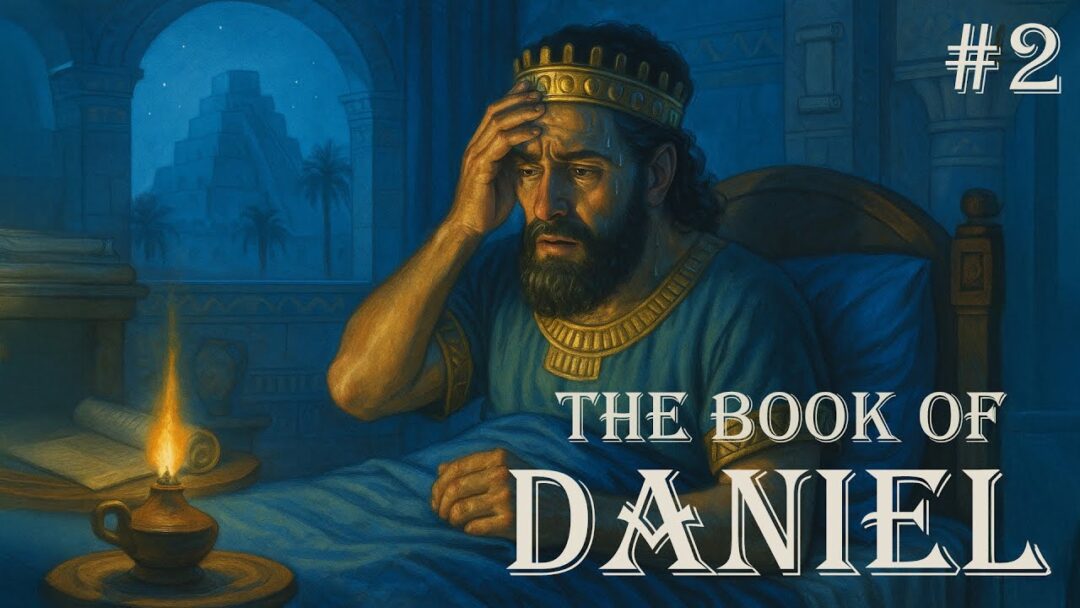
From our Sunday service on May 4, 2025, Daniel 2. This is part 2 of our Daniel series. Watch the full message: The Revealer of Secrets – Daniel Series #2 on YouTube.
Daniel chapter 2 is one I’m very excited to do, because this is where you start to get into the prophecy part of Daniel. Last time we left Daniel standing up for himself and his friends, Hananiah, Mishael and Azariah, as they were taken from their family as captives of war. So what I want you to take away today is that God wants you to respond to crises with faith, humility, and wisdom.
A Dream That Won't Let Go
We’re immediately introduced to the issue. Nebuchadnezzar is deeply disturbed by something he can’t understand. A frightening image appeared to him in the middle of his dream, and the thought of it now pounds constantly in his mind like the beating of a heart. The word “troubled” is literally the Hebrew word used for a heartbeat. I’ve had times when something bothered me like that. Like the Pharaoh in Genesis, he knows there is something important to learn from the dream, but the wisdom to understand it escapes him, and this existential dread keeps him from sleep.
Now he calls his pagan advisers, four categories of them. The magicians were some kind of scribe who practiced divination, something like a fortune teller with tarot cards or palm reading. The astrologers, or conjurers, claimed to commune with the dead. The sorcerers: the Greek translation of the Old Testament uses the word that gives us “pharmacy.” These people mixed elixirs, what we’d today call psychedelic drugs, to create an experience that might reveal truth. And the Chaldeans were an ethnic group of wise men, the wise men of all wise men. The king is desperate. It’s all hands on deck.
An Impossible Demand
The Chaldeans spoke to the king in Aramaic, which the King James calls “Syriack.” They say, “O king, live for ever. Tell us the dream, and then we will tell you the interpretation.” “The thing is gone from me” means that what he’s about to say is an unbreakable law. “Cut in pieces” in Aramaic means you will be a pile of limbs, and your houses will be made a dunghill. He says, in effect, “I want this to be impossible, because if I get an answer, I want to know with 100 percent certainty what the dream means.”
The advisers say they need to know the dream, and he goes, “No, I knew this was going to happen. You’re trying to buy time.” If they really could do what they claimed, getting the information should be no problem. “If you can’t figure out what the dream is, how in the world are you supposed to tell me what it means? You’re lying, and if you’re lying now, you’ve probably been lying to me all along.”
The Chaldeans answered before the king, and said, There is not a man upon the earth that can shew the king’s matter: therefore there is no king, lord, nor ruler, that asked such things at any magician, or astrologer, or Chaldean. And it is a rare thing that the king requireth, and there is none other that can shew it before the king, except the gods, whose dwelling is not with flesh.
Daniel 2:10–11
Now the advisers know that, as the kids would say, they’re cooked. They panic. Their final excuse is that no one knows except the gods, and the gods don’t interact with humanity. That’s a theological statement: the gods don’t care about us and don’t communicate with us. Rather than give them time, he immediately calls for the execution of all of Babylon’s wise men. He stamped his name into his bricks and even onto projects he didn’t finish, including work on Etemenanki and the Ishtar Gate. So when somebody tells him something can’t be done, his anger comes out.
Daniel Answers With Counsel and Wisdom
How do we fight egomania? With counsel and wisdom, discernment and discretion. Daniel answered Arioch, the captain of the king’s guard, who had gone out to slay the wise men of Babylon. The word suggests Arioch was a kind of butcher and executioner. Instead of running away, Daniel goes to the very man whose job it is to put him to death. He asks the king for time, and says he’ll show the interpretation. Then he goes to his house and tells Hananiah, Mishael and Azariah: “Friends, let’s pray to the God of heaven that He would reveal this.”
Christian, you don’t have to face all your crises alone. You have brothers and sisters in Christ who can face them alongside you. We have a prayer list in our church. You can send your needs to the prayer list, and people in this church will pray with you. Daniel knew that the prayer of a righteous man accomplishes much, so how much more will be accomplished when four people pray together? Unlike the king, who responds in anger, Daniel responds with wisdom and tact. He embodies the principle of Proverbs 15:1:
A soft answer turneth away wrath: but grievous words stir up anger.
Proverbs 15:1
Often we isolate ourselves in times of difficulty. We don’t want others to see our hardships, and to protect our reputation we push people away rather than calling them in to help. The Bible tells us the opposite. A threefold cord is not quickly broken. It’s important that we as a church build community, pray for each other and care for each other in our times of difficulty.
Praise Before Anything Else
God answers the prayer of Daniel and his friends with a vision in the middle of the night. What is Daniel’s first response? Not to go tell the king, and not to go tell his friends. He bursts into praise. He attributes all authority and wisdom to God, declaring that God is in control of everything: the times, the seasons, the kings and the kingdoms. He affirms God’s sovereignty over history. And in acknowledging that God gives wisdom to the wise, Daniel shows humility. When God answers a prayer, the proper response is to go back in prayer and thank God for what He did.
Daniel comes before the king with humility. I love how often the passage brings up that Daniel is going to his executioner. And I like that Arioch brought Daniel to the king “in haste.” In Aramaic that implies this man was waiting desperately for anyone to stop this. He has probably worked for Nebuchadnezzar for years and knows how crazy he can be. Daniel makes sure to say the answer comes from the God of heaven. When you do something with God’s help, make sure you give God the glory.
The Dream and the Interpretation
Daniel perfectly describes what happened in Nebuchadnezzar’s dream: an enormous statue made of metals of decreasing value from head to toe, smashed by a stone cut without human hands. When the stone hit the statue, it shattered into dust that blew away in the wind and was never found again, and then the stone covered the whole earth. “Terrible” carries the idea of existential dread. I don’t know how many of you watch the Marvel movies, but in Infinity War there’s a snap and people turn into dust. It actually comes from the Bible, because that’s the image that happens here.
Daniel says to Nebuchadnezzar, “Your kingdom is the head,” the gold, because God set him up to bring His people into exile. After him comes the silver kingdom, the Medo-Persian Empire led by Cyrus the Great, whom God would use to send His people home to rebuild the temple. Then came the bronze kingdom, the Greeks led by Alexander the Great, and Rome, the iron kingdom, led by Caesar Augustus. What follows I call the 4.5 kingdom, because the commentaries couldn’t agree on the numbering. The empire split into East and West, the two legs, and then into toes mixed of clay and iron. Hippolytus of Rome in AD 235 said the toes signify the democracies that would rise after Rome, and he wrote this before any of those democracies came about. Today nations work together, even in the United Nations, but they don’t cleave together. They’re still distinct.
God was going to raise up the Roman Empire so He could bring Jesus in the flesh to the world and spread the gospel to all the earth. Cyrus the Great, Alexander the Great, Caesar Augustus: all these leaders were ordained by God for a purpose. “In the days of these kings,” plural, means we’re in the last age. We have the last kingdom, which I’ll call kingdom number five, the kingdom of heaven. The kingdom of heaven is on earth now, but not in its full reality. The church operates as the kingdom of heaven. Jesus Himself says:
And he beheld them, and said, What is this then that is written, The stone which the builders rejected, the same is become the head of the corner? Whosoever shall fall upon that stone shall be broken; but on whomsoever it shall fall, it will grind him to powder.
Luke 20:17–18
What happened in Daniel’s vision? The stone struck the image and it turned to dust. Jesus says, “I am the uncut stone that brings about the kingdom of heaven.” It is not cut with human hands because Jesus Christ is not of human origin. He is uncreated, the ever-existing God and King, and one day He will come and bring His throne to the earth forever.
The Revealer of Secrets
“Worship” here doesn’t mean Nebuchadnezzar worshiped Daniel as a god. The word in Aramaic literally means to bow on your knee, and an oblation and sweet odors would be a gift of food and perfumes. The prideful king falls on his knees and acknowledges Daniel’s God as God of gods and Lord of kings. This shouldn’t be understood as a conversion statement. He’s not saying he’ll worship only God, but it is an important recognition of God’s divine authority. Just as Joseph rose to prominence in Egypt, Daniel is promoted, and he makes sure his friends who prayed with him are also honored. God wants you to respond to crises with faith, humility, and wisdom. So the question today is, how will you respond?
Recent Comments