
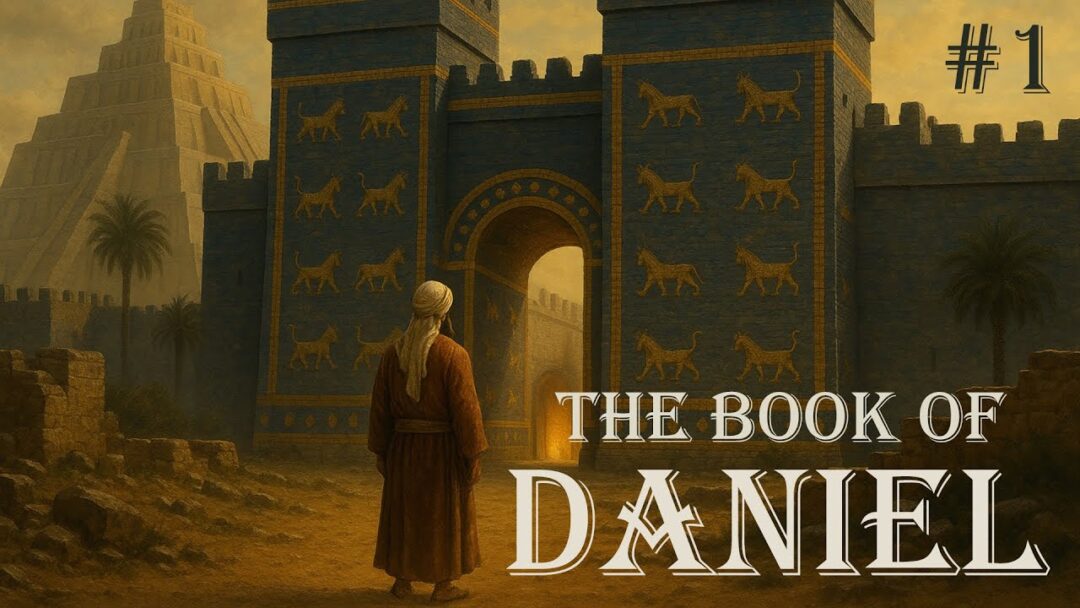
From our Sunday service on April 27, 2025, Daniel 1, with Jeremiah 25 and 29 and 2 Kings 24. This is part 1 of our Daniel series. Watch the full message: Undefiled – Daniel Series #1 on YouTube.
We’re starting a brand new series on the book of Daniel. Daniel has some prophecy in it about the end times, so we’ll get the story of Daniel, and at the end a little of that Revelation vibe. Instead of giving historic background first and then the lesson, today I’m going to let Scripture explain the background of Daniel, because the background is laid out clearly in the Bible. So we’ll start outside of Daniel and work our way there. The proposition for this first chapter is: God wants you to remain faithful despite life’s circumstances.
Why Israel Went Into Exile
Our first stop is Jeremiah 25, where Jeremiah gives a prophecy about the nation of Israel. “Hosts” means armies, so this is the Lord of armies speaking. Nebuchadnezzar is not part of Israel, yet God calls him “my servant.” God is going to use a pagan king. Scripture says the king’s heart is in the hand of the Lord. A ruler may be there as punishment for a nation or to bless it. Nebuchadnezzar stamped his name in the bricks, and sometimes he put his name on other people’s buildings. God says, “I’m going to use this man and his thirst for power to teach you something.”
Then God lists what He will take away. The voice of mirth and gladness: I’m going to make you sad for a while. The voice of the bridegroom and the bride: no more wedding parties in a foreign nation. The sound of the millstones, which is business: you won’t be grinding your own grain, and you’ll lose everything. The light of the candle: candles, really oil lamps, were very expensive in those days, and you won’t be able to afford the oil to stay up at night. It will last 70 years. So God says, “Nebuchadnezzar is coming, and he will take your nation.”
Nebuchadnezzar came to the gates of the cities of Judah, captured the king, and took thousands of Jewish people, the best the nation had to offer, and left the poorest of the poor to scrounge for themselves. This defeat was a slap in the face to what had become an empty religion. God allowed all the valuables of the temple to be carried away. The temple itself had become idolatry, because what they practiced in the temple didn’t match their lives. During this invasion the ark of the covenant disappears from history. “You followed the rituals and the outside behavior, but in your hearts you haven’t followed My law.”
Throughout the whole Bible, God’s attitude toward the temple was more “I will allow you to do this.” Jesus says Moses wrote the bill of divorcement because of the stubbornness of their hearts, and I deeply believe the temple was given for the same reason. Think of Jacob setting up a stone and pouring oil over it, a pagan practice God respected because Jacob didn’t know any better. The temple was a way for God to meet mankind in the middle, but over time it became a distraction. God says, “I don’t care about the temple the way you do, or how pretty the ephods look. I care about your heart. Since you’ve missed it, I’m going to take away your empty symbols of worship.”
God's Message to the Captives
But God doesn’t give up. In Jeremiah 29, this is what Daniel was told. Verses 5 and 6 are pretty simple: “You’re in captivity, but you need to live your lives.” You need to get married, have kids, raise them and teach them the ways of the Lord. Just because the present doesn’t look as good as the past doesn’t mean it’s time to give up. Verse 7 gives a huge challenge: pray for the Babylonians. Later in the book, Daniel will be arrested for praying, and if you know what Jeremiah told them to pray about, you know what he was doing. If you pray for the peace of your oppressors, you will have peace too.
For I know the thoughts that I think toward you, saith the LORD, thoughts of peace, and not of evil, to give you an expected end. Then shall ye call upon me, and ye shall go and pray unto me, and I will hearken unto you. And ye shall seek me, and find me, when ye shall search for me with all your heart.
Jeremiah 29:11–13
Then God says not to listen to the false prophets. They’ll say you can overthrow Babylon and come back. But God says, “I told you through Jeremiah, this is 70 years. Don’t fight. This is your time out in the corner to get right with God.” It looks like praying for your enemies, being content with what you have, and finding the best in any circumstance. And how do they return home? “Search for me with all your heart.” When you’ve discovered Me in your heart, then you will find hope and return home. And that’s how we get to the book of Daniel.
New Names, Same Identity
This is the same story we read in 2 Kings. These people were taken into Babylonia, the best Israel had to offer, and the items from the temple were taken into the house of Nebuchadnezzar’s god, Bel. Bel and Baal are sometimes thought to be the same god, but they’re not. Bel is a short form of Baal, and in this Eastern culture Baal was used for both the Babylonian god and the Canaanite god. They’re both storm gods with similar etymologies, but Bel should be understood as Marduk, the Babylonian god of thunder and storms. Daniel was probably some descendant of David.
The chief of the eunuchs gave each of them a new name. In Hebrew the word is “appointed,” and it matters because there’s wordplay coming. Daniel’s name in Hebrew means “he is God’s judge.” They gave him Belteshazzar, which means “Bel protect the king.” Having his name changed that way must have been very hurtful. Hananiah means “Yah has favored.” They named him Shadrach, “Aku’s commander.” Mishael, “who is like God,” became Meshach, “who is like Aku,” the moon god of Babylon. Azariah, “Yah has helped me,” became Abednego, “servant of Nabu.” All of them had their identities taken away and were forced to take on new identities.
Daniel Purposed in His Heart
But Daniel purposed in his heart that he would not defile himself with the portion of the king’s meat, nor with the wine which he drank: therefore he requested of the prince of the eunuchs that he might not defile himself.
Daniel 1:8
In the Hebrew, the chief of the eunuchs “appointed” them names, but Daniel “appointed” in his heart that he would not defile himself. They had been appointed new identities, but Daniel appointed in his life that the new name wouldn’t change who he was. The “king’s meat” is some kind of delicacy, clearly better than normal citizens had access to. But the issue wasn’t that the food was delicious or fancy. The issue was that the king’s food was blessed by pagan idols and used in the worship of Bel, Aku and Nabu. He had heard Jeremiah’s call and had chosen to be faithful even in this difficult time.
Here we see something similar to the story of Joseph. Everywhere Joseph went he found favor with his oppressor, and Daniel finds the same thing. The chief of the eunuchs liked him and had compassion on him. He says, “Daniel, I like you, but I’m afraid of my king. If I make you look scrawny, my head’s on the table.” Daniel was still a young person, probably a teenager. He says, “Give us a 10-day test run on a vegetarian diet, since those foods aren’t used to worship your idols, and judge us by what you see.” That pleased Melzar, who figured 10 days wasn’t going to cost him his head.
Melzar is surprised. These young men are healthier than the others, even a couple of pounds heavier from eating vegetables. So he says, “Sure, keep doing it.” And God gave these four young men knowledge, skill, learning and wisdom, exactly what the king was looking for. Because they chose to be faithful and follow His instructions, God blessed them in that nation. One sad thing is that this implies nobody else did it. There were thousands of people from Judah captured, and only four were willing to speak up. Because they prioritized honoring God, God enabled them to learn faster than their peers and eventually surpass even the Babylonians.
Ten Times Better
Now at the end of the days that the king had said he should bring them in, then the prince of the eunuchs brought them in before Nebuchadnezzar. And the king communed with them; and among them all was found none like Daniel, Hananiah, Mishael, and Azariah: therefore stood they before the king. And in all matters of wisdom and understanding, that the king enquired of them, he found them ten times better than all the magicians and astrologers that were in all his realm. And Daniel continued even unto the first year of king Cyrus.
Daniel 1:18–21
Nebuchadnezzar sat down and talked with them, and he was blown away. These young men were ten times better than the best men he had, men who had probably been his administrators for decades. He found these young people so far beyond everybody else that he appointed them to serve him. Daniel even continued to the first year of King Cyrus, a Persian who conquered Babylon. Daniel’s service to the king outlived the entire nation of Babylon. That’s how talented he was. Daniel had decided, “I am going to remain faithful to God no matter my circumstances.” Because of that, God greatly blessed him.
In the face of judgment, exile and uncertainty, God calls His people with a clear calling: be faithful. Israel’s defeat and the destruction of the temple were not signs that God had abandoned them but that He was stripping away their false securities to bring them back to Himself. He took them to a place where they were uncomfortable, so that when all their comfort was gone they would turn to Him because they had nothing else. God is tired of empty rituals. He wants changed hearts. God wants you to remain faithful despite life’s circumstances. So will you choose to remain faithful today?
Recent Comments