
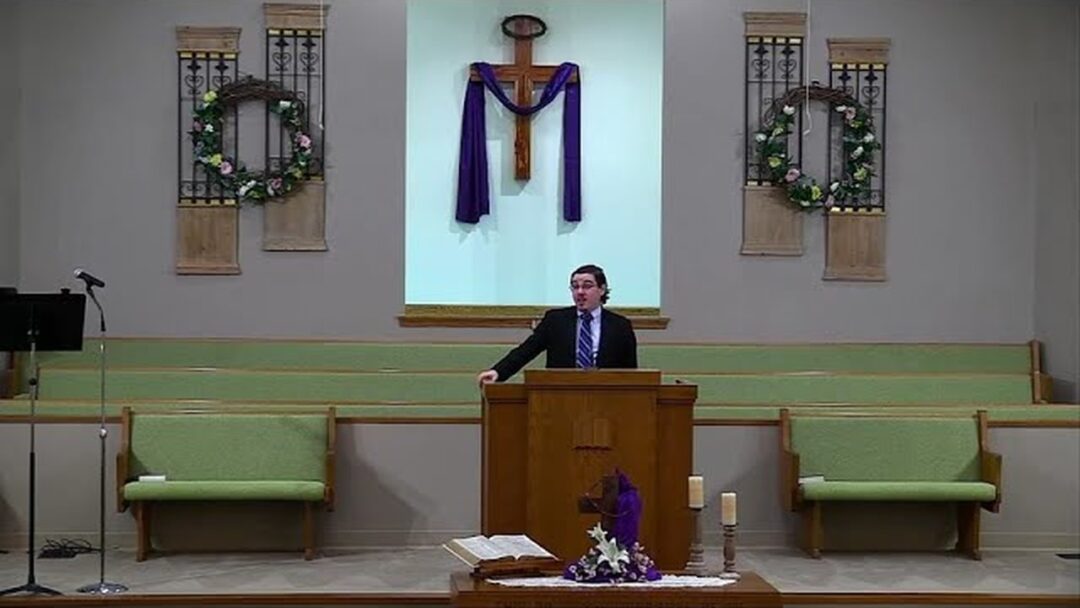
From our Sunday service on March 30, 2025, Ephesians 4. This is part 4 of our Ephesians series. Watch the full message: Walking Worthy – Ephesians Series #4 on YouTube.
If you remember our last message on Ephesians 3, Paul left off with a statement of praise: now unto Him that is able to do exceeding abundantly above all that we ask or think, unto Him be glory in the church by Christ Jesus. God wants you to walk worthy of your calling.
A Worthy Walk Starts with Humility and Patience
I therefore, the prisoner of the Lord, beseech you that ye walk worthy of the vocation wherewith ye are called, With all lowliness and meekness, with longsuffering, forbearing one another in love; Endeavouring to keep the unity of the Spirit in the bond of peace.
Ephesians 4:1–3
We might hear “vocation” and think of a job. Some of us might think, “I’m not a pastor or a Bible teacher, so this doesn’t apply to me.” But the Greek word for “vocation” is the same word as the “called” in the second half of the phrase. It means “the calling wherewith ye are called.” This isn’t written just to preachers. It’s written to every single believer. Why does Paul call himself “the prisoner of the Lord”? He suffered for the growth of the gospel, and he’s saying that’s okay. He urges us to walk worthy of the invitation we’ve received, the invitation to be saved and transformed by the Holy Spirit.
“Lowliness and meekness” mean humility and gentleness. Meekness is having the ability to do something and refraining from it. “Longsuffering” is someone who suffers long. “Forbearing one another in love” literally means “to carry.” The most modern word we have would be “to tolerate.” If you’re tolerating someone, it means you don’t like what they’re doing. In the church, we’re not going to like everything everybody else does. They may not be immoral, just conflicts of personality. But we are to tolerate each other in love, because we are endeavouring to keep the unity of the Spirit in the bond of peace. Have our grace last longer than someone else’s mistakes.
One Body, Many Gifts
Christian, you have more in common with other Christians than you have not in common. Don’t let small things that rub you the wrong way ruin the unity that we have. This is also a trinitarian statement: “one Spirit,” “one Lord,” and “one God and Father” point to the Holy Spirit, God the Son and God the Father. “One faith” and “one baptism” are not the same thing. Some denominations teach that baptism is what saves you. But here there is a faith by which we put our trust in God for salvation. We are regenerated by the baptism of the Holy Spirit, and then we receive a baptism through water as a symbol of that inward change. Baptism does not save you, but it represents that you have been changed by God. So walk worthy of this call.
Paul plays with words. He says “one, one, one,” unified, and then he spins it off: we are one, but each of us is given a unique gift. We are unified, but we are diverse. God does not give us the same measure of gifts. In the parable of the talents, each person was given a different number and was expected to do the best they could with what they were given. In most churches, 20% of the people do 80% of the work. But everybody is called to do a little bit. We should find how to use the gifts God has given us.
“Wherefore he saith” refers to Psalm 68:18. “He that ascended” and “he that descended” refer to John 3:13, where Jesus says no man hath ascended up to heaven but He that came down from heaven. “The lower parts of the earth” refers to 1 Peter 3:18-19: Christ went and preached unto the spirits in prison. Jesus didn’t only descend to the earth. When He died on the cross, He descended further and preached to the spirits in prison. If I were in hell and someone came to me and said, “I’m the Messiah,” I’d say, “Then why are you here?” But that’s what happened. Paul is reminding us just how powerful this giftgiver is.
Apostles would be the first generation of the church, taught by Jesus. Evangelists, like Paul, traveled around preaching city to city. Pastors stay at a local church and continue to teach there. That’s my role. Teachers had no formal position but taught the word of God. If you don’t have the gift of prophecy, you shouldn’t be saying what God wants you to do. “A perfect man” doesn’t mean we never make mistakes. The goal is to be a perfect reflection of who Jesus was as He walked on this earth.
Growing Up and Putting On the New Man
“Tossed to and fro” is the picture of being in the water driven by the wind. Christians without a solid foundation hear a new teaching, say, “Oh, that’s so cool,” and adopt it without asking whether it aligns with Scripture. Paul says you’ve got to grow some roots and know what is from God and what is not. “The sleight of men” is like the cup game with the ball: when you’re not looking, they slip the ball out, and there’s no way to win. “Lie in wait to deceive” carries the idea of a one-degree turn: if I keep you going down that path, eventually you’ll be really far from where you’re supposed to be. Remember what Satan did when he tempted Jesus: he used the Bible, just twisted a little. How do we correct this? By speaking the truth in love. Paul uses the illustration of the church as different parts of one body. If everything from your elbow to your shoulder is missing, your hand won’t work, because the blood flow won’t get there. If we’ve made mistakes and God has grown us through them, and we hide those mistakes, we’re hurting people by not teaching them what we’ve already learned.
Christian, it’s possible for you to live like an unsaved person. Unbelievers walk with empty minds, so calloused from doing evil repeatedly that they live in perpetual self-destructive sin. The Greek word for “darkened” is the idea of foggy, blurry, dim. The “blindness” of the heart is literally a hardness, so calloused it cannot feel a single thing. When I play guitar, my fingers get calloused. If you start out playing for hours, your fingers will bleed, but as you continue, you build up a callus and it doesn’t hurt anymore. We play with sin a little bit, and at first we feel guilty. But if you continue, you build up calluses and stop caring. You become feelingless and surrender to lasciviousness. Greed isn’t limited to money. It can be involved in all self-driven actions.
That ye put off concerning the former conversation the old man, which is corrupt according to the deceitful lusts; And be renewed in the spirit of your mind; And that ye put on the new man, which after God is created in righteousness and true holiness.
Ephesians 4:22–24
Being renewed in Christ is a purposeful activity. We must choose the path we will walk, like we pick our clothing at the beginning of each day. We need to take off the old man and put on the example of Christ. You can’t wear both. I can’t put my suit coat on one side and my t-shirt on the other. These are completely different natures, incompatible with each other. It’s not a fake holiness or a fraud.
What Righteousness and Holiness Look Like
It looks like telling the truth instead of lying. Why? “For we are members one of another.” Why are we hiding the hardship in our lives from our brothers and sisters who could say, “Let me pray for you”? Put away lying. Don’t try to pretend you have your perfect life together. It looks like being angry and not sinning from it. It’s okay to be angry. There is injustice every day, and that ought to make us mad. But don’t let the sun go down upon your wrath. Don’t let it grow into bitterness. It looks like not giving place to the devil. What is your besetting sin? If pornography is one of those temptations, remove yourself from situations where you fall into it. If you’re tempted to cheat on your spouse, don’t ever be alone with somebody else. “Let him that stole steal no more.” The Greek word for “labour” means to work to a sweat, so you can help other people not get to the point where they’re tempted to steal. “Corrupt” speech literally means rotten, decaying, disgusting, and that isn’t talking only about swear words. Use your voice to encourage, so that it may minister grace unto the hearers.
And grieve not the holy Spirit of God, whereby ye are sealed unto the day of redemption. Let all bitterness, and wrath, and anger, and clamour, and evil speaking, be put away from you, with all malice: And be ye kind one to another, tenderhearted, forgiving one another, even as God for Christ’s sake hath forgiven you.
Ephesians 4:30–32
Bitterness, wrath, anger, clamour and evil speaking could also be called bitterness, fury, anger, shouting and slander. It grieves the Spirit of God when you’re bitter, when you wish ill on people, when you start shouting at them, and when you talk badly about them. All five are to be put away “with all malice.” You ought to wish good for your neighbor, not bad. Then Paul gives a gentle slap to the face: “Remember how gracious God has been to you.” God could do all those things to you, yet He doesn’t. He gave His Son to die on a cross for you. So the least you can do is extend the same grace you’ve received to others.
That calling is not just a title or a job. It’s a lifestyle. God has uniquely gifted each of us to build up His church, and spiritual maturity comes through unity, truth, love and service. To get there, we each make a daily choice to take off the old self and put on the new. We can’t wear both. God wants you to walk worthy of your calling. Will you choose to walk worthy today?
Recent Comments