
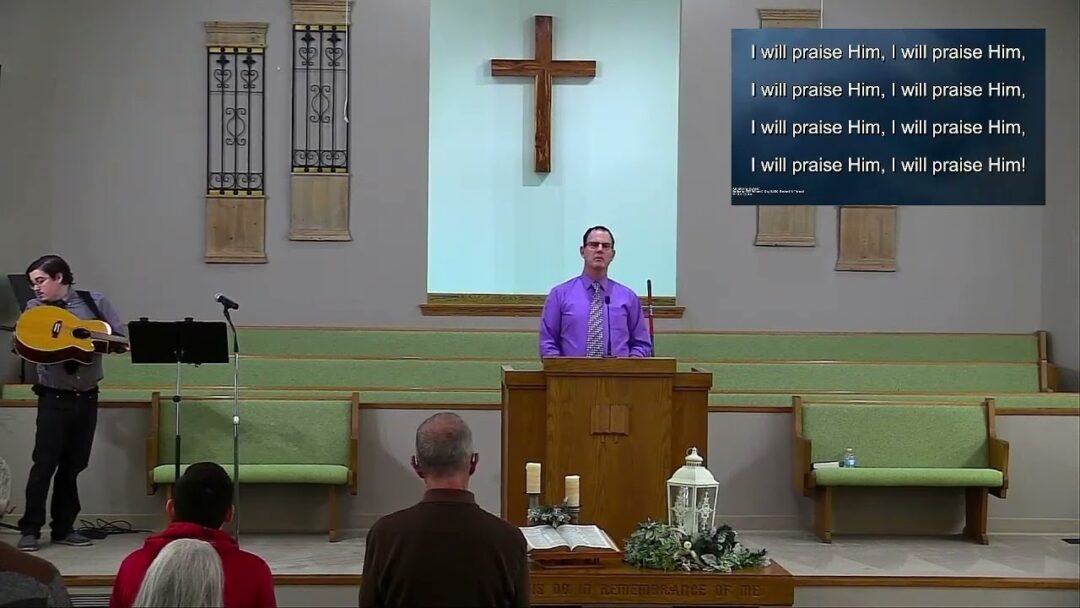
From our Sunday service on March 9, 2025, Ephesians 2. This is part 2 of our Ephesians series. Watch the full message: By Grace Through Faith – Ephesians Series #2 on YouTube.
Last time we introduced this series on the book of Ephesians and talked about the blessings of salvation: because we are saved, we can inherit every spiritual blessing in heavenly places in Christ. It is easy for us as Christians to lose sight of everything God has done for us. Ephesians is written to a church that was faithful to God. They were getting the foundations of Christianity down. They had good morals, they loved Jesus, and they were willing to serve. But having the foundation pretty solid doesn’t mean there’s no room to improve, so Paul wrote to encourage them to continue to grow in the faith and in the ministry of following Jesus. In this message he explains the process of salvation to them again. When we get saved, we often don’t know much more than that Christ died on the cross, I’m a sinner, I need to ask Him for forgiveness because I can’t save myself, and through faith I can trust God to save me. Paul says, in effect, you’re Christians and you’ve heard it before, but it never hurts to hear it again. Then he turns to a reminder of where we came from, and to the words “But God.” If you get nothing else out of this passage, I want you to remember this: God wants you to remember who you were without Christ and cherish who you’ve become in Him.
Where We Were
There are three phases in this chapter: where we were, what God did, and how He transforms us. Paul starts with death: “And you hath he quickened, who were dead in trespasses and sins.” There are two deaths in Scripture. Physical death is the separation of the soul from the body. Spiritual death is the separation of the soul from God. When Adam and Eve sinned, they were separated from the tree of life and from walking with God in the garden. They were still physically alive, but the relationship was broken. Spiritual death still brings chaos, anxiety and a broken identity. You can be walking around, going to work, raising a family, and still be dead toward God. “The course of this world” means this age, the system of the world as it is now. “The prince of the power of the air” is Satan, an unseen influence. After the cross, Satan can no longer accuse the brethren in heaven the way he once did, and that means he has more free time to mess with the children of disobedience. He is still at work in the unseen places, and if we forget that, we will act as if the world’s course is just the way things have to be. “Conversation” here means citizenship and allegiance, the way you live and the side you belong to. We “were by nature the children of wrath, even as others.” A toddler doesn’t need to be taught to steal a cookie. That nature is already there. In Roman culture, a slave in a household could not inherit until he was adopted as a son. Until that adoption, he belonged to the house in one sense, but he did not have the standing of a son. That’s the picture: we were under wrath by nature, and God would have to adopt us before we could belong. This is not an us-versus-them passage. We were all on the same team of wrath, even as others. When we look at people who still do not know Christ, we are looking at who we used to be. Our job is to invite people, not fight them.
But God
But God, who is rich in mercy, for his great love wherewith he loved us, Even when we were dead in sins, hath quickened us together with Christ, (by grace ye are saved;) And hath raised us up together, and made us sit together in heavenly places in Christ Jesus: That in the ages to come he might shew the exceeding riches of his grace in his kindness toward us through Christ Jesus.
Ephesians 2:4–7
“But God.” Those two words change everything. He is rich in mercy. He is not impressed by your resume, and He is not counting a line of 23,700 sins before He will consider you. He loves us. He quickened us together with Christ, made us alive when we could not make ourselves alive. He raised us up together, and made us sit together in heavenly places in Christ Jesus. “Heavenly places” is not a promise that we live in heaven permanently right now. Heaven is just a temporary place; we’re coming back. God will finish what He started. The “riches of his grace” in Ephesians point toward the fulfillment of the resurrection, a sinless state, back to the garden, the life God intended from the beginning. And then Paul gives the sentence that sits at the center of the gospel.
For by grace are ye saved through faith; and that not of yourselves: it is the gift of God: Not of works, lest any man should boast.
Ephesians 2:8–9
“Are ye saved,” not “will ye be saved.” This is personal. It is not your parents’ faith that saves you. Faith, belief and trust are the same original word. It is not of works, lest any man should boast. Believing the team won doesn’t make you the reason they won. You cannot take credit for a gift. Grace is God doing what you could never earn, and faith is the empty hand that receives it.
How He Transforms Us
For we are his workmanship, created in Christ Jesus unto good works, which God hath before ordained that we should walk in them.
Ephesians 2:10
We are His workmanship. Jesus was a carpenter, and you don’t praise the chair or the Eiffel Tower as if they built themselves. The glory belongs to the craftsman. We were created in Christ Jesus unto good works, which God hath before ordained that we should walk in them. A Christian without good works has missed the purpose. God did not save you only to leave you standing still. He saved you for an abundant life, a life of good works He already prepared. “Walk” together means the same destination and the same pace. We do not invent our own path and then ask God to bless it. We walk in the works He already laid out.
Then Paul turns to the Gentiles. You were aliens from the commonwealth of Israel, strangers from the covenants of promise, having no hope, and without God in the world. But now in Christ Jesus, ye who sometimes were far off are made nigh by the blood of Christ. Gentiles have been grafted in. We did not replace Israel; we were brought in. “He is our peace.” Jesus is not merely a peacemaker who stands in the middle and asks both sides to get along. He Himself is our peace. That doesn’t mean conflict disappears in every earthly relationship, but it means the war between us and God, and the wall between Jew and Gentile, has been dealt with in Him. The “middle wall of partition” is not the veil in the temple that was torn when Christ died. It is the court wall that kept Gentiles out of the inner courts where the Jews worshiped. That wall said, you may come this far and no farther. Christ broke it down. The law of ordinances has been fulfilled. There is no Jewish church versus Gentile church. As Galatians 3:28 says, there is neither Jew nor Greek, for ye are all one in Christ Jesus. In Philemon, Paul sends Onesimus back not as a slave only, but as a brother. And when Paul says, in effect, “Don’t treat me as somebody better than you just because I’m a missionary who has gone on three huge mission trips,” he is talking about himself. The man who planted churches still stands on the same ground of grace as everyone else. There is no spiritual upper class in the household of God.
Now therefore ye are no more strangers and foreigners, but fellowcitizens with the saints, and of the household of God. Citizenship is a national picture. Household is a family picture, and family is closer than a nation. You are built upon the foundation of the apostles and prophets, Jesus Christ Himself being the chief corner stone. That means Scripture is still relevant. We are not under the ritual law of the Old Testament, but the testimony of the apostles and prophets is still the foundation we stand on. In whom all the building fitly framed together groweth unto an holy temple in the Lord. There are no gaps. No brick is more valuable than another. This is a corporate temple. People still go to the Western Wall, the weeping wall, because they want a place where heaven and earth meet. Paul says that place is us. We are being built together for an habitation of God through the Spirit. 1 Peter 2:5-6 calls us lively stones, built up a spiritual house. You are not a loose brick on your own. You belong in the wall with the rest of the church, and God dwells there. God wants you to remember who you were without Christ and cherish who you’ve become in Him. Will you remember, and will you cherish what He has made you?
Recent Comments