
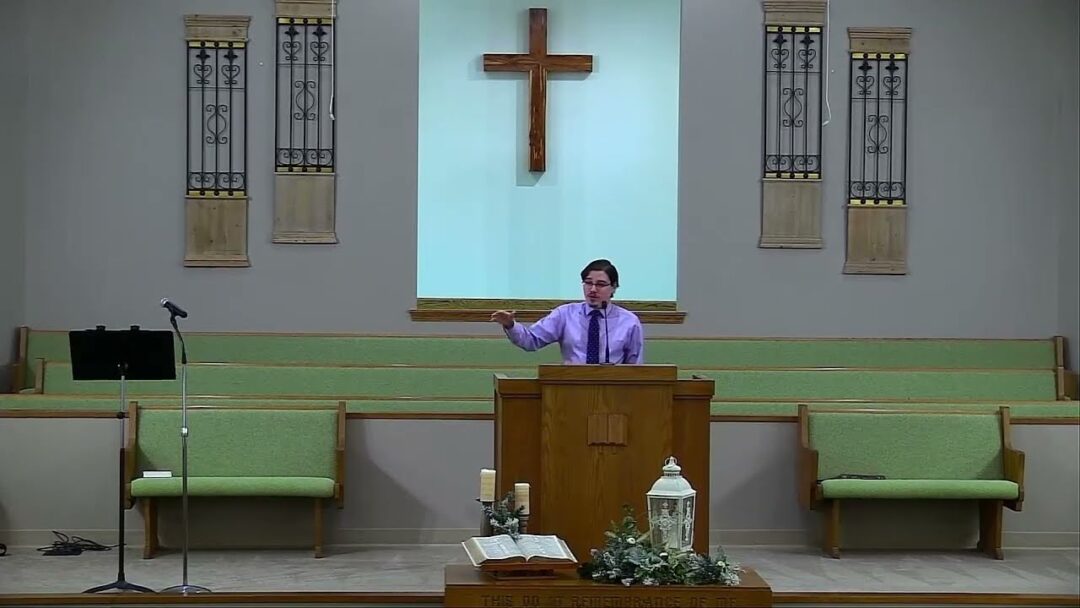
From our Sunday service on January 19, 2025, 1 Corinthians 15, 1 John 1, Isaiah 43, Genesis 3, Isaiah 59, and Romans 8. Watch the full message: How Can We Know We Are Forgiven? on YouTube.
This message came from a question one of our church members asked about forgiveness. If one of us has questions, it is probably a good topic for all of us. Psalm 51:7 says, “Purge me with hyssop, and I shall be clean: wash me, and I shall be whiter than snow.” Look at snow falling and what do you see? Nothing but white as far as the eye can see. It is like the joke from elementary school: “I drew a picture in art class.” “What is it?” “A snowman in a blizzard.” And it is just a white sheet of paper. How do we know Christ can truly forgive us and wash us to 100% purity? Our ability to be forgiven is not a mystery and not wishful thinking. It is grounded in two unshakable realities: the resurrection of Jesus Christ and the unchanging promises of Scripture. God wants you to know you are forgiven.
The Resurrection Is Our Assurance
To have confidence in our forgiveness, we need to know that Jesus was who He said He was, and that God truly wants to and is willing to forgive us.
But if there be no resurrection of the dead, then is Christ not risen: And if Christ be not risen, then is our preaching vain, and your faith is also vain.
1 Corinthians 15:13–14
There is no gospel if Jesus did not rise from the dead. Atheists often use this as an argument against us, as if it were a new revelation, but Paul himself says that if Jesus did not rise, everything we are talking about means nothing. If Jesus did not keep His promise to return to His disciples, how can we trust Him to keep any other? In the Old Testament, if a prophet failed even once, he was considered a false prophet, and one false prophecy was enough to condemn you to death under Israel’s law.
I have good news: if you treat Scripture like any other book of history, like the accounts of Alexander the Great or the pharaohs of Egypt, you have one of the most attested facts in all of history. Almost all secular historians do not deny the death of Jesus Christ under Pontius Pilate in Jerusalem, around A.D. 30. The people who refuted Christianity in the time of Jesus do not refute the fact that the Christians believed He rose. You will only find, hundreds of years later, the theory that the Jews stole the body. The body disappeared, and that is a fact of history. Every account agrees there was no body. They just disagree about how it disappeared.
We have four gospel accounts, two by eyewitnesses and two by people who talked to eyewitnesses. Luke was a doctor, and he approached his Gospel historically. He collected the documents he could get to explain to Theophilus what happened. Before Jesus rose, the disciples gave up. Peter went back to fishing. “It’s game over. My prophet’s dead.” No one had survived a Roman crucifixion. If the Romans were known for anything, it was that they knew how to kill a person. We even get the word “excruciating” from it. When Jesus came back, the man they saw nailed to a tree, bleeding water and blood, was walking with them with holes in his hands, eating alongside them, and teaching them for forty days. More than five hundred people saw Him alive at once. That is the only explanation for how Christianity could take over the Roman Empire so quickly. We even have Paul, who was against Christianity and had his whole life set out, comfortable and famous in Israel. Yet when Jesus came to him, he switched. When Jesus said “It is finished” on the cross, the resurrection confirmed that what He said was true. Our confidence does not rest in how we feel, but on the historical, proven fact that Jesus truly rose from the dead.
The Promise of Scripture
Now that we know Jesus is a reliable prophet, what did He promise? John, the disciple “whom Jesus loved,” wrote this.
But if we walk in the light, as he is in the light, we have fellowship one with another, and the blood of Jesus Christ his Son cleanseth us from all sin. If we say that we have no sin, we deceive ourselves, and the truth is not in us. If we confess our sins, he is faithful and just to forgive us our sins, and to cleanse us from all unrighteousness.
1 John 1:7–9
Here is the promise that Jesus will cleanse all who walk with Him. There is a stipulation: to be saved, you have to admit you are a sinner. If you say you have never sinned, you are lying to yourself and escaping grace. If we confess our sins, God is faithful and just to forgive us and cleanse us from all unrighteousness. The question is whether we believe it.
Some of us have failed hundreds if not thousands of times on the same issue. Is God tired of forgiving me? Can I be forgiven the 1,798th time? In Isaiah 43, God tells Israel they have bought Him no sweet cane, they have not gone out of their way to give Him gifts, they have made Him serve with their sins, and they have wearied Him. The words “serve” and “wearied” literally mean we have forced God to work hard and made Him exhausted by the length of it. But then He says He blots out our transgressions for His own sake, and will not remember our sins. Though God is wearied by our sin, He forgives because of who He is. If God felt this way in the age of law, how much more is He ready to forgive in the age of grace? Jeremiah 31:34 says He will remember their sin no more. Psalm 103 says His mercy is as great as the heavens are high above the earth, and as far as the east is from the west, so far hath He removed our transgressions from us. You can keep going east, or keep going west, looping around forever. That is how far He has removed our sins.
Forgiveness is not just wiping the slate clean. It is also about transformation. In Romans 7, Paul describes sin as a disease that infects us, an intruder in our lives. It is not what defines us. “It is not me but the sin that dwells in me.” Sin has a cure, and the cure is the resurrection. For those who are saved, we will be resurrected and restored, and the sin that lives in us will be removed.
Does Sin Separate Us from God?
Yet sometimes we still doubt, because of the greatest lie Satan wants believers to believe: that sin separates the Christian from God. In Genesis 3, Adam and Eve hid themselves among the trees, and the LORD God called unto Adam, “Where art thou?” Was it God who separated from man, or man who separated from God? It is not God removing Himself because He cannot be around sin. It is us moving away because of our shame. God did not wait for Adam and Eve to repent. He came to them. Look next at Job 1. Even Satan is allowed in God’s presence. If God cannot be around sin, why can Satan go to the throne room and accuse the believer? Jesus sat at meat with publicans and sinners, and when the Pharisees complained, He said He came not to call the righteous, but sinners to repentance. He went to the prostitutes, the thieves, and the woman at the well, who was living with a man she was not married to. God did not wait for them to repent. A good shepherd leaves the ninety and nine and chases after the one that is lost.
What about Isaiah 59, “your iniquities have separated between you and your God… that he will not hear”? The word “hear” in Hebrew carries the idea of obedience. When you tell your child, “You need to listen to me,” you are saying they need to follow your commands. When God says He will not hear you, He is not going to answer your prayers and bless someone living in sin. He will not reinforce your self-destructive behavior with blessings. And even in Isaiah 59 the problem is resolved: “And the Redeemer shall come to Zion.”
For I am persuaded, that neither death, nor life, nor angels, nor principalities, nor powers, nor things present, nor things to come, Nor height, nor depth, nor any other creature, shall be able to separate us from the love of God, which is in Christ Jesus our Lord.
Romans 8:38–39
Paul is convinced nothing can separate us from the love of Christ. He has put His Spirit inside you, 24/7, 365, so we have a direct line of communication at all times. Psalm 66 says, “If I regard iniquity in my heart, the Lord will not hear me.” The word “regard” has the idea of noticing sin and then protecting it. If I am protecting my sinful lifestyle, God is not going to bless me in my disobedience. But the next verse says God has heard me. He is paying attention. A more accurate statement than “sin separates us from God” would be this: if we choose to live a sinful life after we are saved, we choose to break fellowship with God. He has not withdrawn from us. The second we are ready to turn back, God is waiting.
God is the father waiting for His child to return home. Remember the prodigal son. When he returned, the father ran to meet him, kissed him, and threw a party. Even if you take every blessing God has ever given, live in sin, and waste everything, when you come home He is going to celebrate that you are back where you belong. God wants you to know you are forgiven. Will you start acting like you are forgiven today?
Recent Comments