
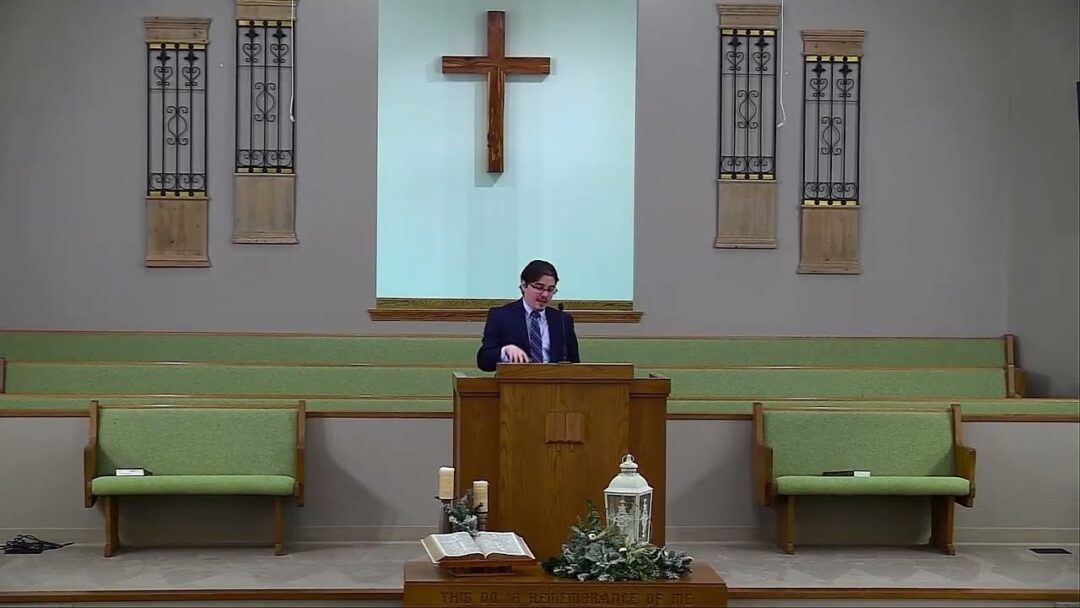
From our Sunday service on January 5, 2025, Leviticus 25, Luke 4, John 8, and Ephesians 4. Watch the full message: A Year of Jubilee on YouTube.
I’ve wanted to preach on the Year of Jubilee for a long time, because it has a lot to say about freedom. First, a disclaimer: this message has nothing to do with the Catholic Year of Jubilee. This is the Year of Jubilee as it is described in Scripture. God wants you to experience true freedom.
What Is the Year of Jubilee?
It is not often we get the opportunity to go to Leviticus.
And thou shalt number seven sabbaths of years unto thee, seven times seven years; and the space of the seven sabbaths of years shall be unto thee forty and nine years. Then shalt thou cause the trumpet of the jubile to sound on the tenth day of the seventh month, in the day of atonement shall ye make the trumpet sound throughout all your land. And ye shall hallow the fiftieth year, and proclaim liberty throughout all the land unto all the inhabitants thereof: it shall be a jubile unto you; and ye shall return every man unto his possession, and ye shall return every man unto his family.
Leviticus 25:8–10
A jubilee, by definition, is the sounding of a trumpet or ram’s horn. In the King James you’ll sometimes see it spelled “jubile.” A sabbath year was a year when the Israelites would plant their fields for six years and then, in the seventh year, let the fields rest. You number seven sabbaths of years, seven times seven, and the space of those years is forty and nine years. Then in the fiftieth year you sound the trumpet, and you proclaim liberty throughout all the land unto all the inhabitants thereof. Notice the day: verse 9 says the day of atonement. That’s the day the sins of the nation of Israel were paid for through the sacrifices, a picture of Christ, who would one day pay for the sins of the world.
“Return every man unto his possession, and return every man unto his family” is talking about bond servants. We Americans struggle with slavery in the Old Testament because we immediately think of the American South. That is not the same system. In Israel there was no prison in the sense we think of. If you owed a debt, you paid it back, often with fees, by working. Captives of war could be brought into that system, and a person could also buy himself back. On the fiftieth year, anybody who had sinned and found themselves stuck in bond servitude, anybody who had been bought, was set free and returned to his family and his possession.
There are two aspects here: the slave’s perspective, where I’m being liberated from what I owe, and the master’s perspective, where “ye shall not therefore oppress one another.” The debtor is freed, and the creditor must release him, even at cost to himself. Jubilee is not only about receiving freedom. It is also about extending it.
Live in the Freedom Christ Gave
I hope we all know that we don’t need to live in guilt over our past sins, or in worry that we’re not enough, because Christ died to set us free. In Luke 4, Jesus returns in the power of the Spirit into Galilee, and then He goes back to His hometown of Nazareth. On the Sabbath, Saturday, He’s going to teach in the synagogue, the equivalent of their Sunday School classes. It was the custom to stand and read, and He is handed the book of Isaiah. He reads, “The Spirit of the Lord is upon me, because he hath anointed me to preach the gospel to the poor; he hath sent me to heal the brokenhearted, to preach deliverance to the captives, and recovering of sight to the blind, to set at liberty them that are bruised, to preach the acceptable year of the Lord.” The acceptable year of the Lord is the year of jubilee. Then He closes the book and says, “This day is this scripture fulfilled in your ears.” Here Jesus announces to the world what He is about to do. He is going to die, and He’s going to deliver the captives, captives of sin.
Jesus came for our freedom, but He wants us to actually live in it. It’s not enough to know that Jesus died for our freedom. We have to walk in it. In John 8 He says, “If ye continue in my word, then are ye my disciples indeed; and ye shall know the truth, and the truth shall make you free.” His hearers answered that they were Abraham’s seed, and were never in bondage to any man. They thought they were as free as can be. Jesus is telling His followers there’s more to this walk than following Him around and eating snacks. On the Sermon on the Mount people followed Him everywhere, but when we see the feeding of the five thousand, we see why some of them were there. They wanted free bread. True freedom is not merely freedom from outside oppression. It is freedom from the captivity of immorality inside. “If the Son therefore shall make you free, ye shall be free indeed.”
Jonathan Edwards, years and years ago, gave two resolutions we need if we want to experience the joy of God in our lives. Resolution one: I will live for God. Resolution two: if no one else does, I still will.
Stand fast therefore in the liberty wherewith Christ hath made us free, and be not entangled again with the yoke of bondage.
Galatians 5:1
Paul gives us a challenge here. We can be set at liberty from sin through salvation, and our slate gets wiped clean. I was saved at a young age, so I didn’t get this experience, but people who are saved later in life often describe it as a 180. The danger is falling back and becoming entangled again with the yoke of bondage. Paul also says in Philippians 3:13, “This one thing I do, forgetting those things which are behind, and reaching forth unto those things which are before.” Paul had a lot of sinful problems in his old life, and he knew that if he kept looking back, he would be discouraged and slow down.
Sometimes we wonder whether how we feel about our sin is a feeling from God or from Satan. God’s voice convicts you to change, gives you comfort and hope when you repent, and gives you peace and security for the future. Satan’s voice condemns you for your past sins, gives you anxiety that you are not good enough even when you repent, and brings confusion and insecurity for the future. If you are feeling condemned because of your past sins, that’s not God condemning you. Christ died on the cross to save you from those sins. “God is not the author of confusion.” Scripture also says a just man falleth seven times, and riseth up again. Jeremiah 29:11 is as good an example as any of God’s attitude toward us: “For I know the thoughts that I think toward you, saith the LORD, thoughts of peace, and not of evil, to give you an expected end.” God doesn’t plan bad for you. Christ didn’t wait for us to get our lives together. While we were yet sinners, Christ died for us.
Extend Freedom to Others
We should not only free ourselves from the shackles of sin but also extend that freedom to others. Remember our original passage: “Ye shall not therefore oppress one another.” The Jubilee was not just about accepting freedom but about giving it.
And grieve not the holy Spirit of God, whereby ye are sealed unto the day of redemption. Let all bitterness, and wrath, and anger, and clamour, and evil speaking, be put away from you, with all malice: And be ye kind one to another, tenderhearted, forgiving one another, even as God for Christ’s sake hath forgiven you.
Ephesians 4:30–32
Once again we’re reminded that Christ has taken our sins and removed them from us. But here the challenge is not to grieve the Holy Spirit of God, not to make God sorrowful by our behavior. Notice that the examples here aren’t the usual sins like lust. They’re about interpersonal relationships: bitterness, wrath, anger, clamour, and evil speaking. In other words, holding resentment toward someone after they’ve wronged you, being angry about your situation in life, gossip. No matter where we are in life, there will be times when people wrong us. It could be people in the church who misunderstood something and spread a rumor. It could be people at work fighting for a new position.
In 2 Corinthians 2, Paul writes about someone who had caused grief. “Sufficient to such a man is this punishment, which was inflicted of many. So that contrariwise ye ought rather to forgive him, and comfort him.” This passage shows the destructive effects of resentment. The Corinthians had a lot of things messed up, and one of their problems was that they didn’t forgive each other. Paul says this is how you confirm your love toward him, and this is a proof of your obedience. You cannot love someone and harbor resentment against them. You cannot love someone and be bitter against them or hold their past against them. Why be so quick to forgive? “Lest Satan should get an advantage of us: for we are not ignorant of his devices.” A lack of forgiveness is the easiest way for Satan to get an advantage. Lewis B. Smedes said, “To forgive is to set a prisoner free and discover that that prisoner was you.”
If we want to live in a year of jubilee, we have to free ourselves and remain free of the entangling sin, bitterness, and anger that would wrap us right back up in the chains we’ve been liberated from. Christ died to give us a new beginning. God wants us to accept that freedom and also extend it to others, not only to benefit them but to free ourselves and protect ourselves from Satan’s influence. God wants you to experience true freedom. Will you walk in that freedom, and extend it, today?
Recent Comments