
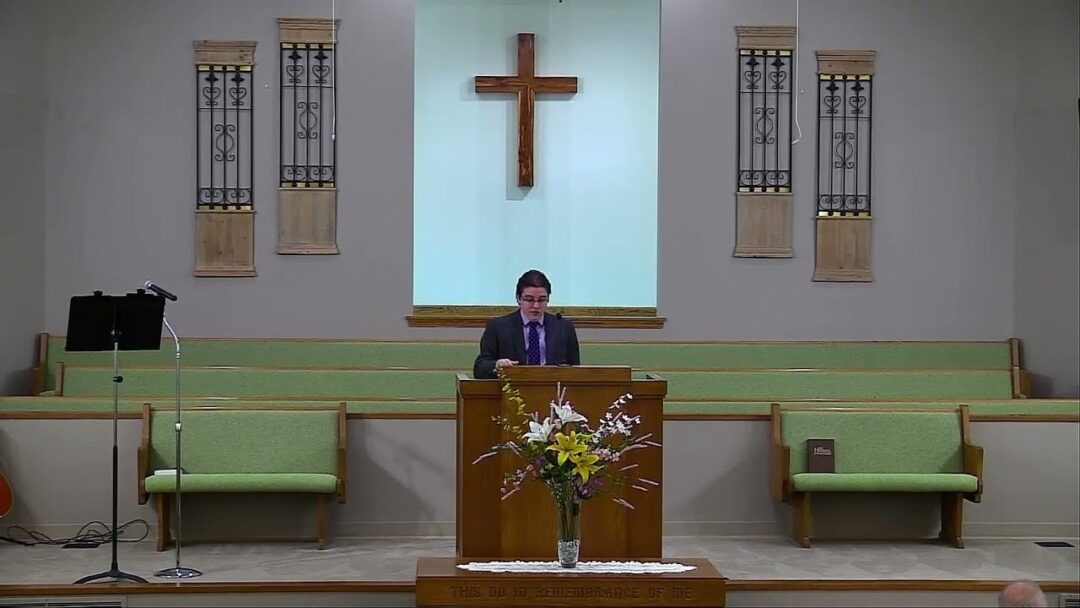
From our Sunday service on August 18, 2024, Psalm 56. Watch the full message: This I Know: Psalm 56 on YouTube.
The inspiration for this message was a little different than normal. I got it from a TikTok. I’ll admit I try to stay off TikTok, because if you spend too much time on that platform it starts to rot your brain. Because I’m such a Bible nerd, I get all these TikToks about the Bible. Sometimes it’s so much that I think, “Please just give me something else.” But sometimes you get something good. A man named Chad Bird had made a TikTok about a Hebrew phrase that he says can get you through the darkest times. Chad Bird is a pastor, and he has been going through hard times. His wife has had cancer twice. Just after she got over it, his son, who was special needs, passed away. After all that, his father passed away. He was experiencing difficulty after difficulty, and he started making TikToks about how God has been faithful through it. As a Hebrew scholar, he says there is a phrase from the Bible that got him through the darkest times in life. The phrase is zeh yadati ki Elohim li, which is translated, “This I know, that God is for me.”
We’re often in transitional times. Maybe it’s a job we just started, and that can be challenging. Maybe we’re facing medical worries. As somebody who does visits, I know there’s always a need and always health concerns. I’m a diabetic, so I know what that’s like. Maybe it’s your finances. Maybe after COVID things just never got better, the income hasn’t been enough, and things have been tight. There are many challenges in life regardless of who we are, so this phrase, “This I know that God is for me,” is something for everyone. Psalm 56 is referenced in a few other places in the Bible. Its refrain is quoted in Psalm 118, in Hebrews 13, and in Romans 8: “If God be for us, who can be against us?” If those passages have ever brought you comfort, that comfort was inspired by this psalm. It is a psalm of hope despite the difficulties life may bring.
Let your conversation be without covetousness; and be content with such things as ye have: for he hath said, I will never leave thee, nor forsake thee. So that we may boldly say, The Lord is my helper, and I will not fear what man shall do unto me.
Hebrews 13:5–6
The Context of Psalm 56
The psalm wasn’t written out of no context. David wrote it in the context of 1 Samuel 21. David was anointed by Samuel to be the next king of Israel. The current king was Saul, and he wasn’t serving the Lord as he should. He abused his power, and he was prideful and arrogant. God rejected him, and Samuel anointed David. But David didn’t let this go to his head. He said, “I will not touch the anointing of the Lord. God anointed King Saul, and when God wants Saul out of the way, God will be the one to take him out of the way.” So David faithfully served Saul. He married Saul’s daughter, and he became best friends with Saul’s son. The difficulty arose when people started to celebrate David more than Saul, because David had been more brave in battle. Saul became concerned about his legacy, his title, and his honor. It got so intense that he threw a javelin at David, and David barely escaped with his life. Saul’s son delivered the message: “Run. Get out of here. It’s not safe. My father wants you dead.”
David is on the run because the throne wants him dead, despite his doing nothing wrong. He can no longer spend time with his best friend. He has to spend time away from his wife. He is without food and starving. In desperation he went to the priests for the showbread, something you couldn’t do without priestly authority. The priests gave it to him anyway, because he was starving. He runs to Nob and says, “I have no weapon.” The answer is, “The only weapon we really have here is Goliath’s sword, the giant you killed.” The sword’s way too big for him, but he says, “That’ll do.” Saul finds out that the priests of Nob helped, and he says, “Anybody who helped David, I’m going to slaughter them all.” David finds out that everybody who just helped him was dead. This isn’t a moment of pride or honor in David’s life. This is David at one of his lowest points, and it’s in this mindset that he writes Psalm 56. The one lesson we can get from Psalm 56 is that God wants us to rely on Him. Some of the psalms have little titles at the front that function as a director’s note. The authorship is David. The tune is “Jonath-elem-rechokim,” which roughly translates to “The Silent Dove in Distant Places.” And the title also notes when the Philistines took him in Gath.
Daily Pressure, and the Choice to Trust
“Be merciful unto me, O God: for man would swallow me up; he fighting daily oppresseth me.” If you want to get the emotion in this, you have to make your voice quiver a little bit. The Hebrew for “daily” is “each day,” which is more dramatic. The word “swallow” is a little weird. The best way I picture it is a snapping turtle. If you put a stick there, it snaps on it. They’re trying these quick attacks, just barely missing, like a snapping turtle snapping at your finger. David was running from Saul’s army, and they weren’t far behind him. At one point, they were both camping in the same cave, and Saul’s army didn’t know. You can picture them being just one step behind. I don’t know if you read it, but in Nigeria there was a situation where Muslims came into a Christian community and slaughtered 50 Christians. That kind of situation is a reality for some Christians. David says there are many against him. He’s one man versus an army. He didn’t have a sword, an extra pair of clothes, or any food. But he says, “O thou most High.” He has one person on his side.
What time I am afraid, I will trust in thee.
Psalm 56:3
“What time I am afraid, I will trust in thee.” That’s the choice. David doesn’t deny the fear. He is afraid. But when he is afraid, he will trust in God. The refrain of the psalm is, “In God I will praise his word… I will not be afraid what flesh can do unto me.” David has already said he is afraid, and then he says he will not be afraid. The fear is real, but it does not get the last word, because his trust is in God and in God’s word. The wicked twist his words and gather themselves together. They hide and watch his steps. David asks God to judge them. And then he says something that has been a comfort to a lot of us.
What God Does in Response
Thou tellest my wanderings: put thou my tears into thy bottle: are they not in thy book? When I cry unto thee, then shall mine enemies turn back: this I know; for God is for me.
Psalm 56:8–9
That’s the first half: God knows the facts of our life and the facts of our difficulty. But it doesn’t end there. “Put thou my tears into thy bottle.” Here David is talking about his emotional pain. He’s not just talking about the facts that he’s suffering, or the mean things people are saying, or the army pursuing him. Now he’s talking about his tears and his weeping. God doesn’t deal with our suffering from a distance. He is intimately connected to how it makes us feel. Here David recognizes that God is putting his tears into a bottle. He’s not forgetting them. It’s not that He just sees them. He’s storing them, remembering them, and keeping them. God is intimately involved in this mourning process with us. “When I cry unto thee, then shall mine enemies turn back: this I know; for God is for me.” That leaves us with a question: how do we know God is for us? If you remember back to the book of Joshua, Joshua is going to fight the Battle of Jericho, and he meets the angel of the Lord standing there with a sword. He asks, as I’m paraphrasing here, “Are you for us or for our enemies?” The angel of the Lord basically says, “Neither.” Joshua is asking the wrong question. He’s asking, “Is God on my side?” What the angel of the Lord really wanted was for him to say, “I am on God’s side.” When you’re on God’s side, God is on your side. When I am truly on the side of God, then He will be for me, because I am aligned with His will.
This I Know, That God Is for Me
No matter what, we can always praise the Lord. David was at the bottom of the bottom, and yet he recognized, “I can have joy and praise the Lord. I will give an offering of thankfulness, not because of my situation right now but because I know You will bring me out of it and give me what You have promised.” This I know, that God is for me. No matter our circumstances, the promises of God still remain. We are not alone. God is keeping a tally mark of our suffering. God is keeping our tears in His bottle. So as we go through times of change and times of hardship, remember: God is for us, so who can be against us? This I know, that God is for me. What is your trust in? Is your trust in God or in your circumstances? Have you called on the Lord for help? Is there a difficulty you’re facing where you just assumed God is going to help, but you’ve never humbled yourself and said, “God, I need to ask for Your help”? If you haven’t humbled yourself, it may be that God is just waiting for that call to move into action. And lastly, have you placed yourself on God’s side? Have you chosen that no matter where you are in life, your ultimate goal is going to be to follow Christ?
Recent Comments